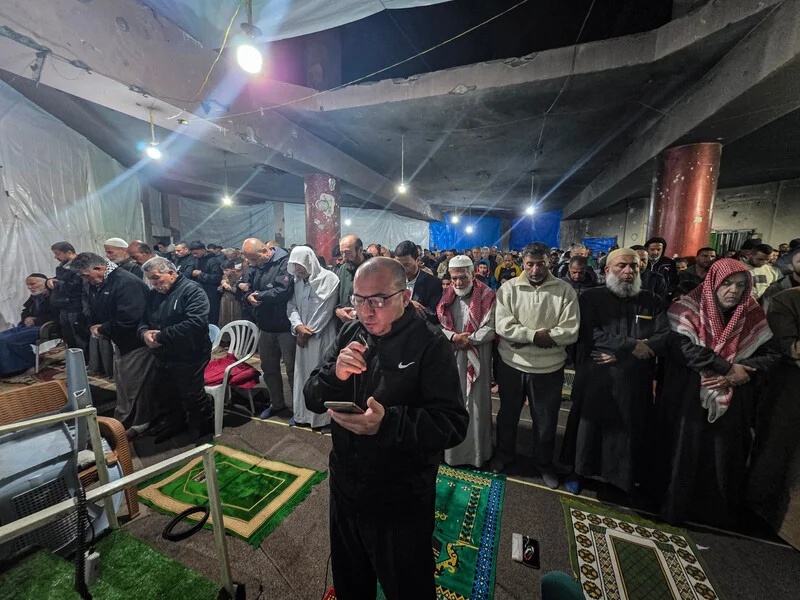
On the night of 10 March, I performed the tahajjud prayers – the late-night Ramadan prayers – with a group of worshippers in a makeshift mosque in a tent camp for displaced people in al-Mawasi, Khan Younis, for the first time in two years.
A few days before the Muslim holy month of Ramadan started on 17 February, my neighbors in my tent camp decided to build a makeshift mosque in which we could pray together.
When Israel forcibly displaced us in May 2025 from my neighborhood, Sheikh Nasser, east of Khan Younis, most of my neighborhood decided to move together to a plot of land made available by a member of our extended family.
It was natural then for us to name the mosque in our camp after our old one in Sheikh Nasser, al-Mustafa Mosque.
For two years, Israel has prevented us from gathering to pray, especially for night prayers. This is not only because they have destroyed most of the mosques in Gaza, but also because, after two years of genocide and two decades of brutal aggressions, we know that most of the Israeli bombardments happen at night.
During Ramadan last year, which ended in late March, Israel resumed a genocide it had paused since January that year. But even though the first weeks of Ramadan had been relatively quiet, we, still in Sheikh Nasser, could not gather to pray, as we had not been able to build another mosque.
We had thought to use the rubble that covered all the open spaces in the area, and the municipality had just recently opened the main road. But then Israel restarted its killing and destruction and all such plans came to nothing.
I would, instead, lead prayers for my family of six in our damaged home at the time.
Four-by-eight prayers
This year, despite a pseudo ceasefire that allows Israel to attack Gaza at will without comment or repercussion – Israeli military violence has killed over 630 people since 10 October last year – we at least can gather in a small makeshift mosque to pray.
And what a joy it was for me on the first day of Ramadan. I had sorely missed the feeling of putting my shoulder and foot next to another’s, as I align with fellow worshippers during communal prayer.
Our mosque is a four-by-eight meter tent that can hold nearly 50 worshipers for each prayer. The floor is uncomfortable and uneven, with only a nylon sheet beneath our bare feet and the sand below. Sometimes when I get down to the floor to prostrate, I feel my head getting absorbed in the soft sand underneath, and when I rise again I sometimes lose my balance.
The absence of loudspeakers, especially at night, has deprived Ramadan of a significant amount of its atmosphere.
At sunset, as people prepare to break their fast, my displaced neighbors from the far edges of the tent camp gather around the tent mosque to hear the adhan al-Maghrib, the call to prayer at sunset, and then immediately scatter to inform their families the fast is over.
When the place gets jammed during the taraweeh prayers – which we do only during Ramadan – I can barely find a space. I try to come early, even before the adhan, to secure a spot. Even on chilly nights, the tent mosque feels suffocatingly hot when crowded, as if we are competing for every breath.
Sometimes, people have to pray outside the tent mosque, next to drain water and sewage. It’s hard out there to hear the imam who leads the prayers, so people inside pray out loud in order for people outside to hear.
As our original imam is displaced elsewhere, Ahmad Rafiq, 27, volunteers to lead the prayers. He told me that he has never led prayers before and he struggles to raise his voice because he has been suffering from a sore throat recently.
“Israel has killed 75 imams since the beginning of the genocide,” Amir Abo al-Omrain, of Gaza’s Ministry of Awqaf and Religious Affairs, told The Electronic Intifada. “And as far as we know, 10 are being held captive in Israeli prisons.”
Most of the makeshift mosques across the Gaza Strip are under the supervision of the ministry, but ministry officials don’t intervene in choosing the imams these days as they have yet to collect definitive data on who from the ministry was killed, is detained or buried under rubble, according to Abo al-Omrain.
Ramzi Nawajha, director of media at the ministry, told The Electronic Intifada that officials are waiting to submit data about the state of Gaza’s mosques to “the new technocratic government” before the ministry can properly start functioning again.
Still dangerous
Unlike the taraweeh prayers, not many come out from their relatively warm tents to an empty and freezing makeshift mosque to pray the tahajjud prayers. Ramadan has come this year carrying chilly evenings and frosty dawns, and the temperatures can drop at night to between 8 and 12 degrees centigrade.
While large groups of men manage to catch prayers at makeshift mosques, women no longer participate in prayers at mosques. Ordinarily, mosques have a floor or section for women to pray. But the makeshift tent mosques are suffocatingly tiny, with barely enough room for men.
My neighbor from Sheikh Nasser, Nabila al-Farra, 69, is one of many women who can’t go to pray in mosques under the present circumstances. Her son, Mahmoud, who was 43 when he was killed in his sleep from shrapnel from an Israeli bomb last summer, used to accompany her to the mosque before the genocide.
She has lately returned to live with her daughter in downtown Khan Younis, in an area that has suffered extensive damage. She now prays alone in her daughter’s damaged house.
“When dark falls, I prevent my two adult sons, Imad and Muhammad, from going to the makeshift mosque near us to pray taraweeh,” said al-Farra. “The tanks start shooting randomly at night, and the quadcopters do not leave the sky. I fear for my children.”
This is the third Ramadan since the unfolding of the genocide, but this year feels different because it comes during a relatively quiet time. Still, the families who once gathered together inside mosques during taraweeh prayers are now scattered.
The constant bombardments may have quietened, but so have the sounds of Ramadan.
We no longer hear the adhan echoing through our neighborhoods as it once did. We no longer hear the joyful shouts of kids at play, and late-night gatherings are now gone, as many prefer to sleep early to prepare for yet another hard day.
Israel destroyed 93 percent of Gaza’s mosques, and a month that has always been about gathering as a community, is now nearly devoid of this spirit.
As we bid farewell to the holy month of Ramadan, however, something of Ramadan has survived. The small act of gathering and praying side by side in tiny tent mosques, the unamplified calls to prayer, and the laughter we still manage when someone loses their balance on the uneven floors, make this holy month worth living and are a reminder of the spirit of the people of Gaza.
[Qasem Waleed El-Farra is a writer based in Gaza. Courtesy: Electronic Intifada, an online, not-for-profit, independent, Chicago-based publication covering the Israeli–Palestinian conflict from a Palestinian perspective.]