❈ ❈ ❈
Why Chhattisgarh’s Midday Meal Workers Have Not Given Up Their Fight for Better Pay
Nolina Minj
On February 24, the Chhattisgarh state government presented its annual budget for the coming financial year. Among those who scrutinised its details closely were the state’s midday meal workers, thousands of whom had been on strike in shifts for two months, demanding an increase in their wages, from under Rs 70 a day currently to at least Rs 350.
The workers were in for a crushing disappointment – there was no mention of them at all in the budget.
The total lack of even an acknowledgement from the government left them dismayed.
The protest had extracted a tragic cost for some. Workers told Scroll that cold weather during those weeks, and unsanitary conditions at the site had led to many contracting ailments. In late January, two striking workers, Dulari Yadav and Rukmani Sinha, died after falling ill.
“We protested for two months,” Ramrajya Kashyap, the state president of the Chhattisgarh School Madhyanbhojan Rasoiya Sanyukta Sangh, told Scroll. “We spent all our money and begged others for food and money to continue protesting, and not a single official or leader came to see us.” The association represents more than 90,000 mid-day meal workers from across the state.
Kashyap added, “The least they could have done was to tell us that our demands would be ignored.”
The day after the budget was presented, the workers adjourned their protest at Naya Raipur’s Tuta Dharna Sthal. By then, it had by then been underway for 59 days. On March 2, they returned to their work at government schools in their hometowns.
But Kashyap explained that the workers did not view this as the end of their struggle. He noted that midday meal workers had over the decades mounted several protests, and won small increases in their pay. “We are disappointed but we have not lost,” he said. “We are thinking of picking up the protest again before the July assembly session.”
He added that they would also aim to issue a “muh todh jawab”, a jaw-breaking response, to the current government in the 2028 state election.
The scheme and the demands
Midday meal workers work under the centrally sponsored Pradhan Mantri Poshan Shakti Nirman scheme, formerly known as the National Programme for Mid Day Meal in Schools.
Under the scheme, the government provides one hot cooked meal to children enrolled up to Class 8 in government and government-aided schools across India.
According to the scheme’s guidelines, schools with up to 25 students have to employ one “cook-cum-helper”, while those with between 26 and 100 students have to hire two. For every additional 100 students a school enrols, they have to hire one more worker.
Midday meal workers are not classified as permanent government employees but as volunteers. In keeping with this categorisation, the scheme’s guidelines state that the workers are to be paid for around 10 months of the year, when schools are open, and not for the other months, when they are closed.
Currently, the central government pays an honorarium of Rs 1,000 per month for each worker. However, the scheme’s guidelines note that states are “free to give more honorarium over and above the prescribed minimum”.
In March 2025, in an answer to a parliamentary question, Jayant Chaudhary, the union minister of state for education, listed the rates paid to workers across the country. Among the states that paid the workers the highest honorariums were Kerala, which pays Rs 12,000 a month, and Lakshadweep, which pays between Rs 18,000 and Rs 20,200 a month. However, Chhattisgarh pays only an additional Rs 1,000 to each worker.
Workers say this pay is not commensurate with the time and effort that is required from them. The pay they are demanding, they argue, is more consistent with government-mandated wages for several other comparable categories of workers in the state.
“Most of us have been doing this work for some 30 years in the hope that the government realises our worth and increases our pay,” Kashyap said. “Who can afford to work six hours a day and survive on Rs 66 a day?”
The workers also demand greater stability for their posts. “We want all part-time posts to be made full-time posts,” Kashyap said. “And no workers should be removed if the number of students at a school drops.”
They have also put forward demands that have arisen over the course of the protest itself. On January 29, the workers marched to the Naya Raipur railway station – in response, police lodged FIRs against 600 unnamed workers, accusing them of rioting. The workers have demanded that these FIRs be withdrawn. Further, they have called for the government to pay compensation to the families of the two workers who died in the period of the protest.
Gruelling workload
Around 95% of Chhattisgarh’s midday meal workers are women. Development economist Dipa Sinha noted that the scheme encourages the employment of marginalised women. “The scheme prioritises women from Dalit and Adivasi communities, and also single women who are widowed or unmarried, or whose husbands are unable to work,” Sinha said. “In many cases they are the primary breadwinners in their homes.”
Those Scroll spoke to described a taxing daily routine. “Most of us are occupied for five-six hours daily in schools,” said Durga Sen, a worker from Rajnandgaon district. “We have to reach school by 9 am and start preparing the food. Many schools don’t provide gas cylinders, so we have to cook on firewood, which makes our eyes burn. By 1.30 pm we serve food, and then washing up can take till 3 pm.”
Workers complained that this routine left them little time to take up other work to supplement their incomes. “There is no time to take up other labour or NREGA work,” Sen said.
Workers explained that while the lack of time hampered their ability to earn an adequate income, so also did the administration’s ambiguous categorisation of them.
Kachra Chandrakar, a worker from Mahasamund district, noted that when it came to wages, “we are viewed as part time workers who don’t deserve proper pay”.
But in other contexts, she added, they are treated as government employees, such as when they are assigned election duties. Crucially, she noted, local authorities also often view workers as formal government employees, and thus deny them other work or benefits to which such employees are not entitled, under schemes such as the Mahatma Gandhi National Rural Employment Guarantee Scheme, and Mahatari Vandan Yojana.
As a result, workers struggle to earn enough to meet their families’ basic needs. “They say they are providing us opportunity, but they are actually exploiting us,” Chandrakar said. “Most of us are unable to send our children to college.”
Teeja Nag, a widowed worker from Dantewada district, recounted, “Last year I couldn’t even buy new clothes for my children on festivals. I am unable to feed them well, so I have had to send them off to stay with my relatives.”
The workers’ strike drew support from teachers in the state, and parents of students. “They do a lot of work and it takes up half their day,” said a middle school principal that Scroll met in Dhamtari district, who requested anonymity because they had not been authorised to speak to the media. “Even the cleaning staff gets paid more, around Rs 3,400, and they work fewer hours than them.”
Parents, meanwhile, expressed deep appreciation for the workers. “My wife and I are both labourers and we are not at home in the daytime, so we depend on the school to feed our two children lunch,” said one parent, Chetan Mahar, whom Scroll also met in Dhamtari. “What is Rs 2,000 a month these days? On good weeks where I find decent work, I earn that much within a week.”
[Courtesy: Scroll.in, an independent Indian digital news platform launched in 2014, known for explanatory journalism, investigations, culture writing, and in-depth coverage of politics, society, and human rights. Its English edition is edited by Naresh Fernandes.]
❈ ❈ ❈
‘Govt Doesn’t Seem to Care for Those Taking Care of Country’s Mothers, Children’
Mallica Patel
On February 18, 2026, the Gujarat government announced its annual budget for the year 2026-27. Digital tourism, building a Commonwealth and Olympic-ready city, and developing temple infrastructure were some of the main discussion points in the state assembly. For some time, Ahmedabad has been gearing up to host the Commonwealth Games as well as the Olympic Games, all of which contribute towards the tireless efforts of the government to present a narrative of a global city.
Urban practitioner Renu Desai, in her essay ‘City Imagineering, Place Marketing and Citizenship in Ahmedabad’, discusses the process by which Ahmedabad has undergone a transformation in recent years, focused on entrepreneurial urbanisms through staging mega-events and aggressive economic development to invite greater capital and investments. The neoliberal reimagining of the city, however, comes with a systematic exclusion of its vulnerable populations.
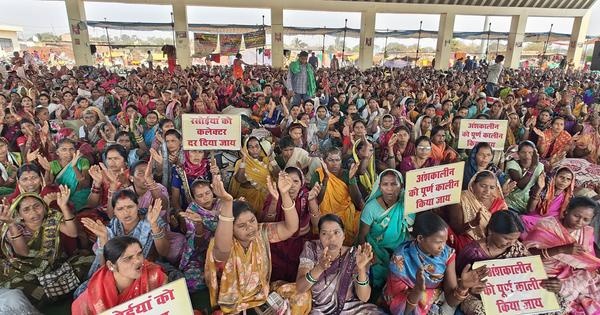
Just a week before the budget was presented, lakhs of Anganwadi workers and Anganwadi helpers gathered at the Town Hall in Ahmedabad as part of the Bharat Bandh called by most major trade unions in the country a few days prior. “The budget is what we are aiming towards. Once that is gone, nothing is going to change for a year,” said Ashaben*, an Anganwadi worker.
The women had gathered to put forth their demands, primary amongst which was the implementation of an order by the Gujarat high court directing an increase in their monthly wages. The workers this author spoke to were part of the Centre for Indian Trade Unions.
Although this strike was called for all workers – including construction/kadiya workers and farmers, the rally consisted largely of women Anganwadi workers and Anganwadi helpers. While other workers were present, an aerial view of the rally would have revealed a greater percentage of saree-clad Anganwadi workers and helpers rather than their male counterparts.
Their overwhelming participation hints at two things: the workers’ commitment to defying their workplaces and participating in the rally, and the difficult circumstances that are pushing them to undertake repeated demonstrations.
Burgeoning responsibilities and state apathy
An Anganwadi worker is, to cite some definitions of the term, a woman ‘employed to provide additional and supplementary healthcare and nutritional services to children and pregnant women’. Their services come under the POSHAN Abhiyaan programme. They are responsible for the nutrition of children aged three to six who visit the Anganwadi centre, as well as the pregnant and lactating mothers in the panchayat. Anganwadi workers in Gujarat are currently paid Rs 10,000 per month.
An Angwadi helper, on the other hand, is responsible for cleaning the Anganwadi, cooking meals for the children and also feeding them at regular intervals. They are currently paid Rs 5,500 per month in Gujarat, which has been unchanged for more than a decade.
However, the average Anganwadi worker in Gujarat is constantly beleaguered with unending responsibilities and often the stress of convincing a recalcitrant beneficiary.
“We start at 9 am, but we don’t know when the day will end. There are also times when we are called upon to be a part of rallies that are held for ministers who are visiting the panchayat. We are told to come in regular clothes so that we are not recognised as Anganwadi workers. This is the kind of work they expect us to do,” said one Anganwadi worker at the rally.
Almost all the workers spoke about their seemingly ceaseless work and the pressure from officials to abide by these duties with no regard to their needs. Their day tends to run till late at night in part because of the additional digital labour they are expected to do.
“We are supposed to give pregnant women supplements called ‘matrshakti’ and infants ‘balshakti’, but people are very unhappy with these supplements. They actually throw the packets at us out of frustration. The public is not satisfied with us, and yet we are the ones who have to assure them that we are working in their interests,” said another worker standing close to her.
The workers explained how the supplements are unpalatable and usually difficult to consume, leading to a lack of interest. Anganwadi workers are also advised to develop recipes that would make the supplements taste better, thereby showing how the burden of the state is being transferred onto underpaid Anganwadi workers and helpers.
Increasing digital labour
All the women I spoke to at the rally noted their burgeoning responsibilities due to the increasing digital labour they have to undertake. Earlier, there was the POSHAN tracker application; recently, the Gujarat government introduced the Anganwadi Visit Tracker application, which goes a step further.
The POSHAN Tracker application was first introduced by the Union government in 2021 to digitally maintain a record of Anganwadi centres, beneficiary data and the services delivered. The aim was to monitor the progress made in the centres.
The newly introduced state application requires workers to fill in details of each house visited, the people in the family, details regarding their identification documents and pictures of those children visiting the centre, which is the toughest job of them all.
“We have to capture the women’s and children’s faces, and we are often not able to, so we have to make multiple trips to their homes. When that doesn’t work, we call them over to the Anganwadi. We have to keep hunting for them and their identification documents,” said one worker.
Workers insisted that with an already heavy workload, this new addition has led to immense stress. “Sometimes the server is down, so if the server were to restart later at night, they will call us and ask us to make the entries right then. We work day and night,” the worker quoted above added.
The workers are also not provided with the appropriate phones to undertake these activities. They complain about using their own phones and internet to conduct these processes, all using the meagre income they receive.
Increasing digital labour for Anganwadi workers has been reported in other states as well, such as Tamil Nadu where similar to Gujarat the state introduced an application that increased the workers’ labour manifold.
As in Tamil Nadu, here too the application acts as a surveillance mechanism for the state to monitor the Anganwadi worker, although whether the monitoring is leading to any discernible improvement in the services provided by the Anganwadi is dubious, as seen with regard to the poor quality of food supplements.
Unimplemented court order
In August 2025, the Gujarat high court ordered an increase in the Anganwadi workers’ and helpers’ monthly salary from Rs 10,000 to Rs 24,800 and from Rs 5,500 to Rs 20,300, respectively. This was supposed to be implemented retroactively from April 2025, with the arrears paid for the gap months.
What should have been a huge victory for the workers remains unimplemented to date. “The order was like candy that they gave us just to silence us, but they don’t really want to do anything. The government doesn’t seem to care for the people who are responsible for taking care of the children and the mothers of this country,” says one worker.
The recent budget also mentions that the honorarium for both Anganwadi workers and helpers has been ‘increased’; however, it simply says they will “get Rs. 10000/month and … Rs. 5500/month” respectively. It leaves the question of implementing the order unanswered.
Thus, someone unaware of the lack of implementation might take this as a reflection of their current income.
Income, not honour
In spite of the promise of the increased honourarium, the recent budget actually sees a reduction in the total budget for the Integrated Child Development Scheme, which covers the POSHAN Abhiyaan.
While the budgeted estimates of 2025-26 stood at Rs 2,994.55 crore, the latest budgeted estimate stands at Rs 2,884.43 crore. The POSHAN Sudha Yojana – a scheme which provides nutrition and healthcare support to women and children in predominantly tribal districts – also witnessed a reduction in the budgeted estimates from Rs 89.65 crore to Rs 86.65 crore.
Earlier, too, the workers had mobilised themselves and demanded the implementation of the order in other demonstrations as well. However, they are forced to take to the streets owing to apathy from the authorities on the implementation of the order.
A worker leading the protest mentioned that the rally was a show of strength to inform the government what they are capable of if this state of inaction continues. “While our labour is glorified, it is not accompanied by an equivalent increase in wages or improvements in our working conditions,” she added.
While the government has a very clear plan forward with regards to the state’s temples and sports enclaves, it is overlooking the plight of Anganwadi workers and helpers, who are responsible for upholding the health of the state’s women and children. The vision of the global city has eclipsed the needs of its underpaid working-class women, whose labour continues to be vital but is undervalued in the journey towards becoming a world-class city.
*Names have been changed to protect the identities of individuals.
[Mallica Patel is a researcher at the Centre for Labour Research and Action, which focuses on the rights and welfare of migrant workers in western India. Courtesy: The Wire, an Indian nonprofit news and opinion website. It was founded in 2015 by Siddharth Varadarajan, Sidharth Bhatia and M. K. Venu.]