Part I
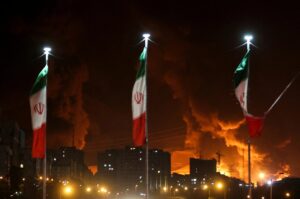
What are the implications for India of the US-Israel attack on Iran? To understand this, we need to place this development in the context of the present world situation, and India’s political economy within that. Let us first address the following questions: Why has the US undertaken this attack? What are its implications for the region and the world?
The United States and Israel have begun the attack by assassinating Iran’s top-most political and military leadership: the Supreme Leader, Ayatollah Ali Khamenei; the Armed Forces Chief of Staff; the Defence Minister; the Secretary of the Supreme National Defence Council; and the Commander of the Islamic Revolutionary Guard Corps (IRGC). While such an assassination by any government would normally be treated as an international outrage, the Western media have taken for granted that this is a legitimate act, and depicted it as an achievement.[1] In fact it falls in the category of crimes defined in the Nuremberg war crimes tribunal, “namely, planning, preparation, initiation or waging of a war of aggression, or a war in violation of international treaties, agreements or assurances.” By international law, Iran thus possesses the right of self-defence and retaliation, both against the countries directly carrying out these attacks and those assisting them.
Countering wrong notions
The bombing of a girls’ school in Minab, where the death toll has now reached 175, should not be seen as an isolated event or an aberration. Fascism works by a completely different logic. For the logic of fascism, pretences at humanitarianism are not only no longer necessary, but counter-productive. The school massacre is intended to tell the Iranian people that this will be their fate if they do not submit. To remove any doubt, by the third day, the US/Israel bombed 9 hospitals, in a calculated reminder of Gaza.
There is a widespread notion that the aggression on Iran is the result of Israel-Netanyahu manipulating the US-Trump; some go so far as to talk of the US as a puppet of Israel. Such talk is at best mistaken, at worst diversionary. The kidnapping of Venezuela’s president Maduro, and the attempt this time to starve Cuba of fuel and make it submit, are in line with this aggression on Iran. Yet no one would claim that Israel manipulated the US into those earlier actions. Rather, all these actions are intended to serve broader US policy. The danger in such mistaken notions is that they lull people into thinking that the present policy can be overcome merely by changing the individuals in office, or even just changing the minds of those at present in office.
Another mistaken but widespread notion is that this aggression can be ascribed to the madness of Trump as an individual. In fact, all the institutions of the US state are carrying out these policies, and the strategic vision behind them is spelled out in key documents of the present administration. US Secretary of State Marco Rubio, addressing the Munich Security Conference on February 14, called for a return to the era of European colonialism:
For five centuries, before the end of the Second World War, the West had been expanding – its missionaries, its pilgrims, its soldiers, its explorers pouring out from its shores to cross oceans, settle new continents, build vast empires extending out across the globe…. But in 1945, for the first time since the age of Columbus, it was contracting…. The great Western empires had entered into terminal decline, accelerated by godless communist revolutions and by anti-colonial uprisings that would transform the world and drape the red hammer and sickle across vast swaths of the map in the years to come.
Rubio called on Europe to join the US in reviving “the West’s age of dominance”. His speech was welcomed by the European imperialists. On March 1 the UK, France and Germany joined the US and Israel as partners in the aggression on Iran, while Japan, Canada and Australia have extended their political support to it. Clearly, we must not restrict our analysis to individuals, but to the logic of the system.
Aggression part of a systematic drive
Indeed, this aggression is part of a broad, systematic drive by a declining US imperialism to re-assert its military and economic hegemony over the world, principally by attacking the Third World. At some places this takes the form of military aggression and terrorism, at others the form of the imposition of sweeping, unilateral economic concessions or outright capitulations garbed as ‘trade deals’.
Countries which defy US imperialism are invaded militarily; countries whose rulers submit to it and supplicate it, such as India, are invaded economically. As such, the Indian people are experiencing another aspect of the same power that is bombing Iran. The difference is that the Indian people find their own rulers on the other side: The so-called ‘trade deal’ announced between India and the US, which was welcomed so enthusiastically by Indian big business, is not a trade deal at all, but a colonial-style imposition on India.
The stakes of the present US venture are high. The global hegemony of the US dollar has been slowly eroded for some time, particularly during the last few years. The re-assertion of US political control over West Asia is key to re-assertion of dollar hegemony. Further, the US economy has staked vast outlays on its financially bloated tech sector; a powerful cabal of US tech moguls has provided Trump crucial backing; and Trump in turn is promoting the global dominance of these firms by classical imperialist measures. All these efforts, however, hinge on the re-assertion of overall US hegemony worldwide. Without that, they fall apart. For all their grumbles, the Europeans and the Japanese appear to have finally clambered on board this venture.
As part of its gamble, US imperialism has made clear that it is willing to undergo a period of instability, even chaos, in the international economy. “Whatever it takes”, said Trump on the fourth day of the war, laying out his vision for the military campaign. Stock prices internationally have fallen, the strait of Hormuz (through which passes 30 per cent of global seaborne oil trade and 20 per cent of global LNG trade) is closed, oil prices have climbed, the world’s busiest airport (Dubai) is closed. It is even possible that the US wants this disruption: Asian economies, which are particularly dependent on oil from the Gulf, will be hit hardest. But any such turmoil, in the situation of existing uncertainty worldwide, is bound to affect the US economy as well. For this reason, several analysts assume that Trump is misled, or ignorant. However, what we saw last year, during Trump’s unilateral imposition of tariffs worldwide, was that US imperialism is prepared for a period of chaos (even within the US) in order to achieve its aims, since it sees that those aims cannot be achieved in the normal course.
It is true that US imperialism’s grand venture is, in the final analysis, doomed, but such objective constraints never stopped imperialists from trying to grab, or hang on to, power. The pace at which, and form in which, those objective constraints get manifested is the outcome of the subjective effort of millions of the world people, including the leaderships of those efforts. The New York Times of September 6, 1934 told the world that “HITLER FORECASTS NO REICH OVERTURN IN 1,000 YEARS”. That project was similarly doomed to fail, but it did not fail on its own. Millions had to give their lives before it could be stopped and turned back. The turning-point came at the Battle of Stalingrad in 1942, and it required many more battles, overwhelmingly on the Soviet front, but also other fronts, before it could be actually defeated. And so it is not enough to say that the US is a paper tiger strategically; for it is a real tiger tactically.
Iran is a special target precisely because it has been the linchpin of resistance to this joint venture of the Western imperialist alliance, and more generally to Western imperialist control of the entire region. The immediate participants in the resistance – Ansarallah in Yemen, Hezbollah in Lebanon, Hamas in Gaza, Bashar al-Assad in Syria, Kata’ib Hezbollah in Iraq – have all been attacked, some most grievously, and Bashar al-Assad has been ousted. Iran has played a critical role in sustaining this resistance over the last two or three decades.
The media, and even much of the alternative media, fail to report that the various contingents of this resistance see themselves as part of a broader, indeed worldwide, resistance to imperialism – not limited to West Asian or Muslim countries. This has been reflected repeatedly in the statements of Hezbollah, Hamas, and Ansarallah, as well as Iran. The Supreme National Security Council of Iran, in its statement after Khameini’s martyrdom, said that not only the nation of Iran, or the Islamic Ummah, but the “freedom-seekers of the world are in mourning”. It stated that “Undoubtedly, the martyrdom of that immensely significant figure will mark the beginning of a great uprising in the fight against the world’s oppressors.”
If the resistance were to be ousted from Iran, it would strengthen the hands of US imperialism in Latin America; if the resistance by Iran and its allies endures this aggression and thereby triumphs over the aggressors, that victory would be felt in Havana and Caracas as well. The resistance being waged by Iran is thus not of Iran alone.
Part II
The ‘regional war’ bogey
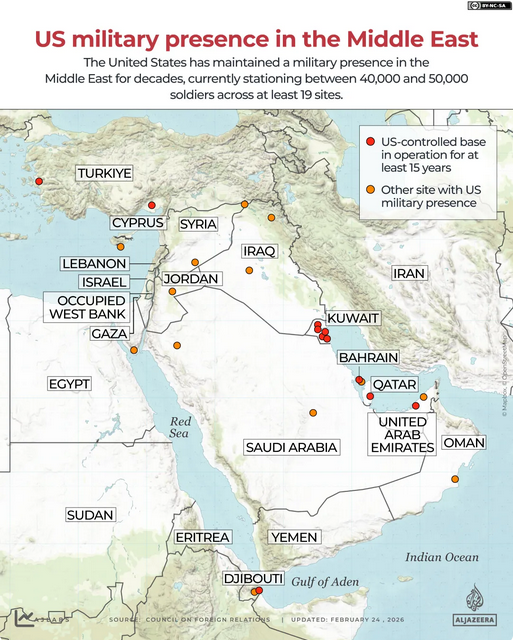
Source: Al Jazeera, based on Council on Foreign Relations
The claim that ‘Iran has started a regional war’ has served as the chief alibi for those who wish to line up behind the US and Israel. The reality is that (1) the US has stationed its forces throughout the region by agreement with client states, and (2) throughout the imperialist build-up to the US-Israeli aggression, Iran consistently warned that, if attacked, it would strike back against all US and Israeli assets in the region.
The US has military bases, facilities, and equipment throughout the region – in Jordan, Kuwait, Bahrain, Syria, Qatar, Saudi Arabia, Turkiye, Iraq and the UAE. Hence no one should have been surprised when Iran proceeded to do as it had promised after being attacked. Nevertheless, Iran’s self-defence has been greeted with cries of simulated outrage. The UK, France and Germany promptly used this as an excuse to join the US and Israeli aggression.[2]
The impact on India, and the stand of the Indian government
The Indian authorities failed to criticise the US-Israeli aggression, or the assassination of the head of state of Iran. This is despite the fact that the Indian government till recently referred to Iran as a friendly country. Given the strains or outright hostility marking India’s relations with the majority of its neighbours, its warm relations with Tehran were particularly important to it. Iran was a major supplier of oil to India on generous credit terms, until May 2019 (when the US pressurised the Indian government into discontinuing purchases from Iran and Venezuela). India had made large investments in Iran’s Chabahar port, but these were discontinued in the latest Central Budget. Chabahar would have provided it access to Afghanistan, as well as the critical International North-South Transport Corridor between India, Iran, Azerbaijan and Russia.
Now the Indian Prime Minister has condemned Iran’s strikes, which are carried out in self-defence. Instead he has phoned the rulers of the UAE, Saudi Arabia, Bahrain and Jordan to express his solidarity with them. With this, the Indian government appears to have abandoned even the remnants of neutrality, and thrown in its lot with the US-Israeli side. What explains this stand? In fact the stand taken by India is a carefully considered one, as we shall see.
No doubt, the impact on India of the present war may be very severe. Half of India’s oil imports come through the strait of Hormuz (between Iran and the Arabian landmass), as do 60 per cent of its LNG imports and an even higher share of its LPG imports. There is no aspect of India’s economy which would be untouched by a prolonged conflict, since oil is a universal input, including transport, fertiliser, irrigation, and food. Further, the Gulf countries and Iran are important destinations for Indian exports, and so export earnings too might suffer. Finally, 9-10 million Indians work in the Gulf region, and they sent home nearly $50 billion in remittances last year.[3] This critical inflow may be interrupted by the present war. In short, India would require more dollars for each barrel of oil, but less dollars would be flowing in. So the exchange rate of the rupee, which has already been under pressure due to outflows of foreign investment, will fall further.
This development brings to the fore certain contradictions of India’s economy and the extent of its domination by foreign capital:
(1) If the hiked international price of oil, and the rupee depreciation, are passed on to Indian consumers, that would lead to all-round inflation. This inflation could trigger yet further depreciation of the rupee, as foreign investors pull out. A downward spiral of the rupee may cause the Reserve Bank of India to hike interest rates, in order to offer attract foreign capital inflows and suppress inflation. An increase in interest rates may push Indian industry from its current stagnation into outright recession.
(2) If the hiked price of oil is not passed on to consumers, the difference would have to be absorbed by the Government, by slashing the heavy taxes on petroleum products. This would substantially reduce budgetary funds, so heavy is the dependence on petroleum taxes for Government revenues. And so Government spending would have to be cut. Reduced Government spending too would depress aggregate demand.
(3) In theory, the loss in tax revenues could be made up by increasing Government borrowing (i.e., increase the fiscal deficit), thereby protecting at least the existing level of Government expenditure. However, international credit ratings agencies disapprove of any increase in Government borrowing, and their disapproval would result in further exit of capital from the country, and yet further depreciation of the rupee. The Government’s earlier opening of Central Government bonds to foreign investors, and its efforts to attract more foreign investment into such bonds, is an additional pressure on it to maintain the fiscal deficit target. It is in such desperate situations that Third World governments make yet further concessions to foreign investors, opening up new sectors or selling off precious assets.
(4) The Gulf crisis of 1990-91 contributed to India’s balance of payments crisis in 1990-91, which crisis led the Indian rulers to approach the International Monetary Fund for a structural adjustment loan. This time, however, it appears that India has vast foreign exchange reserves and is thus protected from any such desperate situation. However, India’s foreign exchange reserves have not been built up from export surpluses, since in fact it runs current account deficits continuously. Rather, the reserves have been built up from foreign liabilities, that are even larger than the reserves. These liabilities are in the form of foreign loans and foreign investments in India. These funds, including much of the foreign direct investment (FDI, which is supposedly more stable and long-term), are volatile. Over the years, successive Indian governments have opened the country further and further to foreign capital flows; thus India is now at the mercy of international capital movements.
(5) The immediate steps taken by the authorities to meet the present crisis would either push up prices or depress aggregate demand, or, more likely, some mix of the two. As we have written earlier, the incomes of large sections of the Indian people have been depressed, and they have had to cut back on simple items of mass consumption such as textiles, garments, leather goods, and items of daily use such as soap, detergent, toothpaste, tea powder, food products, medicines, and paper. This new development may thrust vast numbers into yet deeper misery.
Thus the decision of US imperialism to commit aggression on Iran is one with enormous implications for India. Given the scale of this impact, and given the long build-up to it, one might have expected that any state power concerned with the lives of its citizens would make active diplomatic efforts to prevent the war. An active role of a large country such as India could not have been simply dismissed, and it might have rallied round other countries around the world which too might stand to lose from such a war.
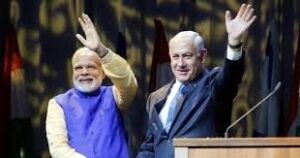
However, the Indian government took a considered decision to do the opposite: namely, for the Indian Prime Minister to visit Israel just two days before the war. There India and Israel elevated their existing “strategic partnership” to a “special strategic partnership”, encompassing defence and security, technology, cybersecurity, trade, and supply of Indian labour to Israel. The Indian Prime Minister announced to the Israeli Parliament that “India stands with Israel, firmly, with full conviction, in this moment, and beyond.”
The real significance of this is that India stands with the US, in this moment and beyond. As such, this stand cannot be seen separately from the decision of the Indian government to conclude a ‘trade deal’ with the US which is not a trade deal at all, but a colonial-style imposition on the Indian people. (In passing, one should note that, if India wishes to import Russian oil as an alternative in the present emergency, it clearly will need Trump’s permission to do so.) A plain reading of that “framework for an Interim Agreement”, along with various statements by the US authorities which have not been denied by their Indian counterpart, reveals that the “framework” will have ruinous effects for the Indian people (a subject that requires a separate discussion).
However, Indian big business welcomed the “framework” unanimously. It has hitched its wagon to US imperialism. The same considerations lie behind the Indian government’s stance regarding Israel and Iran. The present war on Iran lays bare once again the direct conflict in class interests within India.
Notes
- Obituaries in the New York Times, the Washington Post, the Guardian, Associated Press, CNN, the BBC, and Le Monde celebrate this assassination. The BBC obituary is headlined “Ayatollah Khamenei’s iron grip on power in Iran comes to an end”. Nowhere do any of them question its legitimacy in international law.
- March 1, 2026: “The Leaders of France, Germany and the United Kingdom are appalled by the indiscriminate and disproportionate missile attacks launched by Iran against countries in the region, including those who were not involved in initial US and Israeli military operations. Iran’s reckless attacks have targeted our close allies and are threatening our service personnel and our civilians across the region. We call on Iranz to stop these reckless attacks immediately. We will take steps to defend our interests and those of our allies in the region, potentially through enabling necessary and proportionate defensive action to destroy Iran’s capability to fire missiles and drones at their source. We have agreed to work together with the US and allies in the region on this matter.”
- Nearly double the figure for net inward foreign direct investment (FDI), which was $29 billion in 2024-25. Indians in the Gulf are predominantly manual labourers, who manage to send back around $400-$500 per worker per month.
[Courtesy: Research Unit for Political Economy (RUPE), a Mumbai based trust that analyses economic issues for the common people in simple language.]