❈ ❈ ❈
The US Supreme Court, Race and the Right to Vote
Marjorie Cohn
In perhaps its most insidious decision in nearly a century, the U.S. Supreme Court disemboweled Section 2 of the landmark Voting Rights Act (VRA) of 1965, the “crown jewel” of the U.S. civil rights movement.
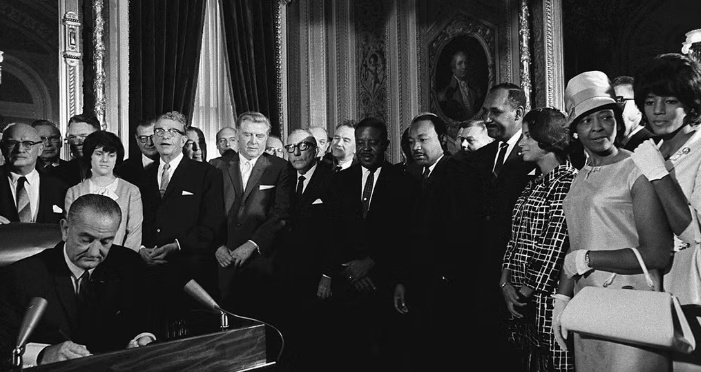
The VRA ended Jim Crow-era election procedures that precluded Black people from voting in the South through intimidation, literacy tests and poll taxes. It was part of a system of post-Civil War legalized racial segregation meant to restore white supremacy after the end of slavery and the federal, military occupation of the South.
Jim Crow lasted from 1877 until passage of the Civil Rights Act of 1964 and the Voting Rights Act the following year.
Section 2 of the VRA allows states to draw voting districts that benefit candidates from racial minorities and enables citizens to challenge election maps as racially discriminatory.
In its Wednesday ruling in Louisiana v. Callais, the 6-3 rightwing supermajority of the Court struck down a congressional map that a group of self-described “non-African American” voters had challenged as an unconstitutional gerrymander.
Court members Samuel Alito, John Roberts, Clarence Thomas, Brett Kavanaugh, Neil Gorsuch and Amy Coney Barrett held that drawing districts to remedy past discrimination itself constitutes unconstitutional racial discrimination.
For 61 years, the VRA has been one of the most significant protections against racial gerrymandering. Thanks to the VRA, there are now more than 10,000 Black elected officials throughout the country, compared to about 1,500 in 1970.
Callais paves the way for the largest decrease in representation by Black members of Congress. It will lead to the elimination of dozens of Black and Latino-majority districts throughout the South and a substantial number of current congressional seats.
“This court’s project to destroy the Voting Rights Act is now complete,” Elena Kagan wrote in dissent, joined by Sonia Sotomayor and Ketanji Brown Jackson. “Today’s decision renders Section 2 all but a dead letter.”
Section 2 prohibits any voting qualification or prerequisite to voting, or practice or procedure, that “results in a denial or abridgment of the right of any citizen of the United States to vote on account of race.”
That occurs when voters of color “have less opportunity than other members of the electorate to participate in the political process and to elect representatives of their choice.”
Congress amended Section 2 in 1982 to provide that evidence of discriminatory intent is not necessary to prove racial discrimination; even policies that appear neutral can have a discriminatory effect on a particular group.
In the 1986 case of Thornburg v. Gingles, the Supreme Court interpreted the amended Section 2 and established a multi-factor test to decide when a jurisdiction must draw districts to provide minority voters a fair opportunity to elect representatives of their choosing.
The Gingles test has been used by courts for 40 years. Three years ago, the high court affirmed the test in Allen v. Milligan and held that Alabama’s congressional map likely violated Section 2.
The Callais Majority Rewrites a Congressional Statute
In Louisiana v. Callais, a coalition of Black voters and civil rights groups sought to reinstate a map that the Louisiana state legislature had adopted in 2024. The map established a second majority-Black congressional district. It was drawn in response to a U.S. district court ruling that a map drawn in 2022 likely violated Section 2.
That 2022 map included only one majority-Black district out of Louisiana’s six congressional districts. The coalition maintained that the 2022 map diluted the votes of Black residents, who comprise about one-third of Louisiana’s population.
The Fifth Circuit Court of Appeals affirmed the district court decision that the 2022 map likely violated Section 2, and the appellate court ordered Louisiana to draw a new map by Jan. 15, 2024. The Louisiana Legislature complied and drew a map with a second majority-Black district.
In response, the “non-African American” voters challenged the 2024 map as unconstitutional because it separated voters based primarily on race.
Samuel Alito, writing for the Court’s supermajority, said that the 2024 map “relied too heavily on race.” He wrote that the coalition of Black voters had not proved “an objective likelihood that the [2022] map was the result of intentional racial discrimination,” even though it only contained one majority-Black district out of the state’s six Black districts.
Despite the 1982 congressional amendment to Section 2, stating that racial discrimination can be proved by showing discriminatory effect, the Court restored the requirement that voters challenging district maps must prove that “circumstances give rise to a strong inference that intentional discrimination occurred.”
While asserting that it was simply “updating” the Gingles test, the Court actually rewrote it to erect an insurmountable barrier to plaintiffs’ claims of racial discrimination.
“In sum,” Alito concluded,
“because the Voting Rights Act did not require Louisiana to create an additional majority-minority district, no compelling interest justified the State’s use of race in creating [the 2024 map]. That map is an unconstitutional gerrymander, and its use would violate the plaintiffs’ constitutional rights.”
After the Supreme Court’s decision, states can now defend their maps by claiming they were just engaging in partisan (as opposed to racial) gerrymandering. The high court decided in the 2019 case of Rucho v. Common Cause that although partisan gerrymandering is unconstitutional, it cannot be challenged in federal court.
“Today . . . the majority straight-facedly holds that the Voting Rights Act must be brought low to make the world safe for partisan gerrymanders,” Kagan wrote in her dissent.
Now “the State need do nothing more than announce a partisan gerrymander. Assuming the State has left behind no smoking-gun evidence of a race-based motive (an almost fanciful prospect), Section 2 will play no role.”
Kagan further declared:
“The Voting Rights Act is — or, now more accurately, was — one of the most consequential, efficacious, and amply justified exercises of federal legislative power in our Nation’s history. It was born of the literal blood of Union soldiers and civil rights marchers. It ushered in awe-inspiring change, bringing this Nation closer to fulfilling the ideals of democracy and racial equality.
And it has been repeatedly, and overwhelmingly, reauthorized by the people’s representatives in Congress. Only they have the right to say it is no longer needed — not the Members of this Court. I dissent, then, from this latest chapter in the majority’s now-completed demolition of the Voting Rights Act.”
‘An Outright Power Grab’
“With this decision in Louisiana v. Callais, the Supreme Court has opened the door to a coordinated attack on Black voters across this country,” Democratic Rep. Yvette Clarke of New York and chair of the Congressional Black Caucus, said at a press conference after the ruling was announced.
Nearly 70 of the 435 congressional districts are protected by Section 2, according to election law expert Nicholas Stephanopoulos.
Democracy Docket has data showing that the Callais ruling will likely derail 28 pro-voting lawsuits that seek to prevent state legislatures from drawing maps that dilute the power of racial minority voters.
The ruling has already prompted a rash of Republican redistricting efforts throughout the South in advance of the 2026 midterm elections this November. Republicans in Louisiana, Tennessee and Georgia are considering redistricting before the midterms.
Louisiana has suspended next month’s primaries to allow lawmakers to pass a new congressional map first. If these efforts occur and sustain legal challenges, the GOP stands to gain as many as five new seats this year.
GOP-led states could pick up as many as 19 new GOP-allied House seats in the coming years.
David Wasserman, senior editor and elections analyst for The Cook Political Report with Amy Walter, told Axios, “I think, realistically, we’re probably talking about one to three seats for 2026, but it’s not hyperbolic to call this an apocalyptic ruling for Black majority districts in 2028 in the Deep South.”
An analysis conducted by The New York Times last year found that Democrats could lose about 12 majority-minority districts throughout the South if the Court struck down part of the VRA.
“This is an outright power grab,” Rep. Clarke said. “It’s about silencing Black voices, dismantling majority Black districts and rigging the maps so that politicians can choose their voters instead of the other way around.”
[Marjorie Cohn is professor emerita at Thomas Jefferson School of Law, dean of the People’s Academy of International Law and past president of the National Lawyers Guild. She sits on the national advisory boards of Veterans For Peace and Assange Defense, and is a member of the bureau of the International Association of Democratic Lawyers and the U.S. representative to the continental advisory council of the Association of American Jurists. Her books include Drones and Targeted Killing: Legal, Moral and Geopolitical Issues. Courtesy: Consortium News, a US based investigative internet news magazine that seeks to challenge the many misguided conventional wisdoms.]
❈ ❈ ❈
Supreme Court Attacks Black Voting Rights, Native Nations
Gary Wilson
On April 29, the U.S. Supreme Court gave state legislatures a green light to break up Black and Native voting districts — an attack on Black self-determination, Native sovereignty and basic democratic rights.
The 6-3 ruling in Louisiana v. Callais gutted what remained of Section 2 of the Voting Rights Act of 1965. It struck down Louisiana’s second majority-Black congressional district and opened the door for similar attacks across the country.
Lawmakers can now break up Black and Native voting districts, then say it was not racism — it was just a plan to give Republicans more seats.
The decision landed while public attention was fixed on the U.S. war on Iran, soaring gas prices and preparations for May Day. That timing mattered. War and crisis pushed one of the most sweeping attacks on basic democratic rights since the end of Reconstruction out of the center of public attention. Coming on the eve of May Day, the ruling showed the class character of the attack: It struck at Black political representation, Native sovereignty and the right of oppressed peoples to determine their own political future, while the workers’ movement was preparing to march against war, austerity, racism and repression.
Writing for the conservative majority, Justice Samuel Alito held that Louisiana’s effort to ensure fair representation for Black residents — who make up one-third of the state’s population — was unconstitutional “race-based discrimination.”
Justice Elena Kagan, dissenting, called the ruling the “latest chapter in the majority’s now-completed demolition of the Voting Rights Act.”
She is correct. But the attack did not begin in 2026, and it cannot be understood as a legal matter alone.
1877 again
This is not the first time Black democratic rights have been traded away in a ruling-class crisis.
In the Compromise of 1877, Northern capital and the Southern ruling class struck a counter-revolutionary deal that ended Reconstruction. Control of the South was returned to the old slaveholding order and its successors — the planters, merchants, politicians and railroad magnates who ruled the “redeemed” South. In practice, “home rule” meant white-supremacist rule over the Black masses of the South, enforced by a reign of terror.
Black people in the South paid the price. Federal protection was withdrawn. Reconstruction governments were destroyed. The Southern ruling class imposed Jim Crow: a system of white-supremacist rule over Black people, enforced through disfranchisement, terror, poverty wages and segregation, and used to keep the whole working class divided.
The 1965 Voting Rights Act was won through mass struggle. Black-led movements across the South, joined by supporters across the country, marched, organized and built local movements under the threat of jail, beatings and murder. Black people forced the ruling class to concede basic democratic rights: the right to vote, to be represented and to assert their right to self-determination. Today, the Supreme Court is turning the ruling-class attack on those rights into law. The Louisiana ruling marks a new stage in that attack.
Cover fire
The April 29 ruling did not arrive in a vacuum. The United States is waging a losing war on Iran. Oil prices have surged. Food costs are rising. The government is paying more to borrow money to keep the war machine running.
In the middle of that crisis, the Court struck at basic democratic rights.
From Louisiana to North Carolina, Florida to Mississippi, at least 15 House districts are now at risk. Losing even a handful could produce the largest drop in Black representation in Congress since the end of Reconstruction.
This is how democratic rights are taken back. The ruling class does not need a secret plan. It needs a crisis and the power to use it. While war and economic pressure dominate public attention, the Court and state legislatures move to weaken Black, Native, Latine, Asian, Arab, immigrant and working-class communities before they can answer with organized force.
A map that scatters Black voters in Memphis across rural conservative districts, or eliminates three of Florida’s four Black-held congressional seats, produces exactly that.
State officials moved immediately.
Louisiana Gov. Jeff Landry moved first. He used the Supreme Court ruling to declare an “election emergency” and suspend the May 16 congressional primary after voting had already begun. Ballots already cast were thrown out. The Court had struck down Louisiana’s second majority-Black congressional district; Landry moved to eliminate it.
Alabama moved next. Attorney General Steve Marshall asked the Supreme Court to lift the orders that blocked Alabama from using its old congressional map. That map had been stopped because it broke up Black representation in a state where Black residents make up more than one-quarter of the population. Marshall cited the Louisiana ruling and demanded quick action in three cases.
Tennessee Gov. Bill Lee called lawmakers back to Nashville to redraw the state’s congressional map. The target is Memphis — the state’s only majority-Black district.
Florida moved at the same speed. On April 29, lawmakers approved a DeSantis-backed map just two days after he unveiled it. The map could move Florida’s House delegation from 20-8 Republican to 24-4. It reshapes Democratic areas around Orlando, Tampa-St. Petersburg and South Florida, and effectively eliminates one nearly majority-Black district.
Native sovereignty under attack
The attack on voting rights also reaches Native nations, where political representation is tied directly to sovereignty.
The Court has changed the rules to protect the politicians drawing maps that break up Native communities. Native voters can show that a map splits their communities and denies their sovereignty. The Court ruling says that’s okay.
For tribal nations, political voice affects infrastructure, health care, environmental protection, collectively held land and treaty rights. When Native voters are split among several conservative rural districts, their collective voting strength is destroyed.
Native sovereignty also shapes fights over land, water, pipelines and mining — exactly where corporations and the war economy press hardest. Breaking up Native communities serves the same class interests as breaking up Black representation in Memphis, Louisiana or Florida.
The ruling also shows what “colorblind” constitutionalism does. It takes the political map produced by slavery, Jim Crow, Native dispossession and centuries of exclusion, then declares that map neutral. The result preserves racist inequality while pretending race has been removed from the question.
[Gary Wilson is a retired computer network engineer and long-time socialist agitator currently working as co-editor of Struggle-La Lucha. Courtesy: Struggle La Lucha, a US based socialist publication.]
❈ ❈ ❈
Black Disenfranchisement Has Not Been This Intense Since Jim Crow
Austin C. McCoy
The Supreme Court’s decision to invalidate Louisiana’s congressional map creating two Black-majority districts continues to remind us of how much the U.S. has backpedaled away from the so-called racial “reckoning” of the summer of 2020. The Supreme Court ruling in Louisiana v. Callais undermines another key plank of the 1965 Voting Rights Act, passed more than 60 years ago with the intent of protecting Black Americans’ voting rights and political representation.
With SCOTUS ruling majority-minority districts as a form of discrimination against non-Black people, Republican-led states are poised to dilute Black political power in a manner echoing the Jim Crow era when white southerners retook power from elected Black lawmakers and neutralized Black Americans’ voting rights for multiple generations. During Reconstruction, hundreds of African Americans won elected office as thousands of newly emancipated citizens engaged in the electoral process. The number of Black officeholders declined following Reconstruction’s end in 1877, when federal troops were withdrawn from the South. White supremacist groups like the Ku Klux Klan launched terror campaigns against Black communities in efforts to blunt Black political power. Many whites also justified their attempts at undermining Black power by claiming African Americans were corrupt and thus not fit to participate in self-governance.
White theft of African Americans’ civil rights and economic power accompanied the destruction of Black political influence following the end of Reconstruction. White southerners moved to pass laws instituting segregation in education, public accommodations, and in the private sector. Jim Crow laws also entailed enforcing policies preventing Black Americans from voting, such as poll taxes and literacy tests.
One difference between the racial dictatorship of Jim Crow and the burgeoning racial regime is the contemporary manifestation of oppression is grounded in what sociologist Eduardo Bonilla-Silva calls “colorblind racism,” or non-racialized actions and policies that reinforce Black and Brown marginalization. In 2013, Chief Justice John Roberts, writing for the conservative majority, justified invalidating Section 4b of the Voting Rights Act in Shelby County v. Holder by pointing to the “great strides” in Black participation in electoral politics. Justice Samuel Alito echoed Roberts in his opinion for Louisiana v. Callais: “First, vast social change has occurred throughout the country and particularly in the South, which have made great strides in ending entrenched racial discrimination.”
However, eliminating minority-majority districts threatens to leave millions of Black Americans without representation that reflects their interests. Florida Gov. Ron DeSantis signed off on a new congressional map which could award up to four more GOP seats. Tennessee Republicans have drafted a new map that would eliminate the only predominantly-Democrat, and predominantly-Black, district. Alabama Gov. Kay Ivey’s call for state Republicans to revisit Alabama’s map is striking because she is framing her actions as an attempt to remain in compliance with the law. Again, this ruling allows Republicans in states to disenfranchise Black voters under the guise of following “colorblind” law.
SCOTUS’s decision is the latest in a series of rollbacks in civil rights not seen since the post-Reconstruction era. Since Donald Trump returned to office in January 2025, his administration has sought to eliminate any policy associated with addressing historical instances of racism. The administration’s attack on diversity, equity, and inclusion (DEI) policies has led to historic job losses for Black women. According to economist Katica Roy, more than 319,000 Black women lost their jobs in three months in 2025.
Many red states, especially in the South, continue to wage a war against Black history, especially the aspects of it that challenge myths of colorblindness and white innocence and victimhood. After complaining about how anti-racist activists have tried to “erase” history by tearing down Confederate monuments during his first presidency, Trump’s federal government continues its efforts to whitewash history, from its unsuccessful attempt to remove mentions of George Washington enslaving Black people at Independence Hall in Pennsylvania to reinstating names of military bases named after Confederate generals. This follows the ongoing assault that Republicans and higher education administrators in Florida, Texas, and Alabama have waged against DEI programs in education and the teaching of African American Studies, race, and gender studies. These attacks on anti-racism descend from the “Lost Cause” myth that emerged amid Reconstruction, which erased slavery as a cause of the Civil War and instead emphasized how the Confederate South fought valiantly to defend “state’s rights.”
Diluting the Voting Rights Act, attacking Black history and employment, challenging birthright citizenship legalized in the 14th Amendment — another pillar of Reconstruction policy — and eliminating immigration from “less desirable” countries in Latin America, Africa, and the Middle East are all part of this administration’s strategy to maintain the United States as a white nationalist country. The “Great Replacement” theory animates these attacks as many Americans believe that people of color threaten to overrun the U.S. and replace and oppress white Americans.
Like white reactionaries in the South attacking Black Americans’ freedoms and white northerners’ defense of segregation after the Civil War, this administration’s efforts to curb Black political and economic power and immigration are a backlash to the global racial justice uprisings in response to Breonna Taylor’s and George Floyd’s murders by police in 2020. The 2020 protests represented everything that many white nationalists feared — a multiracial, multinational, and working-class movement against police violence, racism, colonialism, and capitalism. It seemed that a new political majority seeking a long overdue reckoning with the histories of racism and settler colonialism was on the cusp of formation amid the rebellion.
The backlash to the anti-racist conflagration emerged soon after the summer of 2020. Believing that anti-racist education projects like the 1619 Project lay at the foundation of the rebellion, Trump tried to undermine it with the “1776 Project,” which asserted a whitewashed and American exceptionalist interpretation of U.S. history. Attacks on critical race theory and DEI efforts followed and continued after Trump left office, as right-wing activists like Christopher Rufo waged a culture war against anti-racism. Democrats like then-Rep. and now-Virginia Gov. Abigail Spanberger and President Joe Biden criticized calls to defund the police. Biden called for funding law enforcement, further undermining one of the main demands of 2020 demonstrators.
Resistance to this racist regime may start in a manner similar to Black Americans resisting Jim Crow and structural racism in the North during the 20th century civil rights movement and the organizing that laid the foundation for the 2020 protests — local people resisting “colorblind” racism and organizing protests and movements against the structures of white supremacy. Minnesotans have demonstrated the power of collective solidarity and community defense while resisting Immigration and Customs Enforcement (ICE) and Customs and Border Protection’s attempts to round up immigrants. And, as Jonathan Stegall and Anne Kosseff-Jones wrote in January for Truthout, Minneapolis’s anti-ICE resistance would not have transpired without the city’s 2020 racial justice uprising.
Collective political education is once again relevant as state legislatures and the federal government have sought to ban Black history, ethnic studies, gender studies, and other disciplines critical of settler colonialism, imperialism, and capitalism. Political education programs such as Study and Struggle and efforts such as the hundreds of Black churches creating history programs to educate their communities are great examples of critical education capable of countering right-wing propaganda about race and racism, gender, war, immigration, and capitalism. Studying how power operates, organizing tactics and strategies, and histories of resistance also prepares us for confronting and defeating authoritarianism.
The only path to stopping this regime from completely disenfranchising everyone but its most privileged adherents is to make good on the longstanding calls by Black activists like W. E. B. Du Bois, Martin Luther King Jr., Angela Davis, and groups like the League of Revolutionary Black Workers and the Black Workers Congress to transform U.S. society. We also learned from the range of abolitionist organizations and formations in the Twin Cities fighting against state violence like Black Visions, Reclaim the Block, the Minnesota Immigrant Rights Action Committee, and the recent collective opposition to ICE that we cannot reform ourselves out of structural racism. The structure of white power that can rear its monstrous head in response to racial justice movements must be destroyed and a new, more just and equal system must be built in its place.
[Austin McCoy is a scholar of African American history, labor, social movements, and popular culture. He is also the author of Living in a D.A.I.S.Y. Age: The Music, Culture, and World De La Soul Made. Courtesy: Truthout, a US nonprofit news organization dedicated to providing independent reporting and commentary on a diverse range of social justice issues. Its editor-in-chief is Negin Owliaei, an Iranian American journalist, editor, and researcher known for her work on inequality, labor, and social justice issues.]