❈ ❈ ❈
The U.S. Killing Machine
David Rosen
When the U.S. goes to war, it goes to win – and to win, it kills and kills.
The U.S-Israel war against Iran began on February 28, 2026. On March 2nd, Sec. of “War” Pete Hegseth declared: “If you kill Americans, if you threaten Americans anywhere on Earth, we will hunt you down without apology and without hesitation and we will kill you.”
As of March 16th, The Guardian reports 12 U.S. military personnel have died in the U.S.-Israel war with Iran – 6 killed from a drone attack and 6 died from a airplane refueling crash; some 200 others have been wounded.
The BBC reports: “On 14 March, the US-based group Human Rights Activists in Iran (HRANA) reported 3,040 people had been killed in Iran – including 1,122 military personnel and 1,319 civilians, of which at least 206 were children. Another 599 fatalities were ‘unclassified’ (civilian/military).”
As the U.S.-Israel war continues on and on and on, the irrational ratio of U.S. military deaths to that of the Iranians will no doubt continue to escalate – to be made that much worse if Pres. Donald Trump decides to deploy U.S. military personnel in a ground campaign.
While “War” Sec Hegseth rants on with his killing rhetoric, his efforts pale in comparison to the horrendous slaughters orchestrated by Air Force General Curtis LeMay during WW-II. His Air Force fire bombed Dresden, Germany, in February 1945 killing 25,000 people and followed, between March and July, dropped tons of incendiary bombs on Japan killing 233,000 and injuring 473,000; in August, U.S. bombers dropped atomic bombings of Hiroshima leading to approximately 140,000 deaths and Nagasaki with between 70,000 to 74,000 deaths.
● ● ●
The current war in Iran raises a deeper question: How many people – both military and civilian – has the U.S. killed in wars during the “modern” era?
One can date the “modern” era with World War II that took place in Asia and Europe during the period of 1939-1945.
World War II saw a total of 60 million death – 15 million were military and 45 million civilians; of these, 6 million Jews were murdered by the German Nazis. Japan saw 2.1 million military death and 0.5 to 1 million civilian deaths; the Soviet Union saw 24 million deaths, of these 8.8 to 10.7 million were military. The U.S. military saw 416,000 deaths.
Korean War – lasted from 1950 to ’53 and the death toll among South Koreans military and civil is estimated at 595,000 – U.S. military deaths are estimate at 54,000.
Vietnam War – lasted from 1965 to ’73 and the death toll of South Vietnam military and civilians is estimated at 890,000 – U.S. military deaths are estimated at 56,000.
Latin American Follies – Fidel Castro marched into Havana on January 7, 1959, a week after U.S.-backed dictator Fulgencio Batista fled to the Dominican Republic. In April ’61, the CIA orchestrated an invasion of Cuba at the Bay of Pigs; 1,000 CIA foot soldiers, Cuban exiles, were taken prisoner. The U.S. officially broke diplomatic relations with Cuba in 1961. A half-century later, relations were partially reestablished under Pres. Barack Obama but returned to cold war status under Trump who has blocked oil from the country and threated a “friendly takeover” of the island nation.
Since the 1950s, the U.S. has initiated numerous military — and/or CIA-backed — campaigns in Latin American, often with dire consequence for the targeted country:
- The CIA overthrew of Guatemala’s elected government (1954) — the CIA claims at least four dozen people were killed.
- The U.S.-backed dictatorships of Papa Doc and Baby Doc Duvalier in Haiti (1957-1986) – it killed an estimated 60,000 people.
- The U.S. orchestrated military coup in Brazil (1964) – led to an estimated 500 people being killed or “disappeared.”
- The U.S. military occupation of Dominican Republic (1965-1966) – led to at least 1,000 people killed.
- U.S. orchestrated military coup of socialist government of Salvador Allende in Chile (1973) – more than 3,000 people were killed or disappeared.
- In Nicaragua, the U.S.-backed the government of Anastasio Somoza is defeated by the Sandinista National Liberation Front (“Sandinistas”/FSLN) (1974-1979) — an estimated 10,000 to 50,000 people killed, including 7,000 civilians.
- In Nicaragua, from 1980 to June 1987, 43,176 Nicaraguans on both sides of the war between Soviet Union/Cuba-backed FSLN and the U.S.-backed Contras were killed, wounded or kidnapped. Among these casualties were 22,495 dead, 12,065 wounded, and 8,616 kidnapped or captured.
- In the El Salvador civil war, U.S.-backed military, including death squads (1979–1992) – an estimated 75,000 civilians were killed or “forcibly disappeared.”
- U.S. military invasion of Grenada (1983), dubbed “Operation Urgent Fury” – “Eighteen US troops were killed in combat, one died of wounds, 115 were wounded and 28 suffered nonhostile injuries. The Cubans lost 24 killed, 59 wounded and 605 captured who were later returned to Cuba. The Grenadian People’s Revolutionary Army (PRA) suffered 21 killed and 58 captured. There were 24 Grenadian civilians killed during the operation.”
- U.S. occupation of Panama (1989-1990), dubbed “Operation Just Cause” – at least 300 Panamanian civilians died; and 23 U.S. service personnel were killed 325 wounded.
Operational Stalemates – these include a host of military campaigns across the globe.
- Operation Desert Storm – launched by Pres. George H. W. Bush from August 2, 1990 to January 17, 1991. It saw 294–382 total US deaths (147–154 in combat) and 467 wounded. According to one source, “The majority of U.S. deaths were non-battle related (65–235), including accidents and friendly fire. Iraqi casualties were significantly higher, with estimates ranging from 10,000 to over 100,000 killed.”
- Operation Enduring Freedom – the first phase of U.S. war in Afghanistan was announced on October 7, 2001, by Pres. George W. Bush in the wake of the September 11thattacks. It became part of the “war on terrorism.” It dragged on until December 28, 2014. The Taliban and Al-Qaeda had over 51,000 casualties.
“Coalition forces” – i.e., U.S., Britain and other allies — suffered 3,486 deaths; of these, over 2,300 were members of the U.S. armed forces.
- Operation Iraqi Freedom — launched by Pres. Bush on March 19, 2003, and ended December 15, 2011. (This includes Operation New Dawn, the U.S. Air Force’s involvement in Iraq after August 2010.). It began when Bush claimed that to Saddam Hussein’s regime possessed, produced and was stockpiling weapons of mass destruction (WMDs). Iraqi deaths attributable to the war through mid-2011 to be about 405,000. U.S. casualties were 4,488 military deaths and over 32,000 wounded.
- Operation Inherent Resolve — launched by Pres. Barack Obama, it was coalition of 80 national and organization groups against ISIS (the Islamic State of Iraq) in Iraq and Syria and ran from 2014 to 2020 and finally concluded in 2025. According to the Combined Joint Task Force, “The Coalition conducted at least 35,045 strikes between August 2014 and December 2021. CJTF-OIR assesses that, since the beginning of Operation Inherent Resolve in August 2014, at least 1,437 civilians have been unintentionally killed by Coalition actions during combat operations against ISIS.” Wikipedia notes, “Tens of thousands more were killed by partner forces on the ground (the SDF alone claimed to have killed 25,336 IS fighters by the end of 2017). According to Airwars, between 8,220 and 13,299 civilians were killed in the airstrikes in Syria and Iraq, with an additional 1,437 civilians killed in other operations. The U.S. military suffered 213 U.S. fatalities.
- Operation Freedom’s Sentinel (OFS) — launched by Pres. Obama on January 1, 2015, following the conclusion of Operation Enduring Freedom. The U.S.-led mission focused on counterterrorism and training Afghan forces, officially ending around August 30, 2021, following the withdrawal of U.S. troops from Afghanistan. U.S. military deaths totaled of 108 and 620 wounded. No estimates of Taliban deaths and/or wounded could be found.
“Humanitarian” Operations – are military campaigns to contain local crises. Among such actions were:
- Operation Allied Force – was a U.S.-backed, NATO air campaign against the Federal Republic of Yugoslavia during the Kosovo War. The campaign lasted from 24 March 24, 1999, to June 10, 1999. Human Rights Watch estimatedthat no fewer than 1,200 civilians and up to 2,500 civilians were killed and 5,700 wounded as a result of NATO airstrike
- Operation Deliberate Force – was a U.S.-backed, NATO air campaign involving 15 nations against Bosnia Serbs that occurred between 1994-1995. Human Right Watch notes, “cluster bomb use by the United States and Britain can be confirmed in seven incidents throughout Yugoslavia (another five are possible but unconfirmed); some ninety to 150 civilians died from the use of these weapons.”
- Libyan Intervention — in March 2011, Pres. Obama authorized US military intervention in Libya as part of a NATO-led coalition. This military action resulted in“a total of 21,490 persons were killed, 19,700 injured and 435,000 displaced.”
Finally, TomDispatch documented that as of September 2013, the U.S.’s Africa Command recognized 54 countries in Africa and “U.S. military involvement with no fewer than 49 countries.”
Now, as the U.S.-Israel war against Iran drags on, Trump & company are asking Congress to pony up $200 billion to fight on and on. “War” Sec Hegseth put the request in the starkest terms: “As far as the $200 billion, I think that number could move, obviously,” Hegseth told reporters. “It takes money to kill bad guys. So we’re going back to Congress and our folks there to ensure that we’re properly funded for what’s being done.”
The U.S. killing machine marches on.
[David Rosen is the author of Sex, Sin & Subversion: The Transformation of 1950s New York’s Forbidden into America’s New Normal (Skyhorse, 2015). Courtesy: CounterPunch, an online magazine based in the United States that covers politics in a manner its editors describe as “muckraking with a radical attitude”. It is edited by Jeffrey St. Clair and Joshua Frank.]
❈ ❈ ❈
US War Machine Is Built on Decades of Lies. The Assault on Iran Is No Exception.
Scott Kurashige
The first casualty of war is the truth.
This truism — understandably repeated at the outset of each new U.S. war — is proving itself once again.
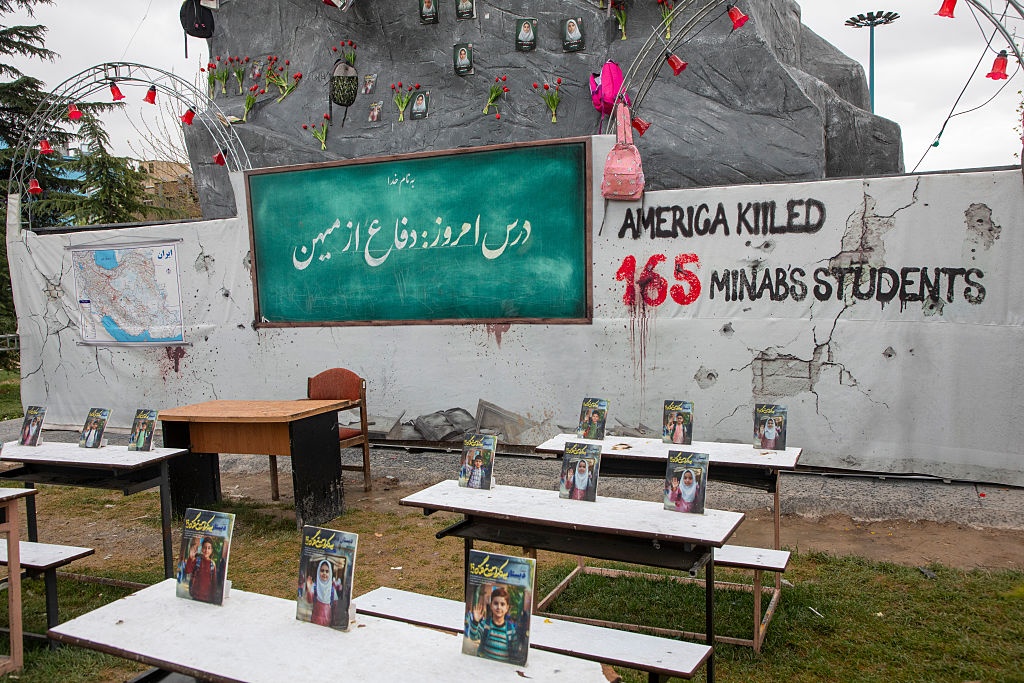
With all evidence pointing toward U.S. responsibility for the February 28 bombing of Shajarah Tayyebeh elementary school, President Trump claimed that the attack “was done by Iran.” In spreading this blatant misinformation, Trump was not in fact shattering presidential norms — rather, he was continuing a White House tradition.
Back in 1945, in a public statement announcing the U.S.’s atomic bomb strike on Japan, President Harry Truman falsely described the city of Hiroshima as “an important Japanese Army base.” In fact, the overwhelming majority of those killed were civilians. The bomb targeted thousands of schoolchildren, including nearly 6,000 who died as part of a service patrol near the center of Hiroshima. In Nagasaki, more than 1,400 students and teachers at Shiroyama Elementary School were killed.
But like most students attending U.S. schools after World War II, I was taught that dropping the atomic bombs saved lives.
Long before George W. Bush asserted that Saddam Hussein had WMDs, dubious claims and outright lies served as pretexts for the U.S. to launch major wars. A jingoistic fervor following an explosion on the battleship USS Maine prompted the Spanish-American War in 1898. In 1964, LBJ cited a “phantom battle” to push the Tonkin Gulf Resolution authorizing military intervention in Vietnam.
Trump stands out mostly because he made little effort to sell his lies before going to war. In his prime-time address on April 1, 2026, he retroactively offered his first attempt to justify the war, claiming without evidence that Obama’s nuclear deal made Iran a greater threat and that Iran was on the cusp of aiming missiles at “the American homeland.”
Calling truth a casualty of war may imply, however, that truth survives between wars. But the reality is that militarism and the warfare state are sustained by lies which stretch over decades. The ideology of American exceptionalism is driven by the myth that U.S. intervention plays a unique role in spreading freedom and democracy around the globe. Keeping the public uninformed and miseducated has been a key tactic to tamp down dissent.
The most common and continuous form these lies take is omission, erasing the pattern of U.S. war crimes from military records, history textbooks, and public memory. This record of erasure has proven so effective that many of those speaking out against war crimes do not seem to understand the degree to which they, too, have been miseducated. Chastising the Trump administration’s response to the school bombing, The New York Times’s David Wallace-Wells recoiled at the notion of a mass civilian massacre being “treated by U.S. officials as the normal cost of waging war.”
That civilian massacres have been a regular feature of warfare under Democratic and Republican administrations throughout U.S. history has apparently been lost on Wallace-Wells and countless others. Racism and xenophobia play a crucial role in this erasure, as they are used to rally support for war while devaluing the millions of nonwhite lives lost in pursuit of U.S. interests. As General William Westmoreland said bluntly during the Vietnam War, “The Oriental doesn’t put the same high price on life as does a Westerner.”
In this way, war-related lies have been integral to the formation of our national identity.
This is particularly true for the series of wars stretching across East, Central, and West Asia since the late 19th century that I researched for my book, American Peril: The Violent History of Anti-Asian Racism. Rudyard Kipling’s invocation of “the white man’s burden” in his 1899 call for the U.S. to colonize the Philippines was unmistakably racist. But in its time, it was meant to be instructive: Waging the “savage wars of peace” required Americans to shed their “childish” innocence and embrace the brutish nature of imperial power.
The message was sadly taken to heart by U.S. troops in the Philippines, where lynching, torture, concentration camps, and mass murder became all too common. Some atrocities continued long after the U.S. declared an end to combat. In 1906, American troops on Jolo Island in the southern Philippines killed 1,000 Moro people in what the U.S. recorded as a great military victory over Muslim fanatics in the “Battle of Bud Dajo.” Recounted by historian Kim A. Wagner, it was a horrific massacre, whose victims included women and children, as well as outgunned or unarmed men attempting to surrender.
Regarding the firebombing of Tokyo during World War II, Robert McNamara admitted, “In that single night, we burned to death 100,000 Japanese civilians in Tokyo: men, women, and children.” After WWII, McNamara served as secretary of defense, overseeing the escalation of the Vietnam War that resulted in over 3 million deaths. The My Lai massacre, which was marked by wanton slaughter and sexual assault — was initially recorded as a successful defeat of “enemy” combatants in March 1968, but more accurate news about it finally broke through decades of silence on U.S. war crimes. Most Americans quickly bracketed it off, a horrific exception rather than the culmination of a pattern.
But My Lai was a near replay of tragedies from the Korean War that the U.S. military systematically covered up. South Koreans had long memorialized the hundreds of unarmed and defenseless civilians, from babies to elders, massacred by U.S. soldiers at No Gun Ri. It was only brought to the attention of the U.S. public, however, by a Pulitzer Prize-winning team of Associated Press reporters nearly a half-century later. Even today, mainstream histories largely ignore U.S. military involvement in the brutal partition and occupation of Korea.
And My Lai was far from the only civilian massacre in Vietnam. Indeed, on the same day, dozens of Vietnamese civilians in My Khe were killed by U.S. troops. American soldiers commonly used the most vile, racist epithets and dehumanizing stereotypes to characterize Vietnamese people — both combatants and civilians, friends and foes alike. “Murder, torture, rape, abuse, forced displacement, home burnings, specious arrests, [and] imprisonment without due process,” as author Nick Turse documented in Kill Anything That Moves, “were virtually a daily fact of life” for Vietnamese people.
Although the U.S. defeat in Vietnam caused veterans like Colin Powell to adopt a more protective approach to the deployment of U.S. troops, the pattern of civilian massacres continued. On February 13, 1991, over 400 Iraqi civilians taking refuge in a shelter were killed in Amiriyah by two laser-guided “smart bombs” in the U.S.-led war on Iraq. Though in this case U.S. officials did acknowledge the civilian deaths, they were largely dismissed as “collateral damage” from a strike on a military target.
Amnesty International investigated 10 incidents involving at least 140 civilians, including at least 50 children, killed in the U.S.-led war on Afghanistan, for which there were no war crimes prosecutions of any kind. Retired Lieutenant General Douglas Lute, the former deputy national security advisor, acknowledged, “We virtually never held anyone accountable for civilian casualties.”
Whether actively or passively, our culture — just as it fails to value all American lives equally — has internalized the lies that elevate the value of American lives far above those who look like the enemy.
None of this is meant to imply that the U.S. always targets civilians deliberately or to deny that America’s enemies have committed atrocious crimes against humanity. Lies and dehumanization are a common tactic that all parties use in war. But with America’s unrivaled post-WWII military and economic superpower has come the concordant privilege to act with impunity, to disregard what the rest of the world thinks of us, and to dismiss the suffering of others.
When the Tokyo Trials were set up after World War II to prosecute Japanese war crimes, the U.S. ensured that the conduct of its military was barred from review, setting in motion a chain of disregard for equitable governance under international law. Since 2002, the U.S. has failed to endorse the International Criminal Court. The Trump administration has gone much further, attacking and placing sanctions on its judges, while waging war on Iran with Israel as Prime Minister Benjamin Netanyahu is wanted for arrest by the ICC for war crimes in Gaza.
The incremental steps our own government has taken have been rapidly reversed, as well. Pete Hegseth, the Fox News host turned self-proclaimed “Secretary of War,” bombastically declared that “We negotiate with bombs,” while expressing disdain for “stupid rules of engagement.” Signaling this intent last year, he dismantled Pentagon programs intended to mitigate civilian harm. Such actions complement the misinformation campaign to eliminate “controversial” and “unpatriotic” topics from our public schools and national monuments.
But as the latest wrongheaded war reveals another layer of the United States’s limitations and declining power, those imperial privileges are waning. Trump’s threat to obliterate Iran’s civilian infrastructure should be opposed because it is a war crime in the making against innocent people and because such attacks could boomerang into a global economic meltdown, intensifying suffering at home and abroad.
Holding the individuals responsible for these decisions accountable — at the ballot box and under international law — is just the first step that people in the U.S. can take to become responsible citizens of a global community and stop the next atrocities before they occur. But we cannot wait for change to come from those at the top.
Historian Judy Tzu-Chun Wu has chronicled the diverse U.S. activists who built transnational and multiracial solidarity through travels to Vietnam while it was under siege from the U.S. Since the 1990s, the International Women’s Network Against Militarism has brought U.S. educators, artists, and activists together with women in many of the places most impacted by war and the negative effects of permanent overseas U.S bases. Their multifaceted efforts to overcome militarism advance a decolonial model of solidarity crossing Asia, the Pacific Islands, and the Caribbean.
More recently, the humanitarian aid flotillas acting to alleviate starvation and death in Gaza and Cuba owing to Israel’s and the U.S.’s respective illegal blockades serve as important examples of the people-to-people relations necessary to break the chain of the lies that have torn us apart for too long. Reckoning with the legacy of empire ultimately requires a level of awareness that can best be achieved through these forms of solidarity from below.
[Scott Kurashige is co-author of Grace Lee Boggs’s The Next American Revolution: Sustainable Activism for the Twenty-First Century. Scott is president of the James and Grace Lee Boggs Foundation. Courtesy: Truthout, a US nonprofit news organization dedicated to providing independent reporting and commentary on a diverse range of social justice issues.]