❈ ❈ ❈
Hate Speech Gets a New Safe Zone
Saurav Das
Two minds sit inside the Supreme Court’s hate speech judgment of April 29, and they do not speak to each other.
The first mind, distributed across Part I of the IV parts of the judgment delivered by the bench of Justices Vikram Nath and Sandeep Mehta, is verbose on fraternity. Spread over 85 of the 125 pages, hate speech is rightly described by Justice Nath, who authored the judgment, as “fundamentally antithetical to the constitutional value of fraternity” which “strikes at the moral fabric of our Republic”. It condemns the “us versus them” mentality and reminds public figures that words have consequences in a diverse society.
The vocabulary is, unsurprisingly, unimpeachable. This is the version of the judgment that will be quoted in seminars and op-ed pages, the version that lets the judge here appear to take hate speech seriously.
The second mind, lodged in Part II and III of the judgment, deals with what hate speech looks like when actual ruling-party politicians and those supporting them speak it. This is where the court got a chance to strictly enforce what it so eloquently pontificated in the previous 85 pages.
Two appeals were before the bench in Part II. The first was a criminal appeal arising from CPI(M) leader Brinda Karat’s complaint against the January 2020 speeches by BJP leaders Anurag Thakur and Parvesh Verma—particularly the infamous slogan “Desh ke gaddaron ko, goli maroon saalon ko”—in the immediate context of the anti-CAA mobilisation. The second was a civil appeal from Telangana concerning Islamophobic posts and hashtags circulated online, and sought criminal action against offending parties.
In the criminal appeal, the Supreme Court first corrected an important legal error: the Delhi High Court had wrongly held that prior sanction was required before a Magistrate could order FIR registration under Section 156(3) CrPC—a welcome decision since such prior sanction was necessary only at the stage of taking cognisance, not for setting the criminal law in motion via FIR registration.
But what about the hate speeches already uttered?
Having corrected the law, Justice Nath’s bench proceeded to judge the merits of the case. In just three short paragraphs, the bench agreed with the Delhi High Court’s conclusion that no offence was made out in the BJP leaders’ case.
The Delhi High Court had relied on a police status report which held that “gaddar” meant “traitor” generically and therefore did not refer to any specific community, and that the second speech was merely about the Shaheen Bagh protest. The Supreme Court did not simply defer to that view procedurally but also independently endorsed the conclusion that no cognisable offence was made out.
But what about the method which is the main problem? Communal political speech in India, particularly since 2014, works overwhelmingly through coded reference rather than explicit naming, called “dogwhistling”. The identity of the “gaddar” addressed at the height of the anti-CAA mobilisation, in the immediate vicinity of Shaheen Bagh, was of course not legally ambiguous but quite politically obvious.
Justice Nath proceeds as if the meaning of words can be assessed independently of audience, context, and purpose. Can one even assume that the judge knew nothing of the term dogwhistling, particularly when pointed out by several counsels of the petitioners? Such wilful naivete fools none.
The dangerous precedent that the Supreme Court has now endorsed is that coded incitement through dogwhistling is immunised from criminal action.
The bench’s correction on sanction is immediately drained of practical effect by endorsing the merits conclusion that the speeches before the bench disclosed no offence. Such a flip-flop stand taken by the court is reminiscent of the Chandrachud court. In that sense, the Supreme Court has completely sidestepped constitutional accountability.
The Telangana appeal received even shorter treatment. In just a single paragraph, the grievance, the bench held, had been “adequately addressed” and no further adjudication was warranted.
This is the operative voice.
It is the one police and magistrates will reach for in the future. And it tells them, in effect, that as long as inflammatory political speech avoids naming a community in unmistakable terms, as long as the politician opts for “gaddar” instead of a religious label, or wraps incitement in deniable references to a protest site, a street, a particular kind of name, the laws addressing hate speech that apparently exists today does not reach them.
In Part I, the bench framed four questions which it answered. Can the court create or expand criminal offences? No. Does the existing legal framework adequately cover hate speech? Yes. Are procedural remedies against non-registration of FIRs, like through approaching a senior police officer or the magistrate if police refuses, sufficient? Yes.
The fourth, and the most important, was the question of judicial monitoring of the law’s enforcement. Should continuing mandamus be issued against the executive? The court said that “in the absence of any legislative vacuum or systemic failure of such magnitude as would warrant continuous judicial monitoring, such a course would be neither justified nor consistent with the principle of judicial restraint”. In other words, Justice Nath’s bench felt that there is no large systemic failure of anti-hate speech law enforcement that would justify its continuing intervention. Judicial restraint is therefore necessitated.
But it is impossible to miss out on the cost of this judicial restraint being borne unevenly.
The court tells petitioners to trust the police station. Then the Superintendent of Police. Then the Magistrate under Section 156(3). Only after that, the writ jurisdiction of the higher courts. As an account of ordinary criminal procedure, this is unobjectionable. But hate speech complaints against politically powerful speakers are not ordinary. The petitioners’ submissions, recorded in the judgment itself, repeatedly alleged that police stand inactive while speeches are delivered in their presence, that FIRs are not registered, that political alignment dictates whose words are investigated and whose are not. Not to forget, the risk of grave personal harm to someone pursuing such cases.
The bench notes these submissions and then asks petitioners to trust the same institutions whose selective inaction had triggered the litigation in the first place. What is lost on the bench is that its procedural answer treats both sides as equals but today, the field of power is as unequal as it can get.
Taken together, the Supreme Court has retreated in its commitment to upholding the secular democratic character of the nation. The court has chosen to absent itself from a field in which its earlier interventions, like in the Pravasi Bhalai Sangathan, the Tehseen Poonawalla, and the Shaheen Abdulla cases had at least kept some institutional pressure on enforcement.
The direction to transmit a copy of the judgment to all High Courts in page 125, with a suggestion that they may consider issuing administrative practice directions or guidelines, is the formal closing of a chapter that ran, fitfully, for over a decade.
The grave contradiction and dangerous precedent
The judgment’s own internal evidence undermines its confidence in the adequacy of existing remedies. Part III, dealing with at least eight contempt petitions of the Court’s earlier directions to the Police for suo-motu registering FIRs when hate speeches are made, records that two matters are closed only because compliance had been achieved, but in at least four others the respondent authorities were granted two more weeks to file responses, with separate listing directed for May 19.
Importantly, two petitions seeking contempt action filed directly without approaching the police with relevant material first were closed as the court stated that inferring automatic contempt would be “overly broad and untenable”.
If Part I is correct that there is no systemic failure of such magnitude as to warrant the court’s continuous monitoring, then Part III cannot sit on the same shelf. The existence of both contradicts each other.
Online hate
The treatment of online hate is equally unconvincing. The Telangana appeal in Part II concerned precisely the kind of digital ecosystem in which hate speech is now industrialised: hashtags, viral clips, algorithmic amplification, the conversion of a single inflammatory statement into a thousand repetitions. The court disposed of that appeal in a single paragraph. For a judgment delivered in 2026, after years of evidence about how communal speech is produced, distributed, and consumed online, there is a remarkable intellectual hole in Justice Nath’s judgment. It registers the problem and walks past it.
Germany’s Section 130 criminalises incitement of hatred against national, racial, or religious groups, calls for violent or arbitrary measures, and certain forms of dignity-attacking dissemination, with penalties of up to five years in serious cases. The United Kingdom’s Public Order Act 1986 criminalises threatening, abusive, or insulting material intended or likely to stir up racial hatred, supplemented by religious-hatred provisions and now by the Online Safety Act’s illegal-content duties. Canada’s Criminal Code names protected groups expressly under Section 319 and criminalises advocating genocide under Section 318.
Of course, none of these systems are without criticism. However, other democracies are increasingly recognising that bare reliance on generic public-order offences is insufficient to deal with online hate speech. They have specified the harm more precisely and institutionalised enforcement more directly.
The Indian Supreme Court was free to refuse to legislate from the bench. It was not, however, obliged to claim that the existing patchwork is sufficient. The Karnataka legislature evidently does not think so. Its Hate Speech and Hate Crimes (Prevention) Bill, 2025, attempts a dedicated definition, makes offences cognisable and non-bailable, prescribes graded imprisonment of one to seven years for a first offence and two to ten for repeat offenders, empowers preventive action, and authorises platform takedown directions through a designated officer.
The Bill has its own constitutional vulnerabilities of breadth, vagueness, executive discretion, and the risk of selective prosecution, and the Governor has even reserved it for the President’s consideration, but its very existence rebuts the easy claim that nothing more specific is needed. It also exposes the hard work to engage with the complicated issue that Justices Nath and Mehta were unwilling to undertake.
Elections and the speeches
What makes the April judgment more than a missed opportunity is the political environment into which it is delivered. The 2024 general election campaign saw the Prime Minister describe Muslims as “infiltrators” who have “more children” and accuse the opposition of planning to redistribute Hindu wealth to them. The Election Commission of India, after much delay, asked star campaigners to refrain from campaigning along religious lines.
India Hate Lab’s 2024 dataset recorded 1,165 in-person hate-speech events for the year, an increase of more than 74 per cent over 2023.
The 2026 State elections deepened the Hindu–Muslim split in voting patterns. In Assam, Himanta Biswa Sarma said that “4-5 lakh Miya votes” (a term used for Bengali-speaking Muslims in Assam) would be removed during the Special Intensive Revision, that his job is to “give trouble to Miya people”, and that the BJP is “directly against Miyas”.
Later, the Supreme Court Chief Justice’s bench declined to entertain a petition seeking to restrain Sarma and pushed the matter to the Gauhati High Court, which has since only issued notice. Meanwhile, Sarma continued giving hate speeches.
This is the background against which Justice Nath’s judgment’s words “no cognisable offence was made out” land. They land in a political economy in which polarising speech is not an unfortunate by-product but a well-thought out organising strategy. They land where dogwhistling has been refined into a method. They land at a moment when the judiciary’s capacity to set norms, through suo motu cognisance, continuing mandamus, even sharply worded oral observations, is one of the few external pressures still available against majoritarian campaign rhetoric.
The Supreme Court has now substantially reduced that capacity and offered the doctrinal language of “judicial restraint” as the justification.
The Constitution’s promise of fraternity is one of its hardest promises. It is also the most easily orphaned, because no single agency owns it.
The hope that the judiciary might at least insist on its enforcement against the most powerful speakers, the Ministers, the Chief Ministers, was always a thin hope. After April 29, it is thinner. Restraint of this kind has a name. Permission.
[Saurav Das is an investigative journalist writing on law, judiciary, crime, and policy. Courtesy: Frontline magazine, a fortnightly English language magazine published by The Hindu Group of publications headquartered in Chennai, India.]
❈ ❈ ❈
Is SC’s ‘Existing Law’ Argument on Hate Speech Enough?
Tanishka Shah
In 2025 alone, on average, four hate speech events occurred per day. Last week, the Supreme Court of India rejected the argument that India suffers from a legal vacuum on hate speech and declined to frame fresh guidelines, emphasising that while constitutional courts may step in to fill limited “interstitial gaps” to protect fundamental rights, such interventions are inherently temporary and cannot substitute for legislative action by Parliament or State legislatures.
The bench comprising Justices Vikram Nath and Sandeep Mehta also held that no cognizable offence was made out against BJP leaders Anurag Thakur and Parvesh Verma, thereby upholding the Delhi High Court’s clean chit in relation to the “shoot the traitors” slogan raised against the backdrop of the 2020 protests against the Citizenship (Amendment) Act, 2019.
What were the petitions asking for?
Around thirteen writ petitions were clubbed together. Some of these drew from the 267th Report of the Law Commission of India, which had concluded that existing laws carry structural deficiencies in addressing hate speech and had recommended inserting dedicated penal provisions into the IPC. On this basis, the petitioners urged the Court to direct the Union to revisit the existing legal framework and enact clearer, more targeted hate speech legislation. Set out below is a brief breakdown of the background and relief asked for in a few of these petitions:
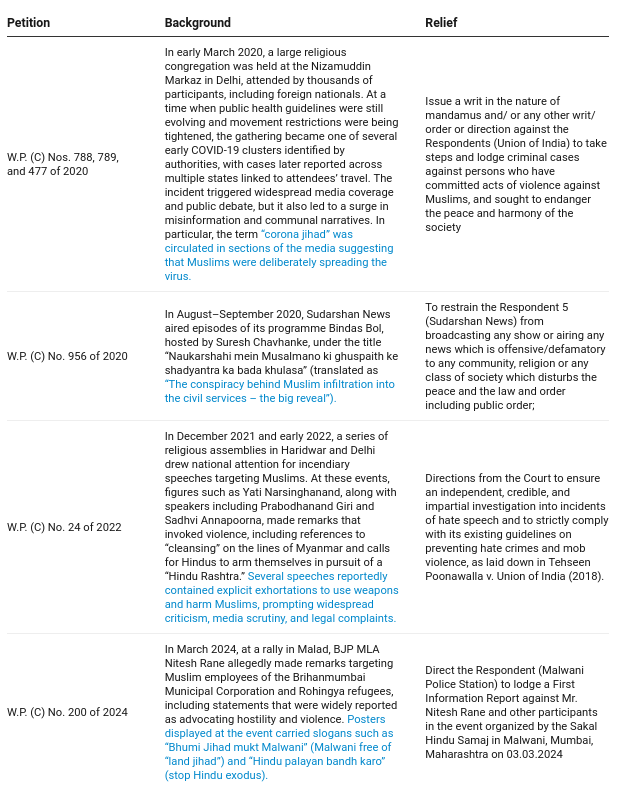
Disposing of the petitions, the Court noted that many of the specific prayers had become infructuous, having been tied to the communalisation of COVID-19 and went onto formulate four issues instead.
The Court framed the following questions for consideration: (i) whether it could create or expand criminal offences in the absence of legislative action; (ii) whether existing substantive criminal law adequately dealt with hate speech or the field was legislatively unoccupied; (iii) whether the existing procedural framework provided adequate and efficacious remedies, particularly in cases of non-registration of an FIR; and (iv) whether a continuing mandamus should be issued.
What did the Court hold?
On the demand for expanding criminal offences, the Court reaffirmed the doctrine of separation of powers. The creation of criminal offences, it held, lies squarely within the legislative domain. While courts may interpret existing law and frame interim guidelines where the law is genuinely silent, such measures are stop-gap arrangements and cannot harden into permanent substitutes for legislation. The judgment read::
30. …in the absence of constitutional silence or a legislative vacuum, the Judiciary cannot assume the role of the Legislature by determining what ought to constitute an offence or by prescribing the appropriate punishment for a particular criminal act. Where the Legislature has already enacted a law governing the field and has provided for the corresponding punishment, the Court cannot, in exercise of its jurisdiction, supplant the legislative scheme.
On the adequacy of criminal law, the Court rejected the argument that there is a ‘legislative vacuum’ regarding hate speech and found that the existing framework including Sections 153A, 153B, 295A, and 505 of the IPC (now corresponding to the Bharatiya Nyaya Sanhita, 2023) and the Representation of the People Act, 1951 already penalise acts that promote enmity, outrage religious feelings, or disturb public tranquillity. The Court concluded that the difficulty stems from selective, delayed, or inconsistent enforcement of these laws.
Regarding non-registration of FIRs, the Court ruled that the Bharatiya Nagarik Suraksha Sanhita, 2023 (‘BNSS’) already provides a layered and comprehensive mechanism for aggrieved persons including approaching the Superintendent of Police under Section 173(4), petitioning a Magistrate to direct investigation under Section 175, and filing a formal complaint under Section 223. The Magistrate’s supervisory jurisdiction, the Court emphasised, is of wide amplitude and acts as a vital safeguard against police inaction. It said:
62. In view of the layered statutory and constitutional remedies available within the existing legal framework, it cannot be contended that the law is either silent or deficient in addressing grievances arising from conduct that disturbs public order or fosters inter-group hostility….
Regarding issuance of continuous mandamus, the Court declined to assume an ongoing supervisory role and cautioned against judicial overreach. Mandamus, it held, cannot be issued on speculative fears of future inaction. Para 75 of the judgment read:
75. This Court [in Tehseen Poonawalla] cautioned that such an exercise would amount to “micro-management” of matters falling within the domain of the executive authorities and would be neither feasible nor consistent with the constitutional scheme. It was thus emphasised that mechanisms for enforcement must operate within the existing institutional framework rather than through continuous monitoring by this Court.
On the SLPs
The Court then turned to two Special Leave Petitions.
The first concerned alleged hate speech by Anurag Thakur in the context of the CAA. In 2020, a video surfaced showing Thakur raising the slogan “desh ke gaddaron ko,” to which a crowd responded with “goli maro sa*** ko” (“shoot the traitors”).
The appellants initially approached the Commissioner of Police, Delhi. Following inaction, they sent a representation to the Station House Officer, and subsequently filed an application under Section 156(3) of the Code of Criminal Procedure, 1973 (‘CrPC’) before the Additional Chief Metropolitan Magistrate. The investigating agency submitted a status report stating that no cognizable offence was made out. On August 26, 2020, the Trial Court dismissed the complaint, holding that prior sanction was required to prosecute public officials.
This finding was upheld by the Delhi High Court on June 13, 2022, which ruled that under Section 196 of the CrPC, a Magistrate could not direct registration of an FIR or investigation without prior sanction. The matter was then brought before the Supreme Court.
The Supreme Court partly allowed the appeal. It set aside the High Court’s reasoning, clarifying that the requirement of prior sanction applies only at the stage of taking cognisance of an offence, and not at the earlier stage of registration of an FIR or investigation. However, the Court ultimately declined to direct registration of an FIR, agreeing with the investigating agency that the speech in question did not disclose a cognizable offence.
The second SLP arose from a challenge to an order of the Telangana High Court, which had closed a petition concerning Islamophobic social media posts and hashtags such as #Islamiccoronavirusjihad that circulated during the COVID-19 pandemic. The petitioner had sought broad directions restraining social media platforms from hosting content that insulted or hurt the sentiments of a particular community. The High Court declined this relief, noting that:
2. The second relief prayed for by the petitioner is for issuing directions to the respondents No.1 and 2/Central Government to restrain all online social media networks operating in India and not to carry out any Islamophobic posts or messages hurting or insulting the feelings of a particular community. Having regard to the manner in which the second prayer is couched, this court being a State High Court cannot grant such a relief. It is for the petitioner to approach the Supreme Court for appropriate orders.
Dismissing the appeal, the Supreme Court held that the grievance had already been adequately addressed in the proceedings before the High Court. In light of its broader conclusions on judicial restraint and the adequacy of existing statutory remedies, it found no reason to undertake further adjudication.
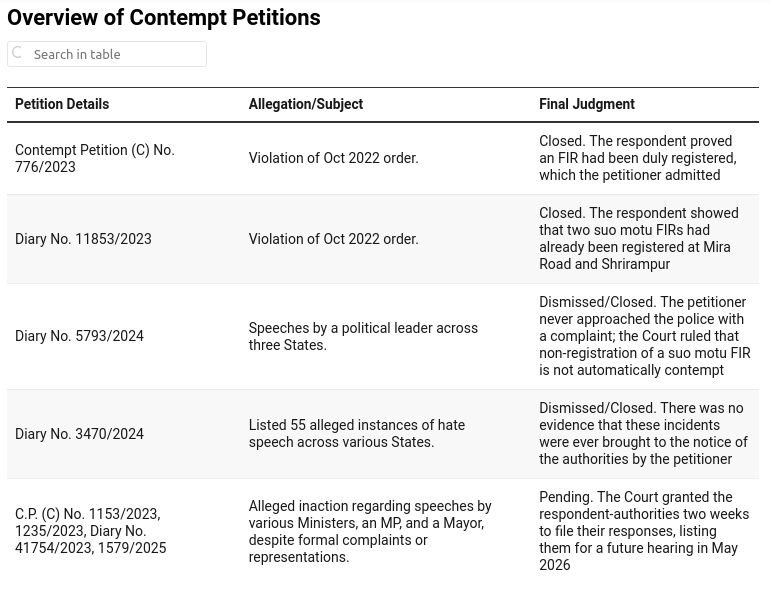
Contempt proceedings
In October 2022, the Court had directed the police in Delhi, Uttarakhand, and Uttar Pradesh to take suo motu action to register FIRs whenever a speech attracted offences under IPC Sections 153A, 153B, 295A, and 505, even if no formal complaint was made. In April 2023, these directions were extended to all State Governments across India.
In this context, several contempt petitions were filed alleging that authorities failed to register criminal cases against various political figures who made statements targeting religious communities
The Court closed several petitions where FIRs had in fact been registered. It also clarified that failure to register a suo motu FIR does not automatically amount to contempt. For contempt to be established, there must be clear evidence of wilful disobedience or deliberate inaction despite knowledge of a cognizable offence.
One petition, however, remains pending. It concerns the failure of the Directors General of Police of Tamil Nadu and Kerala to register FIRs over remarks attributed to figures including Udhayanidhi Stalin who have alleged to have called for the eradication of Sanatan Dharma.” Responses from the concerned authorities have been sought.
Rising Hate Speech and its constitutional implications
India Hate Lab (‘IHL’) documented 1,318 hate speech events targeting religious minorities, particularly Muslims and Christians, in 2025 across twenty-one states, one union territory, and the National Capital Territory (NCT) of Delhi. It found that on average, 4 hate speech events occurred per day marking a 13 per cent increase from 2024, and 97 per cent increase from 2023.
A total of 1,289 speeches, or 98 percent, targeted Muslims, either explicitly or alongside Christians. 88 percent of these hate-speeches occurred in states governed by the BJP, either directly or with coalition partners, as well as in BJP-administered Union Territories.
The judiciary has not been unaware of the problem. In Pravasi Bhalai Sangathan v. Union of India (2014), the Supreme Court acknowledged the legitimacy of judicial guidance in the absence of legislative action:
In case of vacuum of legal regime to deal with a particular situation the court may issue guidelines to provide absolution till such time as the legislature acts to perform its role by enacting proper legislation to cover the field. Thus, direction can be issued only in a situation where the will of the elected legislature has not yet been expressed.
Three years later, the 267th Law Commission Report (2017) gave the legislative gap a name and a remedy. It observed:
6.24 …What is at issue is the criminalisation of hate speech and how the existing laws look at it. Since it is entrenched in the constitutional right of freedom of speech and expression, “hate speech” has been manipulated by many in different ways to achieve their ulterior motive under the garb of such right and the law courts in absence of clear provisions in IPC, are not able to prosecute hate speech charges brought before them with success.
The Report recommended inserting two new provisions into the IPC:
s. 153C (Prohibiting incitement to hatred) and s. 505A (Causing fear, alarm, or provocation of violence). It also summarised certain parameters for identifying hate speech: to include (i) incitement threshold; (ii) extremity; (iii) status of author and victim; and (iv) context and potentiality.
India has since overhauled its criminal law framework entirely, replacing the IPC with the BNS, yet, neither the recommended sections nor any equivalent provision found its way into the new legislation. Meanwhile, the use of communal and caste rhetoric by politicians, including senior leaders and the head of government, has only intensified.
The question, then, is pointed: Is it acceptable for Courts to wait for executive action that has been overdue for at least nine years?
In Vishaka v. State of Rajasthan (1997), the Court held that where domestic law is silent, they may draw upon international conventions, provided these do not conflict with fundamental rights under Part III of the Constitution. India has ratified both the International Covenant on Civil and Political Rights and International Convention on the Elimination of All Forms of Racial Discrimination, which expressly require state parties to prohibit by law any advocacy of national, racial, or religious hatred that constitutes incitement to discrimination, hostility, or violence. These treaty obligations would seem to provide a clear basis for judicial direction.
The Court, however, has rejected this line of reasoning. In paragraph 38 of its judgment, it held:
38. The mere occurrence of incidents of hate speech cannot lead to the conclusion that the law is silent on the subject. More often than not, the difficulty lies in the effective enforcement and application of the existing statutory framework. At best, such instances may reveal deficiencies in implementation in particular cases. That, however, cannot furnish a ground for the Court to assume the legislative function or to supplant the statutory scheme enacted by the Legislature.
Arguably, that is treating the existence of law as equivalent to its adequacy. The Law Commission said as much in 2017. The data from IHL suggests the situation has only worsened since.
If the legislature will not act, and the executive does not enforce, the burden on the judiciary will plausibly only become heavier.
[Tanishka Shah is a writer for The Leaflet, where she has recently written explanatory pieces on Indian governance, constitutional law and electoral reform. Courtesy: The Leaflet, an independent platform for cutting-edge, progressive, legal & political opinion, founded by Indira Jaising and Anand Grover.]