❈ ❈ ❈
A New Silence: SC’s Turn Toward Non-Interference in Hate Speech Cases
Sabrang India
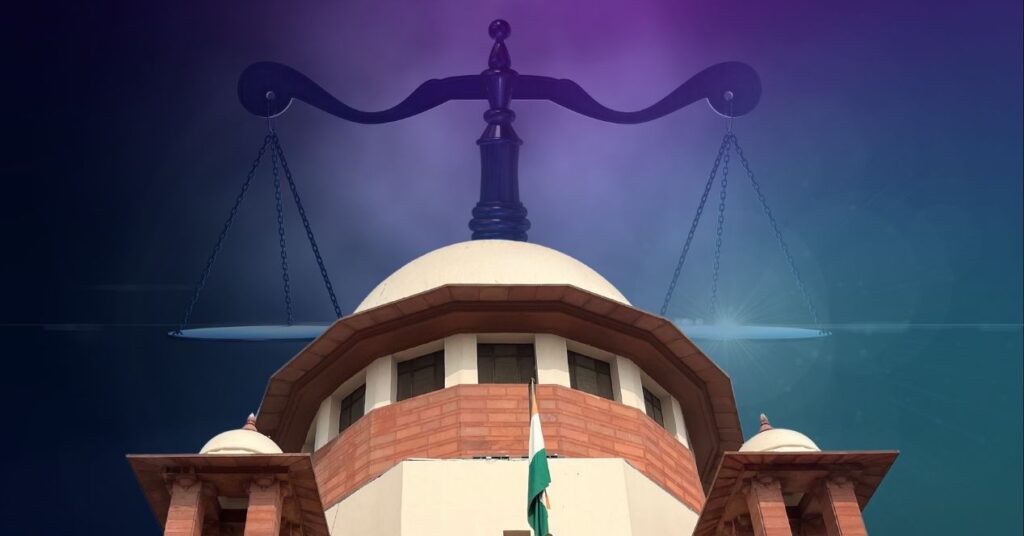
On November 25, the Supreme Court made it clear that it would not convert itself into a “national monitoring authority” for every incident of hate speech occurring across the country. A Bench of Justices Vikram Nath and Sandeep Mehta, hearing an application alleging calls for the social and economic boycott of a particular community, underscored that the Court’s role could not expand into legislative or policing domains simply because a petitioner sought blanket supervision.
According to The Hindu, the bench remarked “We are not legislating in the garb of this petition. Rest assured, we are not inclined to either legislate or monitor every small incident which takes place in X, Y, Z pocket of this country”. Stressing the constitutional architecture already in place, the judges noted, “There are high courts, there are police stations, there are legislative measures. They are already in place.”
The Supreme Court’s latest remarks—disclaiming responsibility for monitoring hate-speech incidents and directing petitioners to High Courts and police stations—represent an increasingly pronounced judicial retreat at a time when hate speech has become pervasive, organised, and often politically sanctioned. Coming from a Bench of Justices Vikram Nath and Sandeep Mehta, the Court’s insistence that it “cannot legislate or monitor every small incident” may appear administratively pragmatic, but constitutionally, it raises serious concerns.
‘Approach the High Court; We cannot monitor the entire country’
The Bench initially directed the applicant to raise the grievance before the concerned High Court. “How can this court continue to monitor all such instances all over the country?” it asked, according to The Print. “You approach the authorities. Let them take action, otherwise go to the high court.”
Counsel for the applicant, Advocate Nizam Pasha, submitted that he had filed an application in an already pending writ petition on hate speech, bringing forth “additional instances” of boycott calls. When the Bench observed that the calls appeared to be made by private individuals, counsel responded that “some public representatives are also issuing similar calls.”
Solicitor General Tushar Mehta interjected sharply: “Public interest cannot be selective to one particular religion… There are severe hate speeches going on amongst all religions. I will supply those details to my friend (applicant). Let him add that and espouse that public cause on a pan-religion basis.”
The applicant’s counsel insisted that he approached the Court only because the authorities “are not taking any action,” and invoked earlier directions of the Court where State inaction on hate speech was to trigger suo motu registration of FIRs and potential contempt for non-compliance.
Mehta maintained that while “no one can be indulging in hate speech,” a public-spirited litigant “cannot be selective.” The Bench reiterated that statutory mechanisms existed: “Whichever state you have a problem with, you approach the jurisdictional high court for appropriate relief.”
Advocate Nizam Pasha, appearing for journalist Qurban Ali and others, reminded the Court of its October 2022 order. In October 2022, disturbed by the “unabated ferocity” of hate crimes and warning that a “climate of hate prevails in the country,” the Court had directed police authorities to suo motu register cases against hate-speech offenders. However, these remarks suggest a recalibration: the Supreme Court asserting that enforcement must be handled at the proper institutional levels, not continuously escalated to the apex court.
In addition to this, Pasha also referred to an affidavit flagging a post shared by an Assam minister following the BJP’s victory in Bihar, claiming it referenced the 1989 Bhagalpur massacre by alluding to “Bihar approving gobi farming”—an alleged nod to victims whose bodies were buried in cauliflower fields.
The Bench listed the matter for further hearing on December 9, 2025.
A Court that once called arresting hate crimes a “sacrosanct duty” now says: go elsewhere
These oral observations represent a notable moment nearly seven years after the Court’s landmark Tehseen Poonawala (2018) judgment, where it held that preventing hate crimes is the State’s “sacrosanct duty.” The Court had then laid down extensive guidelines to prevent mob violence and lynching.
In Tehseen Poonawala (2018), the Supreme Court emphatically held that preventing hate crimes is the State’s “sacrosanct duty” and placed considerable constitutional responsibility on the judiciary to ensure compliance.
When the Bench says: “We are not inclined to either legislate or monitor every small incident”, the question naturally arises: What counts as “small” in hate speech? Hate speech is not an isolated “X, Y, Z pocket” problem; it is a structural, national, and increasingly legitimised phenomenon that fuels violence, radicalises communities, and undermines constitutional fraternity. Treating each incident as merely local—best handled at the nearest police station—ignores the systemic, not episodic, nature of the problem.
Additionally, the petitioner’s counsel explicitly reminded the Court of its own earlier directions: If States fail to act on hate speech, police must register FIRs suo motu; if police fail, contempt proceedings follow. By refusing to even monitor compliance with its own framework, the Court creates a paradox:
- Duty to act remains,
- but enforcement evaporates.
This turns constitutionally mandated preventive oversight into judicial suggestion, not judicial command.
In regards to Solicitor General’s assertion that public interest cannot be selective and that all religions face hate speech is a familiar rhetorical manoeuvre that:
- Equates majority-to-minority hate speech with minority-to-majority rhetoric, flattening unequal power structures;
- Deflects from documented, systemic hate speech targeting Muslims, including political campaigns;
- Reframes structural discrimination as generic social disharmony.
The Court’s willingness to echo the “pan-religion basis” line dilutes the urgency of addressing majoritarian hate speech, a constitutional and empirical reality widely acknowledged by previous benches.
Chhattisgarh High Court: Reinforcing judicial distance from enforcement
The Chhattisgarh High Court’s decision on November 21 in a separate hate-speech matter further illustrates the judiciary’s growing reluctance to scrutinise investigative lapses in such cases. A Division Bench of Chief Justice Ramesh Sinha and Justice Bibhu Datta Guru dismissed a plea seeking coercive action against Johar Chhattisgarh Party leader Amit Baghel, accused of repeated inflammatory statements against Agrawal, Sindhi, and Jain communities
The Division Bench held firmly that the petitioner had failed to substantiate allegations of State inaction, emphasising that mere accusations of “State apathy” could not justify extraordinary judicial intervention.
The Court observed:
- “The Petitioner has not brought forth any cogent material to demonstrate that the investigating agency has either shut the investigation or refused to act on the FIRs.”
- “Mere dissatisfaction with the pace or nature of investigation cannot, in law, furnish a ground for invoking the extraordinary jurisdiction of this Court under Section 528 of the Bhartiya Nagarik Suraksha Sanhita, 2023 or Article 226 of the Constitution.”
The Bench cautioned that the reliefs sought—direction for arrest, supervision by a specific-rank officer, periodic status reports, consolidated chargesheet—would amount to “judicial micromanagement” of investigation and intrude into the statutory domain of the police.
The Court reiterated established law: a writ of mandamus cannot compel arrest, dictate the course of investigation, or require a consolidated chargesheet when the statute does not mandate one. “The Petitioner has not shown any exceptional circumstance to indicate non-compliance with these guidelines, nor is there any imminent threat to public order warranting extraordinary measures,” the Court added in its order.
Finding no exceptional urgency or imminent threat to public order, the petition was dismissed.
The Chhattisgarh High Court’s dismissal of the plea against Amit Baghel fits seamlessly into this larger pattern of institutional distancing. By insisting that:
- dissatisfaction with investigation pace is not enough,
- courts cannot “micromanage,”
- no “exceptional circumstances” exist,
the High Court reinforces a trend where judicial review of State inaction on hate speech is increasingly restricted, even as hate speech intensifies.
The constitutional misdiagnosis at the heart of India’s hate-speech crisis
The core difficulty lies in the Court’s very conceptualisation of hate speech: by repeatedly characterising it as a routine “law-and-order” matter to be handled by local police or challenged before jurisdictional High Courts, the Supreme Court collapses a profound constitutional crisis into an administrative problem. This framing disregards the Court’s own jurisprudence recognising hate speech as a threat to equality, an assault on dignity, a catalyst for mob violence, a barrier to democratic participation, and a weapon disproportionately used against minorities and dissenters—phenomena that cannot be meaningfully addressed through ordinary policing. Far from being “pocket-level incidents,” contemporary hate speech is intimately connected to electoral mobilisation, vigilante networks, and entrenched patterns of institutional discrimination, placing it well beyond the capacity or neutrality of local law-and-order mechanisms. The Court’s withdrawal from scrutiny therefore carries structural consequences: it signals to State authorities that inaction will not attract judicial oversight; it chills public-spirited litigation by suggesting that constitutionally significant harms are too “small” or “local” for the Supreme Court’s attention; and it sits uneasily with the Court’s own earlier precedents mandating suo motu FIRs and warning States of contempt, thereby diminishing both doctrinal coherence and the credibility of constitutional adjudication. In effect, reducing hate speech to a routine policing matter does not merely minimise its gravity—it risks normalising it.
Conclusion: A constitutional moment demanding vigilance, not withdrawal
India is living through a documented and politically charged escalation in hate speech, and at such a moment the Supreme Court’s assertion that it cannot monitor “every small incident” risks being interpreted not as judicial restraint but as a signal that State authorities may do less, not more. No constitutional court is expected to police every episode—but it is expected to ensure that State machinery functions, that fundamental rights are meaningfully protected, and that its own earlier mandates are not rendered hollow through non-enforcement. By appearing to withdraw just when constitutional vigilance is most necessary, the Court creates a troubling gap between constitutional promises and institutional practice. At a time when hate speech carries structural, electoral, and communal consequences, this is not a moment for judicial distance but for principled constitutional engagement; stepping back now risks weakening precisely the safeguards the Constitution relies on courts to uphold.
[Courtesy: Sabrang India, an online portal dedicated to fighting the cancer of divisive politics. It is edited by Teesta Setalvad and Javed Anand.]
❈ ❈ ❈
Former Judges and Advocates Urge CJI to Uphold Rohingya Rights
Countercurrents Collective
[An open letter, addressed to the Chief Justice of India (CJI) written by former judges, senior advocates, and members of the Campaign for Judicial Accountability and Reforms (CJAR) conveys their deep concern over remarks made by a Supreme Court bench on December 2, during a hearing on the alleged custodial disappearance of Rohingya refugees in India. The letter says that the statements made by the bench—such as equating Rohingya refugees with illegal intruders, comparing them to people who dig tunnels to enter India, questioning their entitlement to basic needs like food, shelter, and education, and referencing domestic poverty as a justification for denying fundamental rights—reflect a troubling departure from constitutional values. They emphasize that such remarks are dehumanising and undermine the equal human dignity of Rohingyas, who are protected by Indian constitutional law and international law.
The letter contextualises the plight of the Rohingya people, describing them as one of the most persecuted minorities in the world, stateless and subjected to decades of violence in Myanmar, including what international bodies have termed ethnic cleansing and genocide. Like other persecuted communities historically welcomed by India, Rohingya refugees come seeking safety and basic protection.
The authors highlight that the CJI, as head of the judiciary, holds moral and institutional authority extending beyond the courtroom. Judicial remarks influence not only the subordinate judiciary but also state authorities and public perception. When vulnerable groups are characterised as “intruders,” the letter argues, it erodes the judiciary’s role as the protector of the marginalized and undermines public trust in the courts.
The signatories reaffirm that Article 21 of the Constitution—protecting life and personal liberty—applies to all persons residing in India, not just citizens. They cite the Supreme Court’s own jurisprudence, including NHRC v State of Arunachal Pradesh (1996), where the Court held that the State is obligated to protect the life and liberty of every human being. They also note that customary international law, particularly the principle of non-refoulement (prohibiting the return of refugees to a place of persecution), is recognized as part of Article 21 rights.
The letter outlines India’s longstanding humanitarian tradition of sheltering refugees—from Tibetans and Sri Lankan Tamils to millions fleeing East Pakistan before the creation of Bangladesh. India has standard operating procedures for refugee status determination, demonstrating alignment between international norms and domestic practice. Even recent legislation such as the Citizenship Amendment Act acknowledges persecution as a legitimate basis for protection, though controversially limited to non-Muslim groups.
The authors argue that dismissive or hostile judicial rhetoric threatens constitutional morality, compassion, and the protection of human dignity. Such remarks may create reasonable apprehension of bias and could impact ongoing and future cases concerning Rohingya rights. The letter urges the CJI to publicly reaffirm the judiciary’s commitment to constitutional values, human dignity, and justice for all persons regardless of origin. The signatories conclude that the true majesty of the Supreme Court lies not merely in its verdicts but in the humanity and moral clarity with which justice is administered.]
5th December 2025
Open Letter to the Hon’ble Chief Justice of India
Dear Hon’ble Chief Justice,
We, the undersigned former Judges, current advocates and the Campaign for Judicial Accountability and Reforms (CJAR), are writing with due respect to the Hon’ble Court, to convey our deep concern at certain unconscionable remarks made about Rohingya refugees on the 2nd of December 2025, by the bench of the Hon’ble Supreme Court that was hearing a plea alleging custodial disappearance of Rohingya refugees in India. The petition has been filed by Dr. Rita Manchanda who is a renowned writer, scholar and human rights activist specialising in conflict resolution and peacebuilding in South Asia with particular attention to vulnerable and marginalised groups, including forcibly displaced persons. For reasons given below, the remarks from the bench are contrary to core constitutional values. They have had the effect of dehumanizing Rohingya refugees whose equal humanity and equal human rights are protected by the Constitution, our laws and by international law.
As citizens committed to equity, human dignity and the moral foundations of justice, we are deeply troubled by the remarks made in the recent hearing, particularly the reported statements questioning the legal status of the Rohingya as refugees, equating them with intruders illegally entering India, the references to persons who dig tunnels to enter illegally, the questioning whether such entrants are entitled to food, shelter and education, the invocation of domestic poverty as a reason to deny basic constitutionally guaranteed entitlements to refugees and the suggestion that they be spared third degree measures, in their treatment in India!
We would like to bring to your notice that the United Nations has described the Rohingya as “the most persecuted minority in the world”. They are an ethnic minority in Buddhist majority Myanmar who have endured decades of violence and discrimination. Denied citizenship, the Rohingya are stateless. They have fled to neighbouring countries in waves over the past many years, escaping what has been described by the International Court of Justice as ethnic cleansing and genocide at the hands of the armed forces. They are fleeing to India, like centuries of refugees before them, seeking basic safety.
As the head of the judiciary, the Chief Justice is not just a legal functionary — but is also the custodian and final arbiter of the rights of the poor, the dispossessed, and the marginalised. Your words carry weight not simply in the courtroom but in the conscience of the nation and have a cascading effect on the High Courts, the lower judiciary and other government authorities. A remark that equates vulnerable persons (who in the case of the Rohingya include thousands of women and children) seeking shelter with “intruders” who “dig tunnels”, further dehumanises those fleeing genocidal persecution and weakens the moral authority of the judiciary. Further, invoking the plight of the poor in India to justify denying protections to refugees sets a dangerous precedent, being contrary to the principles of constitutional justice. The Rohingya, as indeed any person residing in India, is entitled to the protections of Article 21 and not just protections from “third degree measures”. This fundamental right is available to an individual who is a citizen or any other person residing in India. In NHRC v State of Arunachal Pradesh, 1996 SCC (1) 742, this Hon’ble Court has held that, “the State is bound to protect the life and liberty of every human being, be he a citizen or otherwise”.
In this context, it is pertinent to point out briefly:
- The Rohingya have a qualitatively different status of being refugees, as compared to illegal immigrants. Refugee status determination is declaratory in nature: a person does not become a refugee because of recognition, but is recognised because he or she is a refugee. It follows from this and from the obligation of non refoulment (which is a non derogable norm of customary international law) that a refugee has a right to be formally and individually determined as a refugee in order to formalise her status. Any refoulment, imprisonment or detention without having individually and formally determined their claim as a refugee, is therefore illegal. It is gutting the right to non-refoulment which the Courts have held to be a part of Article 21.
- India has a Standard Operating Procedure for Foreign Nationals Claiming to be Refugees (2011 and updated in 2019). It defines refugee as a person who has “… grounds of a well founded fear of persecution on account of race, religion, sex, nationality, ethnic identity, membership of a particular social group or political opinion…”. This shows that there is no conflict between customary international law and established municipal practice.
- India has always recognised refugees as having a qualitatively different status from migrants. India has a strong track record of hosting refugees of different profiles and has the experience in extending humanitarian protection while balancing national security interests and the concerns of its citizens. The government has issued special documentation to Tibetans and Sri Lankans, recognizing their status as refugees, and allowing them to access basic socio-economic rights. In the period just prior to the formation of Bangladesh in 1970-71, India allowed millions of refugees fleeing persecution from the authorities in erstwhile East Pakistan and the then Government people of India willingly contributed to ensure not only their safety but also for their health and other needs, till such time as they were resident within our borders. The Citizenship Amendment Act, in fact grants exemption from the provisions of the Foreigners Act to religious minorities (other than Muslims), fleeing persecution, from Bangladesh, Pakistan or Afghanistan. Numerous writ petitions questioning the discriminatory nature of the legislation are pending before the Court.
Judicial authority is built on the principles of constitutional morality, compassion and protection of human dignity. When those who flee violence and persecution are dismissed with rhetoric that is hostile to their very dignity, it threatens the foundational values of our Constitution and undermines public faith in the courts as a refuge for the vulnerable. Such remarks provide a reasonable basis for apprehension of prejudice on the part of the bench against the rights of the Rohingya refugees and for concern that they will adversely affect public trust and confidence in the judiciary when it comes to protecting the rights of the most vulnerable amongst us. We therefore call upon you to reaffirm, in public statements, remarks in court and judicial verdicts, a commitment to constitutional morality based on human dignity and justice for all, regardless of origin. The majesty of the Supreme Court and your office is measured not merely by the number of verdicts or administrative measures but more by the humanity with which those verdicts are delivered and considered.
Regards,
- Justice AP Shah, former Chief Justice, Delhi High Court
- Justice K. Chandru, Former Judge, Madras High Court
- Justice Anjana Prakash, Former judge, Patna High Court
- Prof. Mohan Gopal, Former Director, National Judicial Academy
- Dr. Rajeev Dhavan, Senior Advocate, Supreme Court
- Mr. Chander Uday Singh, Senior Advocate, Supreme Court
- Mr. Colin Gonzalves, Senior Advocate, Supreme Court
- Ms. Kamini Jaiswal, Advocate, Supreme Court
- Mr. Mihir Desai, Senior Advocate, Bombay High Court
- Mr. Gopal Shankar Narayan, Senior Advocate, Supreme Court
- Mr. Gautam Bhatia, Advocate, High Court & Supreme Court
- Ms. Shahrukh Alam, Advocate, High Court & Supreme Court
- Working Group, CJAR: Prashant Bhushan (Advocate, Supreme Court), Nikhil Dey (RTI Activist & Co-Founder Majdoor Kisan Shakti Sangathan), and many others
[Courtesy: Countercurrents.org, an India-based news, views and analysis website, that describes itself as non-partisan and taking “the Side of the People!” It is edited by Binu Mathew.]