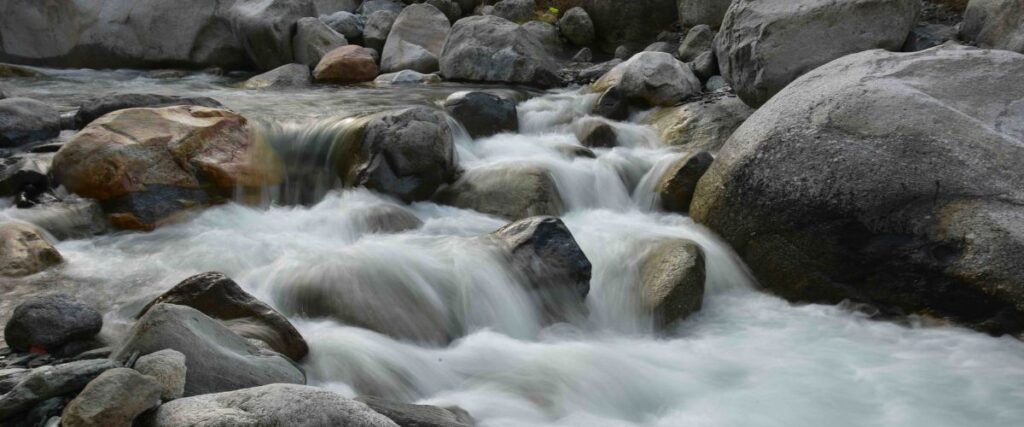
[Recently, I was a lucky observer of what was surely the first ever gathering of this kind, at least in living memory. South Asia’s rivers came together to discuss the various issues they are facing, and work out strategies to deal with them. Each was represented by a tightly bound set of water drops that travelled to the meeting place courtesy some obliging clouds. The confluence was hosted by the Narmada in central India, a respected elder, being kind of equidistant for rivers across the region.
To understand the conversation, I took a course on understanding liquid language. Admittedly, the various accents that rivers spoke in were difficult to follow (even for each other!), but I had the kind help of some human community members from various regions, who were steeped in ancient traditions of speaking with rivers.
The confluence began with a moving ceremony where each of the rivers deposited one of their drops into a common pool, pledging to leave behind any differences or angsts they may have had against each other (on the sidelines, I learnt about some of these problems, such as tributaries upset about the loss of their identity when merging into a mainstream, or the latter feeling that sometimes the former flowed into them with too much force, or those from the southern part of the subcontinent who are resentful of the greater attention that northern rivers get). They also pledged to work together for a strong, collective representation of their agency.
Here is what I hope is a more or less accurate representation of the conversation.]
● ● ●
Narmada: Welcome, brothers and sisters. I greet you on behalf of all the elements of this ancient landscape. May our sacred confluence today result in the common good of all, not just of us rivers but of all the lands, oceans and their beings. May I remind you that the purpose of our gathering here is to share the issues that each of us faces, especially the ways that humans are treating us, and to find ways of resolving them. Since this is a common purpose, my request is that we leave behind the complaints and angsts we may have against each other, and focus on what we can achieve as a united front as we have just pledged in the opening ceremony. This does not, of course, mean that we submerge our individual identities—we are, after all, if I may be allowed a pun, plu-river-sal—ha ha! But there are things that bind us together, including the ways in which we nurture the lands we flow through and the seas or lakes that receive us.
At this point, there was an astonishing medley of roaring, gushing, and gurgling as all the drop-sets expressed their appreciation.
Narmada: Thank you, thank you. May the blessings of all life be bestowed on all of us. Now, I call upon our beloved sister Ganga to open the discussion.
Kaveri (before Ganga could speak): Respected Narmada, I appreciate your call to leave behind our complaints, but surely you need to be sensitive to our long-standing angst of northern rivers getting more attention than us? Sometimes, we should get to speak first!
Narmada: My apologies, beloved Kaveri. I am sure Ganga will not mind—please speak, and if other southern rivers want to speak, please do so. Then I will revert to Ganga.
Kaveri: Thank you. As you all know (or should!), humans have been fighting over my waters for decades—they don’t seem to know how to share their blessings. Worse, they are oblivious to my plight—dammed, polluted, and traumatized by how my own children are treating me. They even formed a Tribunal to sort out their conflict. But would you believe it, they did not invite me to their deliberations! All I can do is pray for some enlightenment to come to them.
A roaring sound from above startles all the participants. Looking up, they see a cluster of drops bearing down on them—it is Indus, arriving late!
Indus: Greetings, dear sisters and brothers! Sorry I’m late, but it took some time to gather my drops from different parts of me, especially across these stupid human borders of India and Pakistan. Julley and adab to everyone! You know, for many moons these human nations had come to some sort of agreement on sharing my (and my tributaries’) waters. But now they are fighting again, with India threatening to block me before I flow into Pakistan—as if it can! But you know…
Krishna (interrupting): Hey big fellow, Ma Narmada gave us southern rivers first voice, let us finish first!
Indus: Oh, a thousand apologies! I’ll finish my point later.
Krishna: You all think you have problems? There are over a dozen dams on me and my tributary sisters, hardly any of my water is able to flow into the sea—which, by the way, has been complaining; maybe next time we should invite her too—and the amount of pollution that chokes me has to be seen to be believed. I’m told that these humans living along my shores consider me sacred—but their behaviour towards me is anything but reverential!
Ganga: Firstly, my apologies to my southern sisters and brothers—the attention given to me by humans is not of my doing. Like you, dear Krishna, they say I am sacred. Initially I was quite pleased with how they fawned over me, prayed to me, and wrote tomes of paeans praising me. But soon it got tiring, and now I want to be left alone. Instead, they have dammed and diverted me and those of you, like Yamuna, who pay tribute to me by merging your Himalayan waters into me. And the pollution—I hear you, Krishna. I have no words to describe its horrific effects. To top it all, very recently they congregated in enormous numbers for something called Mahakumbh, and, to cleanse themselves of all their sins, they sullied and poisoned me to levels I’ve never experienced before. Humans have a very strange way of appeasing those they consider to be sacred! I am hardly a river any more, and I’m ashamed that I’m struggling to nurture the lands I used to. The dolphins that have played in my waters forever are also facing a threat to their existence.
Brahmaputra: Friends, please also consider my plight. The nation which calls itself China is going to build a huge project to produce what they call hydroelectricity on the Yarlong Tsangpo, before she becomes the Siang, and who contributes her waters to me. I heard Yarlong Tsangpo was not able to come here, did China block her travel? Now, if you ask the Siang…
Siang (interrupting Brahmaputra): Hey, big brother, I’m here, I can speak for myself!
Brahmaputra: Oh, sorry, I did not see you there, hidden by our big brothers and sisters! Ok, friends, Siang will tell her own story, but let me finish mine… If China goes ahead with these plans, my health will be seriously compromised. Maybe much less water and silt will flow through my course. And all the beings that are dependent on my uninterrupted waters will also be affected.
Mahakali/Sarada: Dear Brahmaputra, this is the result of these humans dividing us across what they call countries—look how they made me a border between what they call Nepal and India, and are now fighting over my waters!
I overhear two rivers I’m sitting close to muttering to each other: “why does this one have two names, is schizophrenic or what?” “shhh, you ignoramus… She has one name in Nepal, and another in India… so does Indus, did you not know he is Singhe Khababs, Sindhu, and Indus in different stretches?”
Teesta: Listen, guys and gals, we just have to take more militant action. See how I demolished one of the dams that they dared build on my course (with a bit of help from a glacier)? You all have to muster up the strength and courage to do that. I know that lives will be lost in the process, but think of all the lives that will be freed!
Indus: I think that’s a good idea. I’ve tolerated one dam they’ve already made, I won’t stand any more. Let them try!
Kosi: He he! You know those stupid humans keep trying to constrict my flow by constructing embankments, but I regularly break them. Why shouldn’t I continue being playful (they call me erratic!), flowing any way I want to?
Sabarmati: I’m not sure I approve of such violent tactics. You know, I always believed in peaceful co-existence with all creatures living in and along me. The human called Gandhi, who set up his home on my banks, also spread a message of non-violence–every day he would meditate and pray on my banks, and we would both find peace. How can I dishonour that, knowing that it’s possible for other humans to be like him?
Siang: But look what they did to you! With most of your water coming from Mother Narmada, you are not even Sabarmati any more! And I’m told that they have even bound you in cement-concrete in something they fancifully call Riverfront Development?
Sabarmati: Yes, you are right. First, they destroyed the Aravalli hills where the rain falls and percolates through to my course. Then, they erased my identity by flooding me with Ma Narmada’s water—with due apologies to you, Ma. And then they bound me between two walls and I have not yet found the strength to break them, unlike Kosi.
Narmada: Don’t apologise, dear Sabarmati—I can feel your pain. But it was no less painful for me. To get water to you, they shackled me in a huge dam and forced so many of my faithful human custodians to move away because their lands and houses were drowned. It pained me that my waters caused so much suffering.
Indravati: Brothers and sisters, I think we also need to call upon the sensitive sections of human beings to help us. I recall many moons back, when those living along my shores gathered to form a human chain garlanding me, declaring that I am their mother, and protesting proposals for two mega-dams. They were successful. Otherwise I would have been blocked and broken, as has happened to so many of you. Some rain clouds passing my way told me that the same thing happened to our sisters Koel and Karo. I know that many humans tried to stop the dam in your case also, dear Narmada. They did not succeed but their struggle inspired many other humans to take up our cause and many rivers to continue to dream of freedom.
Rathong Chu: Yes, something similar happened with me: some human communities who consider me sacred stopped other humans from building a dam. But now, they are finding it hard to sustain their resistance.
Ken: Hey listen, I have heard some humans talking about linking all of us into a huge garland—do you think this would be a good way to unite?
Godavari: No no, not at all, dear Ken! This so-called River Inter-linking project will mean many more dams blocking our flows, erasing our unique identities, mixing up our stories, and hindering our union with the seas. This is a disastrous idea!
Ken & Betwa (together): Yes!
Betwa (continuing): They are actually connecting us even as we speak!
Ken (picking up the cue): And we’re not sure that’s what we want. Don’t get us wrong, we love each other, but the way they are doing it, through huge construction, creating debris and dust, and without ever having asked us… we fear the worst.
Ganga: There is another strategy that may work, if we can get our human friends to pay attention to it. A while ago a wise man in one of those human courts of law declared that sister Yamuna and I had rights as a river—the same rights that a human being has. In fact, I heard from our brothers and sisters in many parts of the planet—places they call New Zealand, Colombia, Canada, and even our neighbours in Bangladesh—that their rights have been recognised too. So far, Yamuna and I have not seen any difference in how humans are behaving towards us. I think that man’s declaration has been forgotten, and anyway he did not really elaborate on what he meant by our rights. But it looks like in some other areas the declaration has helped to stop destructive actions by humans. We should work more on this!
The Yamuna drop-sets bob up and down in unison, signalling their assent.
Turag: Yes friends, my rights were also recognised by a human court in Bangladesh, and then all my sisters’ and brothers’ rights were too! We are also not yet sure what that means, or how this will stop human’s dams and pollution from destroying us. But we are hopeful.
Narmada: How strange it is that we have to urge humans to recognize our rights, when it is us who gave birth to them! But yes, let us do what we can, uniting in this manner, and using all the strategies we can think of. I’m not so sure about sister Teesta’s dam-breaking tactic, since some of us object to such violence, but I leave it to each one’s wisdom to decide what is the most effective move which will cause the least damage to any life form. I’m told that even Gandhi, who our dear sister Sabarmati spoke about, was accepting of violence as self-defense rather than cowardly retreat. So let us all do what we can to—excuse another pun—riverse the curse that some humans have put on us! We will convene again, wherever one of our brothers or sisters hosts us. Next time, we will also call the seas and oceans we nurture and who in turn replenish us, and the clouds—the sky rivers that are our messengers. Perhaps we can even work towards all the planet’s rivers coming together in a global confluence. Meanwhile, here’s to our freedom!
The gathered river drop-sets all dance about, gush, roar, gurgle, and make myriad other moves and sounds I can’t even describe… Then, they slowly disperse, heading off in various directions. I’m left dazed and speechless. And, more than ever, determined to do what I can, recognizing that in their freedom lies ours too.
[Ashish Kothari is a founder and ex-member of Kalpavriksh, and has been involved in many people’s movements. He has taught at Indian Institute of Public Administration, coordinated India’s National Biodiversity Strategy and Action Plan, served on boards of Greenpeace International and India, and the ICCA Consortium, and been a judge on the International Tribunal on Rights of Nature. He is the co-founder of Vikalp Sangam, Global Tapestry of Alternatives, and Radical Ecological Democracy. He is the co-author or co-editor of Churning the Earth, Alternative Futures, and Pluriverse: A Post-Development Dictionary.]