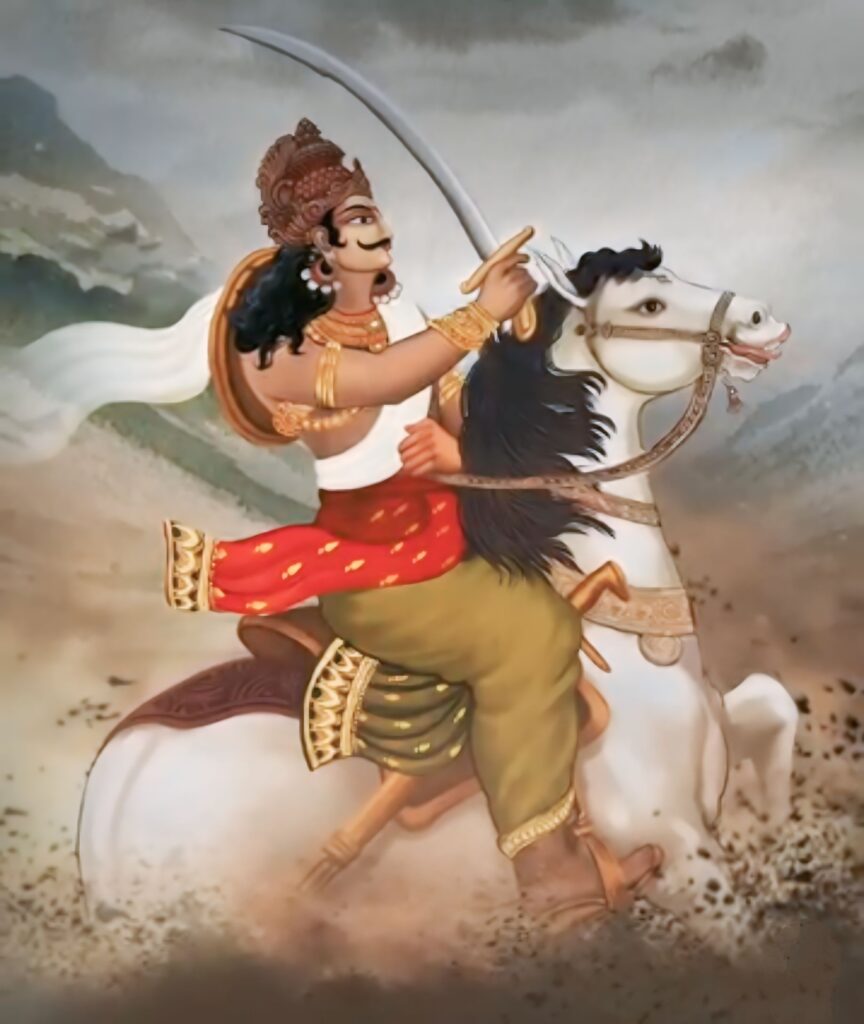
The Opening: A Twitter War in Search of a King
In August 2023, a Twitter exchange crystallized the polarized reception of Pushyamitra Shunga. One account, with a substantial following, posted: “Pushyamitra Shunga, the Hindu king who protected India from Buddhist traitors and Greek invaders. Salute.” A reply from an Ambedkarite account, with a comparable following, countered: “Pushyamitra Shunga, a Brahmin genocidaire who massacred 5 million Buddhists. Never forget.”[1]
Neither post cited a source. Neither acknowledged uncertainty. The exchange was not a debate but a duel, two certainties colliding, each amplified by its own echo chamber.
This was not an isolated incident. A routine search for “Pushyamitra Shunga” on any social media platform produces the same spectacle: Hindutva accounts hailing him as a defender of dharma, Ambedkarite and Buddhist revivalist accounts denouncing him as a Brahmin counter-revolutionary. The claims are categorical, the tone moralized, the stakes absolute. Between them lies not dialogue but denunciation, amplified by thousands of shares, likes, and reiterations.
What is striking is not merely the intensity of these exchanges but their epistemic confidence. Both sides speak with certainty about a figure who lived over two millennia ago, in a period for which the evidentiary record is fragmentary, uneven, and often indirect. Assertions of heroism and persecution circulate with equal ease, each presented as historical fact rather than interpretive claim. The debate appears settled, twice over, in mutually incompatible directions.
Who, then, is Pushyamitra Shunga? Why does his name provoke such disproportionate political investment? And how has a relatively obscure figure from the second century BCE become a recurring site of ideological contestation in twenty-first-century India?
This essay advances three arguments:
First, it undertakes a critical re-evaluation of the sources that mention Pushyamitra Shunga and demonstrates that the evidentiary foundation for both celebratory and condemnatory narratives is remarkably fragile. The sources describing persecution are late Buddhist moral tales, uncorroborated by archaeology or contemporary texts.
Second, it contends that even if the most extreme claims about persecution were historically demonstrable, their centrality to contemporary anti-caste politics would remain analytically misplaced. Caste is a structure, not a royal whim. No single king, benevolent or malevolent, has ever dismantled it. Fighting over Pushyamitra is a form of symbolic displacement, a retreat from material struggle into symbolic contestation.
Third, it proposes that the persistent fixation on premodern kings, whether as heroes or villains, constitutes a broader syndrome within political discourse. This essay names it the Pushyamitra Syndrome: the obsessive investment of political energy in figures about whom little can be known with certainty and whose material consequences are nil. It is a syndrome because it is recurrent, systematic, and disabling, affecting both Hindutva and Ambedkarite formations, though in different ways.
The argument proceeds in three stages. The next section evaluates the primary sources on Pushyamitra, attending to their chronology, genre, and evidentiary weight. The following section examines how these sources are selectively mobilized in contemporary political discourse, producing symmetrical but competing narratives. The final two sections draw on the work of Anand Teltumbde and Gopal Guru, as well as my own published work on the “double stage” of caste (Priya 2026b; 2026c), to argue that even a confirmed persecution would be irrelevant to caste today, and to offer a positive agenda for anti-caste historiography.
The certainty of the claims on social media, this essay will show, is inversely proportional to the evidence available.
What We Actually Know: A Critical Audit of the Evidence
This section does not seek to resolve the historical question of Pushyamitra Shunga definitively. Given the state of the evidence, definitive resolution is impossible. Rather, it evaluates the evidentiary weight of the sources on which modern claims rest, with careful attention to their genre, chronology, and context. Such an approach does not eliminate uncertainty; it clarifies its scope (Thapar 2014, 3-28).
Contemporary and Near-Contemporary Evidence
There are no surviving narrative accounts of Pushyamitra from his own time. No inscription commemorates his deeds. No court chronicle records his reign. No Buddhist text from within a century of his rule mentions persecution (Singh 2009, 330-338).
The closest contemporary source is the Mahābhāṣya of Patañjali (c. 150 BCE), a grammatical commentary that includes incidental references to political events. Patañjali mentions conflicts involving Indo-Greek forces and refers to the broader political milieu of the period. He does not provide a narrative account of Pushyamitra’s reign, nor does he describe any religious persecution. The references are circumstantial and embedded in linguistic illustration rather than historical exposition (Patañjali, Mahābhāṣya, Kielhorn ed., 1:78-82; see also Thapar 2012, 204-209).
Material evidence from the period similarly offers limited support for dramatic claims. Archaeological sites associated with Buddhism, such as Sanchi and Bharhut, show evidence of continued activity and, in some cases, expansion during the Shunga period. There is no clear archaeological layer indicating widespread, systematic destruction attributable to state-sponsored violence. While John Marshall proposed that the Sanchi stupa was vandalized in the 2nd century BCE before being rebuilt, this theory remains contested; the overall archaeological record suggests continuity rather than rupture during the Shunga period. As Gregory Schopen’s archaeological studies of Buddhist monasticism have shown, material evidence often contradicts textual narratives of persecution, suggesting that Buddhist institutions adapted and persisted rather than simply suffering destruction (Marshall 1936, 18-25; Shaw 2016, 98-110; Schopen 1997, 45-70; Luders 1973, nos. 1-50).[2]
Numismatic evidence is also sparse. Coins from the early Shunga period are rare and lack royal names, making it difficult to attribute them definitively to Pushyamitra. Later Shunga rulers issued named coins, but these carry no anti-Buddhist imagery. If Pushyamitra had launched a systematic persecution, one might expect some commemorative coinage, some royal inscription, some triumphal monument. There is none (Mukherjee 1999, 45-58; Gupta 1996, 67-72).
The absence of direct, contemporaneous narrative evidence does not in itself settle the question. As the historian Romila Thapar has repeatedly cautioned, absence of evidence is not evidence of absence (Thapar 2014, 15). However, it establishes an important baseline: any strong claims about systematic persecution must rely on later sources. And later sources, as we shall see, come with their own complications.
The Purāṇic Traditions
The Vishnu Purāṇa and Vāyu Purāṇa, compiled in their extant forms several centuries after the events they describe (c. 300-500 CE), include lists of dynasties and rulers. These texts identify the Shunga lineage and provide regnal durations, situating Pushyamitra within a broader genealogical framework. They do not offer narrative accounts of his rule, nor do they mention religious conflict or persecution (Vishnu Purāṇa, Wilson trans., 4.4.35-41; Vāyu Purāṇa, Tagare trans., 99.340-348).
The genre of the Purāṇas is significant. As Thapar has argued, these texts are not chronicles in the modern sense. They function as repositories of genealogical and cosmological knowledge, designed for ritual specialists rather than historians. Their concern is not to provide detailed political history but to situate rulers within cyclical and sacred frameworks. As such, their silence on persecution cannot be taken as definitive evidence of its absence. But neither can they be mobilized to support claims of dramatic religious conflict. They simply do not speak to the question (Thapar 1978, 265-292).
The Buddhist Narratives: Aśokāvadāna, Vibhāṣā, and Śāriputraparipṛcchā
The most frequently cited source for the claim that Pushyamitra persecuted Buddhists is the Aśokāvadāna, a narrative embedded within the larger Divyāvadāna corpus. Scholarly consensus dates the Aśokāvadāna to the 2nd century CE, approximately three centuries after Pushyamitra’s reign, though some arguments place it in the 3rd century. One episode describes a king identified as Pushyamitra who offers rewards for the killing of Buddhist monks and the destruction of monasteries (Divyāvadāna, Cowell and Neil ed., 429-434; see also Rotman trans., 2008-2016).[3]
The Aśokāvadāna is not the only Buddhist text to mention Pushyamitra. The Vibhāṣā, a Sarvāstivādin-Vaibhāṣika compendium generally dated to the 2nd century CE, offers a separate account of a king identified as Pushyamitra burning Buddhist scriptures, killing monks, and destroying monasteries in and around Kashmir (Lamotte 1988, 109). The Śāriputraparipṛcchā, translated into Chinese between the 4th and 5th centuries CE, repeats elements of the persecution narrative but relocates the events to eastern India (Strong 1983, 210-220).
These accounts are not identical. The Vibhāṣā emphasizes the destruction of texts; the Aśokāvadāna emphasizes the bounty on monks’ heads; the Śāriputraparipṛcchā shifts the geography. What they share is genre: all three belong to the didactic and hagiographical traditions of Buddhist literature, designed to instruct and inspire rather than to document. None provides specific dates, named victims, or identifiable locations. None is corroborated by contemporary inscriptions or archaeological evidence. The existence of multiple late Buddhist sources does not transform a moral tale into a court record; it transforms one late moral tale into several. The evidentiary problem remains: we have multiple hagiographical narratives, separated by centuries from the events they describe, contradictory in their details, and unsupported by material evidence.[4]
The interpretive challenge here lies in genre. The avadāna tradition, to which the Aśokāvadāna belongs, is characterized by didactic narratives designed to convey moral and religious lessons. As the scholar of Buddhism John S. Strong has demonstrated, these stories typically incorporate miraculous elements, symbolic structures, and formulaic motifs. Their primary function is ethical instruction, not empirical documentation. To read an avadāna as a court record is to mistake a sermon for a police report (Strong 1983, 1-25, 210-220).
The account of persecution attributed to Pushyamitra exhibits several such features. It is presented in schematic terms: a wicked king, a bounty, a generalized slaughter. It lacks specific geographical detail, no named monasteries, no identified victims, no dates. It does not name a single monk who was killed. It does not describe a single building that was destroyed. It is, in short, a parable, not a chronicle (Rotman 2008, 1: xv-xxviii).
The Mahāvaṃsa, a Sri Lankan chronicle compiled in the 5th or 6th century CE, does not mention Pushyamitra. This silence is not decisive: the Mahāvaṃsa is primarily concerned with Sri Lankan Buddhist history, not mainland Indian politics, and its geographical focus makes it an unreliable witness to events in the Gangetic plain. But the absence of any mainland Buddhist chronicle from the period that records persecution on the scale alleged in modern debates is, at minimum, a caution against uncritical acceptance of the Aśokāvadāna narrative (Mahāvaṃsa, Geiger trans., 1912, chapters 5-10).
Upinder Singh’s assessment in her comprehensive history of ancient India similarly emphasizes the limited and contested nature of the evidence for persecution: “The Shunga period has been associated with a persecution of Buddhists, but the evidence for this is largely confined to Buddhist hagiographical texts and is not corroborated by archaeology or contemporary inscriptions” (Singh 2009, 335).
The Brahmanical Literary Account
The Harshacharita, composed in the seventh century CE by Bāṇabhaṭṭa, offers the earliest extended narrative of Pushyamitra’s rise to power. It describes the assassination of the last Mauryan ruler, Brihadratha, and the establishment of Shunga authority. Bāṇa writes with literary flair: the general kills his master while reviewing the army, then seizes the throne (Bāṇabhaṭṭa, Harshacharita, Cowell and Thomas trans., 45-48).
However, the Harshacharita is a work of courtly literature (kāvya), written for a royal patron (King Harsha) and shaped by aesthetic and ideological conventions. It is not a work of history in the modern sense. Bāṇa was a Brahmin writing for a Hindu king; his account is shaped by the expectations of praise poetry and the interests of his patron (Pollock 2006, 120-145).
Notably, the Harshacharita does not mention the persecution of Buddhists. Bāṇa describes the coup but not the religious violence that the Buddhist narratives would later attribute to Pushyamitra. This silence is not conclusive; Bāṇa may not have known these texts, or may have chosen to omit what he knew. But it is another datum in a pattern of absence.
Later Traditions
Later accounts add no independent evidence. The Tibetan historian Tāranātha, writing in 1608 CE, nearly eighteen centuries after Pushyamitra’s reign, repeats elements of the persecution narrative found in the Aśokāvadāna. He adds no new sources, no archaeological evidence, no corroborating inscriptions. By this point, the transmission of earlier texts and traditions had already shaped the available narrative repertoire. Tāranātha is a valuable witness to what Buddhists in seventeenth-century Tibet believed about Indian history. He is not a reliable witness to events of the second century BCE (Tāranātha 1970, 280-285; see also Templeman 1989, 3-19).
Assessment
Taken together, the sources present a fragmented and uneven picture:
| Source | Date | Genre | Mentions Persecution? | Evidentiary Weight |
| Patañjali, Mahābhāṣya | c. 150 BCE | Grammatical commentary | No | High (contemporary) but circumstantial |
| Archaeology (Sanchi, Bharhut) | c. 2nd-1st c. BCE | Material remains | No | High negative evidence (with contested exceptions) |
| Early Shunga coins | c. 2nd c. BCE | Numismatics | No | Moderate (no royal names) |
| Vishnu/Vayu Purāṇas | c. 300-500 CE | Genealogical compilations | No | Low (late, formulaic) |
| Vibhāṣā | c. 2nd c. CE | Sarvāstivādin compendium | Yes | Low (hagiographical, contradictory details) |
| Aśokāvadāna (in Divyāvadāna) | c. 2nd-3rd c. CE | Buddhist moral tale | Yes | Low (hagiographical, uncorroborated) |
| Śāriputraparipṛcchā | c. 4th-5th c. CE (Chinese tr.) | Mahāyāna sūtra | Yes | Very low (extremely late, relocated geography) |
| Mahāvaṃsa | c. 5th-6th c. CE | Buddhist chronicle (Sri Lankan) | No | Not applicable (geographical focus) |
| Harshacharita | 7th c. CE | Courtly literature | No | Moderate for coup, low for persecution |
| Tāranātha | 1608 CE | Tibetan religious history | Yes | Very low (extremely late, derivative) |
This table does not allow for definitive conclusions about the presence or absence of localized violence. It does, however, suggest that the scale, intentionality, and systematic character attributed to Pushyamitra in modern debates rest on a fragile evidentiary base, essentially a handful of late hagiographical sources, none corroborated by material evidence.
If the historical record is so indeterminate, the persistence of confident and polarized claims demands explanation. That explanation lies not in the sources themselves but in how they have been mobilized for contemporary political purposes.
The Symmetrical Instrumentalization of a Fragile Past
The uncertainty surrounding Pushyamitra Shunga has not inhibited political appropriation; it has enabled it. Competing ideological formations have drawn upon the same limited set of sources to construct sharply divergent narratives, each presenting its interpretation as historically self-evident. The symmetry identified here is methodological rather than moral or political: both camps employ similar strategies of selection, amplification, and suppression.
The Hindutva Narrative: Pushyamitra as Hindu Saviour
Within Hindutva discourse, Pushyamitra is presented as a defender of Brahmanical order and a precursor to later forms of Hindu resistance. His overthrow of the Mauryan dynasty is framed as a restoration of dharma, sometimes linked to broader claims about resistance to foreign or heterodox influences (Narain 2002, 45-51).[5]
The late Sita Ram Goel, a prolific Voice of India author, exemplifies this reading. In Hindu Temples: What Happened to Them (1990), Goel argues that Pushyamitra’s coup was a necessary response to Ashoka’s alleged persecution of Brahmins and that the Aśokāvadāna account is “Buddhist propaganda” invented to vilify a Hindu king. Goel does not apply the same critical scrutiny to the Harshacharita or the Purāṇas, which he treats as straightforward historical records when they suit his argument (Goel 1990, 67-82).
This narrative draws selectively on the Harshacharita and the Purāṇic king-lists, treating them as transparent windows onto the past. The absence of corroborated evidence for persecution is interpreted as proof of its non-occurrence. The Buddhist sources are dismissed as sectarian exaggeration. In this formulation, Pushyamitra becomes a symbolic ancestor of civilizational defense, a Hindu king who stood up to Buddhist “degeneracy” and Greek invasion (Sampath 2019, 112-115).
The Ambedkarite Narrative: Pushyamitra as Brahmin Persecutor
In Ambedkarite and Buddhist revivalist discourse, Pushyamitra is cast as a central figure in a “Brahminical counter-revolution” against Buddhism, marking a decisive moment in the reassertion of caste hierarchy after the relatively egalitarian Mauryan period. Kancha Ilaiah Shepherd, in Why I Am Not a Hindu (2022), describes Pushyamitra’s coup as marking “the beginning of the Brahminical counter-revolution that finally drove Buddhism out of India” (Ilaiah 2022, 78-85).
The figure of “5 million” circulates widely in Ambedkarite and Buddhist revivalist social media networks. I have observed this figure in multiple posts across platforms but cannot trace its precise origin, nor find it in any ancient source. What is clear is that the rhetorical scale of the alleged persecution has expanded dramatically in modern retellings, bearing no relationship to the primary sources.
Here, the Buddhist texts are treated as reliable historical sources, with Tāranātha’s later repetition taken as corroboration. Countervailing evidence, archaeological continuity at Buddhist sites, the geographical distance of the Mahāvaṃsa, the late and hagiographical nature of the sources, is minimized or reinterpreted as evidence of the thoroughness of the persecution. The absence of evidence becomes evidence of absence: the fact that no Buddhist text from the period mentions persecution is taken to show that the persecution was so successful that it silenced all witnesses (Rao 2009, 45-52).
Shared Methods, Opposite Conclusions
Despite their opposition, both narratives share key methodological features:
| Feature | Hindutva Use | Ambedkarite Use |
| Selective sourcing | Privileges Harshacharita, Purāṇas; dismisses Buddhist sources | Privileges Buddhist sources; dismisses Harshacharita, Purāṇas |
| Genre flattening | Treats court poetry as history | Treats moral tales as history |
| Suppression of ambiguity | Presents absence of evidence as proof of innocence | Presents absence of evidence as proof of thorough persecution |
| Personalization of process | Reduces complex political transition to individual heroism | Reduces complex political transition to individual villainy |
In each case, the past is rendered legible through the figure of a king who embodies virtue or vice. The actual historical Pushyamitra, a regional elite who won a power struggle, whose actual policies we cannot reconstruct with confidence, is too banal to fit either narrative.
Theoretical Interlude: Trouillot and the Production of the Unthinkable
The persistence of these competing narratives can be illuminated through the work of Michel-Rolph Trouillot, the Haitian anthropologist and historian. In Silencing the Past (1995), Trouillot argued that historical production involves not only the silencing of certain events but also the structuring of what can be meaningfully said. Some events become “unthinkable,” not because they are erased by conspiracy, but because they do not fit the available narrative forms (Trouillot 1995, 70-76, 106-110).
In this case, Pushyamitra is not silenced. He is overproduced. His figure is saturated with meanings that exceed the available evidence. The “unthinkable” here is not a hidden event but a form of historical banality. A routine military coup by a regional elite, plausible, even likely, given the political instability of the post-Mauryan period, does not lend itself easily to contemporary ideological narratives. It lacks the moral clarity and symbolic resonance required for mobilization. As a result, it is displaced by more dramatic reconstructions (Trouillot 1995, 82-85).
Trouillot’s insight is this: what is “unthinkable” is not necessarily erased. Sometimes, it is simply too ordinary to fit the available narrative forms. The routine exercise of power, the assassination of a ruler, the consolidation of authority by a successor, is not a story that mobilizes anyone. Mass violence and salvation are. And so the ordinary becomes extraordinary, the banal becomes dramatic, and a minor political transition becomes a cosmic struggle between good and evil (see also Swami 2013, 1141-1182).
Why Kings? The Ideological Function of Monarch-Centred History
The recurring focus on kings is not incidental. As Antonio Gramsci argued, hegemony operates not only through coercion but through the production of narratives that render power natural and inevitable (Gramsci 1971, 5-23, 244-247). Monarchs provide a narrative form through which diffuse and structural processes can be condensed into identifiable agents. They enable stories with clear beginnings, middles, and ends. They support moral judgments, good or evil, saviour or tyrant. They translate complex social relations into personal action (Roy 1994, 12-30; Dirks 2001, 3-25).[6]
Louis Althusser’s concept of interpellation is instructive here. Ideology “hails” individuals as subjects, recruiting them into ready-made positions. The figure of Pushyamitra functions as such a hailing device: “Hindutva subject, here is your saviour”; “Ambedkarite subject, here is your villain.” The king becomes a point of identification around which political energies coalesce, not because of anything he did, but because the structure of ideological discourse requires such figures (Althusser 1971, 170-177).
In this sense, the figure of Pushyamitra functions as a narrative device as much as a historical subject. He allows competing political projects to articulate broader claims about religion, caste, and power in a form that is accessible, mobilizable, and emotionally resonant. The Hindutva project of civilizational defense finds in him an early champion. The Ambedkarite project of exposing Brahminical domination finds in him an early perpetrator. Both need him. Neither can afford to let him be ordinary (Guru 2002, 4475-4480).
The result is a paradox: a figure about whom little can be known with certainty becomes the site of intense and confident political investment. The debate is not driven by the evidence. The evidence is deployed, selectively and strategically, in the service of commitments formed elsewhere.
As Gayatri Chakravorty Spivak has reminded us, the subaltern cannot speak not because of a conspiracy of silence but because the institutional structures of knowledge production determine what can be heard (Spivak 1988, 271-313). In this case, the “subaltern” is not a person but a possibility: the possibility of a history that is neither mass violence nor salvation, neither heroism nor villainy, but simply the mundane exercise of power. That possibility cannot speak because the available political languages have no room for it.
The question that follows is unavoidable: even if one of these narratives were historically confirmed, even if we could prove, beyond any reasonable doubt, that Pushyamitra had indeed persecuted Buddhists on a significant scale, what would that establish? What would it contribute to the understanding or transformation of caste in the present?
The next section takes up this question directly.
The Teltumbdean Question: “Even If It Happened, So What?”
The preceding sections have established that the evidentiary foundation for the Pushyamitra controversy is remarkably fragile. The Buddhist sources are late, hagiographical, and uncorroborated by archaeology or contemporary texts. The Hindutva and Ambedkarite narratives both rely on selective readings, genre flattening, and the suppression of ambiguity.
This section grants a concession for the sake of argument. Let us assume, contrary to the weight of critical scholarship, that the Buddhist accounts are historically accurate. Let us accept that Pushyamitra ordered attacks on Buddhist monasteries, offered rewards for the killing of monks, and instigated a period of violence against Buddhist institutions. What follows from this concession for anti-caste politics?[7]
Caste as Structure, Not Event
The first answer is: remarkably little. Caste as a system of graded inequality, ritual hierarchy, and embedded material exploitation did not begin with Pushyamitra and did not end with him. It survived the Mauryas, whose most famous emperor, Ashoka, endorsed Buddhist principles while leaving the structure of caste largely untouched. It survived the Shungas, whatever their actual policies toward Buddhism. It survived the Guptas, who patronized both Brahmanical and Buddhist institutions. It survived the Delhi Sultanate, the Mughals, and the British. It has survived seventy-five years of Indian independence, constitutional prohibition, and affirmative action (Dirks 2001, 3-25; Bayly 1999, 1-20).
As Anand Teltumbde has argued, the persistence of caste across such diverse political formations suggests that it is not primarily a product of royal policy. It is embedded in the organization of land, kinship, labour, and ritual authority. No single ruler, whether Ashoka or Pushyamitra, whether benevolent or malevolent, has ever dismantled it. To imagine otherwise is to mistake the symbolic for the structural (Teltumbde 2010, 45-68, esp. 52-55).
The Althusserian framework is again useful here. Caste functions as an “ideological state apparatus,” not in the sense of a formal institution, but as a dispersed set of practices, beliefs, and relations that reproduce social order without continuous state intervention (Althusser 1971, 137-151; see also Devika 2017, 45-52). The king’s edicts, whether for or against Buddhism, operate at the level of the “repressive state apparatus” (the army, the police, the courts). But caste operates at the level of civil society, the family, the village, the temple, the marriage market. No royal decree can abolish it because it is not sustained by royal decree. It is sustained by daily practice (Teltumbde 2010, 60-62).
The Material Present and the Symbolic Past
If caste is a structure, then the relevant terrain of anti-caste politics is the present. Consider the following indicators.
Manual scavenging, the practice of manually removing human waste from dry latrines and sewers, persists in contemporary India despite legal prohibition since 1993. The majority of those engaged in this occupation are Dalits, predominantly women. Official estimates place the number at over 50,000; civil society organizations suggest a higher figure (Ministry of Social Justice 2023, 12-18).[8]
Reported crimes against Scheduled Castes numbered 51,965 in 2022, according to the National Crime Records Bureau. This represents an increase from previous years, driven partly by improved reporting but also indicating continued vulnerability. Conviction rates remain low, and the pace of judicial proceedings is slow. These figures likely understate the actual incidence of caste-based violence, given well-documented patterns of underreporting and non-registration of atrocities against Dalits (NCRB 2023, table 15A, p. 47; Teltumbde 2018, 12-15).
Landownership patterns show persistent inequality. Dalit households own a disproportionately small share of agricultural land, often the most marginal and least productive parcels. Land reform legislation, where implemented, has often been circumvented through legal and extra-legal means (NSSO 2012, table 12; see also Vaidyanathan 2019, 45-62, though his framework requires critical reading).
Educational exclusion remains marked. Enrolment ratios for Dalit and Adivasi students decline sharply from primary to higher education, reflecting not only economic constraints but also institutional discrimination and hostile social environments (U-DISE 2022, tables 2.3-2.7).
Pushyamitra Shunga appears in none of these data. No debate about his character or policies has ever reduced the number of manual scavengers, increased the conviction rate for atrocities, redistributed a single acre of land, or kept a Dalit student in school. The connection between the symbolic past and the material present is not merely weak; it is non-existent.
Symbolic Displacement as Political Failure
The intensity of the Pushyamitra debate is, therefore, an index of political displacement rather than political strength. When movements are unable to effect change on the terrain of material redistribution, they often retreat to the terrain of symbolic contestation. It is easier to denounce a dead king than to organize a union. It is cheaper to share a meme about a Brahmin persecutor than to challenge a Brahmin landlord. It is safer to debate the Buddhist sources than to document an atrocity (Teltumbde 2018, 45-67).
This is not to dismiss symbolic politics entirely. Recognition, dignity, and historical memory are genuine needs, and their denial is a form of violence. Dalit feminist scholarship has shown how symbolic representation and material struggle are intertwined in complex ways (Rege 2006; Paik 2014). The question is one of proportion and priority. As Teltumbde has argued in his critique of identity politics, the danger is not that symbolic politics exists but that it has become a substitute for structural transformation. “The politics of identity,” he writes, “has largely remained a politics of the middle class, consumed with representation and recognition, while the vast masses of Dalits continue to suffer material deprivation” (Teltumbde 2018, 56).
The Pushyamitra debate has consumed thousands of hours of activist labour, generated thousands of social media posts, and produced hundreds of pamphlets and counter-pamphlets. What has it produced in material terms? What collective bargaining agreement, land redistribution, or policy reform can be traced to it? The answer is evident.
The Class Question and the Chimera of Identity Politics
The Pushyamitra debate is also class-filtered. Its participants are overwhelmingly educated, urban, and comfortable enough to have leisure time for historical disputation. A Dalit woman cleaning a dry latrine in rural Bihar may not have the luxury of debating a second-century BCE king. A Bahujan migrant worker walking five hundred kilometres to reach home may not care whether Pushyamitra burned monasteries. These are not arguments from authenticity; they are observations about the distribution of political energy. As Shailaja Paik has shown in her study of Dalit women’s education, the capacity to engage in symbolic politics is unevenly distributed, and those who do so are not necessarily representative of the communities they claim to speak for (Paik 2014, 12-15; Kardam 2018, 78-95).
The debate belongs to what Teltumbde has called the “Dalit-Bahujan middle class,” a stratum that has benefited from affirmative action and upward mobility but remains structurally separated from the mass of Dalit and Bahujan labourers. For this stratum, identity politics serves as a form of distinction, a marker of political sophistication that does not require material sacrifice or risk (Teltumbde 2018, 112-130).
In my own work, I have argued that identity politics, in some of its contemporary forms, has begun to reproduce the very logics of exclusion it once fought against. The transformation of anti-caste thought from a critical tradition into an exclusionary identity apparatus represents a betrayal of Ambedkar’s vision. When only those who emerge from specific caste backgrounds are recognized as legitimate interpreters of anti-caste thought; when the “liberal savarna” label becomes a disciplinary mechanism to silence debate; when Ambedkar is treated as property rather than thought, then the project of annihilation is subverted (Priya 2026a). The Pushyamitra debate is a paradigmatic instance of this closure. The chimera of identity politics is precisely this: it promises transformation through representation, liberation through recognition, revolution through remembrance. But as Teltumbde has consistently argued, the annihilation of caste requires not the rearrangement of symbols but the redistribution of resources, land, capital, education, and political power (Teltumbde 2010, 120-135). A debate about a second-century BCE king delivers none of these.
The Question Restated
The Teltumbdean question, then, is this: Even if every claim about Pushyamitra were true, what would it enable? What would it change? If the answer is “nothing” or, more precisely, “nothing material,” then the obsessive investment in this figure is not only historically ill-founded but politically self-defeating.
This is not an argument for abandoning history. It is an argument for abandoning this history, the king-centred, event-focused, moralized history that reduces structural processes to individual biography. The alternative is not amnesia but reorientation.
The Gopal Guru Intervention: Identity Society and Political Society
The previous section posed a negative question: why the Pushyamitra debate is a distraction. This section offers a positive framework for reorienting anti-caste politics, drawing on the work of Gopal Guru and extending it through my own concept of the “double stage” of caste.
A Foundational Distinction
In a seminal essay published in 2002, Gopal Guru proposed a distinction between “identity society” and “political society.” The terms are descriptive rather than evaluative; they identify different registers of political action (Guru 2002, 1285-1291).
Identity society concerns itself with recognition, dignity, symbolic representation, and the politics of hurt and pride. Its typical objects include statues, names, textbooks, historical figures, and cultural symbols. Its typical claims are for inclusion, visibility, and respect. These are not illegitimate concerns; dignity is a genuine human need, and its denial is a form of violence.
Political society concerns itself with material resources: land, water, housing, healthcare, education, wages, and legal protection. Its typical objects include redistributive policies, land reforms, labour rights, and access to public goods. Its typical claims are for structural transformation rather than symbolic inclusion.
The problem, Guru argued, is not the existence of identity society but its disproportionate growth at the expense of political society. The anti-caste movement, in this reading, has invested heavily in symbolic contestation while retreating from the harder terrain of material redistribution (Guru 2009, 218-234).
Pushyamitra as Pure Identity Society
The Pushyamitra debate is a nearly perfect specimen of identity society. It concerns a historical figure whose material consequences are zero. It generates intense emotional investment but no structural change. It produces winners and losers in the realm of narrative but not in the distribution of resources.
Consider what the debate does not address: landlessness, wage exploitation, educational exclusion, atrocity impunity, manual scavenging, caste-based segregation in housing and employment. These are the terrains of political society. They are also the terrains on which the anti-caste movement has made its most significant gains, and on which it faces its most formidable obstacles.
The disproportion is striking. A handful of ambiguous paragraphs in Buddhist moral tales have generated more activist commentary than the entire body of post-independence land reform legislation. A king who may or may not have existed has received more attention than the millions of living Dalits and Bahujans whose material conditions remain unchanged (Teltumbde 2017, 32-37).
The Double Stage of the Pushyamitra Debate
The Pushyamitra debate can be further illuminated by what I have called the “double stage” of caste: the split between an official public scene that disavows hierarchy and a social obscene that reproduces it.[9] In my analysis of caste’s persistence in modern India, I argue that caste operates through precisely this split. The scene allows the obscene to flourish precisely by refusing to see it (Priya 2026b; 2026c).
The reception of Pushyamitra follows the same logic. On the official scene, both Hindutva and Ambedkarite formations publicly debate his legacy, claim his memory, and invest him with symbolic significance. This scene is visible, noisy, and apparently consequential. In the social obscene, beneath this official scene, nothing changes. Manual scavengers continue to clean latrines. Atrocities continue to be committed. Land continues to be held by dominant castes. The obscene is the material reality of caste, which remains untouched by the symbolic drama unfolding on the stage.
The double stage thus functions as a mechanism of displacement. The more energy invested in the scene, the less attention paid to the obscene. The debate over Pushyamitra is not a challenge to caste; it is a containment strategy, a way of doing politics that leaves the structure untouched. This is not a conspiracy; it is a structural effect of the way caste organizes both social life and political discourse (Priya 2026a).
The Opportunity Cost
Every unit of political energy devoted to Pushyamitra is a unit not devoted to something else. The question is not whether the Pushyamitra debate has some value; the question is whether it has more value than the alternatives.
The alternatives are numerous. Documenting caste-based atrocities for legal action requires painstaking labour; it is less glamorous than historical debate, but it produces convictions. Organizing workers in the unorganized sector requires patience and risk; it is slower than social media campaigns, but it produces wage increases. Challenging the government’s failure to implement reservation policies requires legal and political expertise; it is less emotionally satisfying than denouncing a dead king, but it produces admissions.
The Pushyamitra debate has produced none of these. It has produced affect without consequence, stimulation without transformation. The consumer of this debate is not the Dalit worker but the educated middle-class activist who can afford the luxury of symbolic politics.
Decasting the King: A Positive Agenda for Anti-Caste Historiography
Abandoning king-centred history does not mean abandoning history. It means doing better history, history that serves the living rather than the dead, that illuminates structures rather than celebrating or condemning individuals, that speaks to political society rather than identity society.
My own work on “decasting” provides a conceptual vocabulary for this reorientation. By “decasting,” I mean the practice of reading a thinker or event without reducing them to identity, while also refusing to pretend that identity does not matter. It is not colour-blindness; it is the refusal to let identity be a cage (Priya 2026b). The same principle applies to historical events and figures. To decast the Pushyamitra debate is to refuse to let a second-century BCE king be the vessel for contemporary identity battles. It is to insist that the question is not whether he was good or bad, saviour or persecutor, but why we are still asking this question at all, and what other questions we might ask instead.
What might a decasted anti-caste historiography look like? Several avenues suggest themselves.
First, the history of colonial revenue settlements. The British administration’s efforts to classify, enumerate, and fix caste identities had lasting effects on landownership patterns and social hierarchies. A critical history of this process would illuminate the material foundations of modern caste (Dirks 2001, 150-180; Sharma 1983, 78-95).
Second, the history of post-independence land reforms. The gap between legislative intent and actual implementation is instructive, revealing how legal mechanisms were subverted by dominant castes. This history is directly relevant to contemporary debates about agrarian distress and rural inequality (Sainath 1996, chapter 8; Ramachandran and Swaminathan 2005, 45-68).
Third, the history of atrocity jurisprudence. The Scheduled Castes and Scheduled Tribes (Prevention of Atrocities) Act, 1989, has been the subject of repeated legal challenges and judicial reinterpretation. Tracking these developments provides insight into the limits and possibilities of legal remedies (Baxi 2017, 28-35; Teltumbde 2018, 12-15).
Fourth, the history of labour migration. Caste hierarchies are reproduced in urban informal economies, where Dalit and Bahujan workers face discrimination in wages, housing, and working conditions. Historical analysis of migration patterns can inform contemporary organizing (Breman 1996, 112-145; Jayaram 2015, 67-89).
Fifth, the history of Buddhist survival. The question of what happened to Buddhism after the Mauryan and Shunga periods is genuinely interesting, not as a morality play about persecution, but as a study of how religious traditions adapt, retreat, and sometimes revive under changing political conditions. This history, properly done, would attend to patronage patterns, monastic economies, and regional variation, not to the good or evil intentions of individual kings (Schopen 1997, 45-70; Fogelin 2015, 98-120).
These are all historical questions. They all require source criticism, contextual analysis, and interpretive care. But they are also questions that connect to present struggles, that illuminate structural processes rather than individual actions, that serve political society rather than identity society.
A Methodological Warning: Against Guardians and for Critics
None of this implies that kings are irrelevant to historical analysis. Ashoka’s edicts provide evidence of Mauryan statecraft. The inscriptions of later rulers illuminate patterns of patronage and political economy. The question is not whether to study elites but how, as evidence of systems, not as heroes or villains (Thapar 1978, 25-40).
The Pushyamitra debate fails this test. It asks whether he was good or bad, saviour or persecutor. These are not analytical categories; they are moral judgments in search of a usable past. The appropriate response is not to choose a side but to refuse the framing entirely.
As I have argued elsewhere, there is a profound difference between being a guardian of a sacred identity and being a critic committed to an unfinished revolution. The guardian polices boundaries, defends orthodoxy, and treats the founding thinker as property to be protected. The critic engages, extends, and, when necessary, challenges. Ambedkar, I have argued, did not ask to be worshipped; he asked to be read, debated, extended, and, when necessary, challenged. He did not build a sect; he built a critique. The greatest tribute we can pay him is not to guard his legacy but to continue his work (Priya 2026a). The same applies to the Pushyamitra debate: the question is not whether we defend or condemn him, but whether we are willing to recognize that the debate itself is a distraction from the work of annihilation.
As Frantz Fanon warned the colonized against getting lost in the “mummified fragments” of the past while the present burned, so too must the anti-caste movement resist the lure of a dead king whose material consequences are nil. “National consciousness,” Fanon wrote, “instead of being the crystallization of the innermost hopes of the whole people, instead of being the immediate and most obvious result of popular mobilization, will be only an empty shell, a crude and fragile travesty” (Fanon 2004, 118). The same can be said of anti-caste consciousness that mistakes symbolic contests over dead kings for the transformation of living structures.
Conclusion: Bury the King, Bury the Syndrome
This essay has advanced three arguments.
First, the evidentiary foundation for the Pushyamitra controversy is remarkably fragile. The sources describing persecution are late Buddhist moral tales, uncorroborated by contemporary texts, archaeology, or other material evidence. The Hindutva narrative of Hindu salvation and the Ambedkarite narrative of Brahminical persecution both rest on selective reading, genre flattening, and the suppression of ambiguity. The historical Pushyamitra, a regional elite who won a power struggle, is too banal to fit either narrative.
Second, even if the most extreme claims were historically true, they would be largely irrelevant to the understanding and transformation of caste today. Caste is a structure embedded in land, labour, kinship, and ritual authority. It has survived every regime, every king, and every dynasty. No single ruler, benevolent or malevolent, has ever dismantled it. The obsessive investment in Pushyamitra is a form of symbolic displacement, a retreat from material struggle into symbolic contestation.
Third, this syndrome, the persistent fixation on premodern kings as heroes or villains, is a symptom of political weakness. It reflects the over-investment of anti-caste politics in what Gopal Guru called identity society at the expense of political society. The opportunity cost is unacceptable: hours that could be spent organizing workers, documenting atrocities, or challenging land alienation are instead spent debating a figure who left no trace on the material conditions of Dalit and Bahujan life.
The Pushyamitra Syndrome, Named and Diagnosed
The Pushyamitra Syndrome is the obsessive investment of anti-caste political energy in the figure of a premodern king about whom little can be known with certainty and whose material consequences are nil. It is a syndrome because it is recurrent, systematic, and disabling. It affects both Hindutva and Ambedkarite formations, though in different ways. It thrives on uncertainty, amplifying it into certainty through selective reading and moralized framing. It produces affect without consequence, stimulation without transformation.[10]
The syndrome is enabled by the class structure of contemporary anti-caste politics. It is the characteristic disorder of the Dalit-Bahujan middle class, those who have enough leisure to debate the past but not enough power to change the present. For the mass of Dalit and Bahujan workers, agricultural labourers, manual scavengers, construction workers, domestic workers, the question of Pushyamitra Shunga never arises. They are too busy surviving. Their silence is not consent; it is the structural condition of a politics that has abandoned them for the chimera of symbolic contestation (Teltumbde 2018, 156-170; Kardam 2017, 45-52).
The Double Stage of Anti-Caste Politics
The Pushyamitra Syndrome can be understood as an instance of the double stage that I have theorized elsewhere. On the scene, a furious debate about a dead king unfolds, consuming attention, generating affect, and producing the appearance of political engagement. In the obscene, the material structures of caste continue unchanged. The scene allows the obscene to flourish precisely by providing a theatre of displacement. The more dramatic the debate on the stage, the less likely anyone is to look at what is happening in the wings (Priya 2026b; 2026c).
To break out of this double stage, anti-caste politics must refuse the lure of the scene. It must turn its attention to the obscene: to land, labour, law, and the material reproduction of caste. This is not a call to abandon history; it is a call to do a different kind of history, one that illuminates the obscene rather than performing on the scene.
A Positive Call: Decasting Anti-Caste Historiography
The alternative is not amnesia but reorientation. Anti-caste historiography must abandon king-centred history and turn instead to structures: colonial revenue settlements, post-independence land reforms, atrocity jurisprudence, labour migration, educational exclusion. These are historical questions, but they are also questions that connect to present struggles. They require source criticism, contextual analysis, and interpretive care. They also serve political society rather than identity society.
This is what it means to decast anti-caste historiography: to insist that the question is not who speaks, but what is said; not the identity of the knower, but the quality of the knowledge; not the purity of the lineage, but the rigour of the analysis. Decasting is not the erasure of identity; it is the refusal to let identity be a cage. It is the recognition that the moment one starts envisioning a social order free of caste, one gets decasted from that moment onwards (Priya 2026b).
Closing
Pushyamitra Shunga ruled for approximately thirty-six years, died, and was largely forgotten. His modern resurrection serves those who prefer symbolic contestation to structural transformation. But the choice is not between history and politics; it is between a history that illuminates living structures and a history that displaces political energy into dead kings. The king is dead. The syndrome is disabling. Let us bury the king, decast our politics, and turn to the living.
References:
Primary Sources
Bāṇabhaṭṭa. 1897. The Harshacharita of Bāṇabhaṭṭa. Translated by E.B. Cowell and F.W. Thomas. London: Royal Asiatic Society.
Divyāvadāna. 1886. Edited by E.B. Cowell and R.A. Neil. Cambridge: Cambridge University Press.
Divyāvadāna. 2008-2016. The Divine Stories: Divyāvadāna. Translated by Andy Rotman. 2 vols. Boston: Wisdom Publications.
Mahāvaṃsa. 1912. Translated by Wilhelm Geiger. London: Pali Text Society.
Patañjali. 1880-85. Mahābhāṣya. Edited by F. Kielhorn. 3 vols. Bombay: Government Central Book Depot.
Tāranātha. 1970. Tāranātha’s History of Buddhism in India. Translated by Lama Chimpa and Alaka Chattopadhyaya. Simla: Indian Institute of Advanced Study.
Vāyu Purāṇa. 1987. Translated by G.V. Tagare. Delhi: Motilal Banarsidass.
Vishnu Purāṇa. 1840. Translated by H.H. Wilson. London: John Murray.
Secondary Sources
Bayly, Susan. 1999. Caste, Society and Politics in India from the Eighteenth Century to the Modern Age. Cambridge: Cambridge University Press.
Breman, Jan. 1996. Footloose Labour: Working in India’s Informal Economy. Cambridge: Cambridge University Press.
Devika, J. 2017. “The Althusserian Moment in Indian Caste Studies.” Economic & Political Weekly 52 (15): 45-52.
Dirks, Nicholas B. 2001. Castes of Mind: Colonialism and the Making of Modern India. Princeton: Princeton University Press.
Fogelin, Lars. 2015. An Archaeological History of Indian Buddhism. New York: Oxford University Press.
Goel, Sita Ram. 1990. Hindu Temples: What Happened to Them. Vol. 1. New Delhi: Voice of India.
Gupta, P.L. 1996. Coins. 2nd ed. New Delhi: National Book Trust.
Guru, Gopal. 2002. “Identity Society and Political Society.” Economic & Political Weekly 37 (14): 1285-1291.
Guru, Gopal. 2002. “How Egalitarian is Indian Historiography?” Economic & Political Weekly 37 (44): 4475-4480.
Guru, Gopal, ed. 2009. Humiliation: Claims and Context. New Delhi: Oxford University Press.
Ilaiah, Kancha [Kancha Ilaiah Shepherd]. 2022. Why I Am Not a Hindu: A Sudra Critique of Hindutva Philosophy, Culture and Political Economy. 2nd ed. Kolkata: Samya.
Jayaram, N. 2015. Caste and the Indian Economy. Jaipur: Rawat.
Kardam, Jai Prakash. 2017. “The Dalit Elite and the Dalit Mass.” Economic & Political Weekly 52 (45): 45-52.
Kardam, Jai Prakash. 2018. The Paradox of Representation: Dalit Elite and Politics of Reservations. Jaipur: Rawat.
Lamotte, Étienne. 1988. History of Indian Buddhism: From the Origins to the Śaka Era. Translated by Sara Webb-Boin. Louvain: Peeters. (Original French 1958)
Lorenzen, David N. 1999. “Who Invented Hinduism?” Comparative Studies in Society and History 41 (4): 630-659.
Luders, Alfred. 1973. A List of Brahmi Inscriptions. Varanasi: Indological Book House.
Marshall, John. 1936. A Guide to Sanchi. 3rd ed. Calcutta: Government of India Press.
Mukherjee, B.N. 1999. The Shungas. Calcutta: Indian Museum.
Narain, Harsh. 2002. The Ayodhya Temple-Mosque Dispute: Focus on Muslim Sources. Delhi: Penman.
Paik, Shailaja. 2014. Dalit Women’s Education in Modern India: Double Discrimination. London: Routledge.
Pollock, Sheldon. 2006. The Language of the Gods in the World of Men: Sanskrit, Culture, and Power in Premodern India. Berkeley: University of California Press.
Priya, Skand. 2026a. “The Caste of Theory: Identity Politics and the Closure of Anti-Caste Discourse.” Countercurrents, March 23, 2026. https://countercurrents.org/2026/03/the-caste-of-theory-identity-politics-and-the-closure-of-anti-caste-discourse/
Priya, Skand. 2026b. “Beyond the Ghetto: Ambedkar, the Double Stage and the Decasting of Thought.” Countercurrents, April 14, 2026. https://countercurrents.org/2026/04/beyond-the-ghetto-ambedkar-the-double-stage-and-the-decasting-of-thought/
Priya, Skand. 2026c. “On Theory and Practice of the Double Stage of Caste: Marx, Ambedkar, Gramsci, Foucault and the Metamorphosis of Hierarchy.” SSRN Working Paper. https://ssrn.com/abstract=6287459
Ramachandran, V.K., and Madhura Swaminathan, eds. 2005. Agrarian Relations in India. New Delhi: Tulika.
Rao, Anupama. 2009. The Caste Question: Dalits and the Politics of Modern India. Berkeley: University of California Press.
Rege, Sharmila. 2006. Writing Caste/Writing Gender: Narrating Dalit Women’s Testimonios. New Delhi: Zubaan.
Roy, Kumkum. 1994. The Emergence of Monarchy in North India: Eighth-Fourth Centuries B.C. New Delhi: Oxford University Press.
Sainath, P. 1996. Everyone Loves a Good Drought. New Delhi: Penguin.
Sampath, Vikram. 2019. *Savarkar: Echoes from a Forgotten Past, 1883-1924*. Gurugram: Penguin Viking.
Schopen, Gregory. 1997. Bones, Stones, and Buddhist Monks: Collected Papers on the Archaeology, Epigraphy, and Texts of Monastic Buddhism in India. Honolulu: University of Hawaii Press.
Sharma, R.S. 1983. Perspectives in Social and Economic History of Early India. New Delhi: Munshiram Manoharlal.
Shaw, Julia. 2016. Buddhist Landscapes in Central India: Sanchi Hill and Archaeologies of Religious and Social Change, c. 3rd Century BC to 5th Century AD. London: Routledge.
Singh, Upinder. 2009. A History of Ancient and Early Medieval India: From the Stone Age to the 12th Century. Delhi: Pearson.
Strong, John S. 1983. The Legend of King Aśoka: A Study and Translation of the Aśokāvadāna. Princeton: Princeton University Press.
Swami, Praveen. 2013. “The Production of Hindu-Muslim Violence in Early Twentieth-Century India.” Modern Asian Studies 47 (4): 1141-1182.
Teltumbde, Anand. 2010. The Persistence of Caste: The Khairlanji Murders and the Politics of Shame. New Delhi: Navayana.
Teltumbde, Anand. 2017. “The Chimera of Identity Politics.” Economic & Political Weekly 52 (45): 32-37.
Teltumbde, Anand. 2018. Republic of Caste: Thinking Through Dalit Life. New Delhi: Navayana.
Templeman, David. 1989. “Tāranātha the Historian.” Tibetan Journal 14 (4): 3-19.
Thapar, Romila. 1978. Ancient Indian Social History: Some Interpretations. New Delhi: Orient Longman.
Thapar, Romila. 1989. “Imagined Religious Communities? Ancient History and the Modern Search for a Hindu Identity.” Modern Asian Studies 23 (2): 209-231.
Thapar, Romila. 2012. Aśoka and the Decline of the Mauryas. 3rd ed. New Delhi: Oxford University Press.
a
Thapar, Romila. 2014. The Past as Present: Forging Contemporary Identities Through History. New Delhi: Aleph.
Vaidyanathan, R. 2019. Caste as Social Capital: The Real Story. New Delhi: Rupa.
White, Hayden. 1973. Metahistory: The Historical Imagination in Nineteenth-Century Europe. Baltimore: Johns Hopkins University Press.
Theory and Methodology
Althusser, Louis. 1971. “Ideology and Ideological State Apparatuses.” In Lenin and Philosophy and Other Essays, translated by Ben Brewster, 127-186. New York: Monthly Review Press.
Fanon, Frantz. 2004. The Wretched of the Earth. Translated by Richard Philcox. New York: Grove Press. (Original work published 1961)
Gramsci, Antonio. 1971. Selections from the Prison Notebooks. Edited and translated by Quintin Hoare and Geoffrey Nowell Smith. New York: International Publishers.
Spivak, Gayatri Chakravorty. 1988. “Can the Subaltern Speak?” In Marxism and the Interpretation of Culture, edited by Cary Nelson and Lawrence Grossberg, 271-313. Urbana: University of Illinois Press.
Trouillot, Michel-Rolph. 1995. Silencing the Past: Power and the Production of History. Boston: Beacon Press.
Government and Data Sources
Ministry of Social Justice and Empowerment. 2023. Annual Report on Manual Scavenging 2023. New Delhi: Government of India.
National Crime Records Bureau. 2023. Crime in India 2022. New Delhi: Ministry of Home Affairs.
NSSO 68th Round (2011-12). 2012. “Household Ownership of Land.” Ministry of Statistics and Programme Implementation, Government of India.
Unified District Information System for Education (U-DISE). 2022. Annual Report 2021-22. New Delhi: Ministry of Education, Government of India.
Endnotes:
[1] The posts described are composites reflecting patterns observed across multiple social media platforms in August 2023. I have anonymized handles and paraphrased specific wording to prevent targeted harassment, but the substance, tone, and approximate scale of engagement reflect actual patterns. Screenshots of representative posts are on file with the author. The term “genocidaire” in the original post exemplifies the anachronistic projection of modern legal categories onto ancient figures, a phenomenon this essay analyzes.
[2] Marshall’s vandalism theory is proposed in A Guide to Sanchi (1936, 18-25) but has not been widely accepted. For a critical assessment, see Shaw 2016, 98-110.
[3] For the dating of the Aśokāvadāna, see Strong 1983, 1-25; for the broader Divyāvadāna corpus, see Rotman 2008, 1: xv-xxviii.
[4] On the Vibhāṣā account, see Lamotte 1988, 109; on the Śāriputraparipṛcchā variant, see Strong 1983, 210-220. The geographical contradictions between these sources—Kashmir in the Vibhāṣā, eastern India in the Śāriputraparipṛcchā—are themselves an indication of the narrative’s mobility across Buddhist literary traditions rather than its documentary fixity.
[5] I use “Hindu” here to describe modern political deployments of the term, not to suggest that a unified “Hindu” religious identity existed in the 2nd century BCE. On the anachronism of projecting modern religious categories onto ancient India, see Thapar 1989; Lorenzen 1999.
[6] On the ideological function of monarch-centred history in South Asia, see also Dirks 2001, 3-25; on the narrative condensation of structural processes into heroic biography, see White 1973.
[7] This concession is purely hypothetical. The balance of critical scholarship weighs against the literal truth of the Buddhist accounts. Strong (1983), Thapar (2012), and Singh (2009) all treat these texts as sources for Buddhist self-fashioning, not for the events of the second century BCE. The argument that follows, however, is logically independent of the historical question: even if the persecution happened, it would not matter for anti-caste politics today. This “even if” structure is a common philosophical device for testing the robustness of a claim.
[8] On the underestimation of manual scavenging, see also Teltumbde 2018, 45-67; on the gender dimension, see Rege 2006, 112-120.
[9] I have developed the concept of the “double stage” elsewhere to describe caste’s operation through a split between an official public scene that disavows hierarchy and a social obscene that reproduces it (Priya 2026b; 2026c). For the purposes of this essay, it suffices to note that the Pushyamitra debate functions as part of the “scene”—visible, noisy, and apparently consequential—while leaving the “obscene” of material caste oppression untouched.
[10] The term “syndrome” is used here in the clinical sense, a constellation of symptoms that recur together and indicate an underlying condition. The Pushyamitra Syndrome is not a medical diagnosis but a political one. The underlying condition, in this case, is the structural weakness of anti-caste politics, its retreat from material struggle into symbolic contestation, and its class character as a politics of the educated middle class rather than the mass of Dalit and Bahujan workers.
[Skand Priya teaches history at Shivaji College, University of Delhi. His work develops the theoretical framework of Double Stage of Caste and Caste’s Schizophrenic Modernity. Courtesy: Countercurrents.org, an India-based independent online journal founded in 2002, publishing articles on peace, democracy, social justice, ecology, secularism, and people’s movements. Edited by Binu Mathew, it is known for giving space to progressive, grassroots, and alternative voices often ignored by mainstream media.]