[On the southern shore of Lake Maracaibo, Palmarito is an Afro-Venezuelan community shaped by centuries of history, culture, and resilience. Its people carry forward traditions rooted in their African heritage and in the fishing trade. Central to Palmarito’s way of life is the socialist commune, a form of popular self-government that transforms everyday life and work into a shared project.
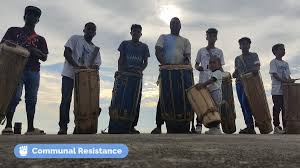
The town is part of the “pueblos santos,” a cluster of Afro-descendant communities bound together by devotion to San Benito of Palermo, the “Black saint,” and the ritual rhythms of the Chimbánguele. Life in Palmarito has always revolved around the lake—its fish provide sustenance and its water routes connect those living along its shores. From the struggle against enslavement and the creation of maroon communities to today’s communal self-governance, Palmarito’s story is one of resistance and collective action.
Part I of this testimonial series on the Palmarito Afro-Descendant Commune examined the project’s origins and the town’s history, while Part II focused on the role of culture in Palmarito. The third installment addresses Palmarito’s fishing economy and cooperative practices on the southern shore of Lake Maracaibo; while the final installment discusses impact of the US blockade and the collective responses of Palmarito’s fisherfolk.]
❈ ❈ ❈
Part III: Fishing Provides for Everyone
Palmarito’s Economy: Fishing, Agriculture, and Tourism
Fishing is Palmarito’s backnone, connecting nearly every household to the lake. Yet agriculture, hunting, and tourism also sustain the community, contributing to its resilience in hard times.
Leonardo Pirela [Leonardo Pirela, the son of fisherfolk, is the Fishing and Aquaculture Ministry representative for Merida state]: For us, life has always revolved around the lake. Fishing is our daily bread, the foundation of our economy, and what has allowed families here to endure for generations.
The lake not only feeds us but has also shaped the very organization of our community: from fishing, we learned that survival depends on working together. At the same time, tourism and small-scale agriculture, mostly conuco-based [in diversified plots], complement fishing and give us other ways to sustain ourselves.
Nereida González [Nereida González Vásquez is a communal spokesperson and the coordinator of the local medical ambulatory]: Around ninety percent of people here live, to a great degree, from fishing. Yet, fishing has never been understood solely as a means of providing individual income. In Palmarito, it has always been tied to solidarity. When the lake provides, it provides for everyone; when times are tough, we organize so that no household is left behind. That is how we understand the economy: not as private gain, but as a collective undertaking.
Olimari Chourio Estrada [Olimari Chourio Estrada is a fisherwoman and the main spokesperson of the Women’s CONPPA]: Long before oil exploitation began in Venezuela, long before the crisis brought on by the US blockade cast such a long shadow over our lives, people here sustained themselves through fishing and agriculture. That was the true wealth of our ancestors. Our grandparents always told us that the lake is generous, but they also reminded us that its bounty only lasts if it is cared for and shared.
That is why, even today, when a boat comes back to shore, it is not just the fishers who rejoice. The entire town feels that joy.
Jesús Enrique Antúnez [Jesús Enrique Antúnez is a fisherman, a member of the Palmarito CONPPA]: When I first came to Palmarito in 2017, I was just seventeen years old. I began organizing with fellow fishers, and since then, I’ve been working side by side with other fisherfolk.
The most valuable thing we have here is our willingness to work hard and our community, because only in that way can we secure the gear we need—the nets, boats, and other equipment for the labor of fishing.
I don’t yet have a boat of my own, but a compañero lends me his, and I contribute what I know best: the art of fishing. When it’s crab season, we share the earnings between us. Right now [in February], our focus is on the crab catch, which means we give the fish a rest so they can reproduce.
Everything runs in cycles: when crabbing slows down, we return to fishing with lines and nets.
Fishing Traditions & the Catch
Leonardo Pirela: There are several ways to fish here. We fish the blue crab using longline palangres baited with chicken heads. Crab is our main economic resource in Palmarito. The second method is fishing for cuero y escama [“skin-and-scale”] fish using nets and hooks.
Finally, in recent years, another practice has become common: fishing from the shore. During the pandemic, when food and fuel were scarce, people waded into the lake on foot with their longline palangres to catch crabs. This practice is especially common among women.
These three methods—longline crab fishing, fishing with nets and hooks, and shore-based crab fishing—sustain our community.
Jesús Enrique Antúnez: With the phrase cuero y escama we refer to different species. Cuero means fish like bagre blanco [white catfish] and bagre pintado [spotted catfish]. Escama refers to fish such as manamana, bocachico, curvina [croaker], róbalo [snook], armadillo, and doncella. With the nets, we can also catch chucho [stingray], raya [ray], and other fish. Sometimes, even sharks get trapped in the nets trying to eat smaller fish.
All these species are part of our diet and our economy, and nature’s cycles determine what we prioritize.
Jean Antúnez [Jean Antúnez is a fisherman and the main spokesperson of the Hugo Chávez CONPPA]: I have fished blue crab all my life—my father did it too. It is a trade that shapes our community and connects us to past generations.
In the high season, you can catch 200 to 250 kilos a day. During the low season, the catch drops to 40 or 50 kilos, sometimes as low as 30. Those rhythms mark our lives. Crab fishing is our tradition, our inheritance, and the basis of our economy.
Leonardo Pirela: Some fisherfolk in the southern shore of Lake Maracaibo cross over to Catatumbo on the side of the lake. There, they fish for manamana, which is highly valued, and curvina. These trips are made in a motor-propelled canoe, with four or five people working together for several days. They return with large quantities of fish.
In the past, there was also pesca a palanca [pole fishing]. Fishermen would move the boat with a pole of about five meters instead of an engine. We saw that practice returning during the worst of the crisis. The ingenuity of our people can be seen in our flexibility and inventiveness: we have used both poles and outboard motors, and later we invented the Pakipaki [fuel-efficient artisanal motor used in the context of the blockade].
We have always invented and developed ways to keep on fishing.
Luis Talez [Luis Talez is a fisherman, campesino, and hunter]: A fishing trip involves many people: patrones [skippers], marineros [mariners], encarnadores [bait handlers], tarimeros [deck hands], and the family members who prepare meals.
When a boat goes out, the whole community is involved, and when it returns, the entire community benefits.
Solidarity & Mutual Support
Nereida González: In Palmarito, there is a culture of mutual support. We can trace its roots to the practice of fishing, which is often cooperative, and to the Chimbángale, which brings practically the whole community together.
When things got really hard, the Palmarito Commune organized collective cuero y escama expeditions. We made a census of families and sent out the boats and crews for three or four days. When they returned with six or seven thousand kilos of fish, we distributed the catch house-to-house and even gave some to nearby communities. That way, no one went hungry.
Evellis Morante [Evellis Morante is a parliamentarian and spokesperson for the Palmarito Afro-Descendant Commune]: Fishing means survival and solidarity. When fuel was scarce, neighbors pooled together what they had so that at least some of the boats could go out. The catch was then divided, ensuring that everyone had food. That’s how we endured the hardest years.
Nereida González: We also organized ourselves to cut costs. We collected money for ice, bait, and fuel. At times, the mayor of Palmarito gave us gasoline, which allowed us to send out the boats. That way, fish reached the community at a fair price, not the speculative prices that gasoline-resellers imposed.
Fisherfolk Councils
Leonardo Pirela: There are local fisherfolk councils here called CONPPAs [Councils of Artisanal Fishers and Producers]. The idea of the CONPPA was conceived by Comandante Chávez to organize fishing communities and give them greater control over their resources as part of the Bolivarian vision of participatory socialism.
The CONPPAs are the organizational backbone of fishing communities anywhere in the country. They are also a mechanism to open channels of cooperation with the Fishing Ministry. The Ministry’s support of fishing communities has been crucial, particularly in these times of blockade.
In Mérida state, there are twelve CONPPAs, and three of them are in Palmarito. The oldest bears the name of our town. Another one is composed entirely of women—the second all-women CONPPA to be formed in the whole country, and the only one in an Afro-descendant community. Finally, there is a CONPPA with the name Hugo Chávez. We are all Chavistas through and through.
Jesús Enrique Antúnez: I helped found the “Palmarito CONPPA.” It was the first CONPPA here in Palmarito: the call went out that we should get organized, and we knew that only through collective effort would we be able to get some of the tools we need.
Jean Antúnez: The Hugo Chávez CONPPA is made up of 32 members, each with a specific role. I serve as the main spokesperson. We also have a deputy spokesperson, a treasurer, and a secretary. Each of us has clearly defined responsibilities, but we all work with the same goals. For instance, the main spokesperson represents the CONPPA in legal matters and is always present.
One of the reasons why we organize is that fishing is a highly collaborative trade. Not everyone here owns a boat, so some share boats, while others fish using equipment lent by their compañeros.
One of our goals is to have a collective boat, but we don’t yet have one.
Nereida González: During the worst years of the blockade, from 2018 until around 2022, life here was very difficult: fuel was scarce and extremely expensive. Thanks to the CONPPAs, we were able to work with the government to open a fuel station right here in Palmarito.
The Fishing Ministry played a central role in making this possible. Before, fisherfolk had to travel to other ports or buy fuel from resellers who charged exorbitant prices. Now, we manage fuel collectively, as a community.
Leonardo Pirela: Through the CONPPAs, fisherfolk have secured funding from the Fishing Ministry. They have gotten nets, hooks, even loans to purchase Pakipakis and outboards. The Mérida state government has also provided nets and other gear. None of this came through individual requests—it was organized through the CONPPAs, which made it possible.
But a CONPPA isn’t only about funding, nor is it restricted to fishers who go out on boats. CONPPAS can involve anyone who makes fishing possible: the bait handlers, the deck hands, the people who cook for the crews, etc. Everyone can have a role.
Since CONPPAs are assembly-based, that is where we collectively decide who will represent us, how to manage resources, and how to distribute the catch. That is the communal spirit: fishing is never a one-person job; it is a collective effort.
For us, the CONPPAs also represent dignity. They give us a way to be heard by the institutions, but more importantly, they help preserve our traditions of solidarity and mutual support.
Our ancestors survived through cooperation. Today, we continue that legacy through these councils.
The Women’s Council
Olimari Chourio Estrada: The women’s CONPPA here is the second of its kind in Venezuela. We created it because women have always been part of the fishing economy, but our work is often overlooked. Men are seen as the center of our society because they are usually the ones who go out on the lake and come back with the catch, but without women, there is no fishing: we prepare the bait, we manage resources, we distribute the catch, and we keep accounts. Beyond that, we also fish, particularly since the blockade began.
When we organized the women’s CONPPA, it wasn’t just to have another council or to have more visibility as women. Our CONPPA was also born to improve our economic position and strengthen the communal fabric. Women represent the majority in the commune’s parliament, the commune’s highest decision-making body; we are the ones in charge of the Communal Bank; and during the pandemic, we were the ones who guaranteed that what came from the lake reached every family. Ultimately, the creation of the women’s CONPPA provided us with a platform to coordinate these efforts with greater effectiveness.
Evellis Morante: During the pandemic, when people had no jobs and no income, women took the lead. We played an important role in organizing fishing expeditions, and we oversaw the distribution of fish. The goal was always clear: every household should have access to protein. It was exhausting work, but it was also deeply rewarding. We divided tasks among ourselves, supported one another, and made sure no one was left behind.
Olimari Chourio Estrada: The women’s CONPPA is not just about managing resources—it’s also about showing our daughters and granddaughters that they, too, can play a leading role, women have always played a role in fishing, farming, and caring for the community. Through the CONPPA, we are now being recognized as fisherfolk and as leaders in our own right.
For us women, the struggle is in part about recognition. For years, our work went unseen. Now, we are fighting to ensure that our work counts. Every crab we catch and clean and every kilo of fish that we distribute is part of the economy. Our goal is to make sure that no one overlooks this work and that our voices carry weight in every decision.
The Blue Crab Processing Plant
Leonardo Pirela: Another achievement in the community is the crab processing plant, known locally as Floressa. It’s organized through a three-way partnership [“triada”] between the private sector, the Bolivarian government of Mérida state, and the community itself. That model is unusual, but it ensures that a fixed percentage of revenues—around ten percent—goes directly to the community.
Nereida González: Having that ten percent of revenue has been crucial. With it, we reactivated the medical center, hired a doctor, and bought equipment for blood testing and dental services. We also repaired roads and fixed the classrooms in the school. In other words, the blue crab processing plant doesn’t just produce for the market; it also sustains the community.
Yoglis Solarte [Yoglis Solarte is a communard and a PSUV member]: The triada model is not without its contradictions. Originally, it was government-owned and run. When production came to a halt, we wanted the commune to have full control, but the outcome of the negotiations led to the current three-way partnership. That was around 2016.
Some say that the private sector captures too much of the value produced, or that the government doesn’t always deliver its part. But at least the community has a guaranteed source of income, and we’ve seen tangible results. Without the plant, it would have been difficult to maintain health services or repair the roads.
Nereida González: We appreciate the resources provided by the triada, but our ultimate goal is to gain greater control over the plant. With just 10 percent of the revenue, we’ve been able to pave roads, build school classrooms, and more… Just imagine what we could achieve with further control!
All this has been a debate in our assemblies: how to balance alliances with our need for self-management.
What’s important is that the plant is not just a business—it is also a communal tool. Every kilo of crab that passes through the plant brings benefits back to our people. That’s why we defend it, even as we strive for greater participation in its management.
Leonardo Pirela: The plant is not only about getting food to the market—it is also about turning fishing into public goods.
Distribution
Jesús Enrique Antúnez: One of the biggest challenges has been dealing with intermediaries. They don’t offer real solutions. What they do is lend equipment or fuel, and in exchange, they keep much of the catch because they have the resources.
That’s why communal organization through the CONPPA is so important: it gives us a way to free ourselves from dependence on intermediaries… But there is still a lot to be done!
Jesús Enrique Antúnez: This is why intermediaries are a problem: they set the terms, not us. If they give you fuel, then you owe them the catch. It means the community loses value. That is why we struggle for autonomy, to manage the fuel ourselves, and for collective management. Only then can the work of the skipper, the mariner, the deckhand, and everyone else truly benefit the people.
Nereida González: When the boats return from the lake, the first question is not “How much will I make?” but “How do we share this?” In Palmarito, distribution has always been collective. In hard times, we organized operativos [collective initiatives] where fish was sold at a fair price and even delivered house by house. Families who could not afford to pay still received their share.
Of course, distribution is a different matter when it falls into the hands of the intermediaries.
Olimari Chourio Estrada: The women’s CONPPA often took responsibility for organizing these distributions outside of the conventional market. We made the lists of households, coordinated with the boats, and ensured that the catch reached every family. It was a lot of work—sometimes we would spend whole nights organizing—but we knew that we had to secure protein for our people.
Debates
Jean Antúnez: Right now, we are facing a familiar dispute over the price of crab and the way we are paid for it. Thanks to Juan Carlos Loyo, Minister of Fishing, the price was raised to two dollars per kilo in the high season. We are really grateful for his support: he has shown himself to be on the side of fisherfolk.
Nonetheless, because intermediaries are now paying in bolívares, many fishers are unhappy. So now, as we speak [March 2024], southern shore fisherfolk are engaged in a work stoppage. The issue is that the processing plants are paid in dollars, yet they pay us in bolívares. This leads to losses for us. For their part, they claim that they can’t convert so many dollars into bolívares, and that’s why they end up delaying payments…
In any case, this is part of life here in the Southern Shore: we fight for good living conditions for fisherfolk, and fortunately, we have a powerful ally in the Fishing Ministry.
Nereida González: We have had to fight so that resources don’t leave our community. That’s why we organized the three-way partnership in the crab plant in the first place, to ensure that at least a portion of the wealth stays here. But the struggle continues. We know that only through communal control can we guarantee that fishing truly benefits everyone.
Jean Antúnez: Sometimes there are tensions among fishers themselves—about access to fuel, about the use of nets, about who gets to fish in which area. But those conflicts are resolved collectively, in assembly. We sit down, we argue, we make decisions together. That is the only way to preserve unity.
Tourism
Nereida González: Fishing is our main source of income, but tourism is also important for the community. On holidays, families from Mérida and other parts of the region come to Palmarito to enjoy the lake, eat fresh fish, and participate in cultural activities. That generates work for people who cook, sell food, or offer rooms for rent.
Evellis Morante: Tourism is not just about money; it is one way of showing people our culture. When visitors come, we share our music, our traditions, and our history as an Afro-descendant people. We want them to see that Palmarito is not only a place to consume but a living community that resists and creates.
In recent years, the [Mérida] governor has helped reactivate tourism in the town. With more visitors coming here, families have been able to supplement their incomes. Some sell crafts, others rent spaces, and still others prepare local foods. The holidays are when many households make a little extra money, which helps them endure the ups and downs of fishing.
Agriculture and Hunting
Leonardo Pirela: Agriculture here is not as central to our economy as fishing, but practically every family has a small plot of land. People grow yuca, plantain, corn, and beans. In the past, cacao, coffee, and sugarcane were important crops in the Southern Shore and those traditions are still alive, but on a smaller scale.
Nereida González: The truth is that agriculture gives us food security. Even if the lake is rough or fishing is scarce, people can still eat arepas de yuca [cassava patties] or arepas de plátano [plantain patties]. Women often prepare enyucado [cassava cake] and sometimes cook with coconut oil, which is part of our ancestral food culture. These practices remind us that the land also sustains us.
Jesús Enrique Antúnez: Apart from fishing, some people have conucos or parcels where they produce plátano, yuca, taro and pumpkin. What we often do is barter: we exchange fish for vegetables or fruits. Barter is very common here — it is part of our way of sharing.
Sometimes we get tired of eating fish, so we organize groups to go hunting. Reptiles such as iguanas are part of our culinary tradition: we stew iguana with coconut and vegetables, or we fry it in the pan.
Luis Talez: My plot of land lies a long boat ride away up in Caño Culebra. Most of what we plant there is for self-consumption, although we sometimes sell some of the crop. But we also hunt. Here we hunt deer, capybara, paca, ducks, and iguanas. We hunt with dogs and shotguns, sometimes using a harpoon. I learned these practices from my father.
Hunting is cooperative, just like in fishing. Every time we kill a capybara or another animal, whoever comes by our house gets a piece of it—a kilo, half a kilo… There is a lot of solidarity, no stinginess. Each person contributes. It is a practice that has always existed in our community.
Evellis Morante: Families exchange fruit and vegetables, fish, and meat, so that no one lacks food. Those in-kind exchanges keep our community strong.
In Palmarito, the economy is not just one thing. It is fishing, it is agriculture, it is hunting, it is tourism. When one sector fails, the others help us survive. That is what makes the community resilient: the ability to combine different activities and always think in terms of cooperation.
Part IV: Fisherfolk Resisting Imperialism
The impact of the imperialist blockade and collective solutions
The US blockade brought scarcity and hardship to Palmarito, but it also unleashed new forms of collaboration.
Luisana Antúnez [Luisana Antúnez is a communal spokesperson and the director of the San Benito de Palermo High School in Palmarito]: The imperialist blockade fell on us like a bucket of cold water. For a moment, everything was paralyzed, especially fishing and tourism, which are the backbones of Palmarito’s economy. We were left asking ourselves, now what? But Venezuelans don’t just give up. If we don’t have something, we invent it; if we can’t invent it, we find another way.
The United States imposed its blockade because our government has not bowed down before them; it is not their lackey. The US wants our riches—our oil and minerals—but we defend our sovereignty.
Chávez was a visionary; he warned us that this would come to pass and tried to prepare us. However, when the blockade began, we suffered enormously. Even so, the enemy has failed. We are standing tall and with dignity. That is why we say: Whoever meddles with Venezuela, withers.
Yoglis Solarte: The aggression against Venezuela is nothing new. I defended the revolution during the 2002 coup d’état. I was even held hostage for 24 hours by those who carried out the coup. Ever since then, the US has been trying to topple our government. The blockade is just another phase of the same war.
Palmarito has long been a community that faces adversity with defiance. Resistance is woven into the Chimbánguele [Afro-descendant musical tradition], into our fishing culture, and into the collective spirit passed down to us from our Afro-descendant ancestors.
This culture of resistance became a source of strength and innovation when the blockade struck, showing us once again that survival comes not from waiting but from struggling, sharing, and enduring together.
Food Shortages
Nereida González: The blockade cut off access to our most basic staple foods, so we had to reinvent our ways of living, including our forms of celebration. When someone had a birthday and there was no flour in the store, we would make a yuca and coconut pie that is called enyucado, using foodstuffs that grow around us. We revived our grandmothers’ recipes.
I won’t say, however, that those were rosy times. Things have been very difficult up until recently, only beginning to get better in 2022 or 2023.
Evellis Morante: We got tired of waiting up to two hours in line for a couple of kilos of Harina Pan [cornmeal]. So, we began instead to make flour from corn or yuca, and we learned how to render pork fat and get oil from coconuts. We also replaced milk with rice and pasta-based chichas with plantain.
People would come here and say: The blockade doesn’t seem to have affected you, you’re not skinny! However, the truth is that to keep our families healthy, we have had to invent new ways of preparing food and rediscover old ones.
Luisana Antúnez: The School Nutrition Program [PAE] was adversely affected by the blockade. What most schools get now are just beans and pasta, which doesn’t make for very nutritious meals. For that reason, the community contributes fish and vegetables. That way, our schools offer better meals to the youth.
Palmarito’s answer to hunger was not despair but creativity. The recipes passed down from our grandmothers became weapons against scarcity in this community. In kitchens throughout Palmarito, resistance meant making yuca cakes and plantain arepas.
Where is the Medicine?
Nereida González: There was a time when we couldn’t even get medicines because they were scarce and expensive, so we turned to alternative cures. We learned from the elders: oregano works for earaches, local herbs work for coughs and flu, and we even grow “acetaminophen” [boldo, useful for stomach and headaches] in our backyard.
Of course, there are many illnesses that we cannot cure with ancestral medicine. So, over the years, we have lost many friends and comrades due to the damned imperialist blockade. Still, we never gave up!
With time, and thanks to communal organization, we reactivated the Palmarito healthcare center, which now operates 24 hours a day. It had been half-abandoned, but we had an assembly and decided that part of the commune’s income from the crab-processing plant would be dedicated to sustaining and expanding medical services. We reopened the maternity ward, set up a dentist’s office, and got equipment for a small laboratory for bloodwork. To keep the health center’s services running, we established very small fees: two dollars for locals and five dollars for visitors to the area. And if someone cannot pay, the fee is simply waived—nobody is left unattended.
Today, people come to the health center not only from Palmarito but also from neighboring towns, because they know they will get good care here.
We also bought an ambulance, which is maintained with communal funds. Everything we have achieved is because we have been like ants working together, pooling resources and demanding contributions from local enterprises and from public institutions. That’s how, even under the blockade, we have kept our health system alive.
Luisana Antúnez: We lost grandparents, friends, and loved ones in the early years of the blockade. Sometimes medicines were simply unavailable, other times they were so expensive that families simply couldn’t afford them. Those were very dark days.
Now things are looking brighter: just a few days ago, my daughter had a very high fever, and not only did she get great care at the health center, but they also supplied most of the medicines she needed.
The commune gets income from the crab-processing plant. Carefully managing these funds has been very important for the maintenance of Palmarito’s strategic infrastructure, including our health center, schools, and roads.
Yucdali Sánchez [Yucdali Sánchez is a campesina and fisher]: We live in a very humid zone, with lots of mosquitoes that bring malaria and dengue. To fight these diseases and others, we have turned to traditional remedies.
We use the leaf and root of the chota plant to treat hepatitis and malaria. For nasal congestion and bronchitis, we prepare oregano with milk and a touch of butter. We combat dengue with infusions of malojillo, lemon balm, and lemon. These practices have never been lost, but when the crisis got bad, we started to use them regularly.
Fuel Shortages
Jean Antúnez: Fishing became almost impossible for a while. When gas reached two or three dollars per liter, nobody could afford to go out in boats. Production dropped to a minimum because we simply couldn’t go out on the lake.
Luisana Antúnez: Families didn’t go hungry here in Palmarito because nature provides for us, and collaboration is a daily practice. However, our fishing yields went down sharply because of fuel shortages, so our cash revenues dropped dramatically. The little fuel available was being hoarded and resold to us at outrageous prices. Many had outboard motors but couldn’t use them.
For this fishing community, it was a devastating blow.
Nereida González: The CONPPA fisherfolk councils finally got a special fueling station for fishers set up here, called “Módulo Pescar Palmarito.” It was a project supported by Insopesca [Socialist Fishing Institute, part of the Ministry of Fishing] and Mérida’s governor.
Each week, the station distributes between 3,000 and 15,000 liters of gasoline. Fishers now receive 120 liters per outboard motor and 30 liters per pakipaki [homemade outboard motor]. Without the collective struggle to obtain the new fueling station, fishing in Palmarito would have collapsed.
Luisana Antúnez: I worked at the fueling station myself. Before it opened, fuel was being resold at outrageous prices, and many fisherfolk couldn’t afford to fish. Thanks to the station, we stabilized the supply of gas.
That meant that with the fuel-efficient pakipaki motors, our people could keep bringing fish and crab to their tables. Without the new fueling station, Palmarito might have gone hungry.
The Hardships of Migration
Nereida González: But fuel wasn’t the only problem; another source of suffering was the departure of many youths due to the blockade. In just one year, more than 200 young people left Palmarito. Buses would depart from here straight to Colombia. From there, many walked through the Darién jungle and beyond, crossing rivers and mountains until they reached the southern border of the United States.
To see so many kids leaving was heartbreaking. We asked ourselves: What will become of us if all the young people leave? Fortunately, the trend has begun to be reversed: some people have begun to come back, though many may never return.
Keeping the youth here is very important to us. That is why we are encouraging the creation of a youth fisherfolk council, a CONPPA specifically for young people. Soon our town will have a total of four fisherfolk councils: the Palmarito Council, which is the oldest, the Women’s Council, the Hugo Chávez Council… and now the Youth Council! Young people want to be involved, not only in the fishing craft but also in all its traditions, learning from their elders how to cast and mend nets, how to navigate the lake, and how to respect its spirit.
The Youth Council is a very hopeful project that incorporates the youth of our community.
María Rangel [María Rangel is a city council representative and a communard]: My son is now in Chicago. He crossed the Darién and then continued north. For many days, we had no news of him, and during that time, we heard macabre stories about people who attempted the same odyssey and didn’t make it.
It was a very difficult time for us. My son had to sell his motorcycle and horse to pay for the trip. His children are still here with their mother, but he sends remittances back. It’s been very hard for me and it’s very hard for my grandchildren too, but that’s what the blockade did: in an effort to make us submit to the US, the blockade tore hundreds of thousands of families apart.
They didn’t break our country’s will, but they sure tore apart many families.
Yoglis Solarte: We must also point to those who desired the migration and benefitted from it: Juan Guaidó, Leopoldo López, and María Corina Machado. These very high-profile people are the worst coyotes [migrant smugglers]. They do the dirty work for the White House, which wants to overthrow the [Maduro] government. These rascals have also made money from their collaboration with the enemy, and migration became one of their businesses.
There are more than one hundred people in Indianapolis from Palmarito. That is probably the largest Palmarito cluster in the United States.
Violence Resulting from the Blockade
Jesús Enrique Antúnez: One of the hardest problems we faced during the blockade was crime groups operating on the lake. There was a gang called “Los Piratas” [The Pirates] that would come in speedboats and rob fishermen of their outboard motors, their catch, even their nets. They even killed some fishermen. The communities on the shore of Lake Maracaibo were living in fear.
Luis Talez: The violence hit us hard. Many compañeros lost their outboard motors and their fishing gear. Without those tools, you can’t fish, so you can’t bring food to your family. Some left the fishing trade altogether and others migrated because they couldn’t recover from the losses.
Jean Antúnez: The assaults were systematic. They would strike when we were out working, hauling in crab or fish from the nets. Families had to go into debt to replace what was stolen, and fear was constant.
Over time, though, things began to change. The fisherfolk Councils and the commune began to join forces with the police: We got patrols going on the lake, there was more control over fuel distribution, and the community organized itself, so we could look after one another. That’s how we began to turn the tide.
Luisana Antúnez: The blockade didn’t just bring scarcity; it also eroded parts of our social fabric. Some sectors fell into desperation, and with it came problems like violence and mistrust.
But at the same time, it awakened something else: a deeper sense of solidarity. The hardships themselves pushed us to come together, to collaborate in ways we hadn’t done before.
Solutions and Creativity
Leonardo Pirela: With the fuel crisis, we had to reinvent the way we fished. Outboard motors can consume up to 70 liters of gasoline per day, so here in Sur del Lago, we came up with what we call the pakipaki. People dismantled the chain system of a motorcycle, adding a shaft and a propeller, and made a small motor out of that!
Fuel consumption went down to 10 or 15 liters per day, although, as you can imagine, a boat using a pakipaki is much slower than one propelled by an outboard motor. The pakipaki, which is a wonderful local invention, allowed us to keep feeding our people when fuel was scarce and expensive.
Luis Talez: During the pandemic, the pakipaki became our salvation. Some said it came from China, but here we learned how to build them. A pakipaki uses roughly one-seventh the fuel of an outboard.
I’m one of the lucky ones: I have both a pakipaki and an outboard motor. When the crab is close to the shore, I use the pakipaki. When I have to go farther, I use the outboard.
They say it’s called pakipaki because of the sound it makes: paca paca paca.
Jean Antúnez: In the days of the fuel shortages, before we got the new fuel station in Palmarito, we also practiced pesca de vara [pole fishing]. We would go to the lake with just a stick, a line, and a hook. It wasn’t about bringing home a big catch to sell, but about making sure no family went without food.
Nereida González: We also organized communal fishing days. Each family would get a share of the catch, whether it was crab or catfish. That’s how we resisted: by making sure nobody went without food, no matter how bad things got!
Palmarito’s ingenuity turned scarcity into invention and necessity into solidarity. From pakipakis built with motorcycle chains to the new fuel station that was won through collective struggle and government support, from developing alternative fishing practices to the sharing of our catches, people here have proven that resistance is not just about surviving but about creating new ways of living.
Just as the rhythms of the Chimbánguele transform hardship into celebration, Palmarito’s fisherfolk transformed the blockade into a lesson in creativity and resilience. Each solution was born out of organization, out of neighbors coming together to face common challenges.
In the end, what has kept Palmarito afloat during this criminal blockade is not only creativity, but the conviction that only through cooperation can we endure and move forward.
Part V: Chávez’s Legacy in Action
Central to Palmarito’s way of life is the socialist commune, a form of popular self-government that transforms everyday life and work into a shared project. In this final installment, the conversation centers on Hugo Chávez and how his legacy continues to inspire the Palmarito communards.
Chávez’s Legacy
Chávez’s vision and policies—continued under President Nicolás Maduro—have opened doors for a people who had long been excluded, making education, housing, and political participation possible in rural areas such as Palmarito.
Leonardo Pirela: Chávez is a father to us, the giant of giants. Even as a child, I felt his magnetism. I recall in 1998, during his presidential campaign, running after his caravan with other kids from the community. That was the moment politics first caught my attention.
For me, there is a clear before and after: before Chávez, my world was cartoons and games; with him, I began to feel committed to my community and to my country.
Years later, in 2012, I had the chance to work with the Comandante as a PSUV coordinator in Cojedes state. That time is unforgettable for us, because he gave visibility to people like me—Black youth from fishing and campesino communities who had been denied opportunities for generations. He gave a voice to those who had long been silenced.
I was also able to study because of the Revolution. Thanks to Chávez’s educational initiatives, many of us could attend university, access libraries and computers, and even live in dorms. He prepared us to assume responsibilities, including positions in government.
For my community, Chávez was a giant figure who recognized us—the humble and the oppressed—and gave us the chance to grow and become protagonists in the making of a better world.
Jean Antúnez: As a young man, I saw Chávez on stage, and he opened my eyes. He stood with the people, listened to us, and helped us. Thanks to him, we’re a stronger community.
There’s still a long way to go, but we are on the right path, on Chávez’s path. Now the fisherfolk councils [CONPPAS] and the communes are collaborating closely with the government of President Nicolás Maduro to make Chávez’s dream a reality.
María Rangel: Chávez brought hope to our people. With him, we discovered a new way of doing politics—one in which we became actors. Before, almost nothing from the state reached our Afro-descendant community: we were invisible.
With the Revolution, electricity came to the humblest households in Palmarito, the roads were paved, and houses were built for families who had never had a roof of their own.
The Revolution also brought education: those who had never learned to read became literate, and many who had been forced to abandon their studies were finally able to finish high school and even attend university. Dreams that once seemed impossible began to come true.
Yet perhaps the most important gift Chávez gave us was the conviction that communal organization could transform our reality. That has carried us through the hardest of times, when the US blockade snatched away food, medicine, and fuel. In those moments, it was our organization—our commune—that sustained us.
Nereida González: Chávez gave power to the people, and he would often say: Only the pueblo can save the pueblo. That is true—even with a revolutionary government, bureaucracy can slow things down, but with resources in our hands, in the hands of the people, we see real change. That’s the beauty of the popular consultations that are going on now.
Popular Consultations
Nereida González: Popular consultations are a stroke of genius—I would go so far as to say they are great discoveries that truly activate communal life.
President Nicolás Maduro launched this initiative in early 2024, and it quickly became the motor of organization in our community. Why? Because consultations not only create the conditions for calling assemblies, they also become a school of self-government: we debate, decide, and then carry out the projects we choose.
Assemblies, which are the heart of communal life, are now more frequent because consultations put real decision-making power in the hands of the people. Each communal council presents proposals—paving a road, building classrooms, repairing infrastructure—and then the pueblodecides what comes first.
This is revolutionary: we manage our resources directly, without waiting for someone from above to fix our problems.
Evellis Morante: Through the popular consultations, we are nearing completion of two strategic projects: building new classrooms for the high school and repairing the most deteriorated roads in town.
The high school had only five classrooms for more than three hundred students, so fifth-year classes were held under a tree. Thanks to the careful use of resources coming from the consultations, we are now giving Palmarito’s youth the classrooms they deserve, while also paving the roads of El Empujón [a Palmarito neighborhood], which had long been in disrepair.
Francisco Segundo Estrada [Campesino, Chimbánguele capitán, and a founder of the Palmarito Afrodescendant Commune]: Being part of the commune allows us to engage directly in government matters and access resources via popular consultations. The commune is the real government of the pueblo for the pueblo.
Evellis Morante: We have advanced step by step, addressing roads, water supply systems, housing, and schools—sometimes with resources from the crab processing plant, other times through the popular consultations. Yet many challenges remain: we have to build more homes and contain the San Pedro River, which still threatens our community when it rains hard.
Even so, the future shines bright. We know that the organized pueblo—what we call popular power—can solve the problems we face, and we can do so with remarkable efficiency. We will never again become passive, not like in the Fourth Republic [1958-1999].
Community Organization
María Rangel: The commune is crucial now because this is the time of popular power. We must work hard to make our organization more robust, advance projects, and truly empower ourselves to continue transforming our community.
Leonardo Pirela: Chávez taught us that fisherfolk and campesinos could become leaders. He gave us tools to grow, to govern ourselves, and to live with dignity. That seed has grown and is alive in Palmarito: the community is our sphere of activity, our way to keep building a better world.
Luisana Antúnez: Here, “Commune or Nothing” is not just a slogan—it’s our way of life. It is how we endure the blockade, how we feed our families, and how we find hope in the hardest of times.
Chávez prepared us for these times when he said: Only the pueblo can save the pueblo. In Palmarito, those words are alive. They guide us, sustain us, and remind us that our strength lies in our unity. Every day, through the commune, we make those words a reality.
[Cira Pascual Marquina is Political Science professor at the Universidad Bolivariana de Venezuela in Caracas. Chris Gilbert teaches Marxist political economy at the Universidad Bolivariana de Venezuela. Courtesy: Venezuela Analysis, an independent website produced by individuals who are dedicated to disseminating news and analysis about the current political situation in Venezuela.]