❈ ❈ ❈
Language Shaming and the Avoidable Burden of the Three-Language Formula
Pulapre Balakrishnan
While war at its borders is something India has often been drawn into without a choice, it has seen avoidable internal wars engulf it occasionally. One such is the language war that pits some states vis-a-vis the Union government.
Strife on this score first erupted in 1965 when the duration of the constitutional provision for using both English and Hindi in the communications of the Union government ended. The prospect of having to accept Hindi as the sole official language of India led to mass agitation in Madras city in particular. The intensity of the response, including self-immolation, shook the conscience of many in the country, and the Indian state abruptly announced that English will continue as an official language alongside Hindi.
The linguistic peace, as it were, held for half a century, but it has been disturbed by some developments recently. One of them is the insistence by the Union government that states adopt the New Education Policy proposed by a committee constituted by it. Predictably, there has been pushback, notably to the recommendation in it that schools across the country teach three languages.
The government of Tamil Nadu and social activists in Karnataka have opposed the three-language formula, requiring the learning of only two languages in their states’ public schools. The common thread in their stand is that imposing the three-language formula on the states of India goes against federalism. This is correct, as, going by the constitution, education is on the concurrent list.
By and large the people of these two states support their government’s stance. However, in an instance of internal discord in Maharashtra, the recent announcement by the state’s BJP-led government that three languages, Hindi being one of them, will be taught from class 1 itself has met strong opposition from civil society. The latter view this as a case of imposing Hindi, resulting in the erasure of Marathi.
Amit Shah’s true intentions behind his remarks on English are no secret
Not to be outdone, the Union home minister has recently predicted that soon Indians who speak in English will be ashamed of themselves.
We cannot be certain of what Shah had in mind when he stated this at a book launch in Delhi. However, it is hardly surprising that it received wide coverage on many news sites including this one, for it is preposterous in the extreme.
If English is one of the official languages of the republic of India, why should the home minister caution Indians from speaking it? Is he not familiar with the spirit behind the retention of English by the state? At any rate, the statement would count as quite inappropriate for a senior cabinet minister to have made.
As a prediction it appears all set to fail. Anyone familiar with this country would know that the ability to communicate in English is an aspiration for many, including the subaltern. They are not going to be moved by ministerial shaming.
The minister’s stated intention is to encourage the use of Indian languages, but surely he must not have in mind that I should speak Malayalam to audiences across the length and breadth of the country when I travel on professional assignments.
It is no secret what the minister had in mind when he said that English should be junked when Indians communicate with people of other linguistic groups. Indeed, Shah had very early on in his tenure as home minister made clear his preference for Hindi as the common language of the country.
The chances that this will somehow come about are slim. Exactly as India’s economic rise has enhanced its autonomy in the wider world, so does the rise of the economy south of the Vindhya enhance its ability to resist various forms of imposition from Delhi. Quite simply, we are not in 1965 anymore.
The political argument against the three-language formula long put forth by the dissenting states would be sufficient ground to reject it. However, there is a case to be made against it on another and equally relevant ground. This has to do with learning, something that the section of the political class driven by linguistic chauvinism seems to be ignorant about or, worse still for the health of the country, is willing to ignore in order to achieve cultural hegemony.
Unlike informal learning, teaching an extra language in school will burden children
The efficacy of schooling must be gauged by the extent of learning that takes place. It is widely believed that learning is potentially very high in early childhood, including during primary school, as the brain is most receptive then. It is also found that children grasp languages easily at that stage of their lives.
We see this among children of migrants in India, where it is not uncommon for them to speak up to three languages, the usual mix being of the mother tongue, the local language and the English taught in school.
This is undoubtedly a good thing, for no one has been made worse-off by knowing several languages. However, insisting that children formally study three languages in school is altogether a different thing.
Teaching a language as an additional subject invariably subjects the process to the protocols of schooling, namely syllabi, formal instruction and the evaluation of learning through written examination. It is this that introduces an additional load on the child, something which proponents of the three-language formula tend to overlook.
Several subjects are part of a school curriculum, and language is only one among them. It is unreasonable to expect schoolchildren to learn more than two languages at a time when they also have to learn other subjects, all requiring considerable effort and attention to grasp.
Two lessons from the rest of the world
If we were to study the international experience we would take away two learnings.
First, not many countries insist that schoolchildren learn more than the medium of instruction, even if they may encourage the learning of several languages informally.
Indian children who are required to learn three languages in school could be left at a relative disadvantage globally when it comes to knowledge of mathematics, natural and social science and the humanities. To this list we should add ‘technological fluency’, which today is the ability to work with the tools of artificial intelligence.
Children have only so much mindspace and time for their development, including play, and educationists, unlike politicians, would take a very considered view as to how to occupy it. Humans are not chatbots. They are prone to limitation of the attention span, deploy effort based on motivation and are prone to stress from information overload.
The writer Perumal Murugan has recounted his experience as a teacher in a government school in rural India. He speaks of children who clear all their subject papers but are held back on account of not clearing the exam in the language other than the medium of instruction.
Implementing a three-language formula in India has involved examinations at an early stage of schooling in three languages, none of which is spoken at the child’s home.
A second learning that we get from an international comparison is that we do a very poor job of teaching in India as it is.
The Program for International Scholastic Aptitude survey of learning in schools shows India faring poorly among the countries that participate in the programme. Having come second-last out of 73 countries in the survey of 2009, India chose to opt out. Surely it shows that students are very poorly instructed in most of India’s schools.
The disingenuous explanation that the low ranking is due to cultural bias in international testing is debunked by the evidence of poor learning outcomes in India’s rural schools reported by the Indian agency Pratham. Pratham’s annual reports reveal that children in India are often not proficient in arithmetic, reading and writing, even when the tests are conducted in their mother tongue.
As other countries reward technological expertise, Indian policy gets its priorities wrong
For a country, the international implication of the quality of its schools is inescapable. Particularly after the emergence of artificial intelligence, if the population of a country is not adept at working with it, it will not be able to compete globally, including holding its own when defending its territory.
This recognition has spread like wildfire across the world, leading to the offer of semi-permanent residence status to highly qualified individuals from abroad by countries in Europe and west Asia.
On the other hand, a proposed public policy in India entails its children having to learn multiple languages, what really matters: the contents and quality of school education.
The insistence on the three-language formula, with Hindi part of the package across the country, is a political project that burdens India’s schoolchildren. Ideally, they must learn their mother-tongue and one of the official languages of India.
Back to the home minister’s prophecy. English is a foreign language for sure, but recognising research that brings together population genetics and the pattern of global migrations well before the common era would leave us far from certain that Sanskrit, the mother of many wonderful languages spoken in India today, is not.
[Pulapre Balakrishnan is honorary visiting professor, Centre for Development Studies, Thiruvananthapuram. Courtesy: The Wire, an Indian nonprofit news and opinion website. It was founded in 2015 by Siddharth Varadarajan, Sidharth Bhatia, and M. K. Venu.]
❈ ❈ ❈
What Ambedkar and Periyar Teach Us About Maharashtra’s Hindi Debate
Aniruddha Mahajan
Since mid-April, Maharashtra became the centre of a major linguistic storm. The state government’s decision to make Hindi a compulsory third language in Marathi- and English-medium schools from Classes 1 to 5 sparked a sharp backlash. Protests came from teachers, students, civil society groups and political parties across the spectrum.
Although the government on Sunday eventually withdrew the policy, the episode exposed a deeper anxiety: is India drifting from its pluralistic roots toward a homogenised national culture?
At the heart of the debate lies the question of who decides which languages matter in India’s classrooms, and by extension, in its public life.
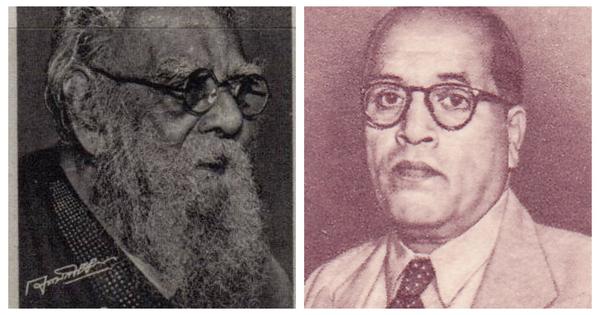
This question has been asked before by the architect of the Indian Constitution BR Ambedkar, by Dravidian leader EV Ramaswamy “Periyar” and even by Italian philosopher Antonio Gramsci, each offering insights into how language relates to identity, democracy, and power.
What Ambedkar knew
BR Ambedkar, a native of Maharashtra, argued powerfully in favour of primary education in the mother tongue. Speaking in the Constituent Assembly on 2 September 1949, he said that education in a child’s native language is not just pedagogically sound, but it is essential for democratic participation.
This view finds echo in a 2025 Unesco report titled Languages Matter: Global guidance on multilingual education. It confirms how children learn best in their first language.
In Maharashtra, where Marathi is the mother tongue for nearly 70% of the population (according to the 2011 census), imposing Hindi from the Class 1 risks disrupting that learning process – particularly for rural and marginalised students already struggling with access to education.
Ambedkar also cautioned against making Hindi the national language. On September 14, 1949, during heated Constituent assembly debates, he warned that Hindi speakers, while a significant group, were still a “minority of the population”. He pointed out that privileging one language over others risked alienating vast regions of India and fracturing its federal spirit.
His later writings, especially Thoughts on Linguistic States (1955), championed the idea of reconstituting Indian states on linguistic lines to ensure administrative efficiency and cultural autonomy. The formation of Maharashtra in 1960, after the Samyukta Maharashtra Movement demanded a separate state for Marathi sapeakers, reflects this principle.
Today, policies like compulsory Hindi in schools can take away the pride and dignity that past language movements fought hard to earn.
The illusion of choice
The National Education Policy 2020 reaffirms the old three-language formula (previously proposed by Kothari Commission in 1966): regional language, Hindi or English, and a third Indian language. On paper, this seems fair.
In practice, however, it disproportionately burdens non-Hindi states. Tamil Nadu has long rejected the formula, sticking to its own two-language policy, which was a result of decades of anti-Hindi agitations.
Paradoxically, in many Hindi-speaking states, schools do not actually offer any non-Hindi Indian languages. The result is an asymmetry: non-Hindi states must accommodate Hindi but not vice versa. This contradicts Ambedkar’s idea of cooperative federalism, where cultural decisions like language policy should be made with consent and context, not by default.
Maharashtra’s rollback was thus not just political damage control, but it was a reassertion of federal balance. But as long as the New Education Policy eaves room for interpretation, the risk of cultural overreach remains.
What Periyar fought against
While Ambedkar believed in institutional safeguards, Tamil leader Periyar waged a more direct war against what he saw as linguistic oppression. In the 1930s, Periyar led massive protests in Tamil Nadu against the compulsory teaching of Hindi. For him, this was not about curriculum, but it was about cultural dominance.
He warned that compulsory Hindi would lead to “linguistic slavery”. His fear was not hypothetical. It was grounded in the lived reality of Tamil speakers who saw their language, literature, and identity sidelined by an increasingly Hindi-centric nationalism.
Periyar’s critique resonates in Maharashtra today. Many there view the push for Hindi as an attempt to dilute regional identity and cultural autonomy. His message remains urgent: language policy is rarely neutral; moreover, it often reflects the power of some to define the identity of others.
The language of power
Italian philosopher and political theorist Antonio Gramsci never wrote about India, but his theory of “cultural hegemony” helps us understand how language operates in complex societies. Gramsci argued that dominant groups do not just rule through laws or violence, but they shape what people see as “common sense”. Language is one of the most powerful tools in this process.
When a Marathi-speaking child from Vidarbha or Marathwada region is told to learn Hindi from Class 1, without any reciprocal push for Hindi speakers to learn Marathi, that child absorbs more than grammar. She internalises the idea that some languages (and by extension, cultures) matter more than others.
This is the slow, often invisible work of hegemony. It does not always come from diktats. Sometimes, it arrives as curriculum reform.
Beyond Maharashtra
The controversy in Maharashtra is not unique or isolated. In 2017, Bengaluru witnessed the #NammaMetroHindiBeda campaign, opposing Hindi signage in the city’s metro system. In Tamil Nadu, resistance to Hindi remains a political mainstay. West Bengal saw students protesting Hindi-only policies in scientific institutions. In Punjab, Panjab University students demanded respect for Punjabi in official communication.
Even the North East – India’s most linguistically diverse region – has pushed back. In 2022, the central government mandated Hindi up to Class 10 in all North Eastern states, prompting fierce objections from local cultural groups who saw the move as cultural erasure.
Each of these movements’ points to a deeper struggle: the protection of linguistic identities in a centralised nation-state.
Who gets to decide?
India’s strength lies not in any single language or culture, but in its ability to hold many together. Ambedkar reminds us that language should be a tool of empowerment, not exclusion. Periyar shows that resistance is necessary when institutions fail. Gramsci teaches us to look beneath the surface of policy and ask: who benefits?
The Maharashtra controversy is not just a local educational dispute. It is a national moment of reflection. Should language be used to unify, or to dominate? Should it reflect our diversity, or override it? And most crucially, who gets to decide?
[Aniruddha Mahajan is a doctoral researcher at the University of Edinburgh, UK. His research interests include caste inequalities, student activism, nationalism, regional and linguistic politics, and the intellectual history of South Asia. Courtesy: Scroll.in, an Indian digital news publication, whose English edition is edited by Naresh Fernandes.]