❈ ❈ ❈
When War Becomes a Meme: Tagore’s Warning Against Hollow Nationalism
Minal D. Patil
In the weeks since the Pahalgam terror attack on April 22 and India’s military strikes on Pakistan on May 7, something unsettling has been unfolding – on our television screens.
The prospect of war became indistinguishable from viral marketing slogans: “strike back”, “teach a lesson” and “avenge” became punchlines in a social media meme battle that trivialised suffering and glorified violence.
On both sides of the border, ordinary citizens – many far removed from the realities of frontline life – engaged in a virtual battle that obscured the human cost of conflict.
The jarring contrast between virtual rage and lived reality begs a question: what have we made of nationalism? Perhaps, more importantly, what has it made of us?
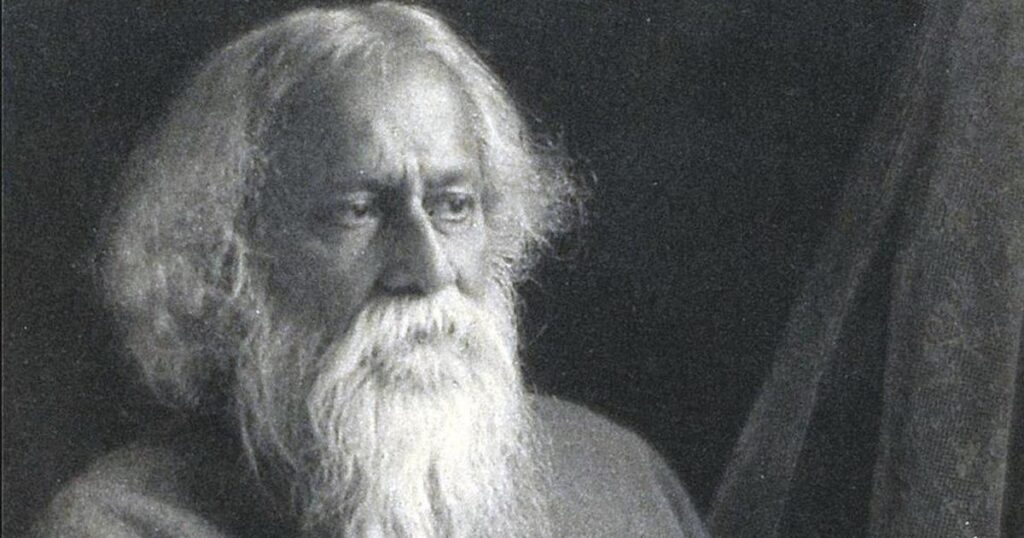
Over a century ago, a quiet voice from Bengal had sensed where unchecked nationalism could lead. Writing in 1917, during the First World War and at the height of imperial ambition, Nobel Laureate Rabindranath Tagore warned of nationalism becoming a mechanical and dehumanising force.
He saw how it could hollow out compassion, reduce individuals to instruments of the state and transform the nation from a space of shared meaning into a machinery of power. His concern wasn’t love for one’s homeland – it was about what happens when that love is stripped of conscience.
Tagore’s 164th birth anniversary was on May 7. His ideals offer a moment of sobering reflection today. As he wrote in Nationalism in India, “Freedom which is not moral freedom is only a form of bondage.”
When collective pride replaces inner reflection, when nationalism silences rather than awakens, it ceases to liberate and begins to control.
Meme wars and Tagore’s nationalism
In Nationalism in India, Tagore drew a vital distinction: society, he said, was a living, ethical community, a space of emotional growth and mutual care. The “nation”, by contrast, was a political abstraction, a structure driven by power and efficiency.
“The Nation,” Tagore wrote, “is that aspect which a whole population assumes when organised for a mechanical purpose.” This shift, from community to machinery, he feared, would strip away the inner life of people. His critique was especially courageous because it came at a time when nationalism was gaining ground in India’s anti-colonial struggle.
Tagore supported India’s freedom but was uneasy about copying Western models of statehood rooted in militarism and exclusion. He warned that without rethinking our political consciousness, we might reproduce the very patterns of domination we were fighting against.
Much of today’s militant nationalism mirrors what he foresaw: where dissent is branded betrayal and conformity is mistaken for commitment. It replaces moral imagination with ideological obedience. Tagore believed in a form of belonging that was expansive and deepened humanity.
At the heart of Tagore’s vision was what he called universal humanism: a belief in the essential unity of all beings. This vision was rooted in Indian traditions: the non-duality of the Advaita school philosophy, the inclusive ethos of the Bhakti movement and the wisdom of Vasudhaiva Kutumbakam – the world is one family.
A nationalism that forgets this interconnectedness, Tagore believed, is not power but spiritual decay.
Tagore’s humanism offers a quieter, deeper resistance. One that does not demand uniformity but respects the individual soul. One that doesn’t glorify war but grieves its necessity.
Tagore was not blind to injustice. He stood firmly against colonial domination. But he also asked: What kind of people are we becoming in our fight for freedom? Are we losing our inner compass? “India is no beggar of the West,” he wrote, “but she should never try to dominate by imitating her.”
Nationalism in India today is less about community and more about compliance. It no longer inspires, it interrogates. A shared cultural ethos has been reduced to a tool of exclusion. Even silence can seem suspect.
The aftermath of the Pahalgam attack made this clear.
Social media, as the primary arena for shaping public sentiment, encouraged a form of digital nationalism aimed at virality – AI-generated war simulations and “clap-back” memes to dehumanise the other side rather than encourage dialogue. The meme, and other social media content, became tools to signal loyalty, to perform outrage, flattening human complexity into consumable content.
It became a contest of slogans, the very danger Tagore warned of: a nationalism loud in pride but hollow in ethics.
“Whatever weakness we cherish in our society will become the source of danger in politics,” Tagore wrote. Memes, slogans and outrage do not emerge from vacuum but are shaped by the emotional habits of a society: the tendency to idolise outdated forms, to look away from injustice, to silence grief.
If one does not confront those habits, the same walls that provide safety today will quietly become prisons tomorrow.
The performative nationalism encouraged by social media distracts us from deeper questions: why do these conflicts keep recurring? Who benefits from these cycles of outrage? What do the families of soldiers need: viral edits or empathy?
Grief, mourning and mirrors
In moments of crisis, there is a tendency to dismiss philosophy as idealism. But it is in those very moments when rage overtakes reason that philosophy matters most.
War can feel abstract for many: a news item, a reel, a statistic. But for a soldier’s family, war is absence, a knock on the door, a silence that never lifts. Grief, real grief, has no borders. It looks the same in every home, on either side of any line.
Reclaiming nationalism with Tagore’s does not mean rejecting it but re-rooting it in conscience. Tagore asked us to reimagine the nation as a sanctuary of responsibility rather than a fortress of pride; where patriotism is not loud, but honest. Where empathy is not weakness, but wisdom.
Aggressive nationalism erases the shared nature of human pain. A nationalism that only celebrates sacrifice but cannot sit with suffering is not patriotism but emotional outsourcing.
If we are to restore meaning to our national life, we must restore our capacity to mourn. Mourn without spectacle, without expectation. Mourn not just the dead, but the violence we carry inside us.
In a noisy world, Tagore’s voice is quiet but insistent: feel, pause, reflect. See the other not as an enemy, but as a mirror. Tagore has no easy answers but only a hard, essential question: what kind of people are we becoming?
(Minal Patil is a philosophy educator and researcher exploring the intersections of socio-political thought, ethics and contemporary public discourse. Courtesy: Scroll.in, an Indian digital news publication, whose English edition is edited by Naresh Fernandes.)
❈ ❈ ❈
India, Pakistan and The Day After
C. Rammanohar Reddy
Are we now so casual about the dangers of nuclear weapons that we do not realise what we have escaped from with the decision by India and Pakistan to cease fire on May 10? The events that led to the intervention of the US in South Asia remain murky, but what did happen for sure is that India and Pakistan were brought down from a nuclear weapon escalatory ladder.
This is not the first time India and Pakistan have come to the edge of a precipice. We will have to wait for historians and declassified records to give us a true picture of past events. But the diaries and accounts of US officials of the time tell us with some persuasion that the two countries have had to be pulled back after one or the other threatened to use these weapons of mass destruction at least thrice earlier: in 1990, 1999, and 2019.
May 2025 is the fourth such occasion where at the very least the nuclear sabres were rattled. A news report on the third day of the conflict announced that Pakistan had convened a meeting of its National Command Authority, the body taking decisions on matters nuclear. The report was predictably later denied; the sequence of events may have been a case of “signalling”. If so, this was a dangerous tactic for a nuclear power to play. The US intervened this time as well to prevent escalation, but the next time neither the US nor any other mediator may be able to.
Blackmail
When India went openly nuclear in 1998 (quickly followed by Pakistan) we were told that with the power of deterrence, military conflict with conventional forces would end. It did not happen. We were also told that there would be red lines to conflict with conventional forces. That did not happen either. And of course we were told that with both countries holding nuclear arsenals, neither would be emboldened to use these weapons against the other that it would deter a nuclear attack. Mercifully there has been no nuclear war, but we seem to have come close to that on more than one occasion.
Clear the fog around the theory of nuclear deterrence and we can see it very simply for what it is: blackmail. Attack me with nuclear weapons, and I will use mine with such force that it will inflict unimaginable destruction on you. This blackmail that is contained in nuclear deterrence is supposed to work because the opposing party is expected to act rationally and not cross the threshold in the use of nuclear weapons. But do nations at war act rationally? In the fog of war, as it is called, the most irrational of decisions are taken at the spur of the moment. The alleged protection against nuclear escalation is based then on as flimsy an assumption as human rationality during a crisis.
The argument for nuclear weapons is that they offer protection against existential threats, but some countries have much lower thresholds. For instance, in 2001, a senior army advisor to Pakistan on its nuclear policy drew red lines that include even economic sanctions, and destruction of key military assets
As Achin Vanaik, the political scientist and peace activist has pointed out, India and Pakistan countries have fought as many as four conventional wars in the past 78 years: in 1948, 1965, 1971 and 1999. A history of frequent conflict adds an additional dimension of risk to the possession of nuclear weapons. It does not help that the two countries have not exhibited great maturity in talking about these weapons. If one country has spoken of the use of tactical nuclear weapons, the other has asked “If nuclear weapons are meant to be used only for Diwali.” In the week since the cease fire, governments, media and political outfits have continued to speak casually about nuclear weapons and new and old doctrines. This is seeping into wider public discourse. We would be horrified if we could only step back and see the implications of our conversations.
Banal evil
To rephrase a well-known phrase, there is a frightening banality in the casualness with which the governments and societies of the two countries now speak about these weapons. These are weapons that can cause civilisational damage. That they have not been used in the past 80 years after Hiroshima and Nagasaki is no guarantee that they will not be used again. We know that during the height of the Cold War, the US and the then Soviet Union on more than one occasion escaped by the skin of their teeth from causing a global Armageddon, the most well-known escape being of course the 1962 Cuban missile crisis. All it will take is one miscalculation for things to go monumentally wrong. This is something that not just the US, Russia, China, UK, France, Israel and North Korea (the latter two the unstated nuclear powers) must remember.
The scope for provocation is increasing in South Asia with each round of conflict. More sophisticated and more powerful weapons are being used (compare 2025 with 2019). This takes us up the escalation ladder and in the heat of war a disastrous miscalculation can well take place.
Added to the military complexity is the emergence of war mongers on TV screens and social media who are neither aware of the dangers of warfare nor care for the human costs of war. They are yet driving public discourse, especially in India. In both countries religious chauvinism is influencing national policy. It is now no longer a case of riding a tiger that the ruling political parties cannot get off. The culture of the past decade has been to look away from, if not to actively, encourage hate and hysteria. This has hatched an army of citizens that is consuming society with its poison.
At the height of the Cold War, a TV film The Day After presented a fictional portrayal of the aftermath of a nuclear war as experienced by two cities in mid-west US. The film unnerved the viewing public. President Ronald Reagan himself wrote in his diary that it left him “greatly depressed” and that it changed his view on nuclear war. Reagan later wrote that the signing of the 1987 nuclear weapons agreement with the Soviet Union could be traced to the impact of the film. A right-wing president who laid store by militarisation changed his mind after realising the horrors of a nuclear confrontation.
Can we hope for a similar change in attitudes in nuclear weapons a week after South Asia came close to a nuclear confrontation? We must wake up and realise what we are sitting on. One escalatory event after the other could lead to the use of nuclear weapons; and one use will cause a catastrophe that can never be reversed.
(C. Rammanohar Reddy is editor of The India Forum. Courtesy: The Wire, an Indian nonprofit news and opinion website. It was founded in 2015 by Siddharth Varadarajan, Sidharth Bhatia, and M. K. Venu.)