❈ ❈ ❈
‘Instant Help’ to ‘Incessant Labour’: The Invisibility of Domestic Workers in Urban India
Daniya Tabassum
Abstract:
This paper critically examines the structural invisibility and devaluation of domestic workers in urban India, focusing on how capitalist and patriarchal systems render essential reproductive labor invisible and precarious.
Drawing on ethnographic fieldwork in Kapashera and Noor Nagar, it interrogates the intersections of gender, class, caste, and informality that define the everyday lives of women domestic workers. Through the lens of feminist political economy and Marxian theories of surplus labor, the study highlights how women’s unpaid and underpaid labor sustains both households and larger neoliberal economies, while denying them dignity and rights. It critiques the commodification of domestic labor through gig platforms like Urban Company. By foregrounding workers’ narratives, the paper argues for (re)conceptualizing domestic labor as ground for rights, recognition, and resistance within contemporary urban landscape.
● ●
“Kaam sab kuch karti hoon – bartan, pocha, kapda dhona, bacchon ka dekhbhaal… Badle mein kiraya nahin leti hai makaan malik. Lekin izzat bhi toh chahiye, sirf chhat nahin.”
(I do all the work — dishes, sweeping, washing, childcare… In return, the landlord waives rent. But I need dignity too, not just a roof.)
–Sakina, a resident and Domestic worker of Kapashera
Introduction
Domestic workers, who perform essential ‘reproductive labour’, occupy a paradoxical position within the capitalist economy, they are indispensable to the functioning of both households and the larger labour market, yet remain structurally devalued and socially invisible. Women’s unpaid domestic labour is the hidden thing to accumulate capital, essential to the reproduction of labour power but devalued. (Federici,1975) Women are the backbone of the modern-day neoliberal production process as they provide individuals with the capacity to produce and more labor time by reproducing essential household activities which are in the realm of ‘care work’.
Domestic workers in India, predominantly women, play a crucial yet under-recognized role in sustaining households. The perspective of domestic work as an inherent aspect of “feminine domesticity” (Sengupta & Sen, 2019) overlooks the complexities of “affective labor” inherent in performing social reproduction tasks and adapting to the nuances of a housechold (Joseph, 2020).
While women overwhelmingly dominate the realm of domestic work, particularly cooking and caregiving within private households, the professional culinary world continues to be disproportionately male. This paradox reveals the deeply ingrained gendered hierarchies within both the public and private spheres of labor. In homes, cooking is seen as a woman’s “natural” duty, emotional, nurturing, and unpaid. But when the same activity transitions into the market as a formal profession, it is rebranded as a craft, an art, even a performance, worthy of status and high salaries. it reflects how the commodification and institutional recognition of labor are shaped by gendered power structures. As Maria Mies (1986) and Silvia Federici (1975) have argued, capitalist systems systematically extract value from women’s labor while denying it visibility and remuneration. Thus, the kitchen becomes a site of both continuity and contradiction: a space where gendered labor is either invisibilized or glorified, depending on who performs it and under what conditions. Recognizing and addressing this divide is crucial to any meaningful revaluation of care work.
This oversight results in the devaluation of domestic work as skilled labor and renders it invisible within societal discourse. Consequently, the issue of low wages for domestic workers must be contextualized within the framework of gendered unwaged housework, highlighting the undervaluation of this essential labor.
Under the minimum wage method, the report titled ‘Formulating a Strategy for India’s Care Economy: Unlocking Opportunities’ finds that the economic value of women’s unpaid care work is around INR 30.7 lakh crores (USD 383.75 billion), close to 5% of India’s gross domestic product (GDP) in 2019-20.[1] This “naturalization” of women’s labor within the family obscures its economic significance and leads to the underestimation of paid care workers, trapping them in low-paying, insecure jobs with limited.[2] While the precarious nature of the work has often been highlighted nationally and internationally, for example, in the ILO convention number 189, these strides have not come into actualization on ground.
Further, in industries like large-scale manufacturing, workers are often concentrated in specific factories, there is a clear division of labor, defined roles and responsibilities, standardized work hours, and hierarchical management structures, facilitating collective action and negotiation with employers. On the other hand, domestic work remains highly individualized, informal, and spatially dispersed across private households. There is no single worksite, no uniformity in tasks, and often no written contracts or standardized schedules.
Brief overview of Domestic Workers
Women make up for nearly half of the world’s population, and thus potentially half of the labour force. As specified by the ILO Domestic Workers Convention, 2011 (No. 189), Article 1: (a) The term “domestic work” means work performed in or for a household or households; (b) The term “domestic worker” means any person engaged in domestic work within an employment relationship. Statistics as per NSSO (2012) reveal that a staggering 66.66% of India’s domestic workforce, equivalent to 26 million individuals out of a total of 39 million, are women who play a pivotal yet often overlooked role in sustaining households.
The sub-categorization of domestic workers as ‘housemaids’ and ‘servants’ limits the understanding of their work to merely cleaning and cooking (Neetha 2009). Most domestic workers perform a wide range of tasks. She argues that domestic workers, especially women, often endure working hours that are equal to or exceed those of formal sector employees, yet they remain excluded from the protections afforded by labor laws. (Neetha, 2017)
The creation of a labour reserve, often referred to as the “industrial reserve army” in Marxian theory, is a structural feature of capitalist economies that ensures a steady supply of cheap, disposable, and surplus labour. As Karl Marx outlined in Capital (1867), the reserve army of labour is constituted by those who are unemployed, underemployed, or precariously employed, and it serves multiple capitalist functions—most notably, to discipline the working class, depress wages, and create competition among workers. This reserve is not accidental but systematically produced through cycles of accumulation. In the context of domestic work, women from marginalized communities are absorbed into informal and often exploitative labour markets precisely because they constitute this surplus labour pool.
Their disposability is built into the system, allowing employers and platforms like Urban Company to draw upon this reserve when needed. Urban Company’s rebranding of domestic labour, from maid to help, and now to ‘instant help’ reflects a deeper neoliberal logic that seeks to depoliticize and commodify the structural realities of feminized labour. Their labour is not only invisibilized through euphemisms like help but also tightly controlled by surveillance and customer feedback mechanisms that enforce docility and hyper-compliance. Urban Company doesn’t employ workers, it merely connects clients and service providers. This evades accountability for fair wages, insurance, workplace safety, or grievance redressal. Domestic work which is already informal and feminized is now further fragmented and invisibilized through gig structures. While the app interface is slick and modern, the labour behind it is deeply entrenched in structures of oppression. Whose labour sustains this convenience? Do we even pause to offer them a glass of water, let alone ensure their dignity or fair compensation? In the rush for instant solutions, we must ask: at what cost, and to whose continued invisibility?
Kapashera: Where the Border Ends, and Precarity Begins
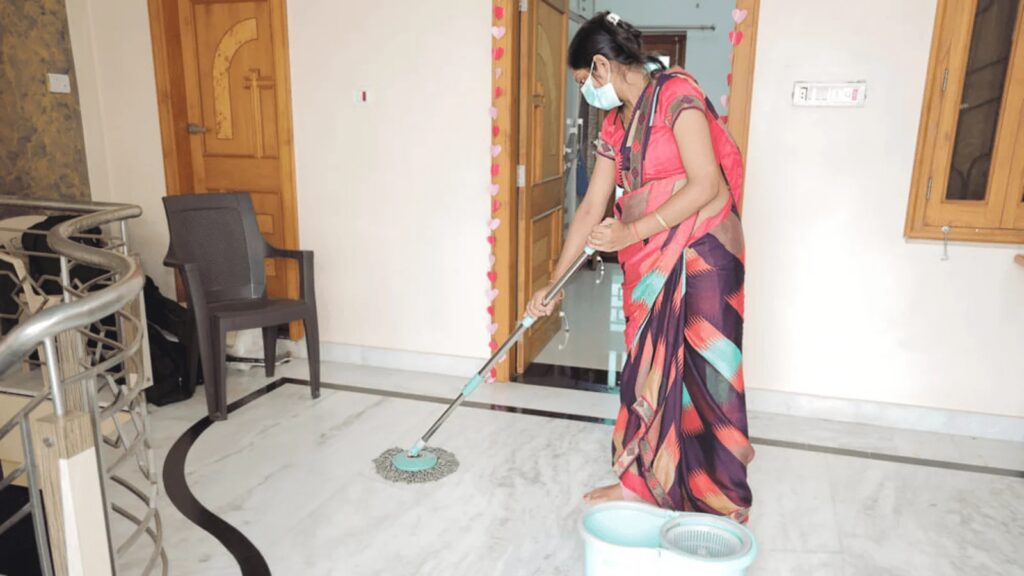
Kapashera is a densely populated settlement located near the Delhi-Haryana border, adjacent to Gurgaon and Manesar. The area houses thousands of migrants, mostly from Bihar and UP, who have come in search of work. While many men are employed in factories, a large number of women work as domestic workers in nearby middle-class and upper-class homes.
Housing in Kapashera is unaffordable and exploitative. Most families rent a single room, often without access to a toilet, for ₹2,500–₹3,000 per month. In one case, a woman reported that in lieu of paying the monthly rent of Rs. 3000, she performs unpaid domestic labour for her landlord—cooking, cleaning, and caregiving. Such arrangements blur the line between tenancy and servitude, echoing what Jan Breman (2007) has described as “neo-bondage” in urban informal economies.
Landlord-tenant relationships in Kapashera are marked by clear hierarchies. Landlords often exercise control beyond housing—dictating rules, interfering in domestic disputes, and in some cases, threatening eviction to discipline tenants. Women domestic workers, who already lack job security and formal contracts, find themselves doubly dependent—first on their employers, and then on their landlords.
During a group discussion in one building in Kapashera, a group of women shared a different, yet equally telling story. In the morning, they worked as domestic workers, and on some nights, they went to nearby factories where work continued into the night. They were paid ₹100 for a night shift, though they didn’t go daily. Contractors, they explained, informed them about “cut-piece” or stitching work, and if there was a need, they were called. Now, while the work is irregular, it adds to the household income. “Ek ki kamayi mein kya hi hoga, itni mehengayi hai, bacho ki fees, kuch nhi bachta”.
What stood out in this conversation wasn’t just the economic hustle—it was how they repurposed this precarious arrangement into something joyful and personal. One woman, whose daughter’s birthday was that day, proudly showed me a photo of a beautiful dress she had stitched using leftover fabric pieces from the factory. The dress was intricate and carefully made—evidence of skill, creativity, and love.
She and her neighbours were planning a birthday gathering with a DJ, food, and dancing. They invited me too. “Aap bhi aa jana didi,” one of them said. “Aap bhi toh Bihar se hi ho, humare yahan se.” This was more than just hospitality—it was a moment of shared identity, solidarity, and joy created in conditions of hardship. The gathering was a way to celebrate small victories, to assert dignity, and to hold on to a sense of community.
Noor Nagar: Muslim Ghetto
The situation in Noor Nagar is shaped by different dynamics but similar structural neglect. It is located near Jamia Millia Islamia, is a Muslim-majority settlement with a concentration of jhuggi clusters.The area includes several slum clusters, often ignored and neglected. Residents frequently lack access to sanitation, drainage, or regular water supply. Last year, a slum demolition drive in the area was temporarily halted after a court stay. But the threat of eviction continues to hang over families living in jhuggis.
Most domestic workers in Noor Nagar are also migrants from Bihar, along with some women from Nepal and Assam. However, sharp divisions exist even within the workforce. Some Bihari women workers pointed out that Nepali workers charge ₹1,000 for the same work for which they charge ₹2,000. This has led to informal segmentation, mistrust, and limited solidarity between groups. Employers often exploit these differences, preferring workers who accept lower wages. This reflects what sociologist Ashwini Deshpande (2011) has noted in relation to labor segmentation: caste, region, and ethnicity shape informal labor markets, often eroding possibilities for collective bargaining or solidarity. While all these women perform the same kinds of work—cooking, cleaning, caregiving—they remain divided by micro-hierarchies that the market exploits.
While women in both locations engage in paid domestic work, they also bear the burden of unpaid labour in their own homes—cooking, childcare, and care work. Many women reported working more than 12 hours a day in total, with no rest days, no medical benefits, and no support system. They are not recognised as workers by law and are excluded from social protection schemes. The concept of “emotional labor,” popularized by Arlie Hochschild (1983), is especially relevant here. Domestic workers manage their own emotions and those of the households they serve, constantly adapting to the needs and temperaments of employers while masking their exhaustion and vulnerabilities.
Now, as per the Child Labour (Prohibition and Regulation) Act, 1986, it states domestic work is prohibited employment for children only up to the age of 14, meaning that children above 14 can legally work under specified conditions (and the home is seen as a “safe” place of work). From newspaper reports to field encounters in resettlement colonies, it is evident that minors particularly adolescent girls are hired either privately or through agency, and face months, sometimes years of torture. In Noor Nagar, I met several such girls, concealing their age, yet embedded in domestic work arrangements with little scrutiny. A woman shared with me how a young domestic worker was accused of stealing a gold ring. The employer, instead of resolving the matter through dialogue or legal process, brought the police into the jhuggi cluster. Whether the girl actually stole the ring remains uncertain—but the more urgent question is: even if she did, why did she do it? Was it a desperate act of aspiration, a silent protest against indignity, or sheer survival in a hostile world?
Delhi, like many Indian metropolises, is imagined as a city of possibilities, a space of social mobility, economic aspiration. For many of us, as urban migrants, it represents the potential for breaking away from the constraints of our natal homes, caste identities, or rural limitations. Yet, this dream is not exclusive to the educated middle class; domestic workers—overwhelmingly women from historically marginalized castes and communities also arrive in the city with similar aspirations: for dignity, livelihood, and a future for their children. However, urban structures of labour, housing, and sociality continue to reproduce exclusionary boundaries.
As middle-class professionals, we often critique capitalist management structures, invoke Marx to protest the denial of paid leave or autonomy at the workplace, yet in our homes we replicate hierarchies that are even more exploitative. Without the non-wage labour of women, no wage-labour would be possible. Domestic workers are rarely given a single day off, are subjected to surveillance, and in many cases are denied even basic dignities such as being allowed to eat from the same utensils or sit on the same furniture. The home, often seen as a space of intimacy and care thus becomes a key site where caste and class inequalities are naturalized.
As one mother in Noor Nagar told me, “Hum apne bachon ko yahi kehte hain, kuch bhi karo, bas iss jhuggi se nikal jao beta.” ‘Their’ dreams, too, are urban, but the city offers ‘them’ something very different. It is not access, but alienation; not recognition, but regulation. This binary between ‘us’ and ‘them’ reflects a spatial and symbolic division where the middle class imagines itself as the rightful subject of the city, while domestic workers, sanitation workers, construction labourers—the ones who materially reproduce the city—are relegated to its margins, both geographically and socially.
Conclusion
The exclusion of domestic workers from labour laws in India not only reflects systemic undervaluation of feminized and informal work but also sets their socio-economic marginalization. At the same time, grassroots mobilization continues to challenge the invisibilisation of this labour. Organizations, collectives/unions like the National Domestic Workers Movement (NDWM) and the Self-Employed Women’s Association (SEWA) have played critical roles in collectivizing domestic workers, and having bargaining powers, but for substantial change there is still a long road ahead.
“They say it is love. We say it is unwaged work.” (Federici, 1975)
References:
Deshpande, Ashwini (2011): “Caste and Class: Changing Patterns of Dalit Discrimination in India,” Economic and Political Weekly, Vol. 46, No. 38, pp. 70-77.
Federici, Silvia (1975): “Wages Against Housework,” in The Radical Feminist Perspective.
Government of India (2024): “Ministry of Labour and Employment: Domestic Workers’ Protection and Welfare Policy,” Press Information Bureau, New Delhi, https://static.pib.gov.in/WriteReadData/specificdocs/documents/2024/mar/doc202435319501.pdf
Hochschild, Arlie Russell (1983): The Managed Heart: Commercialization of Human Feeling, Berkeley: University of California Press.
International Labour Organization (2018): “The Definition of Domestic Work and Domestic Workers for Statistical Purposes,” 20th International Conference of Labour Statisticians, Geneva.
Marx, Karl (1867): Capital: A Critique of Political Economy, Volume 1, Moscow: Progress Publishers.
Mies, Maria (1986): Patriarchy and Accumulation on a World Scale, London: Zed Books.
National Sample Survey Organisation (2012): The Employment and Unemployment Situation in India, New Delhi: Ministry of Statistics and Programme Implementation, Government of India.
Neetha, Neetha (2007): “Changing Labour Market and the Sexual Division of Labour: The Case of Domestic Workers in India,” Economic and Political Weekly, Vol. 42, No. 40, pp. 55-62.
Neetha, Neetha (2009): “Domestic Workers in India: Emerging Issues and Policy Options,” Indian Journal of Labour Economics, Vol. 52, No. 3, pp. 487-501.
Neetha, Neetha (2009): “Domestic Workers in India: The Feminization of Labour,” Economic and Political Weekly, Vol. 44, No. 17, pp. 37-45.
Sengupta, Nilanjana, and Samita Sen (2013): “Bargaining over Wages: Part-time Domestic Workers in Kolkata,” Economic and Political Weekly, Vol. 48, No. 4, pp. 55–62.
The Child Labour (Prohibition and Regulation) Act, 1986, Act No. 61 of 1986, Government of India, Ministry of Law and Justice, New Delhi.
(Daniya Tabassum is a PhD scholar in Sociology at Jamia Millia Islamia, New Delhi. Her research focuses on education, gender, and identity formation among Shia girls in madrasas. Her broader interests include food security, migration, gender, and informal labour rights. Courtesy: Countercurrents.org, an India-based news, views and analysis website, that describes itself as non-partisan and taking “the Side of the People!” It is edited by Binu Mathew.)
❈ ❈ ❈
Karnataka: Domestic Workers Bill a Good Step, But Some Concerns Persist
Madhulika T. and Mohan Mani
While the Bill represents a crucial step towards recognizing domestic work as real work deserving of protection, its success hinges on sound financial planning and legislative coherence.
The Karnataka government recently released a draft Bill on domestic work (‘Bill’) for public feedback and comments. Since Independence, several attempts, mostly through private members’ Bills, have been made to introduce a comprehensive central law to regulate domestic work. None, however, have materialized. In the absence of central legislation, several state governments stepped in to incrementally regulate the sector. States like Andhra Pradesh, Bihar, Karnataka, Kerala, Rajasthan, Jharkhand, and Odisha included domestic work under “scheduled employment” under the Minimum Wages Act, 1948, ensuring minimum wage protection.
Others, such as Kerala, Maharashtra, and Tamil Nadu, established welfare boards to provide social security benefits. If enacted, Karnataka will be the first state with a comprehensive legal and regulatory framework for domestic workers in India.
At first glance, the Karnataka government’s move to regulate a sector that has long operated outside the reach of labour laws is laudable. Yet, a closer reading of the draft reveals significant inconsistencies—particularly in its provisions on social security—which risk undermining the legislation’s effectiveness. For the Bill to achieve any meaningful success, it will require refinement before enactment.
For domestic workers, who are predominantly women, the absence of social security has been a longstanding concern. Underpaid and dependent almost entirely on the goodwill of employers during times of crisis, these workers lack institutional support in cases of illness, unemployment, or old age.
India’s two flagship contributory social security schemes—the Employees’ State Insurance (‘ESI’) Scheme and the Employees’ Provident Fund (‘EPF’) Scheme—do not cover domestic workers. Together, ESI and EPF address all nine branches of social security that the International Labour Organization (‘ILO’) identifies as essential for a decent standard of living. Yet, because these schemes require contributions from both employers and employees, and apply only to establishments hiring ten or more workers, large segments of informal workers, including domestic workers, remain excluded.
Where women workers have been included in ESI and EPF coverage, the outcomes have been transformative. In 2016, for instance, even rumours of proposed restrictions on withdrawals from provident fund accounts sparked large-scale protests by garment workers in Bengaluru, underscoring how deeply these protections matter. Studies have also documented significant uptake and reliance on ESI facilities among women garment workers in Karnataka.
Uncertainty regarding entitlements of domestic workers
Turning to the draft Bill, the scope of entitlements remains unclear. While it proposes extending ESI coverage to all domestic workers – which includes benefits such as sickness, disablement, and dependent benefits, unemployment allowances, and funeral expenses—it also introduces separate provisions for maternity and paternity benefits and funeral assistance, which already fall under the ESI framework.
This duplication creates uncertainty about whether domestic workers will, in practice, receive the full suite of ESI benefits. Further complicating matters, the Bill extends the Employee Compensation Act, 1923 (‘ECA’) to domestic workers, even though judicial precedent establishes that workers covered under ESI cannot simultaneously claim benefits under the ECA.
Additionally, ambitious welfare schemes demand a strong and sustainable financial foundation. However, the funding model envisioned in the Bill appears fundamentally unsound. The Bill proposes an employer contribution of “up to 5%” as a welfare fee. This framework raises two major concerns: first, it does not clarify the base on which this fee is to be calculated and second it allows the government to set any rate between 1 percent and 5 percent, even though a 5 percent contribution is itself grossly inadequate.
To illustrate this inadequacy, it helps to compare the proposed structure with social security contributions in the formal sector. Assuming that the welfare fee is to be levied on workers’ wages — the only logical base — the contrast becomes stark.
The employer contribution towards pension under EPF is 8.33 percent; in addition, 3.25 percent of employer contribution goes towards health cover under ESI. The total employer contribution towards both EPF and ESI for health care and pension thus adds to 11.58% of the formal worker’s wage.
Against this, the Karnataka Bill for domestic workers earmarks only 5 percent to cover all her social security benefits, including both health care and pension. The Bill seeks to offer comparable benefits under ESI and EPF for the domestic worker with only around 40 percent employer contribution towards these schemes as compared to the formal sector worker.
If we do the math, a domestic worker earning Rs.10000 per month from multiple employers can only hope to get a relatively limited health care cover under ESI as compared to the formal sector worker, and a pension of less than Rs.1000 per month at constant price and wage, after 35 years of service. Surely this is not adequate by any standards. There has to be an additional fiscal grant from the government each year to augment the social security fund for domestic workers if it has to be meaningful.
Finally, as a general principle, when the government proposes a new law that entails significant financial implications particularly one financed through a statutory fee such as the proposed 5 percent employer contribution, it must release a complementary financial document. This document should clearly project expected collections and detail how the resulting corpus would be allocated across the various welfare benefits promised in the legislation.
All in all, while the Bill represents a crucial step towards recognizing domestic work as real work deserving of protection, its success hinges on sound financial planning and legislative coherence. Without these, the Bill risks remaining an ambitious but ultimately a hollow gesture.
[Madhulika T is an independent labour lawyer and a research associate at the Center for Labour Studies, NLSIU. Mohan Mani is a visiting fellow at the Center for Labour Studies, NLSIU. Courtesy: The Leaflet, an independent platform for cutting-edge, progressive, legal & political opinion, founded by Indira Jaising and Anand Grover.]