The Lapdog Returns
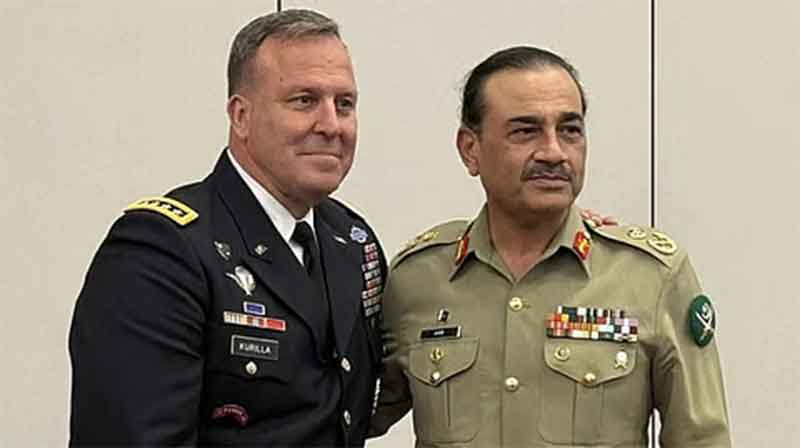
It is a curious spectacle, almost Shakespearean in its tragicomic absurdity, to watch Pakistan once again being marched—boots polished and tails wagging—into the waiting embrace of the American empire. Field Marshal Asim Munir, the latest self-anointed custodian of Pakistan’s destiny, is doing his utmost to restore the country to its former role: not as an equal, not even as a reluctant partner, but as the dependable lapdog of Washington, ever eager for scraps. It is as if the entire trauma of the so-called “war on terror,” with its rivers of blood, drone-struck weddings, and shredded sovereignty, was a mere rehearsal for yet another performance of obedience. And the Americans, as always, are delighted to see their old hound come limping back.
Washington’s New Obsession: India’s Insolence
The irony is thick enough to suffocate. For decades, the United States cultivated Pakistan as a proxy for its regional ambitions: first against the Soviets, later against the specter of terror that America itself had nurtured in Afghan madrassas. The generals in Rawalpindi cashed in on this arrangement handsomely—billions in aid, shiny new toys, immunity from accountability. Meanwhile, the Pakistani people paid the bill: hundreds of thousands dead or displaced, an economy on life support, and a society fractured by militancy generated by the generals and their American patrons. But today, in a grotesque twist of history, Munir and his cronies are parading the nation back toward the same abyss, as though the last forty years were a bad dream and not a reality written in blood.
Why? Because Washington has found itself a new itch to scratch: India. For decades, India was the prized pupil of American affection, a counterweight to China and a darling of Silicon Valley. But Modi’s government, intoxicated by visions of civilizational glory, refuses to bend the knee. New Delhi insists on buying oil from Russia, building the BRICS bloc into a credible alternative to Western hegemony, and proclaiming itself not just a regional power but a global one. This insolence cannot be tolerated. And so the old playbook is dusted off: reward the Pakistani generals, scold the Indians, and remind the subcontinent that only Uncle Sam decides who gets to strut on the world stage.
The Generals’ Hollow Victory
For Pakistan’s elite, this is manna from heaven. After years of being treated as a pariah—lectured, sanctioned, cut off from dollars—they are once again courted, petted, and praised. The recent skirmish with India, in which Pakistan’s Chinese-supplied military hardware humiliated India’s mismatched arsenal, was trumpeted by the generals as proof of their indispensability. But Pakistanis are not fools. They know that the credit belongs to the brilliance of Chinese-Pakistani scientists and the courage of ordinary soldiers, not the degeneracy of a general staff more interested in offshore accounts than national defense. The people see clearly: this was a victory achieved despite the generals, not because of them.
Imran Khan and the Movement for Justice
And yet the charade continues. Munir’s men strut across podiums, puffing their chests, while the kleptocrats in Islamabad sip champagne in private clubs. They believe that, by aligning once more with Washington, they have restored their legitimacy. But legitimacy is not so easily conjured in a nation where the imprisoned Imran Khan remains the most popular man alive, where his “Movement for Justice” refuses to die despite repression, censorship, and brute violence. The courage of Khan’s supporters—beaten, jailed, yet unbroken—shames the cowardice of the entire establishment. Khan may languish in a cell, but his defiance resounds in the streets, an echo of the people’s yearning for a politics unshackled from military tutelage and American diktat.
Beijing’s Calculated Patience
Meanwhile, China watches with its usual poker face. For Beijing, Pakistan is a crucial link in the Belt and Road, a laboratory for joint defense projects, and a rare ally in a hostile neighborhood. But Beijing is not naïve. It knows full well that if Washington is permitted to reestablish a foothold in Pakistan, it will not be Al Qaeda or ISIS that American drones are monitoring. The real target will be CPEC: the ports, the roads, the pipelines—the arteries through which China hopes to secure its energy lifelines and trade routes. Washington’s strategists, forever obsessed with encirclement, dream of sabotaging CPEC from within. And Field Marshal Munir, in his desperation for dollars and pats on the head, seems ready to hand them the keys.
The Afghan Farce
The comedy grows darker still when one considers Afghanistan. For decades, Pakistan cultivated the Taliban like a prized bonsai—nurtured, shaped, trimmed to size—only to now find itself besieged by the same creation. In a display of breathtaking hypocrisy, Islamabad now invites other Afghan forces to help confront the Taliban, and whispers eagerly about bringing the Americans back to fight “terrorism.” Terrorism, of course, being the very monster they themselves midwifed into existence. One imagines Hollywood screenwriters salivating: the nation that armed the Taliban now seeks salvation from the empire that armed Pakistan to arm the Taliban. You couldn’t make this up even if you wanted to.
CPEC’s Mirage
And yet, beneath the farce lies tragedy. For every cynical maneuver by the generals, every smug handshake in Washington, there are millions of Pakistanis who suffer. Inflation devours wages, electricity shortages cripple livelihoods, and the promise of CPEC has turned into a mirage of unpaid bills and half-finished projects. In Gwadar, the so-called crown jewel of CPEC, locals still live without clean water or reliable electricity. The people protest, but who listens? Certainly not the generals who prefer foreign bank statements to domestic grievances.
Even Beijing’s patience is wearing thin. Once willing to bankroll grandiose infrastructure schemes, China is now pivoting to smaller, private-sector projects, wary of Pakistan’s inability to honor its debts. Power companies remain unpaid despite sovereign guarantees, and Chinese firms increasingly prefer to invest in buses and factories rather than highways and megadams. Pakistan’s elite may still cling to the illusion that Beijing’s wallet is bottomless, but the truth is clear: China will not be played for a fool. And if forced to choose between a duplicitous Pakistan and safeguarding its trillion-dollar Belt and Road, Beijing’s pragmatism will prevail.
The People’s Judgment
Thus, Pakistan today stands at a crossroads, or rather, in the middle of a circus ring. On one side, the United States beckons with its leash, promising dollars and legitimacy in exchange for obedience. On the other, China demands reliability, discipline, and protection of its strategic assets. And in the middle of this tug-of-war, the Pakistani people are told to clap politely while their future is auctioned off. But the people are not clapping anymore. They are restless, angry, and aware. They see the generals for what they are: parasites in uniform. They see the Americans for what they are: empire-builders who prefer compliant clients to sovereign partners. And they see Imran Khan, battered but unbowed, as the lone figure who dared to imagine a Pakistan beholden neither to Washington nor Beijing, but to its own people.
Munir and his cohorts may believe they are clever, playing both sides, milking both empires. In truth, they are pathetic. They are men who mistake servitude for strategy, who think that groveling is diplomacy. They gamble with national sovereignty as though it were a stack of poker chips. But sovereignty is not a game, and nations are not poker tables. Eventually, the people will call their bluff.
Conclusion: A Leash Too Short
And when they do, when the streets of Pakistan once again erupt with the fury of a population betrayed, it will not be Washington’s embrace or Beijing’s investments that save the generals. It will be the judgment of their own people—the very people they have scorned, deceived, and impoverished—that will decide their fate. Pakistanis are not dumb. They know the difference between valor and venality, between patriotism and plunder. They know who fights for them, and who sells them.
The tragedy of Pakistan is that it has been ruled for too long by men who confuse obedience with wisdom. The hope of Pakistan is that its people, led by movements like Khan’s, refuse to be deceived forever. The Americans may feel smug, the generals may feel safe, but history is rarely kind to lapdogs. Empires tire of them, and nations, eventually, put them down. Pakistan’s generals should beware: their leash is shorter than they think.
[Prof. Junaid S. Ahmad teaches Law, Religion, and Global Politics and is the Director of the Center for the Study of Islam and Decolonization (CSID), Islamabad, Pakistan. He is a member of the International Movement for a Just World, Movement for Liberation from Nakba, and Saving Humanity and Planet Earth (SHAPE). Courtesy: Countercurrents.org, an India-based news, views and analysis website, that describes itself as non-partisan and taking “the Side of the People!” It is edited by Binu Mathew.]