❈ ❈ ❈
The Empire Comes Home
Stelios Foteinopoulos
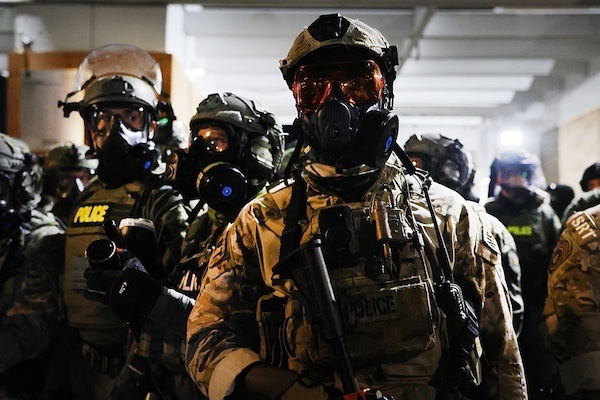
30 January 2026: The horrific events in Minneapolis–the killing of civilians amid militarised operations, armed raids in residential neighbourhoods, and the conversion of an American city into a spectacle of state violence–are not an anomaly but a stark manifestation of a pattern long identified by political scientists and historians. This pattern reveals a fundamental truth: the violence intrinsic to empire knows no topography. Minnesota shows how it seeps back into the foundations of the imperial state itself, transforming domestic policing, social control, and the very conception of citizenship.
For centuries, we have been taught a geography of power: the West acts, the rest suffers. We are told that imperialism is an external project, a theatre of conquest confined to distant shores where armies clash to seize resources. The colonial subject, the foreign ‘other’, is understood as the sole bearer of its brutal legacy. This framing allows the imperial core to imagine itself as separate, insulated, and morally distinct; its domestic tranquillity is seen as unconnected to its foreign brutality. It is a narrative of clean hands. While this is comforting, it is also dangerous.
Imperial Boomerang
The concept of the imperial boomerang posits that the technologies of control, the ideologies of racial hierarchy, and the architectures of violence normalised and perfected at the edges of empire eventually return to the metropolitan centre. Practices first justified in those ‘exceptional’ spaces–the colonies, the border zones, the black sites, the distant wars–cannot be contained. They build their own pathway back through bureaucracy, through institutional memory, through a mindset that starts seeing certain people as ‘deplorables’ in times of systemic crisis. Over time, these tools get a software update and are redeployed in the heart of the once ‘liberal centre’. The target gets relabelled: from the ‘savage’ abroad to the ‘enemy within’.
This dynamic was articulated with prophetic clarity by Aimé Césaire in his seminal 1950 work, Discourse on Colonialism. He dismantled the European conceit that the West had both grown itself through its colonies and ‘civilised’ itself in the process. On the contrary, Césaire argued, while colonialism materially enriched the imperial powers, it simultaneously brutalised them morally, politically, and socially. It required and cultivated a mindset of absolute racial superiority, administrative arbitrariness, and dehumanisation of the ‘other’ to function. For Césaire, European fascism–specifically Nazism–was not a historical aberration but a ‘boomerang effect’. It was the point at which the colonial model of violence, ‘racialised, massified, bureaucratic, and impersonal’, was applied on European soil to European (including white) bodies. This is what led political theorist Hannah Arendt to coin the term ‘imperial boomerang’.
‘They tolerated that Nazism before it was inflicted on them,’ Césaire wrote; ‘they absolved it, shut their eyes to it, legitimised it, because, until then, it had been applied only to non-European peoples.’ The horror of the Holocaust, in this reading, was the shock of Europe confronting a mirrored, intensified version of its own colonial logic.
The historical evidence for this reflux of imperial techniques is extensive. Consider the British Empire. The concentration camp was not invented by the Nazis but was systematically used by the British during the Second Boer War (1899—1902) to detain Afrikaner civilians and Black Africans. Methods of population control, surveillance, and collective punishment honed in Ireland, India, and Kenya–such as curfews, identity passes, and ‘strategic hamlets’–informed later policing and counter-terror strategies in the UK itself, particularly in Northern Ireland during the Troubles, and in the monitoring of immigrant communities post-9/11.
For the United States, this process is deeply embedded in its national narrative. The frontier and the plantation were the nation’s first internal colonies, where ideologies of racial extermination and subjugation were forged. The logic of counter-insurgency practised against Native American populations–attacking civilian encampments, forced removals–prefigured twentieth-century warfare. It also influenced the professionalisation of a more violent, expeditionary-minded U.S. military and fed into the brutal repression of labour movements, such as the 1914 Ludlow Massacre, where the Colorado National Guard attacked striking miners and their families with tactics reminiscent of colonial warfare.
Old Methods, New Enemies
The War on Terror of the twenty-first century has accelerated and digitised this boomerang effect. The post-9/11 paradigm created a global, permanent, and legally exceptional battlefield. Practices authorised in Guantánamo Bay, Abu Ghraib, and CIA black sites–indefinite detention without trial, enhanced interrogation (torture), mass surveillance, and signature strikes based on metadata–did not stay abroad. They fundamentally altered the domestic landscape.
The 1033 programme funnelled billions of dollars’ worth of surplus military equipment–from armoured vehicles (MRAPs) and helicopters to night-vision goggles and assault rifles–to local police departments. The police response in Ferguson, Missouri, in 2014, resembling an occupying army confronting an insurgent population, was a direct visual and tactical manifestation of this flow. And now ICE, an agency whose $30 billion annual budget matches the military budgets of Italy, Israel, and Brazil.
The ‘enemy within’: the ideological construct of a boundless, borderless war against terrorism legitimised the targeting of domestic groups, particularly Muslim, Arab, and South Asian communities, with entrapment strategies, no-fly lists, door-knocking, abductions of parents and five-year-olds, and more.
What is happening in Minneapolis is the institutionalised fruit of a carceral state built on a foundation of racialised control, enabled by the U.S. government. The empire has come home.
[Stelios Foteinopoulos is policy analyst specializing in European public policy and strategy, and a former EU adviser. Courtesy: Tribune Magazine, a socialist magazine established in 1937 to give voice to the popular front campaigns against the rising tide of fascism in Europe. For eighty years, it has been at the heart of left-wing politics in Britain, counting giants of the labour movement like Aneurin Bevan and Michael Foot among its former editors.]
❈ ❈ ❈
The Murderers Among Us
Eve Ottenberg
29 January 2026: Since Donald Trump took office in 2025, ICE has murdered at least 34 people in the U.S. It has deported 623,900 people. Those are not negligible numbers. They are the beginning – mark that, the beginning – of the ethnic cleansing of America. They are the first shot across the bow of any contraption or conglomeration that might oppose shipping nonwhites out of country. There are 68 million Hispanics in the U.S., and it’s safe to say that Scharfuhrer Stephen Miller wants to deport them all. Will Trump’s henchmen limit their ambitions to Hispanics? I doubt it. They and what journalist Mark Ames on X so aptly dubbed their Vichy collaborators aim to deport all “Third World” – racist code – citizens, legal residents, green-card holders, asylum seekers or illegal migrants.
So far resistance to this wickedness has been disorganized. True, there have been weeks of protest over Trump’s immigration crackdown. And there have been protests over the murders of Minneapolis mother Renee Good and ICU nurse Alex Pretti: two particularly egregious slayings, as both were American citizens who’d done nothing to provoke being killed. Good was sitting behind the wheel of her car when shot twice in the face, while Pretti had moved to help a woman, assaulted by ICE, which later lied, claiming he had a gun in his hand. He did not. He held a phone. True he was armed, but legally so: Minnesota is an concealed-carry state.
Department of Homeland Security Secretary Kristi “Unleash the ICE Gestapo” Noem described the Good incident as an attack on law enforcement. “I want to remind everybody that the act like we saw today, of using a vehicle to try to kill an officer…is something that every politician, every elected official, everyone in this country should be able to rally around and say that it is wrong…” Renee Good emphatically did NOT use her vehicle to attack federal agents, but Noem adds: “It was an act of domestic terrorism. What happened was our ICE officers were out on an enforcement action. They…were attempting to push out their vehicle and a woman attacked them…and attempted to run them over and ram them with her vehicle. An officer of ours acted quickly and defensively shot to protect himself and the people around him. And my understanding is that she was hit and is deceased…These vehicle rammings are domestic acts of terrorism.” Video footage from Good’s murder entirely contradicts Noem’s little oration.
Following these two atrocities, the weekend of January 24, DHS defied over 200 years of constitutional law and history by announcing it could break down people’s doors to enter their homes and arrest them without warrants. This is full-on police state garbage. Just like killing over 34 people is full-on police state garbage. The 32 other victims who perished in ICE custody in 2025 were described by the Guardian January 4: “They died of seizure and heart failure, stroke, respiratory failure, tuberculosis or suicide. Some died at ICE detention centers and field offices, others after they had been transferred to hospitals, but were still under ICE custody.” The article notes that ICE was holding 68,440 prisoners in detention in mid-December but nearly 75 percent of them had no criminal convictions.
ICE has zero, zip, nada, zilch respect for American citizens and less for the courts, which have, at least in the Pretti case, struck back. On January 25, U.S. District Court Judge Eric Tostrud “granted a temporary restraining order against the U.S. Department of Homeland Security…barring the department from altering or destroying evidence connected to Pretti’s killing…The Minnesota Bureau of Criminal Apprehension said DHS representatives blocked them from accessing the scene of the shooting, even though the bureau had obtained a judge’s signed search warrant,” CBS reported January 25. Meanwhile Pretti’s family “condemned what they said were ‘sickening lies told about our son by the administration.’”
Pretti’s murder was brutal. “A witness…said in a court declaration that the man was killed after he attempted to help a woman who had been pushed to the ground by federal agents…agents pepper-sprayed three observers, including Alex Pretti, before an agent shoved a woman to the ground, and Pretti went to help her…agents pushed Pretti to the ground…four or five agents had him on the ground and they just started shooting him,’ the witness said. ‘They shot him so many times,’” reported ABC News January 25.
The deaths of Pretti and Good were the most filmed, publicized and possibly the most dramatic of ICE’s many murders. But please don’t forget those 32 other people who died in ICE custody in 2025. The first was Genry Ruiz Guillen, 29, from Honduras, a construction worker caught by the police in late 2024, then locked away in a South Florida immigrant detention center. Another was Ethiopian, Serawit Gezahegan Dejene, 45, who’d begun applying for asylum. He died at a hospital in Phoenix, Arizona, after a stint in ICE custody. Then in February, Ukrainian citizen Maksym Chernyak, 44, after time in the Krome detention center in Miami, died of a stroke. And the list goes on and on.
With the Pretti murder, as Jeffrey St. Clair wrote in CounterPunch January 26, DHS “blocked the Minnesota state police from investigating the killing of a Minnesota resident and U.S. citizen, and the FBI shut down any internal investigation of the shootings. They refused to reveal the identity of the shooter and removed him from Minnesota to another jurisdiction and put him right back on the streets. That’s evidence of guilt.”
It’s worth noting that in 1967, long years after World War II, famous Nazi hunter later better known as unrepentant Zionist Simon Wiesenthal wrote a memoir called The Murderers Among Us. The book’s purpose was simple – having lost nearly 90 family members in the Holocaust, Wiesenthal decided to hunt the escaped perpetrators. The idea, presented in the book, that these killers had merged back into an apathetic postwar society is relevant to what is going on in the U.S. today – on a so far much smaller scale – with ICE. Smaller scale yes, but the general idea is the same: Trump’s DHS appears determined to pass off ICE crimes as legitimate and the perpetrators as heroes just doing their jobs, who will never have to pay any price. If that happens, ordinary citizens like Good and Pretti will have died, obscenely, with no justice.
How apathetic are the strata of American society? Well, so far the news from officialdom, i.e. the U.S. congress, is dispiriting, to say the least. Dems chant that “this version” of ICE must be replaced, while polls show that the vast majority of Americans are not concerned with different “versions” of ICE, because they want ICE defunded, period. So the official opposition not only doesn’t get it, but functions more like the aforementioned Vichy collaborationists. And we all know how they were dealt with, once fascists lost power.
So Dems need to wake up and sponsor bills to eliminate the ICE Gestapo, not “fix” it. The American people already got the memo, their representatives haven’t, and I’d bet that they won’t, until ICE shows up at their homes and breaks down their doors. Then, of course, it’ll be too late.
[Eve Ottenberg is a novelist and journalist. Her latest novel is Booby Prize. Courtesy: CounterPunch, an online magazine based in the United States that covers politics in a manner its editors describe as “muckraking with a radical attitude”. It is edited by Jeffrey St. Clair and Joshua Frank.]
❈ ❈ ❈
Undeterred by Freezing Temps, Statewide Minnesota Strikes Demand ‘ICE Out Now’
Julia Conley
23 January 2026: Twin Cities residents are weeks into the Trump administration’s deployment of thousands of federal immigration agents in an operation that has seen a legal observer and young mother fatally shot; US citizens dragged out of their homes and vehicles by masked officers; one of President Donald Trump’s top Border Patrol officials lobbing a gas grenade at lawful protesters; children as young as 2 detained; and armed agents seemingly lurking around every corner.
But the trauma inflicted on the cities during “Operation Metro Surge” appeared only to have strengthened residents’ resolve to push US Immigration and Customs Enforcement (ICE) out of Minnesota on Friday as residents filled the Minneapolis’ downtown area to march in subfreezing temperatures and assembled at a nearby airport through which an estimated 2,000 people have been deported.
The demonstrations were part of a “no work, no school, no shopping” general strike that labor, faith, and community leaders and businesses have joined in calling for in recent days as outrage has grown over ICE’s arrests of immigrants and citizens alike and attacks on residents’ First Amendment rights.
Demonstrators carried signs reading, “ICE Out Now,” “Stop Pretending Racism Is Patriotism,” and “Stop Disappearing Our Neighbors.”
Businesses and cultural institutions were closed in solidarity across the city and the state on Friday; Truthout reported that about 700 businesses shut their doors across Minnesota, while businesses that remained open planned to donate their proceeds from the day to immigrant rights groups.
Organizers said about 100 clergy members were arrested at the Minneapolis-St. Paul International Airport protest. They were among the protesters who blocked the road at a departures terminal, singing, “Before this campaign fails, we’ll all go down to jail, everybody has a right to live.”
According to union leaders, 12 airport workers are among the Minneapolis-area residents who have been detained by ICE in recent weeks.
Chelsie Glaubitz Gabiou, president of the Minnesota Regional Labor Federation (MRLF), AFL-CIO, acknowledged that the weather on Friday was “dangerously cold.”
“Negative-10°F with wind chills. Like the high is going to be -10°F with wind chills of up to -20F,” Glaubitz Gabiou told the Guardian. “We are a northern state, and we are built for the cold, and we are going to show up.”
Organizers said the goals of the general strike were for ICE to leave Minnesota, the ICE agent who killed Renee Good earlier this month to be held legally accountable, and no additional federal funding for ICE operations.
Seven US House Democrats joined the Republican Party in passing a funding bill for the Department of Homeland Security this week. The legislation still needs to get through the Senate.
Nationwide, data has shown that nearly three-quarters of people arrested by ICE have had no criminal convictions, but the Trump administration has continued to claim it is detaining the “worst of the worst” violent criminals, even as agents have clearly been shown arresting people who are authorized to be in the US and have no criminal records.
[Courtesy: Common Dreams, a US non-profit news portal.]
❈ ❈ ❈
In the Twin Cities, A Massive Strike Against ICE
Luis Feliz Leon
27 January 2026: Icicles hung from the beards of men in union beanies. The lobbies of large commercial buildings in downtown Minneapolis opened to the public for respite filled with people rubbing each other’s sore feet, peeling the sticky adhesive off foot warmers to place them under their socks, and jamming their feet into thickly insulated boots.
On January 23, what looked like more than 50,000 people marched in downtown Minneapolis in a protest dubbed “ICE Out of Minnesota: Day of Truth and Freedom.” They braved temperatures as low as -20°F, with their glasses fogging over, the frost crusting into a thin film. They were demanding that Immigration and Customs Enforcement and its thousands of masked agents wielding war-style weaponry leave the metropolitan area. They also demanded the prosecution of the agent who killed legal observer Renee Good, and that Congress reject additional funding for ICE.
The first major event began around 10 a.m., a protest at Minneapolis–Saint Paul International Airport organized by clergy and community groups. They called on Delta Airlines and Signature Aviation to stop facilitating deportation flights through the airport.
One hundred clergy sang and kneeled on the road in an act of civil disobedience, heads bowed in prayer for the immigrants abducted by ICE. The faces and names of abducted UNITE HERE Local 17 members graced oversized posters. Almost 1,000 other protesters joined the action.
The largest mobilization came in the late afternoon, when workers and community groups marched through downtown for a rally at the Target Center sports arena, home of the state’s two professional basketball teams, the men’s Minnesota Timberwolves and the women’s Minnesota Lynx. The rally, which featured the presidents of the Service Employees Union (SEIU), the American Federation of Teachers (AFT), and the Communications Workers of America (CWA), filled almost all of the 20,000 seats.
Up one flight in a commercial building and across a passageway leading to a dining area, workers found the metal grates of restaurants pulled down, their chairs on top of tables. It was a brief moment of basking in the exuberance of what they had pulled off: a citywide shutdown that echoed the Minneapolis general strike of 1934 and the national “Day Without Immigrants” political strike of 2006.
At the AT&T call center where she works, “they only have about 20-30 people, out of over 100, who are still working,” said Lori Wolf, a CWA Local 7250 member. At “any of the local retail stores, they were offered to stay home or leave work with no pay without any consequences.”
Business Calls for ‘De-Escalation’
While workers shook from the frigid weather outside, the chief executives of Minnesota’s biggest employers shook with frightful thoughts about what was in store if mass action continues to surge nationwide.
CEOs from 60 of them, including Target, U.S. Bancorp, the Mayo Clinic, and 3M, issued a mealy-mouthed open letter on January 25 calling for “de-escalation of tensions,” without explicitly demanding that ICE leave the state.
But hundreds of smaller businesses had closed on Jan. 23, posting signs on their doors in solidarity. “I’m driving down Lake Street, which is usually bustling, and lots of businesses are empty,” said Kip Hedges, a former Minneapolis airport baggage handler and Machinist.
Members of the United Food and Commercial Workers (UFCW) Local 663 at Half Price Books’ locations in the Twin Cities and Peace Coffee pressured their employer into closing. “They had lots of conversations with their individual store managers on why it was important to close up shop that day, and the store managers put pressure on the company,” said Local 663 executive board member Paul Kirk-Davidoff, a sausage-maker for Seward Community Co-op. All of the UFCW union-shop grocery co-ops, which employ hundreds of workers, closed down. Members and leaders joined the march with their union banner.
Employers of members of UNITE HERE Local 17, OPEIU Local 12, IATSE Local 13, SEIU Local 26, and AFSCME Council 5 closed for the day. These included cultural institutions, clubs, and restaurants, among them the Minneapolis Institute of Art, the Minnesota Science Museum, the Guthrie Theater, the American Swedish Institute, Bichota Coffee, and seven First Avenue music venues. Others operated with minimal staffing.
Many immigrant-owned businesses closed, including those in Karmel Mall and Hmongtown Marketplace. Others had closed before the day of action, whether because workers were too scared of ICE to come in, or because owners decided they’d close until the chaos unleashed by federal agents abated. Some businesses may have closed due to the weather, as the day’s high of -9°F was one of the coldest days of the 21st century.
It’s not possible say how many workers withheld their labor or shut down their employers. But from the large windows of a skyway between buildings in downtown Minneapolis, it looked like some 50,000 to 100,000 demonstrators were in the streets, snarling traffic, lifting banners, and waving handmade signs in gloved hands.
Three Shot
The strike came after federal agents faced off against Minnesotans defending their neighbors from abductions in Minneapolis and St. Paul. Federal agents have arrested an estimated 3,000 people.
They have shot three people and killed two American citizens, Renee Nicole Good and Alex Pretti, who was an intensive-care nurse at a Veterans Affairs hospital and a member of the American Federation of Government Employees Local 3669. He was executed the day after the march. They shot and wounded Julio Sosa-Celis. They also abducted 5-year-old Liam Ramos along with his father.
A Department of Homeland Security official called the Jan. 23 strike “beyond insane,” adding, “Why would these labor bosses not want these public safety threats out of their communities?”
Minnesotans have also organized peaceful protests and sit-ins at Target and D.R. Horton, the country’s largest developer of single-family homes, to demand that the companies stop collaborating with ICE. Postal workers and airport workers have also rallied to get ICE agents kicked off postal property and bar federal immigration agents from the Minneapolis-St. Paul airport (MSP).
“What keeps me going is seeing people being organized and being out here,” said Feben Ghilagaber, an airport-food service worker from Eritrea and a steward with UNITE HERE Local 17, at the airport rally on January 23. “I’m not scared of the cold. I’m more scared of ICE right now. They’ve been abducting a lot of my co-workers. But also my co-workers haven’t been working. They are staying home hiding.” In total, 36 union members from UNITE HERE Local 17 and SEIU Local 26 have been abducted by ICE from the Twin Cities since last year.
Hamsa Hussein, a Somali Uber driver organizing a union with SEIU Local 26, said he has seen a 30 percent drop in his income, because “nobody goes out. People are scared to go to grocery stores, school.”
ICE agents harass him even in the lot where cabs wait to pick up passengers at the airport, he added. “They ask you, ‘Are you a citizen?’ If you say, ‘Yes, I am a citizen,’ they ask you, ‘Where were you born?’ And it is an illegal question. I’ve been here for almost 17 years. So I am not afraid to come out for my rights. They stop me every day, two, three times to ask silly questions that I cannot accept. If you say, ‘I’m a U.S. citizen,’ they look at your accent. They say, ‘Oh, your accent is different.’”
That intimidation has stiffened the drivers’ resolve. Three years ago, says Hussein, the organizing committee had a few hundred members. Now, it has 3,000. “When they see what the union is doing, they get energized and they get confidence,” he said.
Airport Arrests
Some 2,000 people have been deported through the airport. “We want to make the point that we want ICE out, and we want MSP to do something about it,” said Renee, a retired associate teacher, who taught all grades and subjects. “Our children in our schools, where I used to work, where I volunteer now, they’re afraid to come to school, the children of color.”
At the airport, police outfitted in riot gear lined up behind the clergy, zip-ties clasped to their uniforms, issuing warnings to stop blocking the road.
“Everybody’s got a right to live,” the clergy sang, clad in snow suits, heavy winter coats, ski goggles, and insulated boots. “Before this campaign fails, we’ll all go down to jail.”
Then cops picked them off the road one by one, binding their hands, and loading them onto school buses.
The rules governing airports are stringent. If flight attendants get arrested at the airport, they can lose their SIDA (Security Identification Display Area) badge, which is required to work in the secured parts. But one flight attendant came to the MSP protest anyway. She said that she’s concerned about the Department of Homeland Security using the airport for deportation flights because of the inhuman treatment of immigrants “boarding planes in shackles.”
She also recounted an incident where DHS agents in civilian clothes pressured a flight attendant to page a passenger. “Mind you, these DHS agents were in civilian clothes, just jeans and sweatshirts,” she said, asking for anonymity to protect herself from retaliation.
“Turns out those agents wanted an apology from this passenger, because the passenger said in the gatehouse what they were doing was shameful,” she said. The agents made it clear that they wanted to remove him and put him on another flight the next day, she said, but the passenger, a U.S. citizen, was ultimately able to board “after a ten-minute shouting match.”
The flight attendant suspected that the agents most likely got the passenger’s name from the gate agent, “if they were doing facial-recognition boarding.”
“There has been no guidance from our airline, or from what I gather, from any other major airline on what our rights are and what we are expected to do in those situations,” she added.
But Minnesota has known many tough situations. “I was in the streets in 2016 when [Trump] first got elected. I was in the streets in 2020 getting pepper sprayed after George Floyd’s murder,” she said. “Minneapolis stands strong every time. We’ve been through so much here, but we always persevere, and you can see it every day the community comes together.”
Thousands Called in Sick
The St. Paul educators pressured the district into shutting down. “In 1946, our predecessors went on the first organized teachers’ strike in U.S. history. They went on strike for toilet paper and books, two pressing needs at the time,” SPFE Local 28’s executive board wrote in a message to members on January 13. “Their strike was illegal. This decision was not made lightly, and educators did what was necessary to meet the needs of their students.”
“We are at a time where people must choose what side they are on. And just like in 1946, SPFE chooses to be on the side of our students and our St. Paul community,” the board said, adding a caveat that “SPFE is asking each member to decide for themselves how they will answer the call to this Day of Action, and to this moment at large.”
That approach worked. On January 22, educators organized an action, wearing stickers in support of their students and the community. Thousands called in sick ahead of Jan. 23, overwhelming the substitute teacher system. The district closed schools because of the frigid weather.
The Minneapolis Federation of Educators had a grading day, meaning teachers could opt to grade at school or remotely. But a sea of blue MFE hats were visible at the colossal march, though no official figures are available for member participation.
Working Around No-Strike Clauses
The unions involved in organizing the day’s walkout included Service Employees Local 26, hospitality workers (UNITE HERE Local 17), telecom workers (CWA Local 7250), grad workers (GLU UE Local 1105), bus drivers and mechanics (ATU Local 1005), stagehands (IATSE Local 13), office workers (OPEIU Local 12), municipal workers (AFSCME Council 65), doctors (SEIU-CIR), and the Minneapolis and St. Paul educators’ unions.
The statewide AFL-CIO, the Minnesota Federation of Labor, also signed on after five of its regional bodies did. Other endorsers included houses of worship and an array of immigrant rights, women’s, tenant, and racial-justice groups, along with the workers center Centro de Trabajadores Unidos en Lucha (CTUL).
Multiple union sources confirmed that they were giving members a nod-and-wink to skip work by raising safety concerns, using sick days or personal days to work around no-strike clauses. The St. Paul Federation of Educators Local 28 and SEIU Local 26 committed to the fight before they had the legal coverage to do so, creating workarounds to ensure a mass walkout would succeed without resulting in a lockout or retaliation.
UNITE HERE Local 17 members marched on the boss to demand businesses close and ran petitions asking for workers taking the day off to return to work without discipline. They had strong protection in pressing these demands, because Minnesota’s Earned Sick and Safe Time law requires most employers to provide paid leave for illness, injury, preventative care, and caring for children missing school due to a snow day.
The decision to close the school districts gave workers an extra layer of protection, said Sheigh Freeberg, secretary-treasurer of UNITE HERE Local 17. He estimates about 500 members participated from restaurants and other venues.
Starbucks Workers United, still fighting for a first contract, took six stores out on an unfair-labor-practice strike and called for ICE to leave the state.
At the University of Minnesota, union members and student groups reduced operations. The university’s management attributed it to the extreme cold, and allowed faculty and grad workers to work remotely. But it also issued a stark warning against using sick time, saying workers could only use vacation or personal time with supervisors’ advance approval.
Graduate workers maneuvered around those restrictions. “I didn’t have direct discussion with my department but my chair is really pro-labor,” said one in the humanities department who asked to be anonymous. “He sent out an email after the university’s email, about how to take time off without violating your contract.”
A worker in another department said supervisors weren’t sticklers for filling out time sheets. “In my case, we were able to flex our time—meaning we did a little more of our work earlier in the week in order to take the day off partially or entirely.”
While the Minnesota Nurses Association and Amalgamated Transit Union Local 1005 endorsed the call, their members continued to work. “I know some called out but, yeah, it must have been low,” said Ryan Timlin, a bus driver and Local 1005 steward. “From what I could tell, light-rail service had minor disruption.” The main disruption to buses was the size of the march in downtown Minneapolis.
The ATU would have had the most leverage to shut the city down. Another point of leverage was large employers in the suburbs. “A shutdown of the massive UNFI warehouse in Hopkins, for instance, would have shut down grocery deliveries to pretty much the whole state,” UFCW Local 663’s Kirk-Davidoff wrote in his Substack, Twin Cities Labor Report.
ICE Going Door-To-Door
General contractors have been struggling to find construction workers. Rumors are flying about jobsites where as many as 80 percent of workers aren’t coming in. A local organizer showed me a screenshot from a Ring camera showing ICE agents going door-to-door in a Latino neighborhood in Minneapolis. The workers in the home shared it with a rapid-response network, so someone could scout the area to tell when the federal agents had left.
“Because of the presence of immigration enforcement, we haven’t been working these past few days,” said Alexander, a siding and roofing worker who asked to only use his first name, in Spanish. “My boss made the decision for us to take a break from work due to the risk, and we’ve already been without work for four weeks.” During those four weeks, he said, “we’ve relied on the support of CTUL and also the support of some brothers from my church.”
The fear is also on school playgrounds. “In my classroom, we have kids learning at home, and we can’t go outside to recess because we are fearful of our kids being snatched up. We’re also fearful for our staff being snatched up,” said Ashley Penney, a first-grade teacher at Pillsbury Elementary in Minneapolis and a member of MFE Local 59. Many parents, she added, were afraid to protest “because they have children at home, and we don’t know how ICE is going to behave, if they’re going to come here and be a threat to those kids.”
“There are people who are scared for their safety just because they’re Black or brown, even if they are a U.S. citizen,” said Penney. About the protests, she said, “Everyone is participating, but it’s just a matter in what way safety would allow them to participate.”
What Would I Have Done?
Last summer, Josh Musikantow, a security guard at RSM Plaza and a member of SEIU Local 26, traveled to Louisiana as part of a cross-country bus tour called “Justice Journeys” to visit detainees there, including Rümeysa Öztürk, a member of SEIU Local 509, and United Auto Workers Local 2710 member Mahmoud Khalil, who had been abducted by federal agents for their free speech and political activities to demand an end to the genocide in Gaza.
“They thought they would never have protesters there, but we did go there,” he said. “I saw some of the detainees there, and we made sure that they knew that the world was watching. And we marched there, on one of the hottest days in the summer, and now today, we marched in Minnesota, on one of the coldest days in the winter.
“We’re going to keep fighting. If they think they’re going to ship people out in the middle of nowhere, we’re still going to go there and fight for them,” said Musikantow. “We’re going to show [ICE] that we don’t want them here. We’re going to do whatever we have to do.”
“Everyone asked themselves, if I was alive during the Holocaust, what would I have done? And if you think honestly, I think we know, because what we’re doing now, that’s what you would have done,” said Musikantow.
“I really believe that never again is now, and that it applies to everybody. I am a Jew. If I see something happening to other people that happened to us, I’m going to fight against it.”
[Luis Feliz Leon is a staff writer and organizer with Labor Notes. Courtesy: Labor Notes, a media and organizing project in the USA that has been the voice of union activists who want to put the movement back in the labor movement since 1979.]
❈ ❈ ❈
In another article published on ‘In These Times’ on January 24, 2026, Thomas Birmingham and Ari Bloomekatz add (A Staggering Number of Minnesotans Took to the Streets Friday to Demand ICE Leave. The Next Day, ICE Responded by Killing Another Resident):
About 50,000 protesters took to the streets in downtown Minneapolis on Friday to demand ICE and its thousands of federal agents immediately leave the state and stop brutalizing and killing residents and, as recently as Tuesday, snatching preschoolers.
The next morning, ICE agents responded to Friday’s economic shutdown, acts of civil disobedience, and uprising in the seemingly only way they know how: by beating, shooting and killing.
In this case, it was 37-year-old Minneapolis resident and Alex Pretti, an ICU nurse who was shot and killed Saturday morning.
“I just saw a video of more than six masked agents pummelling one of our constituents and shooting him to death,” Minneapolis Mayor Jacob Frey told reporters on Saturday during a press conference.
[In These Times is an American independent, nonprofit magazine dedicated to advancing democracy and economic justice.]
❈ ❈ ❈
From Maine to Minnesota and Beyond, Tens of Thousands March to Demand ‘ICE Out!’
Brett Wilkins
30 January 2026: Popular outrage over President Donald Trump’s deadly campaign targeting immigrants and their defenders sparked a National Shutdown day of protests across the United States on Friday, as people from coast to coast took to the streets demanding an end to US Immigration and Customs Enforcement’s “reign of terror.”
“No school, no work, and no shopping,” the National Shutdown said on its website. “The entire country is shocked and outraged at the brutal killings of Alex Pretti, Renee Good, Silverio Villegas González, and Keith Porter Jr. by federal agents.”
“While Trump and other right-wing politicians are slandering them as ‘terrorists,’ the video evidence makes it clear beyond all doubt: They were gunned down in broad daylight simply for exercising their First Amendment right to protest mass deportation,” the campaign continued.
“Every day, ICE, Border Patrol, and other enforcers of Trump’s racist agenda are going into our communities to kidnap our neighbors and sow fear,” the protest organizers added. “It is time for us to all stand up together in a nationwide shutdown and say enough is enough!”
One week after an estimated 50,000 protesters marched in downtown Minneapolis for the “ICE Out of Minnesota: Day of Truth and Freedom” rally, at least tens of thousands of people braved subzero wind chill temperatures to protest the ongoing Operation Metro Surge blitz in the Twin Cities.
Rock icon Bruce Springsteen—who this week released a song called “Streets of Minneapolis” to pay tribute to activists fighting Trump’s assault on immigrants and American democracy—made a surprise appearance at a benefit concert for the families of Good and Pretti.
Maine Public Radio reported that over 150 businesses, mostly in the Portland area, closed their doors Friday amid Operation Catch of the Day, during which ICE enforcers have arrested hundreds of people in the Pine Tree State.
“Today, the working class of Portland has sent a clear message to those in power: Your power is derived from our labor, and we are not afraid to withhold our labor for the safety of our neighbors,” South Portland retail worker Keeli Parker told MPR.
In Chicago—where ICE’s Operation Midway Blitz prompted a special commission appointed by Democratic Illinois Gov. JB Pritzker to recommend the prosecution of federal agents who violate people’s constitutional rights—Nick Mayor, co-owner of Brewed Coffee in the Avondale neighborhood, told the Chicago Sun-Times that the cost of closing his business for the day “pales in comparison to the cost of what is happening to other people and their families, with their lives getting taken and torn apart.”
More than 1,000 people packed into Washington Square in downtown Salt Lake City, Utah, where protesters chanted slogans including “Power to the people, no one is illegal,” and, “No justice, no peace, we want ICE off our streets!”
Three hundred miles southwest of Salt Lake City in St. George, Utah, dozens of demonstrators rallied in the city center, holding signs reading, “ICE Out” and “the wrong ICE is melting.” One disapproving motorist yelled, “Go back to California” while driving by, the Salt Lake Tribune reported.
In Los Angeles, Proof Bakery, a worker-owned cooperative in Atwater Village, also shut its doors for the day.
“We want to show solidarity,” Proof Bakery worker-owner Daniela Diaz told KABC. “We’ve seen historically that strikes work. I hope the violence stops. I want ICE out of our communities.”
Hundreds of high school students walked out of their classrooms in Asheville, North Carolina, where sophomore Henry Pope told the Mountain XPress, “We reject the ICE terror that’s sweeping across our communities.”
“We reject everything this far-right, billionaire administration stands for, and we need justice to be brought to Jonathan Ross and every other killer ICE agent in this country,” Pope added, referring to the officer who fatally shot Good earlier this month.
Kelia Harold, a senior at the University of Florida in Gainesville, rallied on campus with around 100 other students.
“Instead of sitting on my own and being helpless, it really helps to come out here,” she told the New York Times, noting Pretti’s killing.
“If that could happen to him,” she said, “I don’t see why it couldn’t happen to anyone else.”
[Brett Wilkins is a staff writer for Common Dreams. Courtesy: Common Dreams, a US non-profit news portal.]
❈ ❈ ❈
Students Join Nationwide Strike to Abolish ICE
Phil Pasquini
Novato, California (January 31) – On January 30, thousands of people across the Bay Area and in cities nationwide joined a major daylong Free America Walkout strike, by rallying, marching, and protesting to demand the abolition of ICE and in resistance to President Trump’s immigration crackdown calling for an end to all ICE operations that have led to the deaths of two peaceful protesters, Renee Good and Alex Pretti in Minnesota.
In the small northern Marin County town of Novato, students walked out of their classrooms to join the nationwide strike, in solidarity with “No work, no school, no shopping” to protest the killings and kidnappings of immigrants by ICE. Participants demanded an end to ICE’s ongoing violent abuses and unlawful actions, condemning its defiance of the U.S. Constitution and the widespread turmoil it has caused across the country.
The Novato Unified School District and others countywide granted students permission to peacefully participate in the strike during a two-hour window in a show of support and solidarity with Minnesotans. The school district supported students wishing to participate allowing them to do so without penalty. Student participation also served as a live civic lesson in exercising First Amendment Rights.
Rallying outside of City Hall, the large number of student protesters from elementary to highschoolers chanted and held signs calling for ICE Out. One student held his handmade sign saying that “My dog is a better president.” Several others questioned the “humanity” of ICE regarding the kidnappings and killings while one noted “I Like My country Like I like my water, No ICE.”
Regarding the many controversies surrounding ICE, Indivisible Novato, along with other concerned citizens and human rights activists, have mounted a campaign of protests and direct actions calling on the County Board of Supervisors to “Stop the Sheriff from working with ICE.” The Marin County Sheriff’s Office, through its voluntary participation in the federal grant program, State Criminal Alien Assistance Program (SCAAP), has established a lucrative financial relationship by reaping a $1,000 payment for each “Captured Immigrant” who is turned over to ICE custody when released from jail.
SCAAP funding reimburses participating agencies in covering the costs incurred for salaries, training and incarceration of “undocumented criminal aliens.” To receive the funds, the personal information must be provided to the DOJ for each detainee. Many California cities have refused to cooperate in the program due to sanctuary policies that disallow such cooperation or on moral grounds.
According to activists, during the past three years the Marin County Sheriff’s Office has received $1.2 million for processing more than one thousand immigrants, while participating California law enforcement agencies statewide in 2024 collected $59.4 million according to a Congressional report released in 2025.
[Courtesy: Countercurrents.org, an India-based news, views and analysis website, that describes itself as non-partisan and taking “the Side of the People!” It is edited by Binu Mathew.]
❈ ❈ ❈
Trump’s Tactical Retreat in Minneapolis: The Danger of Dictatorship Remains
Patrick Martin and Joseph Kishore
27 January 2026: Over the past 24 hours, the Trump administration has been forced into a tactical retreat following the state execution of ICU nurse Alex Jeffrey Pretti by federal immigration agents in Minneapolis. The retraction, however, is not an abandonment of its authoritarian course—It is a recalibration. The threat of dictatorship remains as present and grave as ever.
Facing a wave of public outrage and protest, the White House has sought to walk back the most inflammatory lies and attacks issued by Trump’s top officials in the immediate aftermath of Pretti’s killing. On Monday, Karoline Leavitt, the White House press secretary, pointedly did not defend statements by Stephen Miller and Homeland Security Secretary Kristi Noem, who labeled Pretti a “domestic terrorist” who tried to “assassinate” law enforcement. Leavitt instead insisted that “we will let the facts lead” and claimed, in an obvious lie, that “nobody in the White House, including President Trump, wants to see people getting hurt or killed.”
At the same time, the administration removed senior Border Patrol official Gregory Bovino from Minneapolis, whose false claims about Pretti were among the first to circulate. Several agents are reportedly being withdrawn, and Trump’s tone has shifted—from blaming Minnesota Governor Tim Walz for “inciting violence” to hailing a phone call with him as showing they were “on the same wavelength.”
This shift is not the result of moral reconsideration or pressure from Democratic politicians. It is the outcome of mass protests, mounting popular anger and a growing movement throughout the country about the need for a general strike. The White House understands that the murder of Alex Pretti—coming just two weeks after the execution of Renée Nicole Good in the same city—has provoked the most serious political crisis of Trump’s second presidency.
This limited pullback only underscores how Trump’s rampage has been facilitated by the Democratic Party. For the past year, the Democrats and media presented Trump as an unstoppable force, claiming that nothing can be done but wait for the next elections. In fact, Trump’s ability to carry out a rampage against the Constitution has depended entirely on the complicity, silence and cowardice of Democratic officials at every level.
To interpret this partial withdrawal as evidence that the threat has passed would be a fatal mistake. The administration is not abandoning its plans for a presidential dictatorship. The invocation of the Insurrection Act remains on the table. Trump has repeatedly said he will be a “dictator on day one,” and he is making good on that threat. This is not the first time a despot has thrown a number of underlings to the wolves, if only temporarily, to regroup, and anything Trump does one day can be immediately reversed the next.
It is striking that amid all the initial cheering from the Democratic Party-aligned media about the supposed triumph of “democracy,” not one word has been said about the fact that Donald Trump, the orchestrator of this reign of terror, remains in office. No one has been held accountable. Alex Pretti’s killers remain unnamed and at large. The instigators of the crime—above all, Trump himself, along with White House adviser Stephen Miller, Homeland Security Secretary Kristi Noem, ICE Acting Director Todd Lyons, and FBI Director Kash Patel—remain in power.
Leading Democrats are moving rapidly to spread complacency, defuse popular anger and portray the situation as under control. On Monday, Minnesota Governor Tim Walz described his phone call with Trump as “productive.” This is the same Donald Trump whom Walz had accurately described just 12 days earlier as carrying out “a campaign of organized brutality against the people of Minnesota.” What changed?
According to Trump, Walz “called him” and said they should “work together.” In response, Trump pledged to send border czar Tom Homan to Minnesota and to ensure cooperation in transferring “any and all criminals” in state custody to ICE. Trump declared the call “very good” and claimed that he and Walz were “on a similar wavelength.” Trump’s spokesperson made clear that the administration’s goal remains the forced handover of all undocumented immigrants, with the full cooperation from state and local police.
Walz’s office, for its part, echoed the warm tone. It stated that Trump had agreed to “work in a more coordinated fashion on immigration enforcement regarding violent criminals” and to consider “reducing the number of federal agents in Minnesota.” The governor’s office even claimed that Trump would help ensure “independent investigations” into the killings of Alex Pretti and Renée Nicole Good.
This statement is an insult to the intelligence of the public. It implies that the chief instigator of the repression will now ensure a proper investigation of the crimes his administration ordered and defended.
The consensus within the US ruling class on the need to try to shut down the protests in Minnesota was expressed in the decision of the Wall Street Journal to publish an op-ed column by Minnesota Governor Walz. The ultra-right newspaper, owned by billionaire Rupert Murdoch, has criticized Trump’s handling of immigration as unnecessarily provocative, editorializing that the killing of Alex Pretti “calls for rethinking how ICE conducts itself, especially in Minneapolis as tensions build.”
In his column, while reiterating certain criticisms of Trump’s methods, Walz maintained that Minnesota is in fact cooperating with ICE by handing over immigrant prisoners for deportation, and declared, “Everyone wants to see our immigration laws enforced.”
The greatest fear of the Democratic Party is not dictatorship, but the independent intervention of the working class. Their central political objective is to block, disorient and suppress the development of a mass movement from below. They also want to create better political conditions to pass all funding bills to prevent a government shutdown—to keep financing the Trump administration and, in particular, the massive apparatus of imperialist aggression with no disruption.
The protests of January 23, which brought over 100,000 people into the streets of Minnesota, were not organized by the political establishment. They arose from the working class and from the youth. The demand for a general strike is gaining momentum. In schools, hospitals, factories and warehouses, workers are discussing how to fight back.
This is the most significant development in American political life. What frightens the ruling class is not just the exposure of a crime. It is the emergence of a mass, working class movement that threatens the dictatorship not only in form but in substance—that is, the dictatorship of capital.
The movement that has been set into motion must not stop. The demonstrations, strikes and mobilizations must continue and deepen. Preparations must advance for mass action, including a nationwide general strike. All the conditions that drove tens of thousands into the streets remain: ICE murders and raids, mass detention and deportation, the escalation of global war, the growth of fascism, and above all, the domination of society by a financial oligarchy that is incompatible with democracy.
This regime is not pulling back. It is regrouping. Its agenda remains: a police state at home, conquest abroad and the defense of obscene wealth and power through repression and violence. The working class must respond with even greater determination and clarity of purpose—through organization, unity and the building of a revolutionary socialist leadership.
[Courtesy: World Socialist Web Site, the online publication of the International Committee of the Fourth International.]