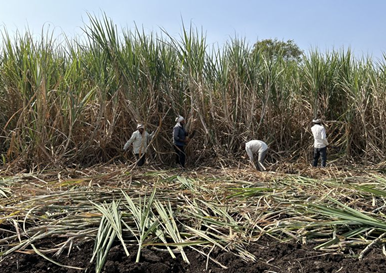
The Deadly Toll of Sugar on Marathwada’s Soil
Amitha Balachandra
[Maharashtra is the second largest producer of sugar in India. The water-thirsty crop is on the rise even in dry regions such as Marathwada at the cost of its soil and people’s health. A six-month investigation by The Wire explored the wide-ranging consequences of defying nature to grow water-intensive sugarcane in the region and why expansion continues.]
1. The Ecological Impact of the Sugar Boom
Maharashtra’s sugarcane fixation has been brutal to its soil. Data analysed by The Wire shows that sugarcane occupies less than a tenth of the state’s agricultural land but sucks up four times more water than wheat. Two out of ten irrigated hectares grow sugarcane in the state. Experts say it leaves the soil dead in its wake. The crop’s insatiable thirst is supplemented with pesticides, fertilisers and water that is running out. Yet, farmers are at its mercy.
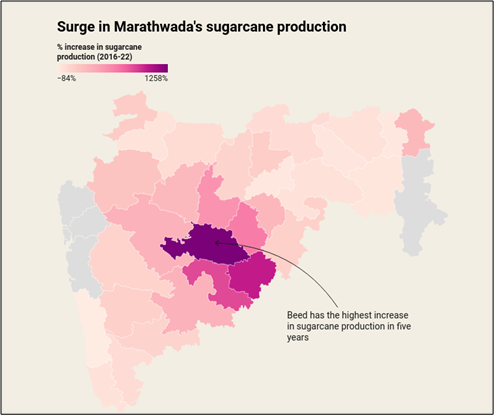
A deep dive into the 10-year area, production, and groundwater data in the state after scraping and analysing it as well as our own independent testing of a soil sample shows just how intensive farming of this thirsty crop is draining wells and slowly killing the soil. Despite this damage, its production has nearly doubled since 2012 in drought-prone Marathwada’s districts such as Beed, Jalna, Chhatrapati Sambhaji Nagar, and Parbhani when compared to the state average, according to our data analysis.
The investigation reveals that excessive sugarcane farming in Marathwada is depleting carbon from the soil, which plants need to stay healthy. Soil in most districts in Marathwada are also deficient in iron.
The Wire travelled to Beed, Dharashiv and Jalna, some of the districts with degrading soil in Maharashtra, to investigate why farmers grow sugarcane despite the consequences.
Drought-prone Marathwada ramps up sugarcane
Marathwada is a dry region of a rainy state: an unlikely candidate to go big on water-thirsty cash crops. The region receives approximately 800 mm of rain, lower than other regions in the state. Despite this, sugarcane thrives in Marathwada.
Some parts of Marathwada receive even less than the region’s already below average rainfall. Farmers in Sonimoha village of Dharur tehsil in Beed district, for instance, often complain of lack of water. That has not deterred Ramraj Tonde, a farmer, from growing sugarcane on half of his four-acre land.
Tonde remembers how he kept the crop “alive” in 2023 with borewell water. “We did a little bit of drip and sprinkler. That’s why it’s alive. It rained in June (2024). Some died and some survived,” says Tonde. Farmers like Tonde are used to the fluctuating weather pattern, but continue to depend on sugarcane.
Defying nature by drilling deeper is becoming the norm to keep up sugar production. As sugarcane farming grows, the use of groundwater in the region is also on the rise. Our analysis shows Maharashtra pumps nearly three times more water for irrigation than India’s average. The state’s production of water-thirsty crops such as sugarcane, rice, cotton and wheat, has increased by one and a half times over ten years compared to India’s average. A significant portion of the water is used to grow sugarcane. Farmers in the region, where droughts are frequent, end up using groundwater when the rain is inconsistent.
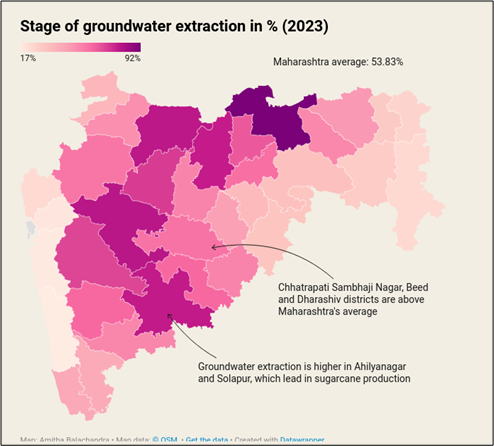
This water-guzzler needs anywhere between 1500 and 3000 mm of rainfall to grow well, exceeding the average rainfall of Marathwada. Beed and Chhatrapati Sambhaji Nagar districts used up more groundwater than other districts in the region between 2012 and 2023 to grow water-thirsty crops, according to Central Groundwater Board data.
The data shows that as of 2023, seven out of nine blocks assessed by the central groundwater board in the district of Chhatrapati Sambhaji Nagar were semi-critical when it came to groundwater extraction. Two out of eight blocks assessed in Dharashiv were semi-critical. One in 10 of the blocks assessed in Latur were semi-critical. This means the amount of groundwater being extracted is coming close to being exhausted. The other districts, including Beed, in the region were in the safe zone, meaning their groundwater extraction had not exceeded 70%.
Experts worry rampant sugar production would be a deterrent even for safe zones, particularly in drought years.”The Maharashtra Groundwater Act-2009 is in force, and it has many provisions that no one can drill deep-wells below 60 metres (approx. 200 feet). But there are no serious efforts at any levels implementing that Act on ground or regulating it, supervising its implementation,” says Eshwer Kale, senior researcher at Watershed Organisation Trust.
Government effort to slow sugar production fails
In 2016, when the region was reeling from a severe drought, with barely any water in the dams, the government called for a temporary ban on sanctioning new sugar mills in the region for five years. The verbal statement did not suppress sugar production. Our analysis of the government’s data shows a nearly sixfold increase on an average from 2016 to 2022. There has been a dip in production the last two years.
The Marathwada region is not the highest sugarcane producing region in the state, but the water stress here is an issue during drought years. Districts such as Ahilyanagar (formerly Ahmednagar) and Solapur in Maharashtra produce more sugarcane in the state overall. They also have high water stress, but also get better rainfall than Marathwada. Agriculture experts concede that the rate at which sugar is growing in Marathwada, which struggles for water in most years, is a concern.
“Earlier, wells were not more than 50 feet deep. Now, bore wells, tube wells, are more than 1000 feet deep. And that means all the soil water is depleted and the soil aquifers have become bankrupt,” says H. M. Desarda, economist and former member of Maharashtra State Planning Commission.
‘Growing Jowar, Bajra not sustainable’
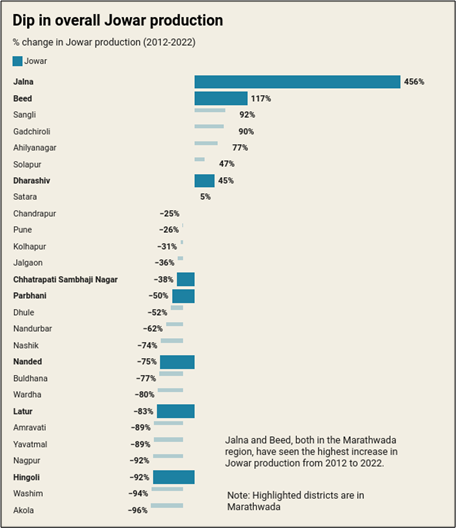
Sugarcane growth in the region means farmers are abandoning traditional, more labour-intensive crops such as jowar, bajra and ragi. The production of jowar went up in Beed, Jalna, Chhatrapati Sambhaji Nagar and Latur districts in 2016 due to successive droughts that made sugar difficult to grow, but has begun to dip again in the last five years.
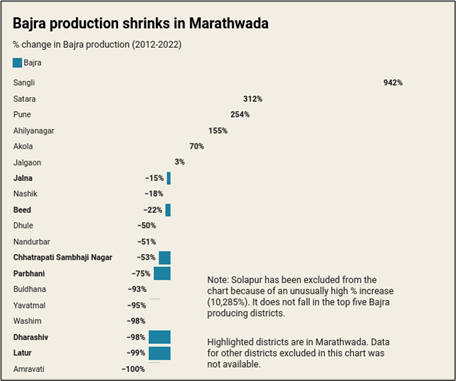
Farmer Ramraj Tonde largely grows jowar, bajra and other pulses for personal consumption. It requires a lot of labour and the returns are low. Sugarcane, on the other hand, takes 12-18 months to mature and can be harvested multiple times with minimal labour.
Tonde is not the only farmer who has stuck to sugarcane. Mahesh Magar, a farmer in Dharashiv’s Shingoli village, switched to this water-thirsty crop in his five-acre land three years ago. He has drilled up to 500 feet to ensure there is enough water for the crop and is quick to dismiss jowar and bajra as unsustainable.
“The government gives ration to a number of people… Who is going to eat jowar? What’s in the ration? Wheat, rice. They get it for 1 rupee a kilo. Who eats Jowar for 20 rupees a kilo?,” asserts Magar.
The Union government declared 2023 as the International Year of Millets. Maharashtra followed suit and launched ‘Millet Mission’ to encourage farmers to change their cropping patterns. When asked what the Maharashtra government has done in the last one year, R. S. Naikwadi, the director of agriculture, extension and training, said the government was “making an effort” and that they are “seeing a difference on ground” but there is “no data on demand”. Naikwadi admits the challenge is that these crops are labour intensive.
Farmers turn to less thirsty but still risky soybean
While millets have seen a slump, changing weather in the region has increased the production of short-duration cash crop, soybean, which brings profits and its own environmental risks. This rainfed crop does not require as much water as sugarcane. According to agricultural data from the Directorate of Economics and Statistics on area, production and yield, soybean has the highest area of cultivation in this region after cotton.
Farmers stick to cash crops such as soybean and sugarcane because of the returns. This, despite sugarcane’s yield in Marathwada being slightly lower than other sugarcane producing districts such as Ahliyanagar (formerly Ahmednagar) and Solapur. While soybean may be better for the water table, it has not improved the region’s soil quality.
“Farmers have gone after soybean or short duration cotton crops because that takes care of the changing weather and crop patterns. But that doesn’t remain all the while because weather is not stable and this cropping pattern which has destroyed the soil fertility is not sustaining the yield,” says economist Desarda. “So, it is just like antibiotics, you take more pills and still it doesn’t cure because of the resistance. Same way, the soils have become in a way dead.”
Flooding sugarcane fields adds to the water stress
Farmers flood their fields for sugarcane. This is particularly a problem in a dry region growing a water-thirsty crop as it leeches vital nutrients from the soil. Drip and sprinkler can help save at least half the water required for flood irrigation. Despite being one of the top five states leading in drip and sprinkler irrigation methods, the adoption is still low. Every four out of 10 hectares in the state is irrigated using drip, according to our analysis of the government’s micro-irrigation data.
The Union government and the state bear almost half the cost of both drip and sprinkler sets as subsidies to farmers owning five hectares of land under the ‘Per Drop More Crop’ scheme. Small and marginal farmers are given 55% subsidy whereas other farmers are given 45% subsidy. Maharashtra went a step further and said it would bear an additional 25% for small and marginal farmers and 30% for other farmers to push them to utilise the scheme.
Farmers, however, say there is a lot of delay in the government reimbursing their money. “When the budget comes, we have to give from our pocket. And after two to three years, the money is deposited in the account,” says farmer Mahesh Magar.
Apart from saving water, fertigation through drip – a method of applying fertiliser through an irrigation system – is also effective. Mahesh Waghmare, assistant professor of soil science and agricultural chemistry at College of Agriculture in Dharashiv says farmers flood their fields because it is an easy way out. “10 to 20 percent farmers are applying the fertiliser through fertigation. But they have the labour problem. And fertigation technology adoption is more cost(ly).” says Waghmare.
The bitter cost of sugarcane farming
Intensive sugarcane farming and flooding fields drain the region’s soil but farmers see no alternative. Ramraj Tonde, a farmer in Beed, admits his crop’s growth has decreased over time. He has to regularly add fertiliser to sustain his yield.
The region’s soil health data by the government mirrors the findings on ground. Most districts that are growing water-thirsty crops, particularly sugarcane, have poor soil health wherein these soils have lost many vital nutrients. The Wire looked at soil organic carbon data, which determines the quality of the soil.
Organic carbon regulates the crop’s ability to hold water. It also helps microbes thrive and is a vital indicator for soil health. Our analysis of soil data shows that most districts in this region have suboptimal organic carbon. Dharashiv and Parbhani in Marathwada have very poor organic carbon, according to the soil health card.
If the organic carbon is not optimal, which is the case in most districts, it leads to the imbalance of other vital macronutrients (nitrogen, potassium and phosphorus) and micro-nutrients such as iron, zinc, and sulphur.
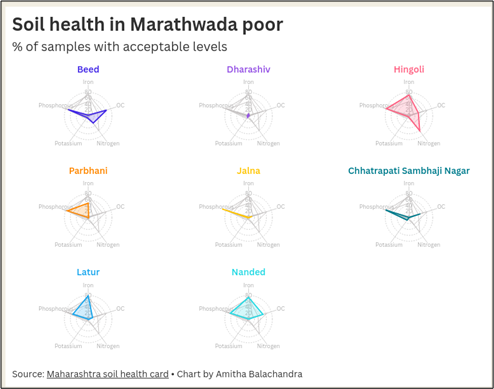
The Wire analysed these vital nutrients in Maharashtra from the government’s soil health card and found that the soil in most districts of Marathwada are deficient in iron. Jalna, Beed and Chhatrapati Sambhaji Nagar districts have the worst levels of iron deficiency in the region. Low iron in soil causes yellowing of leaves and affects the growth and productivity of the crop.
Several other farmers in the region agree that the quality of the soil has suffered because of sugarcane, but feel they have no choice. Farmer Chhagan Andhale, who is also a party worker for BJP and a contractor for a sugarcane factory near Beed’s Pimpla village, primarily grows sugarcane in his 15-acre farmland and relies heavily on fertilisers as a quick fix to increase yield. “This year we have added 5 quintals [of fertiliser] for sugarcane. Next year we will have to add 1 [more] quintal for sugarcane. The fertility of the soil is decreasing. That is why every year we are adding more fertiliser,” says Andhale. All the farmers we spoke to grew climate-resilient crops only for consumption.
Heavy and indiscriminate use of fertiliser is a huge impediment to regenerating healthy soil. The Deputy Director of Agricultural Engineering department at the Maharashtra Institute of Technology, Deepak Bornare, regularly tests farmers’ soil samples in his government recognised private laboratory and often finds soil organic carbon very low because of farmers growing the same crop year after year and their reliance on fertiliser.
“If 1% (organic carbon) is there, then proper flora and fauna will be maintained, microbial count will be good, and further processing, where there is good conversion of fertiliser in different elements. To do that, living things are needed. If they are in proper quantity, then soil health will be maintained,” says Bornare.
Independent investigation: Findings from the soil sample
The Wire set out to do its own soil testing and came up with the same poor results that validate the official government soil health card. We collected a soil sample from Shivraj Nivare’s farm in Georai tehsil of Beed district with the help of the Krishi Vighyan Kendra (Agricultural Science Centre) officials, and gave it for testing at Maharashtra Institute of Technology’s private lab in Chhatrapati Sambhaji Nagar.
Nivare last tested his soil 10 years ago. Like Nivare, several farmers in the region either don’t test their soil regularly because they don’t want to incur the expense or are not aware of the benefits of soil testing. Each district in the state has a Krishi Vighyan Kendra (Agricultural Science Centre) which serves as a knowledge and resource centre to help farmers with the schemes of the government along with other technology. These centres also help farmers test their soil for macro and micronutrients to determine how healthy their soil is.
Experts say that it is imperative for these officials to spread awareness on the benefits of soil testing. “It is important to go from land to lab but also from lab to land. Why is it not compulsory like the census? Just like humans and livestock, do a soil census also. Do a follow up every three years so that you have a benchmark,” asserts economist Desarda.
Nivare, who owns five acres of land in Georai’s Khamgaon village, had just planted sugarcane at the time of the collection in December 2024 after growing soybean in the kharif season.
The results of the investigation confirmed the soil health data findings and painted an even more grim picture. We found that the soil sample had low levels of almost all vital nutrients – including nitrogen, iron, and organic carbon. This was similar to the region’s data which showed how districts with heavy dependence on water-thirsty crops had low iron and organic carbon. The iron level in the soil was three times lower than the acceptable value.
But what happens to the food we eat when the iron levels in the soil are low? In Part 2, we look at the health consequences of bad soil as a result of intensive monocropping and who pays the price.
2. Could Soil Deficient in Iron Be Fuelling Anaemia in Marathwada?
Twenty two-year-old Jyoti Gharat had to take iron-folic acid tablets every day after she found out she was pregnant late last year. When she didn’t take her medication, she would often have headaches. Gharat was diagnosed with anaemia five months into her pregnancy. She constantly worried that her condition might affect her unborn child. “I had weakness in my hands and legs. The doctor asked me to increase my red blood cell count,” said Gharat, a homemaker who moved to Beed city along with her husband as soon as they got married.
The first thing Gharat’s doctor in Beed asked her was what she was eating. He gave her a list of things to add to her diet. The problem was that she had already been eating everything her doctor had suggested.
Like Gharat, 22-year-old Dipali Kadam, also a homemaker, visited multiple hospitals in Maharashtra’s Beed, including private ones when she fell sick. After taking a number of tests to identify other underlying issues, her blood reports also showed low haemoglobin. “I felt dizzy. My legs hurt. When my BP was low, I felt nauseous,” said Kadam, who was prescribed iron supplements as well.
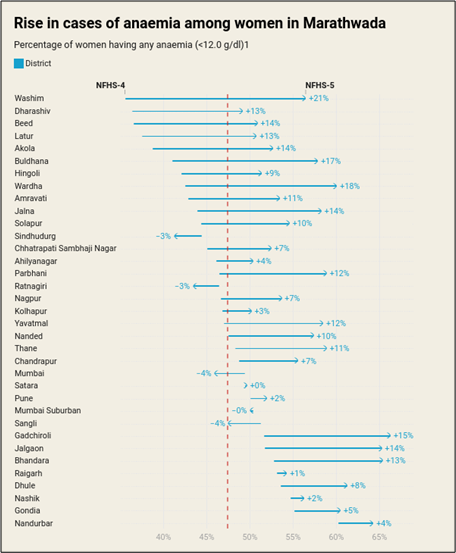
Several women The Wire spoke to in November last year, between the ages 18 and 30, in drought-prone Beed and Dharashiv districts of Maharashtra, were either undergoing treatment for anaemia or had just recovered. The government’s National Family Health Survey data validates this finding – cases of anaemia have gone up in all districts of Maharashtra’s driest region, Marathwada, between 2015 and 2021.
In part two of a six-month investigation by The Wire into Maharashtra’s sugar boom exploring the wide-ranging consequences of defying nature to grow water-intensive cash crops, we seek to unravel a paradox: as the state profits from sugar, many local women are becoming sicker.
The food on our plate: How nutritious is it?
The science is fairly straightforward. Soil that is leached of its nutrients could impact the meals on our plates. While monocropping depletes iron and other nutrients in the soil as reported in the first part of our series, residents who eat locally grown crops could be suffering the consequences.
The National Family Health Survey data underscores the problem – Beed and Latur districts have seen the highest increase in anaemia levels among women in Marathwada. Both districts are top sugarcane producers in the region. Beed also has deficient iron in the soil. Cases of anaemia in Parbhani, Jalna and Nanded districts in Marathwada are higher than Maharashtra’s average.
These women were referred to us by the district health office that tracks their well-being through community health workers in the region. Most of the women monitored by the health workers were homemakers as they were unable to cover women who migrate to work in sugarcane fields.
Scientific research explains how poor soil health could translate into less nutritious food. A study published in Scientific Reports by US researchers in 2023 helps connect the dots by correlating soil iron availability with haemoglobin levels in women. The paper links iron deficiency in soil with the amount of iron-rich food we eat, but also acknowledges that multiple factors contribute to anaemia. This is significant because globally, India has one of the highest prevalence of anaemia among women of all ages, according to the WHO.
The paper stops short of establishing a direct causal impact between the soil iron and anaemia levels in women because of other limitations such as income levels of households, lack of granular data at the district level, and lack of data on the uptake of iron into the crop.
“We know at the district level, what the average levels of soil, iron, and other nutrients are. But within a district, the individuals that we observe in the NFHS data, we don’t know where they are exactly located and what is the soil quality in their vicinity directly,” explains one of the authors of the study, Hemant Pullabhotla, a senior lecturer with the department of economics at Deakin University in Australia. “It’s possible that places that have poor soil quality may also suffer from other disadvantages. The quality of soil may have eroded due to poor land management practises or they may have less access to more iron-fortifying food or higher iron-rich foods in general in dietary patterns.”
We had to rely on anecdotal reports from the women we spoke to in Marathwada about their dietary patterns, and we could not establish a clear connection regarding where their food was sourced from or whether their doctors’ advice was ineffective.
The Deputy Director of Agricultural Engineering department at the Maharashtra Institute of Technology, Deepak Bornare, also points at several variables including the source and non-availability of the food for lack of consumption. “We don’t know which location they have consumed the food from. Food rich in nutrients may not be available locally because of the larger market pattern,” says Bornare.
Anaemia levels among women: What data tells us
While there are several limitations, our anecdotal reporting showed that high anaemia levels was a recurring problem among women we spoke to in Beed and Dharashiv. Jyoti Gharat said she was anaemic the first time she got pregnant as well and she was used to taking iron-folic tablets. “I had 6 points (haemoglobin) then, it increased to 10 because of medicines,” said Jyoti whose doctor told her what to eat but did not explain whether the food she was already eating was a problem.
Among the other women we spoke to at the city hospital in Beed, who didn’t want to speak on record, there were those who had recovered from anaemia faster because they could afford to buy medicines. Farmer Chhagan Andhale in Beed, who owns a car and has over 15-acre land, says the women in his family take tablets for B12 deficiency.
Dr Vijay Ramachandra Gholve, a gynecologist in Beed, who sees a higher prevalence of such cases in women and children points at inadequate nutrition as the biggest cause. “They are mostly neglecting their health – they are not getting nutritious food,” says Dr Gholve.
Accredited Social Health Workers (also known as ASHA workers) often bridge the gap between patients and primary healthcare centres by conducting door-to-door health surveys. They are the point of contact between patients and the hospitals. “Sometimes when they come to the hospital, they don’t eat. We advise them not to do that. We tell them to eat at least some breakfast,” says Alka Magar, an ASHA worker in Dharashiv.
While not eating iron-rich food could lead to anaemia, the National Institute of Nutrition conducted a study last year which said our food’s nutritional value has declined over the last 30 years. When asked for a comment, the National Institute of Nutrition said they “didn’t have data on the nutritional level change over time”. In 2021, a book called Frontiers in Plant-Soil Interaction, written by a group of researchers, linked iron deficiency in soil to poor iron concentrations in food grains, in turn potentially contributing to iron deficiency in human beings.
“In monocropping, nutrients are taken up or absorbed from a particular layer of the soil or particular zone of the rhizosphere. This means if you continuously grow only one crop, the uptake will be continuous from that zone, that is why nutrient deficiency is more in the monocropping system,” says Harihar Kausadikar, professor of soil science at Vasantrao Naik Marathwada Krishi Vidyapeeth in Parbhani.
Women growing sugar suffer health consequences
While we were only referred to residents of these districts by the health officials and community health workers, we also spoke to women who migrate to work in sugarcane fields. Health consequences as a result of this work are massive, whether they are travelling long distances or staying and cutting locally and cultivating their own food as well.
These women not only cook and look after the nutritional needs of their families but also work in the fields without a break. This causes a number of complications – anaemia being one of them. We had to rely on information by non-profits and anecdotal reporting on migrant workers due to lack of granular data at the district health office.
Mahila Kisan Adhikar Manch (MAKAAM), a forum for women farmers’ rights, conducted a study right after COVID, when the migrations had begun, to assess the health issues women were facing. “We did see the haemoglobin reports of several of the sugarcane workers, which were very, very concerning. So I think clearly there is an issue there, and that leads to multiple other health problems,” says Seema Kulkarni, senior fellow at SOPPECOM (Society for Promoting Participative Ecosystem Management) and national facilitation team member at MAKAAM. The network works with migrant workers to empower women and ensure their human and health rights are not violated.
These migrant workers are usually under the care of a contractor (also known as mukadam – a middleman between sugarcane farmers and factories). For months together, they live out of makeshift tents in poor conditions, earning just enough to repay their debt.
In Beed however, we found a potential change in migration patterns because of the increase in sugarcane production from 2012 to 2022. Many women who were engaged in cane cutting said they were residents of Beed and have had to migrate fewer times over the years.
Small farmer and cane cutter Sindhubhai Ghule is one of them. She decided to grow cotton in 10 guntha (0.25 acre) and sugarcane in 30 guntha (0.74 acre) of her farmland last year to repay her loan. She has been travelling to neighbouring Karnataka for 25 years to cut cane, but has no savings left. She took about 1.5 lakh loan from moneylenders and says growing sugarcane, even for a short period, is the only way to repay some of her debt. The families, residents of Beed, cutting cane for her, have not had to migrate far away as the sugarcane fields in Beed are growing.
“The pattern earlier used to be that, you move out of, let’s say, Beed or Parbhani or Jalna, some of the major districts into either Western Maharashtra or Karnataka and you stay there for that final four to six months. But now what we are seeing is that people may come back from there and then in Beed itself, there is a crop to harvest,” says Kulkarni.
The women, however, continue to suffer health consequences.
Independent study finds a link between soil and anaemia levels among farmer households
Certain networks are experimenting with empowering women to grow their own food and eat better. MAKAAM runs a programme in six districts of the state encouraging women to grow mixed crops without using chemicals.
Watershed Organisation Trust (WOTR) conducted a project called the ProSoil project (supported by the German Society for International Cooperation) in 21 villages of Ahilyanagar, Dhule and Jalna districts post COVID to promote better soil health and nutrition. As part of the nutrition component, 25 farmer households each were selected across six villages to test the correlation between anaemia levels and the food they ate. After an initial orientation, farmers began growing multilayer farms with a variety of organic vegetables, free of chemicals, on part of their farm, and grew cash crops on the rest.
“We planned their dietary balance. What should they eat within a week, how many times should they eat eggs, etc. We monitored them over a period of three years,” says Nitin Kumbhar, senior researcher at Watershed Organisation Trust.
The family members’ blood was checked for haemoglobin levels before the experiment and after. There was a noticeable positive change in the haemoglobin levels, according to the organisation.
Farmer Kailas Teple’s family found that, after growing and consuming vegetables from their backyard over a period of three years, their haemoglobin levels did improve. Kailas Teple could see a considerable difference in his soil quality after he used organic manure.
Kailas Teple is not alone. Farmer Radheshyam Teple used fertiliser in two acres of his land and organic manure in the other two acres at the time of plantation during the COVID pandemic to see what difference it would make. He says his input cost went down by Rs. 10,000 over two years because he ended up using less fertiliser for the organic soil.
Scaling up this project and implementing these practices were challenges. “To do it on a large scale, it requires a lot of hard work. These days, the trend is to buy from the market. Many farmers benefited from this [project]. Some people said that their medical expenses have reduced,” says Kakasaheb Wadekar, senior assistant at Watershed Organisation Trust, who helped with this project for the non-profit on ground.
Is the government doing enough?
Certain government initiatives are trying to achieve similar climate-resilient agriculture practices among women farmers. The state government came up with the nutri-garden initiative to improve nutritional deficiencies in households. Dipti Patgaonkar, programme coordinator at the Krishi Vigyan Kendra (Farm Science Centre) in Chhatrapati Sambhaji Nagar, says that it has empowered women to grow their own vegetables, but scaling up is a challenge.
“So in our area, especially in the university, they recommended bio-fortified bajra, because it has more iron, more zinc, and we introduced it to the farmers. On a large scale, it will take time,” says Patgaonkar.
District health officials in both Beed and Chhatrapati Sambhaji Nagar refused to speak on record about the health outcomes in the region. The recently suspended civil surgeon of Beed’s district hospital, Dr. Ashok Thorat, asked us to delete his video and not to carry his quote, despite having spoken on record, due to fear of negative coverage.
Women like Jyoti, whose second son was healthy at birth, got better with the tablets she was prescribed. However, they have also become used to taking medication with each pregnancy.
3. How Sugarcane Determines the Politics of Maharashtra
Beed’s Majalgaon tehsil is filled with families who have migrated from different parts of Maharashtra. It is late November – the beginning of cane cutting season. Women are busy setting up pots, pans and the ration they have brought from their villages. The makeshift tents, made of black tarpaulin sheets and sugarcane stalks, can barely fit three people. They are lined with medium-sized blue drums filled with water at the entrance. Bathrooms sit beside the tents, without roofs. Young boys and girls, along with cattle, are resting. This is their home for the next six months.
As workers set up tents in the backdrop of sugarcane farms, the stench of the sugar factory that towers over them is nauseating. Their boss is seated at home, a few kilometres away, worried about his business.
Almost everyone in Majalgaon knows who Mohan Bajirao Jagtap is. He is the vice chairman of the Chhatrapati Sahakari sugar factory in the tehsil. He is also a member of the Sharad Pawar faction of the NCP.
2024 has not been a good year for him.
Dressed in a striped white formal shirt, hair parted to his right, a tika on his forehead, and black half-rim glasses, Jagtap meets The Wire, flanked by security and his staff members. It is two hours before noon, there are no visitors yet, and the wait time is barely half an hour.
We have come armed with information about a looming water crisis in Marathwada, driven in a large part by the sugar industry’s unrelenting extraction of groundwater supply. But Jagtap is not perturbed by the drop in water levels, caused by the rise of the water-thirsty sugarcane plantations in a dry region.
“In our area, there is no problem with water. A year ago, there was a problem, that is why sugarcane had gone down. Now, there is water. So, next year, sugarcane will grow more,” says Jagtap, matter-of-factly.
We also presented our findings about the depleted soil in the region. But that does not worry him either.
Jagtap is fresh off his electoral loss to Prakash Solanke, a member of the rival Ajit Pawar NCP faction and the chairman of the powerful Loknete Sunderraoji Solanke co-operative sugar mill in Beed. Solanke is a four-time MLA, who has returned to power in Majalgaon with a little over 5800 votes.
In part three of the six-month investigation by The Wire into Maharashtra’s sugar boom, we look at the powerful political and economic interests that make the industry seemingly immune to the ecological and health consequences of a cash crop that’s drinking up the water, poisoning the land and sickening the local population.
The sweet grip of power
The first lesson in the politics of sugar that farmers learn is how their vote determines who will buy their sugar and up the food chain: politics and sugar prospects remain in lockstep.
Mahesh Magar, a farmer in Dharashiv district of Marathwada, contends his brother was not able to sell his produce to the sugar factory he used to regularly sell it to. The reason: Magar’s brother is in the opposition party in the region. He then had to sell the sugarcane to another factory. Several other farmers The Wire spoke to said factory owners influence the local vote to a large extent.
“You build a sugar factory, you get a commission while erecting a factory. Then there are about 5,000 farmer members. They are obliged to you. Then you have a nexus with the fertiliser company. You have a nexus with the tractor company. So it becomes an interlocking part of a farmer’s whole life,” says economist H.M. Desarda, who has often questioned the government’s policies – such as the Jalyukta Shivar Abhiyan – that he contends has failed to address the agriculture distress in the region.
Jagtap, who runs a sugar factory in Majalgaon, disagrees. He says things have begun to change. “When the factories were few, the farmers had no choice. That is why the farmers were connected to the factory and the chairman. Now, there are a lot of factories. So, there is no need for the farmers and the chairman to meet. If you don’t take [the produce], someone else will take,” says Jagtap.
The evidence, however, stacks up against him. Before the Maharashtra elections in 2024, reports said at least 61 contestants had links with sugar mills in the state; 35 of those contestants won the state elections.
One of the biggest sugar factories in Beed, the Jai Bhawani Sahakari sugar mill, is run by the former MLA of Georai constituency, Amarsinh Pandit. His brother Vijaysinh Pandit is the current MLA of the same constituency.
Several current ministers, including Animal Husbandry and Environment minister Pankaja Munde of the BJP, as well as former ministers such as Diliprao Deshmukh and Amit Deshmukh of the Congress party, are prominent sugar barons in the region.
Research during political cycles in Maharashtra till 2005 shows how funds are misappropriated in politically-controlled mills during election years. “Just before the election years, the price paid out actually goes down. What I found is that this reduction in sugarcane prices seems to happen mainly in mills where there’s a political connection, where the chairman is a politician, is running for election or has some other family member connected who’s also running for election,” says Sandip Sukhtankar, professor at University of Virginia, USA, who authored the research paper on politics in the sugar sector. He says farmers may get compensated on being elected by raising the sugarcane price.
Even though the number of private mills have risen, which in theory, would make the market more competitive, owners continue to have political clout. Economist Desarda says several co-operative mills that were in debt privatised their mills. “What they [politicians] did is liquidate those cooperative sugar mills, because they had huge land and they had the machinery and the whole setup. They have privatised,” he says.
Sugar barons: Immune to criticism
The sugar industry has cultivated a certain immunity to criticism. Despite several reports on environmental and health irregularities, there seems to be a lack of accountability. In 2020, a group of researchers in Italy and USA did a systematic review of the environmental impact of sugar across the world. They included studies on issues such as water pollution, air pollution, and impact on biodiversity, among other things.
India’s Environmental (Protection) Act 1986 mandates that every industry, including sugar, needs to treat their wastewater before they release it to water bodies. Yet, reports show that water pollution is one of the biggest issues of the industry. Sugar mills and distilleries are one of the 17 most polluting industries, according to data released by the Central Pollution Control Board.
“By law, sugarcane factories have to follow water efficiency, water balance. They can’t allow waste water to flow [without being treated]. The Pollution Control Board (PCB) does not monitor all that, even though they are mandated to do so. If the State PCB gives notice to sugarcane factories to close down, then they’ll use farmers as a shield saying they will come and protest. Environmental impact [assessment] is not done. Even if it is done, there is no action,” says public policy expert Donthi Narasimha Reddy, a visiting senior fellow at the Impact and Policy Research Institute, Delhi.
Politicians themselves would be the ones who could put in place stricter oversight of the sugar industry, including monitoring of the environment, labour rights and health outcomes. However, with the political nexus, such actions would only add additional burdens to their incomes through their ownership of sugarcane plantations, mills and distilleries.
For instance, in Maharashtra, several reports have documented how hysterectomies are rampant among migrant women. Yet, it seems to continue unabated. Experts we spoke with said norms continue to be flouted because the ones who make the rules are the ones who control the factories.
Media reports on the issue prompted the Bombay HC to appoint an amicus curiae to give recommendations on improving the working conditions of sugarcane labourers. Among the list of suggestions are better working conditions and facilities for women, and enforcement of labour acts. The court has asked the state to implement this from the next cutting season.
Nearly half of the state’s proposed factories are in Marathwada
While sugarcane production is thriving in the region, politicians like Jagtap, who run co-operative factories, are now batting to impose restrictions on private factories. Most co-operatives are ailing, with the state regularly handing out loans to politicians they favour.
Interestingly, Jagtap’s opponent, Prakash Solanke’s factory was given a loan guarantee days before the state elections.
In a state which has the most sugar mills in the country, Marathwada accounted for a third of the 200 sugar mills that crushed cane till April this year. 60 factories are currently functioning in the region.
In 2015, at the peak of droughts in the region, water expert Madhav Chitale had said that there was “no justification” to continue growing sugarcane in the region. And yet, exactly five years later, during the 2022-23 crushing season, Marathwada’s production of sugarcane had substantially increased. By 2022, government data shows that the area and production of sugarcane in districts of Marathwada had seen an overall increase, as our first story in this series showed.
Taking cue from the Madhav Chitale committee recommendations, the Maharashtra government said no new sugar mills will be set up in Marathwada for a period of five years.
Experts say this was only a verbal declaration. “There was only a political statement. I was the groundwater director at that time. We framed the rules. They are yet to be approved by the government,” says the former commissioner of sugar in the state, Shekhar Gaikwad.
The Wire obtained access to the number of factories that have been under construction or are sitting on licenses since 2008. Forty out of 91 factories are in the Marathwada region. A tenth of the total factories in the region are in Beed alone. Sources said at least four additional proposals for sugarcane factories are under consideration as of last year, one of which is in Beed district.
Government’s sugarcane push: A policy problem
Despite the verbal declaration that there would be no new sugar mills in the region for five years, governments, both at the centre (in the form of ethanol production) and the state, continue to push sugar making it a sure bet for factory owners. Like Jagtap, several other politicians helming these factories benefit from this system. And the only real limitation appears to be that new sugar mills cannot be too close to an existing sugar mill.
“I don’t think politicians are aligned with the people. Generally speaking, they will not think about long-term issues, like depletion of groundwater. And there is no policy because the only legal framework is sugar control order. And they are talking only about aerial distance,” says Gaikwad.
What he means is that there cannot be more than one sugar factory in a 25 km-radius. This seems to be the main criteria to get a license, without really considering the groundwater availability, community health concerns, pollution and land use impacts.
“Anybody can apply to the commerce ministry. And the only thing that goes through the sugar commissioner, after certification by survey – a technical certificate, showing that the new place where licence is demanded has definitely more than 25 kilometres as aerial distance. Right from Pune to Nanded, there is no place where you can fit in a new mill, “says Gaikwad. Perhaps this is the reason why the number of new proposals under consideration in 2024 was in single digits.
Despite farmers already getting higher returns from sugarcane than other crops, factories seem to also benefit because of the export policy and byproducts, such as ethanol. The Fair and Remunerative Price (FRP) is set based on the recovery rate of sugar, which is the ratio of sugar produced versus cane crushed. The centre fixed Rs. 340 per quintal for 2024-25 for a recovery rate of 10.25%. This is the price a sugar mill must pay for every quintal of sugarcane. Farmers have been seeking a higher FRP due to rising input costs and changing crop yield. Meanwhile, the sugar industry has also been pushing for a higher minimum support price (MSP) for sugar.
As for co-operative sugar factories with debt, the ruling party in the state recommended loans for at least five of them early this year.
Agriculture and water experts say that policies such as free electricity, push to increase ethanol production (with a focus on increasing distilleries), loans to factories, and subsidies for fertilisers are the problem. “Almost all states are doing the same thing by giving free electricity to the farmers. And that’s also creating chaos because water is getting freely pumped, so no one is bothered about that. The mechanism we see in terms of promoting solar for irrigation purposes. And our primary observations show that in groundwater-depleted areas, this 24-hour solar available electricity needs to be studied,” says Eshwar Kale, senior researcher at Watershed Organisation Trust.
If subsidies to sugar cultivation were pared back, many politicians with interest in the sugar industry would suffer as a result. Any attempt to reverse the trend needs political will according to economist Desarda.
“You see, they should withdraw all the support to sugarcane and sugar factories. They can give the additional money to promote alternative crops. Farmers will turn to dairy farming, and oilseeds and pulses, if there is assured price, and assured post-harvest price. The political class look at their short-term interest from one election to another,“ he says.
The sugar commissionerate, meanwhile, in response to The Wire’s questions on our findings said “the government doesn’t push for sugarcane cultivation, but it is the farmers’ choice”. The commissionerate said “they cannot ask farmers who have assured water sources to not plant sugarcane”. We were also told that the “pollution control board looks at the environment aspect” and that the sugar (control) order only allows them “to give licenses for cane crushing”.
Farmers, for now, are focused on growing sugarcane despite shrinking water availability in the region. As of April 2025, dams in the region had over 40.49% water storage. The storage was at 18.05% the same time last year due to poor rainfall the previous year. Factory owners like Jagtap are interested in profiteering amidst competition.
“Because of the other factories, we are not able to get enough sugarcane. So we are producing only half the amount of sugarcane. The less sugarcane we produce, the bigger the loss. If the factories keep increasing, some of them will close down,” says Jagtap. But if Jagtap does win the next election, his fortunes may change.
(Courtesy: The Wire, an Indian nonprofit news and opinion website. It was founded in 2015 by Siddharth Varadarajan, Sidharth Bhatia, and M. K. Venu.)
Wombless Women and Bloody Sugar
Pratik Bhamare
Sugarcane plantations and the political economy associated with it is probably one of the most pressing issues of Maharashtra’s social life. What is unfortunate is the almost absent discourse of its politicisation by the mainstream political parties. These plantations, along with sugarcane factories and cooperative banks which form the overall network, are mostly owned and controlled by the landowning caste(s) which gives them a powerful class position in the economic structure and which in turn translates into their political power supplemented by factors such as population percentage as well.
According to the paper published by the International Institute for Environment and Development titled ‘Women Paying the Cost of Climate Crisis with their Wombs’, recent decades have witnessed a significant increase of the migration from Beed district to Western Maharashtra, part where most of the sugar plantations are located, due to decreasing rainfall on the one hand in a already drought affected region and on the other hand, the historically uneven Nature of economic development in Maharashtra.
According to the news by The New Indian Express, over 13,000 women working in these sugar plantations have been opting for removing their uterus and hence sacrificing not only on their bodily freedoms and biological humanness but also on the whole process of having the choice of starting a family. This process is a product of contractors not preferring to hire women who can get pregnant or go through periods which might make them a) physically vulnerable b) possibilities of low labour time c) matters related to their legal rights d) more likely to miss one or two days if they are going through their periods. All this calculation is done in order to extract more work from these female laborers and keep the profit rates high. If they miss one day of work, it reduces a significant amount of money from their pay which compels them to take such an extreme decision of removing their uterus.
Sugarcane plantation work requires the worker to a) do physically demanding labor intensive work b) perform repetitive movements in a particular posture c) expose to various chemical residues d) work in various temperatures as well as in close contact with dangerous animals. Apart from this, the workers are also working in hazardous risky working conditions, extended work hours, irregular breaks and extremely low payments. They mostly stay near the fields in some temporary huts without proper accommodation. In absence of toilets, issues related to hygiene add up to the misery. Since the work hours are also not fixed, many times they have to work at night as well. The working conditions are so vulnerable that one frequently reads about the news of sugarcane plantation workers’ children getting crushed by a tractor by accident or a snake bite.
Two things become important here. First, the exploitation that is happening here should be conceptualized of a capitalist nature and not a residue of any feudal feudal system. The contract here between the contractor and the labourer is based on ‘wages’ and not on bonded labor. The profit is extracted to sell it in the market and in return invest in more expansion, unlike feudalism where it is kept by the lord to consume or create luxury. In feudalism, most of the production related decisions are taken and then executed by the serfs after which a significant portion goes to the lord and only little remains for the serfs, in this case the laborers rarely have any say in the work process and are merely used by the contractor as providers of labor. The decision making power rests in the hands of the employer. Two more things that can be added to supplement this point. The migrant force that is ready for this kind of exploitative work is itself created by uneven capitalist development in Maharashtra where the western part of the state is more industrialized and regions such as Marathwada and Vidarbha are not, leading to become providers of this labor. Apart from this, most of the Dalits are landless laborers but all of the landless laborers are not dalits. Which means that the capitalist processes have created a class of mixed form of migrant workers. The feudal structure of Mukkadams (agents) hiring these people through verbal communication and indirectly selling them to the plantation owners creates a base on which the above-mentioned capitalist dynamics work out.
The second thing, the current progressive discourse around the reproductive rights of women is completely hijacked by middle class liberal narratives which only talk about ‘choice’ of women to have children or not, and generally about their overall reproductive agency, completely sidelining the issue of the economic circumstances in which these choices have to be taken and or the overall condition of the healthcare facilities in India even for the basic medical needs. In a public discourse which is loaded with slogans of abolishing the family on one hand and liberating women through technology on the other, it should be reminded that having a stable family is a dream for all these people. Numerous reports of well known news groups such as BBC, Deccan Herald, PARI, The Print and even New York Times have pointed out the sorrow these women feel as a result of this ‘wombless’ situation. What matters in the first place is not the ‘choices’ but the conditions under which these choices are made for the majority of the working people. Most of these conditions are shaped by their extremely vulnerable economic situations or what Marx calls as “dull compulsion of economic relations”. Here, progressivism should change the way it conceptualizes ‘agency’ and the policies should change the structure of choices in front of people.
[Pratik Bhamare teaches Sociology at The Valley School in Bangalore, a school started by the Philosopher J Krishnamurti.]