A Chandāla, a village pig, a rooster, a dog,
a menstruating woman and a eunuch must not look at the twice-borns while they eat.
— Manusmriti
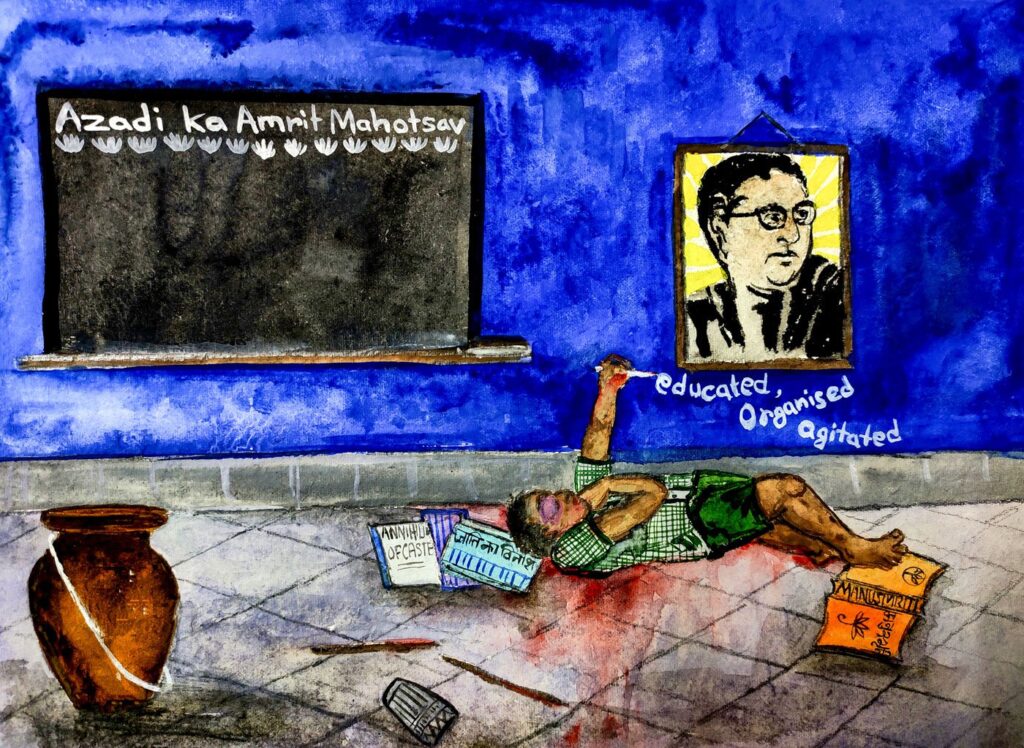
Not just a furtive glance, this nine-year-old boy’s sin was far more audacious. Indra Kumar Meghwal, a Class 3 student, simply failed to contain his thirst. He, a Dalit boy, drank from a pitcher kept aside for upper caste teachers.
Punishment was due. He was beaten, mercilessly, by Chail Singh – his 40-year-old upper caste teacher at the Saraswati Vidya Mandir in Rajasthan’s Surana village.
After 25 days, and after visiting 7 hospitals to seek help, on the eve of India’s Independence Day, the little boy from Jalore district breathed his last in Ahmedabad city.
Worms in a Jar
Once upon a time
there was a pitcher in a school.
The teacher was a demigod,
three bags full –
one for a Brahmin ,
one for a king,
and one for a penny that Dalits they bring.
Once upon a neverland
twice upon a time,
the pitcher taught a little kid –
“Thirst is a crime.
Thy teacher is a twice-born,
life is a scar,
and thou art a worm, lad,
kept in a jar.”
This jar had a quaint name: sanatani desh,
“Your skin is a sin,
kiddo, damned is your race.”
Yet with a paper tongue
drier than a dune,
he drank a li’l drop of the wet mehroon.
Alas!
the thirst was too much to bear,
didn’t the books say: “give, love and share”?
Out spread his fingers brave,
touched the pitcher cold,
The teacher was a demigod,
And he, a nine-year-old.
With a punch and a kick
and a well-placed stick,
the boy was tamed,
with a rage unnamed.
The demigod laughed like a sweet limerick.
Bruises on the left eye,
maggots in the right,
black were the lips
to the teacher’s delight.
His thirst was sacred, his creed was pure,
his heart is a hole
where death endures.
With a sigh and a ‘why’
and hatred high,
the thirst was named,
in wrath untamed.
The blackboard moaned like a graveyard fly.
Once upon a time
there was a corpse in a school,
Yes sir! Yes sir! Three drops full!
one for a mandir,
one for a crown,
one for a pitcher where Dalits they drown.
[Joshua Bodhinetra (Shubhankar Das) has an MPhil in Comparative Literature from Jadavpur University, Kolkata. He is a translator for PARI, and a poet, art-writer, art-critic and social activist. Courtesy: People’s Archive of Rural India (PARI).]