❈ ❈ ❈
The Alliance of the Sahel States Forges Ahead
Ann Garrison
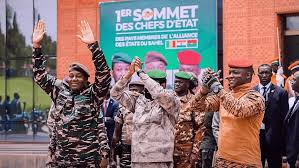
[Between 2021 and 2023 West Africa saw three popular military coups. Assimi Goïta became the president of Mali in 2021, Ibrahim Traoré became the president of Burkina Faso in 2022, and Abdourahamane Tchiani, became the president of Niger in 2023. The three former French colonies expelled French and US military and media. They withdrew from ECOWAS, the Economic Community of West African States, and confederated, forming the Alliance of Sahel States. In French, that’s the Alliance des États du Sahel (AES). They announced their intention to cooperate on regional security, integration, sovereignty, and economic independence.
In January, they announced a common passport, and in February, they raised a common flag. In March, Togo signaled its intent to leave ECOWAS and join the landlocked Alliance, giving it access to the sea. There’s talk of Senegal and other bordering states following suit.
I spoke to Eugene Puryear, author, journalist and Breakthrough News host, who attended the November 2024 Conference in Solidarity with the Peoples of the Sahel.]
● ●
Ann Garrison: Eugene, could you talk about how the Alliance of Sahel States and its three members have moved to free themselves from neoliberalism and French neocolonialism?
Eugene Puryear: I appreciate the question and, when we look at all three countries in the Alliance for Sahel States, we can maybe sum it up by saying that they are reclaiming their sovereignty, challenging neocolonialism, and rearranging the economic setup that previously meant that, despite living in very resource-rich countries, mineral-rich in particular, the people there were extremely poor. They’re turning that pyramid on its head, so that the vast majority of the country’s wealth is no longer extracted by people who live outside the country and an elite sliver of people inside the country. They’re changing a range of policies to make sure that the wealth that comes from under the soil and from the labor of its people is more broadly distributed amongst the people.
AG: The nations of the confederation have nationalized key resources and moved to escape from the neocolonial extractive economy trap. Could you talk about that?
EP: Absolutely. The mineral wealth of Mali, Burkina Faso, and Niger includes uranium, gold, lithium, and iron ore, all things that make modern society run and glitter in the First World countries of Europe and the United States. They are also exporting agricultural products, but minerals are their greatest source of wealth. It’s been extracted without benefit to the people of the confederation because the vast majority of the companies who possess the technology needed to extract minerals from the ground are from the developed world. They come from Europe, China, Turkey, and other places. So you have, on the one hand, foreign companies looking to maximize profit, and they have been able to set unfavorable terms.
The Sahel States are now refusing those terms, demanding not only higher taxes on wealth extracted, but also joint ventures where they are getting a percentage of the overall value of the company. Instead of just levying X amount in taxes, they may demand 20% or more of the company. It’s different in each situation, but the bottom line is that they’re demanding an equity share.
You can look at a country like Mali, which in just the past year or so has reclaimed about $500 million in tax revenues that were being lost in past years, which gives you a sense of how bad the situation was. In addition to having low tax rates, foreign corporations were also just not paying taxes. That should give you a sense of the scale of these changes. They’re bringing in hundreds of millions of extra dollars a year, just by increasing the amount that foreign corporations have to pay in taxes, and also by increasing or putting more joint ventures in place where the government has a larger share and ownership of the company, and thus distribution of the profits and dividends.
AG: How did Mali reclaim the $500 million in tax revenues? Was there a legal process?
EP: Mali claimed they were unpaid tax revenues. Although most of the companies at issue denied that was the case and said they were not evading taxes. But Mali put a number of executives in prison and were then able to come to agreements with a number of companies. So there wasn’t much of a legal process, more of a “pay or your executives stay in jail.”
AG: What about attempts to industrialize, developing a more complex division of labor, more skills, and thus a wealthier society?
EP: Yes, you can see these countries trying to move up the value chain in exactly the way you are describing. In Mali, for instance, they’ve built one of the world’s largest lithium mines, but not just to mine it. They’re also starting to complete the initial stages of refining lithium after it comes out of the ground.
In Burkina Faso, they’re starting to build gold refineries so that gold doesn’t just leave without added value and without employing Burkinabes.
These countries are also starting to industrialize to add value to agricultural products. In Burkina Faso, the president inaugurated a facility that’ll be able to make flour from wheat and other forms of grain, so that they’ll be able to import less flour and make more of their own bread and other basic foods inside of Burkina Faso, not depending on imports. They also grow a lot of tomatoes in Burkina Faso, but they were not producing ketchup or tomato sauce. Now they’re producing and exporting both.
So you can see all across the mineral, agricultural, and oil industries that these countries are trying to add value instead of just exporting raw materials for others to turn into commodities and sell back to them at high cost.
AG: Most of all, the Sahel States need to escape from the tyranny of the CFA franc, which traps them in French financial structures. What do you think of the prospects for that?
EP: Well, I think the prospects are higher than they were before the creation of the Alliance of Sahel States. I mean, it’s a conversation that is very much on the lips of people there. I know there have been official conferences, even held by different governments at different times, where they’ve brought together experts to talk about it. It’s certainly the direction those countries want to go in. But launching a new currency is obviously challenging, because you have the issue of what’s going to back the currency. Then there are the challenges of rearranging your economy and being prepared in the correct way when you introduce a new currency, especially one that you know floats , instead of the CFA franc, which is pegged to the Euro.
So you have different central bank pieces. And a lot of those central banking functions are collectivized because of the CFA franc across a range of West African and Central African countries. You have the West African CFA Franc and the Central African CFA franc. So you have the combination of all these factors. To unravel yourself from that is not just a light switch.
I think at this stage the Alliance of Sahel States is not ready to move aggressively on a currency reform but should start to move deliberately in that direction. It’s about starting the conversation of the mechanics of what it looks like, laying the groundwork and making it sustainable over time. As these economies continue to develop and grow, it becomes more of a possibility.
If they move too fast, it could become a destabilizing factor in the overall economic growth that we’re seeing. And we are seeing a lot of growth.
I watched an interesting video from, I think, Senegalese TV, in which they went to a market in Burkina Faso. They were asking people how it’s going under the new government, and people were saying that the markets are booming and they’re selling all their goods, and that security protecting them from terrorism is making it easier for them to trade. So you can see that new government policies are starting to have an impact, but ultimately, they’re going to have to address the CFA franc.
AG: Western elites are, of course, concerned about Russian influence. What do you think of how the Sahel States Alliance is situated in the new Cold War?
EP: The Alliance of Sahel States are one of the front lines in the New Cold War, but through no fault of their own. They had a critique of development and security cooperation with the US and France, but at no time did they ever say that they wanted to sever all relations with these or other Western countries. They just said that they wanted to be sovereign and be able to dictate more of the terms of their engagement, and that was something that France was especially unwilling to do.
So, ultimately, in that context, we’ve seen the Alliance of Sahel States pursue different security partnerships by working more with Russia in the struggle against ISIS- and Al Qaeda-linked groups. They’ve also deepened their relationships, which were already relatively strong, with countries in Asia and other parts of Africa, and, of course, with each other.
France had been there for decades, but the Sahel was still wracked by violence and terrorism. This became a motivating factor in the popular military coups that put the current governments in power. They had to switch teams basically because the alliance with France was not delivering security.
Many felt the security relationship with France was just enforcing France’s economic dominance, so they wanted a change, and Russia was the only option. The West has since demonized and punished them for making their own choices about who are the best partners for assuming their internal security and economic independence.
AG: Yesterday there was news that Niger had kicked out a Chinese mining company, telling them to pack up and leave in one day because they’d been exploiting workers, not paying taxes, and cheating the people in all the usual ways.
EP: Well, I’m not surprised. Niger, Mali, and Burkina Faso have really stressed that what matters is the letter of the law, no matter what countries or corporations are involved. They’ve penalized countries from China, Europe, and North America.
I don’t think they’re discriminating at all. They’re just saying we have laws concerning workers rights, taxes, and our own development, and if anyone violates those laws, we are going to hold them accountable.
I will add that when you look at the sum total, Chinese companies tend to follow the rules when the rules are enforced, whereas Western companies tend to leave instead. In Eritrea, a lot of the mining companies are Chinese, and they’re following very strict rules. Orano, the big French uranium company, has just exited Niger after it demanded greater royalties. Western companies have a more coercive response to Africa’s demand for a greater share of its resource wealth.
As a friend of mine in Zambia says, Africa doesn’t really have a China problem; it has a capitalism problem. The elites of many countries are 100% willing to overlook bad acts because they are themselves benefiting from the unequal extraction of resources. Companies from China, America, and Europe, are going to take advantage of that, but Chinese companies are more willing to play by the rules and work with countries like Eritrea, Zimbabwe, and now the states of the Sahel States Alliance.
The Chinese government also builds infrastructure and helps deliver healthcare and education, which Western countries are not doing in any way, shape, or form.
Why is the discourse in the West that we have to catch up with China? Did something go wrong here? Trying to catch up with China in terms of building airports, ports, railroads, hospitals, and schools?
AG: Okay, all three of the Sahel States have been fighting jihadi terrorists armed with the weapons that NATO introduced into North Africa when it destroyed the Libyan state. They’ve expelled the French and US military, who were claiming to fight the problem that they’d created. All three countries are now fighting jihadi terrorism on their own. I believe that 40% of Burkina Faso is under jihadi control. Do you think they have a better chance of winning these wars now that the French and US military are gone?
EP: I think so. I think when you look at the long engagement of the French and the US military, the problem was only getting worse.
When you look at what’s happening now, you can see it’s going up and down in different ways. It’s still a mixed bag, but they are certainly fighting more aggressively, and I think they’re also trying to fight more sustainably.
You mentioned Burkina Faso, where one of their main strategies is to engage more Burkinabe people and to have more of a popular mobilization against these various terrorist groups, as opposed to relying on outside forces.
And I think that people trying to reclaim their own land for their own development, in and of itself, will make the fight more meaningful. Various jihadi groups have been able to recruit because of the intense poverty that exists in these countries. When Mali’s revolution happened, all three of these countries had between 85% and 95% of people living on less than $7 a day.
There was a chronic lack of development and infrastructure.
So, for instance, jihadis may take over an area that has gold mines. They’ll smuggle the gold out, then use the money to pay people who have almost no prospects.
Terrorism can also disrupt the transport of agricultural goods, making it hard to establish food sovereignty. So the struggle against terrorism is also a struggle for development
These countries are engaged in mass popular mobilizations, where the whole of a people are recognizing the connection between security and development, working together on a range of fronts.
AG: The Sahel States Alliance declared that they are breaking down unnatural borders created when European states carved up Africa at the 1885 Berlin Conference. At the same time, other African nations are at odds, or even at war, over reclaiming pre- colonial borders. Rwanda is carrying out a devastating war in the Democratic Republic of the Congo to re-establish what it claims are precolonial borders. In 2018, Ethiopia, Eritrea, and Somalia created a promising alliance, but now Ethiopia seems to be on the verge of going to war with either Eritrea or Somalia to establish what it calls precolonial access to the sea. Could you talk about this whole project of breaking down colonial borders?
EP: Yes. This became a major issue in the foundation of the Organization of African Unity in the 1960s, when they decided to respect colonial borders. These borders were drawn by colonizing powers, who did not consider critical African realities, but once they had been established for some time, people often developed a sense of nationality within them.
This created a tinderbox for wars and conflicts and power grabs. So the issue of uniting Africa, Pan-Africanism, and overcoming colonial borders has to be a voluntary, shared process, not a violent process. That’s what’s different with the Alliance of Sahel States. Here you have masses of people who were supporting these three popular military uprisings, as I call them, which had very similar roots. The poverty they suffered under French neocolonialism was essentially the same, and it wasn’t realistic to think they’d be able to lift themselves out of it alone. And so there needs to be more general Pan-African unity, not just between those three countries and others.
I think the question that has always bedeviled Africa is, how do we create a project? Since the 1945 Manchester conference, and some of the earlier Pan-African conferences, it has been widely recognized that in order to maximize their potential, African countries need more unity. They need to do it in a way that is sensitive to the realities of every region, that can be as voluntary as possible, and that doesn’t evolve into warlord-based power grabs. That’s a difficult and a challenging question.
As our mutual friend Elias Amare often says, China suffered 100 years of imperial humiliation, but Africa has suffered 500.
Think about the Chinese example. That was a huge question for those 100 years, where you had all these warlords and different people fighting to control the state or break it up in different ways. And they had to find their own path to unity. I think Africa is very much on that journey. Unfortunately, we have many tragic conflicts happening right now that I hope will end soon, but it’s a part of that journey of figuring out how we create more popular-based, voluntary Pan-African projects like the Alliance of Sahel States.
AG: For anti-colonialists, anti-imperialists and socialists like ourselves, the Alliance of Sahel States may be the brightest spot on the planet right now. Many are very emotional about the need to defend it from inevitable destabilization schemes. So what was it like to attend the Conference in Solidarity with the Peoples of the Sahel in Niamey, Niger, last November.
EP: It was amazing. It’s hard to even describe. Most of the people attending were from Burkina Faso, Mali, and especially Niger, but there were also people from all around the continent. A couple thousand people convened there over a number of days.
We were fully immersed in civil society. That’s the thing that we really started to see. There were people from this organization, or that trade union, this collective farm, or that political party, who had all come together, as they did in the huge protests to kick out the French that many of us saw on social media. These were not what we typically think of as a military coups because people were coming out in huge numbers to support the new leaders.
One individual who was maybe in his late 20s and spoke from the floor at the conference said he’d been voting every five years for politicians who promised to build roads, hospitals, and schools and then failed to. He said that what they need now is not to worry about the issue of formal democracy and voting, but to come together to build roads, hospitals and schools.
I was just reading an interesting interview with Niger’s Minister of Electricity, and he said that, in just two years, they’ve doubled access to electricity, and they’re trying, in five years, to provide electricity to three million people. Hundreds of villages are adding solar panels that will power health centers in rural areas that will be renovated with the money they’re now getting from having more control over their own resources. To industrialize, you have to have electricity to run factories, and now you see all these things happening.
You see the power of the people, so to speak, that is really behind it. Here’s another quick example. In Burkina Faso, they’re really trying to put more of a focus on the quality of produce, so that there’s only good quality produce being found in the marketplaces. Recently, they found 60 tons of expired potatoes. But instead of just throwing them in the trash, they gave them to an organization that works on composting so they can produce organic fertilizer to sell and support their goal of having 30% of all of their arable land in agro-ecology, sustainable agriculture, by 2040.
That wheat factory I mentioned earlier created 300 daily jobs and 10,000 seasonal jobs. We also heard about people volunteering to come together to keep their cities clean.
The West says that they got rid of elections, but the fact is that there are small forms of small “d” democracy growing in so many ways all over these countries. I think we were able to see that at the conference in a way that was powerful.
And everywhere you go, the representations of the Alliance of the Sahel States are everywhere. It’s on the arm patch of Niger’s military, and now they have the Alliance of the Sahel States flag. They’re renaming streets after anti-colonial heroes. We were at the Thomas Sankara Memorial, and there was a march in solidarity with Palestine, where we had people joining us from the streets of Niamey. There were so many cool moments, and it was so interesting. Change is happening in these countries in large and small ways, but it’s adding up significantly.
AG: Okay, is there anything else you’d like to say?
EP: The one thing I’d add is that what’s happening in the Alliance of Sahel States is very threatening to the most powerful people, and we already saw them pressure the ECOWAS states to sanction them. Now, thankfully, those sanctions were defeated by and large, but the Sahel States are still in the crosshairs, and the crackdowns on the Palestine Solidarity movement, including the restrictions on free speech, could spread to them. We need to have an eye, for one, on protecting green card holders from the Sahel States.
AG: Eugene Puryear, thank you for speaking to Black Agenda Report.
EP: Thank you. Always good to be in Black Agenda Report.
[Ann Garrison is a Black Agenda Report Contributing Editor based in the San Francisco Bay Area. In 2014, she received the Victoire Ingabire Umuhoza Democracy and Peace Prize for her reporting on conflict in the African Great Lakes region. Courtesy: Black Agenda Report, a US publication that gives news and analysis from the perspective of the black left.]
❈ ❈ ❈
Burkina Faso: Another Coup Attempt Dismantled
Pedro Stropasolas
On Monday evening (21), Burkina Faso’s military authorities announced that they had dismantled a “major plot” aimed at promoting a coup and “sowing total chaos” in the West African country.
The announcement was made by the Minister of Security, Mahamadou Sana, who stated that the leaders of the coup attempt are allegedly based in Côte d’Ivoire, whose government under President Alassane Ouattara is allied with France’s interests in the region.
According to the minister, the plan of the “terrorists” would be carried out on April 16, 2025, through an assault on Burkina Faso’s presidency by soldiers recruited by the “enemies of the nation”. The assault was planned to take place simultaneously with other large-scale terrorist attacks.
The minister added that the plot masterminds are still active in the Ivorian capital, Abidjan. “The minds of the coup attempt are all housed in the neighboring country,” Sana said in an announcement on the country’s state TV, RTB. He mentioned Commander Joanny Compaoré and Lieutenant Abdramane Barry, described as deserters who had fled to the neighboring country.
The plot was identified after the government intercepted messages between a Burkina Faso’s military officer and the heads of terrorist groups discussing details about the positions of the defense, security forces and military operations. According to the government, the information sent to the terrorists was intended to escalate attacks against the security forces and civilians of the government of Ibrahim Traoré, aiming to “stir up a revolt against the authorities.”
Religious and traditional leaders were also reportedly contacted to convince the military to join the coup project. The goal was to “place the country under the tutelage of an international organization.”
Military personnel arrested
Rumors of a coup have led to the arrests of several military officers and non-commissioned officers from Burkina Faso in recent weeks. These include Frédéric Ouedraogo, former commander of the military justice battalion, and Captain Elysée Tassembedo, commander of the northern sector security forces grouping. Captain Ibrahim Traoré, head of the military junta that governs the country, called for vigilance, declaring that “[although] stateless, the enemies of the nation are very active”. He added that the Burkina Faso government would “await them firmly” and would be “merciless”.
Minister Sana concluded his announcement by encouraging the armed forces to “continue with their mission” and inviting the population to “remain calm and vigilant” and to “flag any suspicious activity”.
Other coup attempts
This is not the first time that the country’s military authorities have announced a coup attempt. In 2024, Traoré had already claimed the existence of a so-called “operations center to destabilize” the country based in Abidjan. In September of the same year, the junta announced that it had dismantled “several attempts at destabilization”, presenting the former president of the transition, Lieutenant-Colonel Paul Henri Sandaogo Damiba, as the head of the “military segment of this plot” in Burkina Faso.
In this same scenario, Ouagadougou says he has asked Abidjan to extradite politicians and military personnel accused of “plotting against Captain Ibrahim Traoré”. The requests, however, were denied by the Ivorian government.
(Courtesy: Brasil de Fato, a progressive Brazilian online newspaper and a radio agency, based in Sao Paulo, Brazil.)
❈ ❈ ❈
The Rising Star of Cpt. Ibrahim Traore – Burkina Faso’s Spirit of Sankara
Nicholas Jones
The Star rose through the ranks…
Many people in the world are unaware of the towering figure of Cpt. Ibrahim Traoré, the interim President of Burkina Faso since 2022. The mainstream media does not wish to shine a light on this man, who already has enough real glow to turn many powerful heads, especially within Africa. Not only in Africa does he turn heads, but also in the powerful states of the U.S., France and the UK, for the former masters are seriously threatened by the vision of this young leader.
He was born in a small town called Bondokuy and was raised in a humble family with little privilege. From a young age he showed his quality and was talented both physically and mentally, though he also impressed his teachers with his humility, a quality that today, is essential to his character. With his mental aptitude apparent, in 2006, he attended the University of Ouagadougou (from which he graduated with honors) and took up Geology as his main subject of study, a subject that is also likely aiding him in his current role as President and this could be where he began his interests in physical economy. Then he started developing his political skills and took a bold and vocal part in the Association of Muslim Students and the Marxist Association nationale des étudiants burkinabè (ANEB). It is said that in the latter of these two parties, he became a delegate due to his strong willed but humble nature and mainly because he was such a staunch defender of his fellow classmates and they elected him duly for this.
Upon graduation, he joined the Army in 2009 and made a quick impression, rising through the ranks rapidly. Initially he was sent to Morocco for anti-aircraft training before then being redirected to an infantry unit base in Northern Burkina Faso where he was about to witness first hand the rapid growth of terrorist activity in that region. In 2014 he was promoted to Lieutenant before joining MINUSMA, a United Nations peacekeeping force involved in the Mali War, on 7 different counter-terrorism missions, for which he received several high level recommendations for courage and quality of leadership. The long-running Mali civil war with the National Movement for the Liberation of Azawad, a northern region of Tuareg people that have been fighting a separatist war with the Malian government for many years now; is the war that largely helped prepare the regional instability for the oncoming horde of terrorists. It is this experience that helped him earn important knowledge in the tactics being used by the extremists and prepared him for what was to come with the increased spread of Islamist terrorism across the Sahel region. Following his time at MINUSMA and due to the increasing jihadi insurgencies, Traoré was recalled to Burkina Faso to begin assisting in the fight. He fought at Djibo, in the “Otapuanu offensive” of 2019, and several other counter-insurgency operations in the country’s north before being promoted to Captain in the Army in 2020. In late 2021, an army of jihadists overran the base of a police station in Inata, Soum, killing 49 policemen and four civilians and the public outroar was enough to offset the quiet murmurings of change. It was around this time that Traoré started to lose faith and trust in the Government due to a severe lack of resources for his soldiers and just like in his University days, his fellow soldiers duly elected him as their spokesman and leader to voice their issues to the leadership back in the capital. Much to the demise of Burkina Faso, those leaders were already compromised by their masters back in London and Paris and offered no hope to the Military in their fight against this extremism. Imagine you are going out to fight and potentially die for your people and country, while suited men sit in the capital handing out “suitcases of money” to bribe local officials and would rather do the bidding of their masters on a foreign continent, in the hope that they keep their political power!
A coup was the only rational choice when faced with such circumstances…
The fake coup leads to the real coup…
And so a coup happened in January 2022 under a man named Paul-Henri Sandaogo Damiba. He was a colleague and fellow soldier with Traoré in the ranks of the Army and was initially supported by Traoré in the early months of the coup. But after 9 months passed it was September and very little progress had been seen in a fight that now was a battle for the nation, as 40% of Burkina Faso’s territory was under ISIS-Sahel and other extremist group’s control. While military efforts were considerable during Damiba’s eight-month reign with more than 200 airstrikes and operations in which nearly 1,300 militants reportedly were killed and over 20 militant bases destroyed; they were not enough to stop the increasing militant activities and it appeared to those around him that he focused too much on finding a political end to the war that included dialogue and reconciliation. The trouble is, who would you expect to trust in dialogue or reconciliation, when dealing with extremists. And so it appears that Damiba himself was either compromised or he was simply unable to perform the demands of the job. He was quite effective in fighting the terrorists as an operative of the Army and so it begs the question, what changed as being its leader?
He was trained at the Ecole Militaire in Paris and holds a masters degree from the Conservatoire National des Arts et Métiers. Between 2010-20 he periodically received military training in the U.S. before returning to Burkina Faso each time. These periods include his participation in the Flintlock Joint Combined Exchange Training exercises in 2010 and 2020, while in 2013 he attended the U.S. State Department funded African Contingency Operations Training and Assistance course. In 2013 and 2014 he joined the Military Intelligence Basic Officer Course for Africa and finally in 2018 and 2019, he was trained in Burkina Faso with a U.S. Defense Department Civil Military Support Element linked to the failed G5. It is now a fact, that the region became overrun with terrorist activity during the American and French-led G5 group’s tenure, between 2014-23 and Damiba did not seek to remove them. And so, though the above information does not offer definitive proof of a traitor, it does throw up many questions; questions that I’ll leave the reader to form and make their own judgement from…
The dynamic coups swept across West Africa rapidly and it was quickly apparent in the streets of the capital cities of Ouagadougou, Niamey and Bamako, that the people were full of joy and hopeful of change. Russian flags started to appear at the rallies and billboards with support for Putin and Traoré were ever present. Russia’s fight in Ukraine against the Globalist Oligarchy seemed to align the country with the entire West African populace. The inevitable coup for Burkina Faso arrives in September 2022 and here enters Cpt. Ibrahim Traoré to the stage; a stage encased in fire and chaos and yet this young man was only 34 when he took power, faced with this seriously daunting task. He immediately showed his honor by rejecting the presidential salary and instead preferred to continue his commander salary from the Army and in doing so, made it easy to announce a pay cut of 30% for his now fellow government ministers and an increase of 50% in pay for civil servants. This was no power grab, these were the actions of a man with a real plan and vision for his nation and his first important plan for Burkina Faso, and regionally for the AES (A newly formed Alliance of Sahel States – Burkina Faso, Niger and Mali), includes the total defeat of terrorism in the Sahel region.
We need to make a list of all the achievements under his leadership that have set Burkina Faso on the path to peace by security and prosperity with economy.
- In February 2023, he expelled the French forces assisting in fighting the local insurgency from Burkina Faso. “We really want to look at other horizons, because we want win-win partnerships” – Traoré.
- In April 2023, he declared a general mobilization of the population to support the military. Already between October and November of 2022 a recruitment drive for the VDPs resulted in over 90,000 volunteers, exceeding the initial goal of 50,000. Under Traoré, the VDP’s role in military strategy has been significantly enlarged, not just as auxiliary forces but as a key element of the national defense strategy against terrorism.
- On 29 July 2023, following the 2023 Russia–Africa Summit, Traoré said that the people of his country support Russia, and communicated that a decision had been made to reopen the Russian embassy, which was closed in 1992. In December, 2023 the Russian embassy was reopened.
- In September 2023, he made the explosive announcement that Burkina Faso, Mali and Niger had come together to form the confederation of the Alliance of Sahel States (AES).
- He banned the use of British legal wigs and gowns in local courts in favor of traditional Burkinabé attire.
- Since we are two years into President Ibrahim Traoré’s leadership, Burkina Faso has witnessed significant GDP growth. The country’s GDP has grown from approximately US$18.8 billion to US$22.1 billion.
- Early on he made bold moves in rejecting the help of multinational lenders, the IMF and the World Bank stating firmly that “Africa doesn’t need the World Bank, IMF, Europe, or America”, showcasing his commitment to economic independence. This is spiritually paralleled in Sankara’s speech made to the United Nations General Assembly, 4th of October, 1984.
- In November 2023, Burkina Faso’s Council of Ministers approved the construction of the country’s first gold refinery. The refinery is set to create 100 new jobs and 5,000 new indirect jobs, with the refinery producing roughly 400 kg of gold daily. A market-value equivalent of US$41,500,000 per day.
- In February 2024, Traoré ordered the suspension of the issuance of export permits for small-scale private gold production, a move aimed at tackling illegal trade. According to the World Gold Council’s 2023 figures, Burkina Faso is the 13th-largest gold producer in the world, producing about 100 tonnes, equivalent to about US$6 billion in value, each year.
- In March 2024, Burkina Faso and Russia signed a roadmap aimed at establishing cooperation in the peaceful use of nuclear energy. Rosatom is leading the negotiations with the Government of Burkina Faso. In August, a delegation of technical experts from the Russian nuclear corporation arrived in Burkina Faso to negotiate the construction of a nuclear power plant.
- In August 2024, Burkina Faso nationalized two gold mines at a cost of about US$80 million. The Boungou and Wahgnion mines were sold last year by London-listed Endeavour Mining to Lilium Mining for US$300 million. On August 27, the mines were purchased by Burkina Faso’s government.
- In August 2024, Burkina Faso built its first pharmaceutical production plant, specializing in the production of generic drugs. Named Propharm and certified by an independent Spanish organization, it will start producing paracetamol 500 mg, phloroglucinol, an antispasmodic, as well as a “kit of oral rehydration salts and zinc, for the treatment of diarrhea”, explained Propharm’s General Manager, Armel Coéfé. “Our production capacity, at present, meets the local need and solves the problem of drastic rupture,” he added, noting that the list of molecules to be produced will grow, especially “with the production of drugs for the management of malaria.”
- In August 2024, Moroccan group CIMAF inaugurated a new industrial unit in the Burkinabe capital, Ouagadougou. This opening comes as part of Morocco’s “win-win” strategy in its relations with African countries. This investment is likely to not only boost local manufacturing capabilities but also facilitate technology transfer and knowledge sharing between Morocco and Burkina Faso. More South-South cooperation like this will bolster the African economy long-term.
- In November and December of 2024, the government, through APEC and Société Faso Tomates (SOFATO), facilitated the launch of two tomato processing units in Bobo-Dioulasso and Yako. These facilities have a combined capacity to process 11 tonnes of tomatoes per hour. One factory cost US$8.9m, covers 1 ha and has a processing capacity of 100 tonnes of tomatoes per day (5 tonnes of tomatoes per hour). The facility has created 100 direct jobs and more than 1,500 indirect jobs, with these numbers expected to rise as operations expand. Expected to generate 7 billion FCFA or US$12.1 million in the first year. In 2022 alone, the country produced 313,500 tonnes of fresh tomatoes, yet it imported around 23,600 tonnes of tomato puree due to a lack of local processing capacity.
- In February 2025, a new flour mill with a daily capacity of 220 tonnes of flour and 80 tonnes of bran was inaugurated in Gampéla, Burkina Faso, as part of national efforts to boost domestic production and reduce reliance on wheat and flour imports. The Moulin Double Star Mill (M2S) was constructed by the Zidnaba Group at a cost of 15 billion CFA francs (US$23.6 million). Burkina Faso imported 270,300 tonnes of wheat and 16,700 tonnes of wheat flour to meet domestic demand in 2023. Burkina Faso does not yet produce wheat. The government announced in October the country had dedicated 5,000 hectares to the grain for the 2024-25 season to enhance food security and begin to reduce dependency on imports.
- He distributed over 400 tractors, 239 tillers, 710 motor pumps and 714 motorcycles to boost production and support rural stakeholders. Access to improved seeds and other farm inputs was also provided to maximize agricultural output. As a result, tomato production increased from 315,000 tonnes in 2022 to 360,000 tonnes in 2024. Millet production rose from 907,000 tonnes in 2022 to 1.1 million tonnes in 2024, while rice production increased from 280,000 tonnes in 2022 to 326,000 tonnes in 2024.
- In March 2025, Burkina Faso inaugurates a new cement plant, CISINOB SA, with 2,000 tonnes-per-day capacity. The plant is a mutually beneficial partnership between Burkina Faso and China. “It is with legitimate pride that I inaugurated today, March 20, 2025, in Laongo, the cement plant of CISINOB SA. With a production capacity of 2,000 tonnes per day, it will provide employment opportunities for hundreds of young people in our country,” Traoré stated on his official X handle
- Now rebranded as SOFITEX, the reopening of the iconic FASO FANI textile factory in Koudougou, which once symbolized the nation’s industrial pride, has been completed this April, while two newly launched cotton processing plants in the economic hubs of Bobo-Dioulasso and Ouagadougou, equipped with modern equipment, have opened too. For years, the nation exported over 95% of its raw cotton without processing it locally.
- In 2025, Burkina Faso’s President Ibrahim Traoré turned down Saudi Arabia’s offer to construct 200 masjids in his country, stating that Burkina Faso already has enough masjids. Instead, he requested that Saudi Arabia invests in infrastructure projects such as schools, hospitals, and job-creating businesses, which he believes are more crucial for the nation’s development and long-term sustainability.
- In the essential department of infrastructure development, Traoré’s government is constructing new roads, widening existing ones and upgrading gravel roads to paved surfaces. A new state-of-the-art airport, the Ouagadougou-Donsin Airport, is also being built, expected to be completed in 2025 with a capacity to handle 1 million passengers annually.
The spirit of Sankara is reborn…
Ibrahim Traoré is a threat to the West because he is a true Pan-African leader, who wants to defeat terrorism and restore real, lasting sovereignty for the nation and security across its borders. Like Sankara before him and, as clearly witnessed in the achievements listed above, Traoré wishes to and has already begun restoring the national economy via the building of the productive powers that will unlock the value that has laid dormant due to the generational corruption. He dreams of a national education standard where every Burkinabe is not only literate in reading, writing and math but scientifically and culturally uplifted by knowledge too.
Sankara poetically said this – “While revolutionaries as individuals can be murdered, you cannot kill ideas”.
It would appear that Traoré is lit by the very same flame, so long may he light up this world with more visionary Pan-African ideas and may the African youth continue to unite around this Pan-African spirit…
(Courtesy: Nicholas Jones’ substack on African geopolitics and Pan-African history, Nkrumah’s Africa.)
❈ ❈ ❈
The US/EU/NATO’s Regime Change Playbook for Burkina Faso and Captain Ibrahim Traoré
Ann Garrison
(Extract)
On April 3, US Africa Command (AFRICOM) Commander Michael Langley testified to the Senate Armed Services Committee during an excruciating two hours obsessively devoted to the ill-fated project of preserving US hegemony. Langley’s testimony was all about stopping Russia and China’s advances on the continent. Some Senators expressed concern that Trump had dispensed with the soft power—their term—projected by USAID and worried that China is stepping in to fill the breach.
Alarm bells went off in Africa, the African diaspora, and peace and justice communities all over the world when he turned attention to Burkina Faso and its leader, Captain Ibrahim Traoré, accusing him of using the gold reserves he nationalized “to protect his junta.”
It would be challenging, of course, to come up with a more arrogant, illogical, and downright idiotic assertion. The head of AFRICOM, a military command openly devoted to securing US interests, with a $2 billion dollar annual budget, accuses an African leader of devoting his own country’s resources to its security?
In a pathetic attempt to give this a bit of humanity or legitimacy, Langley complained that Traoré was using the country’s gold to finance his own security rather than for the benefit of his people, as though there were some universe in which this was a plausible US concern. In the same breath he described North Africa as “NATO’s southern flank.”
Since mid-April a slew of social media posts have reported that the Burkina Faso diaspora, particularly in France, have been protesting and demanding that Captain Traoré step down, accusing him of being a dictator, with some even calling for his arrest. None of these posts are conclusively evidenced, and their scale, sometimes described as “hundreds” or a “small group,” varies across reports. No major news outlets seem to have reported such protests, but real or not, they’re a classic element in the Western regime change playbook.
These are Western playbook moves for overthrowing any government that actually tries to do something for its people in the Global South.
Traoré’s Crimes, in the Eyes of the West
What are Traoré’s crimes in the eyes of the West? As Langley alleged, he nationalized much of the country’s gold reserves. Imagine that. In November 2023, he approved the construction of Burkina Faso’s first refinery to process gold domestically, halting the export of unrefined gold to Europe and advancing the industrialization and skills development needed to create a prosperous domestic economy and lift the Burkinabe people out of the imperialist extractive economy trap.
He suspended export permits for small-scale private gold production to combat illicit trade, such as smuggling, and to regulate the artisanal gold sector.
He renegotiated mining contracts with foreign corporations, demanding greater percentages of ore extracted and favoring local participation, again developing skills needed for a complex, prosperous domestic economy.
He prioritized local processing in other sectors, such as agriculture and cotton. He established two tomato-processing plants and a second cotton processing plant, alongside the National Support Center for Artisanal Cotton Processing, to enhance local value addition and further reduce reliance on exporting raw materials.
In a broader push for economic autonomy, he invested in agriculture to achieve food self-sufficiency, providing farmers with modern machinery and improved seeds, leading to a 2024 harvest of nearly six million tons of cereal.
He expelled French military forces from Burkina Faso. In January 2023, he announced the termination of a 2018 defense agreement with France, giving French forces one month to leave. This followed public protests in Ouagadougou demanding their departure. They’d been stationed in the country for over a decade to combat jihadist insurgencies, which had only gotten worse. By February 2023, French forces had withdrawn , marking the end of their failed Operation Sabre.
He established military sovereignty and diversification of military partnerships, including partnerships with Russia.
Upon assuming the presidency, he announced that he would continue to live on his army captain’s salary.
He appealed to the Pan-Africanist ideals of Burkina’s revolutionary leader Thomas Sankara, who served as its president from 1983 to 1987 before being assassinated in a French-backed coup d’état. He erected a new statue of Sankara on the site where he was assassinated.
When Commander Michael Langley identified Captain Traoré as an enemy of US interests to the Senate Armed Services Committee, alarm bells went off in Africa, the African diaspora, and peace and justice communities worldwide. There have since been cries that there must never be another Libya all over social media, including countless YouTube channels. A global rally in support of Captain Traoré and Burkina Faso was called for April 30, the date of this publication. News and video will no doubt be available across the Web.
Long live revolutionary Burkina Faso and its Captain Ibrahim Traoré!
(Ann Garrison is a Black Agenda Report Contributing Editor based in the San Francisco Bay Area. In 2014, she received the Victoire Ingabire Umuhoza Democracy and Peace Prize for her reporting on conflict in the African Great Lakes region. Courtesy: Black Agenda Report, a US publication that gives news and analysis from the perspective of the black left.)