
❈ ❈ ❈
The AI Bubble and the U.S. Economy
Michael Roberts
The U.S. stock market continues to hit new record highs; the bitcoin price is also close to highs and the gold price has rocketed to all-time highs.
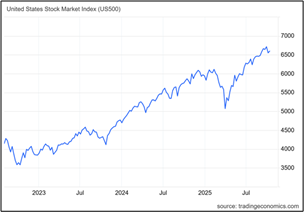
Investors in financial assets (banks, insurance companies, pension funds, hedge funds etc) are wildly optimistic and confident about financial markets. As the chair of Rockefeller International, Ruchir Sharma put it: “Despite mounting threats to the U.S. economy–from high tariffs to collapsing immigration, eroding institutions, rising debt and sticky inflation–large companies and investors seem unfazed. They are increasingly confident that artificial intelligence is such a big force, it can counter all the challenges.” AI companies have accounted for 80 per cent of the gains in U.S. stocks so far in 2025. That is helping to fund and drive U.S. growth, as the AI-driven stock market draws in money from all over the world. Foreigners poured a record $290bn into U.S. stocks in the second quarter of 2025 and now own about 30% of the market–the highest share in post-second world war history. As Sharma comments, the U.S. has become “one big bet on AI”.
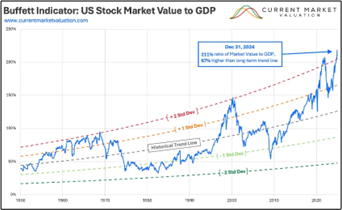
The AI investment ‘bubble’ (as measured as the stock price relative to the ‘book value’ of a company) is 17 times the size of the dot-com frenzy of 2000–and four times the subprime mortgage bubble of 2007. The ratio of the U.S. stock market’s value to GDP (aka the “Buffett Indicator”) has moved up to a new record high at 217%, more than 2 standard deviations above the long-term trendline.
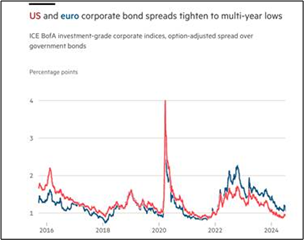
And it is not just corporate shares that are booming. There is a huge demand to hold the debt of U.S. corporations, particularly the large tech and AI companies as per the so-called Magnificent Seven. The ‘spread’ of interest paid on corporate bonds compared to ‘safe’ government bonds has fallen to under 1% pt.
These bets on the future success of AI cover all bases, or another way to put it: all the eggs are in one basket: AI. Investors are betting that AI will eventually deliver huge returns on their stock and debt purchases, when the productivity of labour rises dramatically and with it, the profitability of AI companies. Matt Eagan, portfolio manager at Loomis Sayles, said that sky-high asset prices suggested investors were banking on “productivity gains of the kind we have never seen before” from AI. “It is the number one thing that could go wrong”.
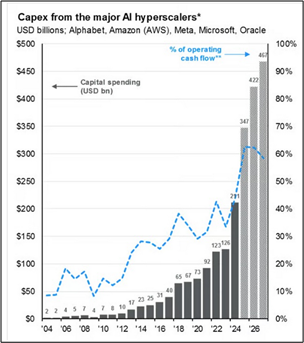
Up to now, there is little sign that AI investment is delivering faster productivity. But ironically, the huge investment in AI data centers and infrastructure is holding up the U.S. economy in the meantime. Almost 40% of the U.S. real GDP growth last quarter was driven by tech capex and the bulk of that capex was in AI-related investments.
AI infrastructure has risen by $400 billion since 2022. A notable chunk of this spending has been focused on information processing equipment, which spiked at a 39% annualized rate in the first half of 2025. Harvard economist Jason Furman commented that investment in information processing equipment & software is equivalent to only 4% of U.S. GDP, but was responsible for 92% of GDP growth in the first half of 2025. If you exclude these categories, the U.S. economy grew at only a 0.1% annual rate in the first half.
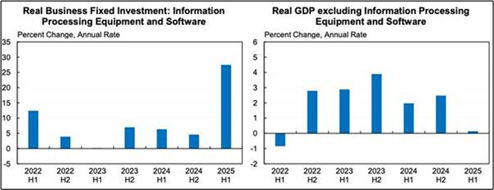
So without tech spending, the U.S. would have been close to, or in, a recession this year.
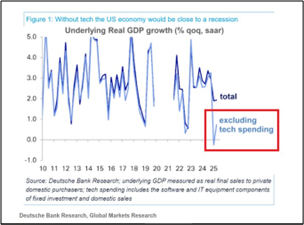
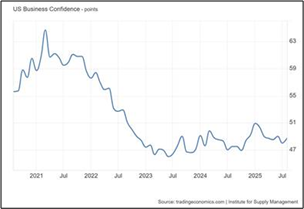
What that shows is the other side of the story: namely the stagnation of the rest of the U.S. economy. U.S. manufacturing has been in recession for over two years (ie any score in graph below that is lower than 50).
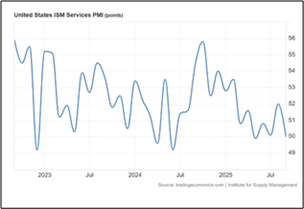
and now there are signs that the larger services sector is also in trouble. The ISM Services PMI (an economic survey indicator) fell to 50 in September 2025 from 52 in August and well below forecasts of 51.7, signalling the services sector has stalled.
The U.S. labour market is also looking weak. Employment grew at an annualised rate of just 0.5% in the three months to July, according to official data. That is well below the rates seen in 2024. “You’re in a low-hire, low-fire economy,” said Federal Reserve chair Jay Powell last month.
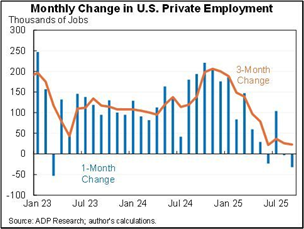
Young workers in the U.S. are being disproportionately affected by the current economic downturn. U.S. youth unemployment has risen from 6.6% to 10.5% since April 2023. Wage growth for young workers has declined sharply. Job vacancies for career starters have fallen by more than 30%. Early-career workers in AI-exposed occupations have experienced a 13% relative decline in employment.
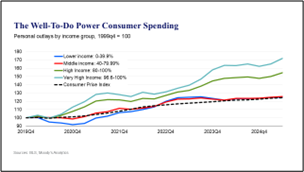
The only Americans spending big money are the top 20% of earners. These households have done well, and those in the top 3.3% of the distribution have done even better. The rest are tightening their belts and not buying more.
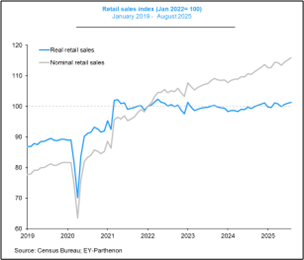
Retail sales (after removing price inflation) have been flat for over four years.
The graph above shows that inflation has eaten into the spending power of most Americans. The average inflation rate remains stuck at about 3% a year on official figures, well above the target rate of 2% a year set by the Federal Reserve. And that average rate hides much of the real hit to living standards and real wage increases. Food and energy prices are rising much faster. Electricity now costs 40% more than it did five years ago.
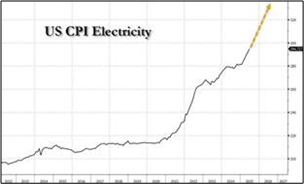
Indeed, electricity prices are being driven up even more by AI data centres. OpenAI uses as much electricity as New York City and San Diego combined, at the peak of the intense 2024 heat wave. Or as much as the total electricity demand of Switzerland and Portugal combined. That’s the electricity of roughly 20 million people. Google recently cancelled a planned $1bn data center in Indiana after residents protested that the data center would “jack up electricity prices” and “suck away untold gallons of water in an area already plagued with drought”.
And then there is the impact of Trump’s tariff tax on goods imports into the U.S. Despite denials by the Trump administration, import prices are rising and beginning to feed through to goods prices inside the U.S. (and not just in energy and food).
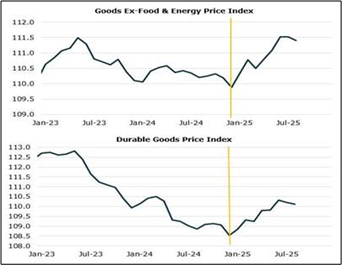
So far, foreign companies, in aggregate, are not absorbing the costs of the tariffs. During the 2018 trade war, import prices were mainly discounted by foreign companies. This time import prices have not declined. American importers rather than foreigner exporters are paying the tariffs, with more pass-through likely ahead for consumers. As Fed chair put it, “the tariffs are mostly being paid by the companies that sit between the exporter and the consumer… All of those companies and entities in the middle will tell you that they have every intention of passing that through [to the consumer] in time.”
Importers, wholesalers, and retailers are paying higher costs upfront and hoping they can eventually raise prices enough to shift the burden. The problem is that consumers are already tapped out. Household budgets are under pressure from rising debt, delinquencies, and wages that do not stretch far enough. Trying to pass along tariff costs in this environment would push demand even lower.
Businesses know this, which is why many of them are absorbing the costs instead. But when they do that, their margins shrink, and it becomes harder to sustain operations without making cuts elsewhere. When profitability gets pressured, management has few options. They cannot control tariffs and they cannot force consumers to spend more. What they can control are expenses. That begins with slowing hiring and scaling back growth plans, then cutting hours and overtime. If tariffs remain in place and consumers stay weak, the ripple effects spread further into the labour market.
Then there is government spending. The current closedown of government departments being imposed by Congress has given the Trump administration a further opportunity to slash federal government employment in a vain attempt to reduce the budget deficit and rising government debt. It’s a vain attempt because Trump’s claim that increased tariff revenues will do the trick is not credible. Tariff revenues since January 2025 are still only 2.4% of the projected total federal revenue in fiscal year 2025 of $5.2 trillion.
And as for the claim that tariffs would eventually fix the U.S. trade deficit with the rest of world, that too has proved nonsense, so far. In the first seven months of 2024, the deficit was $500 billion deficit; the first seven months of 2025, it was $654 billion, up 31% yoy to a record high.
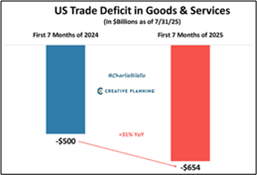
Contrary to Trump’s claims, the tariff hikes on imports will do little to ‘Make America Great Again’ in manufacturing. Robert Lawrence of Harvard’s Kennedy School reckons that “closing the trade deficit would barely raise the share of U.S. manufacturing employment”. The net value-added in the trade deficit in manufactured goods in 2024 was 21.5% of U.S. output. This would be the increase in U.S. value if the trade deficit were eliminated. How much employment would this produce? It would amount to 2.8m jobs, which would be a rise of only 1.7 percentage points in the share of manufacturing in U.S. employment, to 9.7% of overall jobs. But the share of production workers in U.S. manufacturing in this case is just 4.7%, the other 5 percentage points consisting of managers, accountants, engineers, drivers, sales people and so forth. The rise in employment of production workers would be just 1.3m, or just 0.9% of U.S. employment.
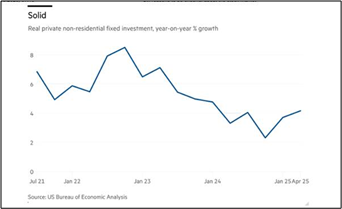
The U.S. economy is not yet on its knees and in a recession as business investment is still rising, if slowing in growth.
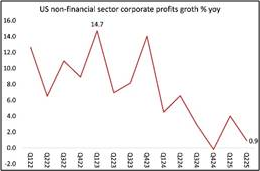
Corporate profits are still growing. Operating income for S&P 500 companies (excluding financials) grew at 9% in the most recent quarter, compared with the year before. Revenues rose 7% (before inflation). But that’s just for the top companies led by the Magnificent Seven. Overall, the U.S. non-financial corporate sector is beginning to see profit growth disappear.
And the Fed is set to cut its policy interest rate some more over the next six months, reducing the cost of borrowing for those who want to speculate in those fictitious financial assets). So a recession has not emerged yet. But increasingly, everything depends on the AI boom delivering on productivity and profitability. If the returns on massive AI investments turn out to be low, that could cause a serious stock market correction.
It is true that the big tech companies have mostly financed their AI investments out of free cash flow. But the huge cash reserves of the Magnificent Seven are being drained and AI companies are increasingly turning to equity and debt issuance.
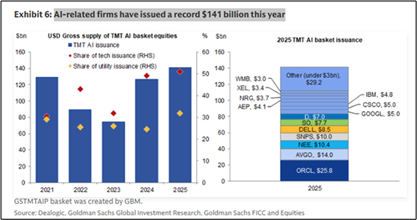
The AI companies are now signing contracts with each other to build revenues. This is a form of financial musical chairs. OpenAI has signed about $1tn in deals this year for computing power to run its artificial intelligence models, commitments that dwarf its revenue. OpenAI is burning through cash on infrastructure, chips and talent, with nowhere near the capital required to fund these grand plans. So to fund its expansion, OpenAI has raised huge amounts of equity and started to tap debt markets. It secured $4bn in bank debt last year and has raised about $47bn from venture capital deals in the past 12 months–though a significant chunk of that is contingent on Microsoft, its biggest backer staying in the mix. The credit monitor Moody’s has flagged that much of Oracle’s future data centre sales relies on OpenAI and its unproven path to profitability.
Much now depends on revenues for the likes of OpenAI rising sufficiently to start to cover the exponential rise in costs. Goldman Sachs economists claim that AI is already boosting the U.S. economy by about $160 billion, or 0.7% of U.S. GDP in the four years since 2022, which translates to roughly 0.3 percentage points of annualized growth. But this is more a statistical trick than real growth in productivity from AI so far and there is little revenue boost for the AI sector. Indeed, returns from further AI development may be diminishing. The cost of launching ChatGPT-3 was $50 million, launching ChatGPT-4 cost $500 million, while the latest ChatGPT-5 cost $5 billion, and according to most users, wasn’t noticeably better than the last version. Meanwhile, the likes of China’s Deepseek and other much cheaper competitors are undermining potential revenues.
So a financial bust is on the cards. But when financial investment bubbles burst, the new technology does not disappear. Instead, it can be acquired at low prices by new players in what Austrian economist Joseph Schumpeter called ‘creative destruction. By the way, this is exactly the argument of this year’s winners of the so-called Nobel prize in economics, Philippe Aghion and Peter Howitt. Booms and slumps are inevitable but necessary to drive innovation.
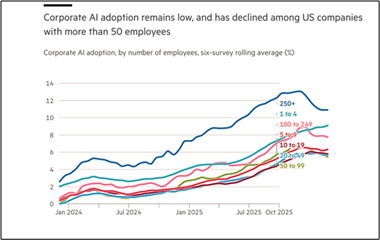
So AI technology could eventually deliver higher productivity growth if it manages to shed human labour sufficiently. But that may materialise only after a financial crash and consequent slump in the U.S. economy. And if the AI-driven U.S. economy dives, so will the rest of major economies. Time is not on the side of the Magnificent Seven. Indeed, adoption of AI technology by companies remains low and is even falling among larger companies.
Meanwhile the spending on AI capacity goes on mounting; and investors keep piling cash into buying AI company stock and debt. It’s one big bet on AI for the U.S. economy.
[Michael Roberts worked in the City of London as an economist for over 40 years. He has closely observed the machinations of global capitalism from within the dragon’s den. At the same time, he was a political activist in the labour movement for decades. Since retiring, he has written several books. Courtesy: Michael Roberts’ blog, The Next Recession.]
❈ ❈ ❈
“Bubbles” and Neo-Liberal Capitalism
Prabhat Patnaik
Neo-liberal capitalism has an immanent tendency towards stagnation, which arises because of the operation of two factors: the first is the growth in income inequality that it continuously spawns; since the poor consume the bulk of their incomes while the rich “save” (that is, do not consume) most of it, consumption demand, and hence overall aggregate demand, tends to fall below the growth of producible output, resulting in a rise in unemployment and unutilized capacity that drives the economy down.
This continuous tendency towards a rise in income inequality arises from the fact that, owing to the mobility of capital across country borders, wages across the entire world have to suffer the baneful consequences of the massive third world labour reserves; and the relative size of these reserves does not diminish despite such relocation of capital from the Global North. On the one hand the withdrawal of state support from petty production and peasant agriculture forces distressed producers from these sectors to move to towns in search of employment, thereby increasing the number of job-seekers; on the other hand, the rise in the rate of growth of labour productivity that is enjoined upon all countries because of trade “liberalisation”, via the adoption of new processes and products, keeps down the number of new jobs being created. Real wages across the world therefore fall behind labour productivity, causing a rise in the share of economic surplus in the output of each country and in world output as a whole; the observed rise in income inequality is an empirical manifestation of this phenomenon and constitutes the basic reason for the tendency towards stagnation under neo-liberal capitalism.
The second factor that underlies the realization of this tendency is the inability of state intervention to rectify this deficiency of aggregate demand relative to producible output. Such state intervention is what John Maynard Keynes, the foremost bourgeois economist of the twentieth century, had pinned his hopes on. But since state intervention to yield results, must mean larger state expenditure financed either by a fiscal deficit or by taxing the rich (the other alternative, of taxing the working people and spending the proceeds does not entail an increase in aggregate demand since the working people consume the bulk of their income anyway), and since both these means of financing state expenditure are disliked by globalized finance and hence ruled out, the Keynesian remedy ceases to work. The tendency towards stagnation arising from over-production relative to demand under neo-liberal capitalism has therefore no effective counterweight in the normal course.
But this is where “bubbles” come in. Speculation in the market for assets or claims to assets pushes up their prices sky-high which encourages extra investment in those sectors (because of the ease of raising finance) and extra consumption by the holders of such claims (who feel extremely wealthy and hence consume more, even though much of this wealth is actually fictitious). Hence even though the asset price bubble is primarily a financial phenomenon, it has an effect on the real economy. And such bubbles play the role of providing a temporary counterweight to the tendency towards stagnation under neo-liberal capitalism.
Such bubbles do not negate the tendency towards stagnation; they do not introduce a long-term growth trend. They occur from time to time, and introduce a temporary wave around the growth trend before dying out. During the upward surge of the bubble there would be some improvement in the performance of the real economy, just as when the bubble collapses, and a financial crisis ensues, the performance of the real economy would receive a setback. Of course a bubble does not arise entirely out of the blue; it is typically associated with the introduction of some new technology, in the form of some new product (or process). The euphoria generated by the new technology translates itself into a bubble that then gets metamorphosed into a speculative phenomenon, where the focus is no longer what the new technology would fetch, but on how other speculators would behave.
The Austro-American economist Joseph Scumpeter had rightly seen technology being introduced in such waves, but had erred grievously in not recognising the phenomenon of deficiency of aggregate demand and the consequent tendency towards over-production, and how that in turn affects the shape and nature of the wave through which technology gets introduced. One consequence of this was his vision that the economy is always at full employment (the wave caused by the introduction of new technology affecting only prices rather than employment), so that when the wave is finally over and dust has finally settled, the workers are decidedly better off owing to the higher labour productivity that the new technology has brought, whose benefits accrue to them in the form of higher wages. This idyllic picture alas does not hold, a point whose significance we shall presently see.
Such a temporary reprieve from the tendency towards stagnation under neo-liberal capitalism, had been provided by two such bubbles earlier, both occurring in the U.S.: the dotcom bubble of the 1990s and the housing bubble that followed almost immediately afterwards (such immediate succession being deliberately engineered to an extent by Alan Greenspan the then chairman of the Federal Reserve Board, which is the U.S. central bank). After the collapse of the housing bubble, the world economy sank into a prolonged stagnation, aggravated in its initial phase by the after effects of the collapse of this bubble. Not surprisingly, the growth rate of the world economy during the decade 2012-21 (that is, after the pandemic-induced drop had been reversed), was lower than the growth-rates during the previous three decades 1982-91, 1992-2001, 2002-2011, which themselves were lower than during the decades of the post-war period.
There is an impression that the Artificial Intelligence bubble currently underway will not only offset the tendency towards stagnation for the present, but will also do so on a more sustained basis. This perception however is completely erroneous. While the size of the AI bubble in financial terms is quite significant, its impact on the real economy is not; indeed two points have to be noted about the impact of the AI bubble on the real economy.
First, its impact on the totality of the real economy within the U.S. itself, though positive, is quite marginal. According to the U.S. Bureau of Labour Statistics, the youth unemployment rate in that country in July 2025 was 10.8 percent, which was not only high in itself, but represented an increase over July 2024 when it was 9.8 percent. In other words, the boost to the level of activity in the real economy provided by the AI bubble today is not significant enough to cause a fall in the year-on-year youth unemployment rate.
What is more, and this is the second point to be noted, when this bubble bursts, as it inevitably will, there will be a substantial rise in unemployment rate in the U.S.; this would be so for three reasons: first, the effect of the bursting of the bubble (and even if there was no speculative bubble, but just the introduction of technology in a wave, the effect of the ebbing of that wave), which would be in the nature of a cyclical downturn in employment; second, the effect of AI itself in reducing employment even in normal times (that is, even if there were no cyclical downturn); and third, the effect of reduced incomes of the employees as a whole (since wages would not be rising while employment falls) on aggregate demand and hence on the level of activity (this is what economists call the “multiplier effect”). Even when the first of these effects has waned, the second and the third will continue, and will ensure that the net long-term consequence of the introduction of AI would have been a vastly increased permanent level of unemployment, which will further accentuate the tendency towards stagnation of neo-liberal capitalism.
Nothing demonstrates more clearly than the introduction of AI the irrationality of capitalism as a mode of production and the unquestionable superiority of socialism over it . A technological breakthrough that in a socialist economy would be absorbed through increased leisure for everyone without any fall in real wages, and would in addition enhance human capacity, causes reduced employment directly, reduced real wages because of it, and an accentuation both these reductions (in employment and real wages) through their multiplier effects via reduced aggregate demand.
[The writer is Professor Emeritus, Centre for Economic Studies and Planning, Jawaharlal Nehru University, New Delhi. Courtesy: Peoples Democracy, the English weekly newspaper of the Communist Party of India.]