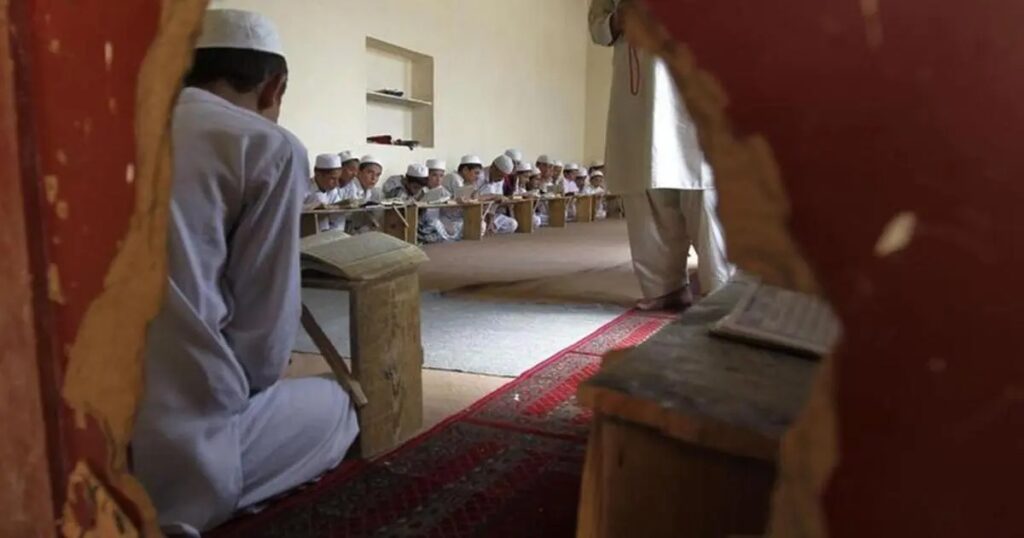
Since the Taliban’s return to power in Afghanistan in August 2021, the country has witnessed a rapid expansion and politicization of its madrasa (Islamic school) system. This shift is not merely an educational change but a political maneuver that raises significant concerns about long-term religious indoctrination and the spread of extremism. While madrasas once played a respected role in fostering intellectual thought and Islamic scholarship, the Taliban’s use of the madrasa system represents a sharp departure from this tradition, turning education into a tool for ideological control and obedience.
Historical Context
Madrasas have historically been centers of intellectual activity across the Islamic world, fostering scholars, philosophers, and jurists who contributed to a rich intellectual tradition. Figures such as Ibn Sina (Avicenna), al-Biruni, and countless others emerged from this tradition, promoting philosophical inquiry, scientific discovery, and cultural engagement. In pre-colonial times, madrasas played a vital role in the transmission of knowledge and the development of intellectual discourse within the Islamic civilization.
However, the colonial era, the rise of nationalist movements, and the advent of political Islam gradually altered the landscape of religious education. The madrasa system became increasingly politicized, with education often serving nationalist or ideological purposes. The Taliban represent the most extreme manifestation of this trend, as their interpretation of Islam is not just a religious or spiritual stance but a rigidly political ideology that suppresses critical inquiry and intellectual pluralism.
Taliban’s Approach to Education
The Taliban’s approach to education marks a dramatic departure from the pluralistic Islamic heritage associated with madrasas. Since their return to power in 2021, the Taliban have rapidly reshaped Afghanistan’s education system, focusing not on preserving Islamic knowledge, but on enforcing ideological conformity. Their ultimate goal is to turn the education system into a mechanism for producing loyal subjects, not independent thinkers.
One of the most concerning aspects of the Taliban’s education reforms is their explicit focus on “Islamizing” the curriculum. Leaked documents reveal that the Taliban plan to overhaul the existing education system and replace it with content that aligns with their interpretation of Islam. This ideological shift is particularly evident in the Taliban’s stance on girls’ education. Despite international calls to reopen schools for girls, the Taliban has stated that girls’ schools will not reopen until the ideological overhaul is complete. This suggests that the issue is not access to education, but control over the content of education—a move that has profound implications for future generations.
In this context, education becomes less about empowering young minds and more about shaping them to align with the Taliban’s vision of an Islamic state. The Taliban’s educational policy, therefore, is not a mere replacement of curricula; it is a fundamental reengineering of Afghan society’s values, norms, and ideologies.
Expansion of Madrasas
The scale of the Taliban’s educational expansion is staggering. Reports indicate that the number of madrasas in Afghanistan has surpassed 23,000 since the Taliban took control. These madrasas are not just educational institutions but are increasingly intertwined with the social and political fabric of Afghan life. Access to food aid, employment, and other social services is often contingent upon families sending their children to Taliban-approved schools. This creates a form of coercion that forces participation in an education system designed to produce ideological loyalty rather than independent thought.
In addition to the rapid expansion of madrasas, the Taliban have also strengthened their ties to various regional and global extremist organizations. According to United Nations assessments, the Taliban maintain relationships with more than 20 such groups, including both local insurgents and global jihadist movements. These connections further solidify the notion that the Taliban’s educational agenda is part of a broader militant strategy aimed at exporting extremism beyond Afghanistan’s borders.
Implications
The consequences of this educational transformation extend far beyond Afghanistan’s borders. The Taliban’s ideological project is not confined to their immediate rule; it is part of a broader global jihadist vision that seeks to extend the Taliban’s interpretation of Islam worldwide. Taliban leader Hibatullah Akhundzada has been described as envisioning a long-term global jihad, with the indoctrination of Afghan youth as its foundation. This vision is troubling, as it suggests that the Taliban are not only seeking to control Afghanistan but are also aiming to position the country as a hub for transnational extremism.
By embedding their worldview into the education system, the Taliban are ensuring that future generations will be indoctrinated into their narrow and rigid interpretation of Islam. This approach to education risks turning Afghanistan into a breeding ground for extremist ideologies, threatening the stability of South and Central Asia and potentially reverberating across the globe. The rise of a new generation of jihadists, indoctrinated through the madrasa system, could have catastrophic implications for regional security, humanitarian efforts, and international counterterrorism initiatives.
The international community’s response to the Taliban’s educational reforms has largely focused on advocating for girls’ education and promoting basic human rights. While these are critical concerns, they often overlook the deeper ideological engineering underway. The Taliban’s efforts to shape young minds are not limited to gender-based restrictions; they are fundamentally about controlling thought and suppressing intellectual diversity.
International responses must move beyond symbolic advocacy and human rights rhetoric to address the ideological underpinning of the Taliban’s educational agenda. The Taliban are not merely denying girls access to education; they are transforming the education system into a tool for ideological indoctrination. Until this deeper issue is addressed, any efforts to promote education in Afghanistan will be limited in their effectiveness, as the content of the education itself will continue to serve the Taliban’s political agenda.
The Taliban’s politicization of Afghanistan’s madrasa system represents a significant challenge to the future of the country and to global security. By transforming education into a tool of ideological control, the Taliban are shaping a generation of Afghans who are more loyal to their cause than to critical thinking, pluralism, or intellectual freedom. The international community must recognize the broader implications of this transformation and work to counter the spread of extremism in Afghanistan, not just by advocating for access to education, but by confronting the ideological content that the Taliban are embedding into the hearts and minds of the next generation. If left unchecked, the Taliban’s educational reforms could have far-reaching consequences for global security and stability.
[Dr. Patrick Austin holds a PhD in International Politics from the University of London, specializing in terrorism and counterterrorism affairs with a focus on South Asian security dynamics. Dr. Austin has worked with prominent policy institutions such as the Centre for South Asian Studies, the International Centre for Counter-Terrorism, and the South Asia Institute. His work has positioned him as a leading expert in South Asian affairs, offering both theoretical and practical insights into global and regional security concerns. Courtesy: Countercurrents.org, an India-based news, views and analysis website, that describes itself as non-partisan and taking “the Side of the People!” It is edited by Binu Mathew.]