❈ ❈ ❈
Synchronized Global Climate Breakdown
Robert Hunziker
The world has entered a new climate era that threatens the fabric of civilization because it’s the reverse of the climate system that society was built upon. As it happens, the biosphere is starting to unravel as the world’s long-standing normal climate system shows clear signs of breaking down while planetary heat throws scientists a curve ball. The normal climate system behavior 0ver the decades is gone.
According to the World Meteorological Organization (which Trump cannot cripple like NOAA) on a global basis the past year was the hottest in the 175-year observational record with record-setting ocean heat and record-setting sea-level rise. Ninety percent (90%) of global warming is hidden from society absorbed by the oceans. Remarkably, the world’s oceans broke temperature records every single day for 12-months-running. (BBC). Now it’s gotten so excessive that scientists are worried about “payback.”
Everything is on the line, major ecosystems like Antarctica and the Amazon rainforest are regurgitating years of abuse; only recently, West Antarctica was rushed to Red Alert status by freaked-out polar scientists, and large swaths of the Amazon rainforest emit CO2 in competition with cars, trains and planes for the first time in human history, as rainfall at Summit Station (10500’ elevation) has been a strange eerie twist for Greenland. This is climate breakdown in full living color.
A recent article in ScienceAlert d/d April 9, 2025 is filled with examples warning of climate breakdown: “Exceptional’ – Ongoing Global Heat Defies Climate Predictions”. [Article published below.]
Weird stuff that never happened thoroughout human history is happening to the climate system. For example, according to Copernicus Climate Change Service, since July 2023, the world has sustained a near-unbroken streak of record-breaking temperatures by the month every month, e.g. March 2025 was the hottest March ever recorded for the European Continent. And every month for the past 21 months has exceeded the dreaded 1.5C upper limit, to wit: “March was 1.6C above pre-industrial times, extending an anomaly so unusual that scientists are still trying to fully explain it. That we’re still at 1.6 °C above preindustrial is indeed remarkable,’ said Friederike Otto of the Grantham Institute for Climate Change and the Environment at Imperial College London.” (Science/Alert, ibid.)
It wasn’t so long ago when climate scientists thought exceeding global 1.5C above pre-industrial, labeled as the “danger zone” by the IPCC, would take decades. Guess what? It’s early!
Repercussions of Climate Breakdown – Worldwide
Anomalous/abnormal climate behavior is now the new normal. Extraordinary climate events from all corners of the world recently happened within a tight window of only 30 days of each other, events classified as either the worst ever or all-time record or unprecedented or once in 100 years, etc. Today, the planet is like a movie script entitled Climate Breakdown with climate disasters all happening all at the same time regardless of location or season. It’s a whacky script with people on the run, searching for a safe place.
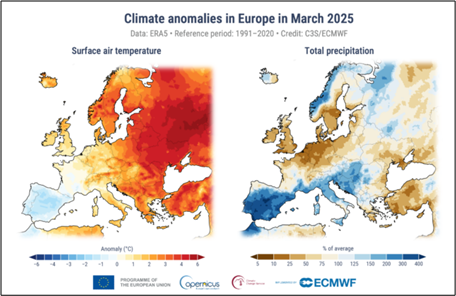
In real life, evidence of this gonzo climate system is everywhere to be found, e.g., in March 2025 different parts of the European Continent experienced “the driest March on record” as other parts of the Continent experienced “the wettest March on record.” At the same time as Europeans didn’t know which end was up, climate change hit India, enduring record-setting scorching heat as Australia was swamped by all-time-record-smashing floods whilst Asia and South America hit new all-time records of devasting heat. This weird global climate system is off its rocker in synchronized fashion. Why is this happening? Human-generated burning of fossil fuels is at the heart of far too many concurrent global climate disasters to ignore any longer the necessity of sharp reductions in burning fossil fuels or suffer an explosive planet. Nothing is normal any longer. Get over it!
The following headlines are evidence of simultaneous, happening within 30 days of each other, record-breaking climate events across the globe (of note: not including Antarctica, which is clearly, and frighteningly, starting to breakdown in an “emergency mode” as is the world-famous Amazon rainforest and Arctic permafrost and Greenland:
- “Bigger Than Texas: The True Size of Australian’s Devasting Floods”, The Guardian, April 4, 2025 “The extent of flood waters that have engulfed Queensland over the past fortnight is so widespread it has covered an area more than four times the size of the United Kingdom. The inundation is larger than France and Germany combined – and is even bigger than Texas.”
- “Dry Topsoil Across Germany Could Impact Crop Yields Following March Dry Spell”, Clean Energy Wire, April 11, 2025.
- “Floods Batter Italy after Florence Sees a Month’s Rainfall in One Day”, The Watchers, March 16, 2025. “Red alerts were in effect across Italy, including Florence and Pisa, following an extreme flooding event that triggered multiple landslides and caused widespread damage.”
- “Heavy Rains Hit Spain for Third Consecutive Week”, Reuters, March 18, 2025. “Spaniards are still on edge after torrential rains four months ago in the eastern Valencia region led to the country’s deadliest natural disaster in decades.”
- “Record-breaking March Heat Reminds Us That Adaptation Cannot Wait”, The Indian Express, March 20, 2025.
- “Record Heatwaves Hits South America: Urgent Call for Climate Action”, Green.org, March 5, 2025. “This year has witnessed South America endure its hottest recorded temperatures, with some regions experiencing heat levels never seen before. Countries like Argentina, Brazil, and Uruguay are reporting temperatures soaring above 40°C (104°F). This isn’t just uncomfortable—it poses serious health risks and disrupts daily life.”
- “Extraordinary March Heatwave in Central Asia up to 10° C Hotter in Warming Climate”, World Weather Attribution, April 4, 2025. “In March 2025, Central Asia experienced an unusually intense heatwave, with temperatures reaching record highs across the region.”
In the U.S, tornadoes in March were more than double the monthly average and three separate outbreaks produced more than 200 tornadoes. (National Centers for Environmental Information, March 2025) More to the point, from March 13th to 16th, 2025 the tornado outbreak was the largest on record for the month of March. Meanwhile, wildfires spread across southern Appalachia, exacerbated by additional fuel available from downed trees following Hurricane Helene (est. costs up to $250 billion). It’s a fact: Warmer ocean waters, a direct result of climate change, fuel stronger hurricanes with higher wind speeds, heavier rainfall, and more destructive storm surges. Hmm.
As stated in ScienceAlert by Bill McGuire, climate scientist, University College London, the contrasting extremes “shows clearly how a destabilized climate means more and bigger weather extremes… As climate breakdown progresses, more broken records are only to be expected.” (ScienceAlert, op. cit.)
Therefore, it’s fair to pose a nagging proposition of what happens when more all-time records continue to pile up one after another to what end? What is that end? And what can be done to stop the relentless pounding of harmful climate extremes. Maybe world leaders need to confront this reality by summoning climate scientists. But will Trump summon climate scientists for advice on how the US can help slow down the biggest, fiercest freight train in all human history barreling down the mountainside?
And what’s to stop this madness?
(Robert Hunziker is a freelance writer and environmental journalist from Los Angeles. Courtesy: CounterPunch, an online magazine based in the United States that covers politics in a manner its editors describe as “muckraking with a radical attitude”. It is edited by Jeffrey St. Clair and Joshua Frank.)
❈ ❈ ❈
‘Exceptional’ – Ongoing Global Heat Streak Defies Climate Predictions
Courtesy: Agence France-Presse
Global temperatures hovered at historic highs in March, the EU agency that monitors climate change said on Tuesday, prolonging an unprecedented heat streak that has pushed the bounds of scientific explanation.
In Europe, it was the hottest March ever recorded by a significant margin, said the Copernicus Climate Change Service. That drove rainfall extremes across a continent warming faster than any other, as planet-heating fossil fuel emissions keep rising.
The world meanwhile saw the second-hottest March in the Copernicus dataset, sustaining a near-unbroken spell of record or near-record-breaking temperatures that has persisted since July 2023.
Since then, virtually every month has been at least 1.5 degrees Celsius hotter than it was before the industrial revolution, when humans began burning massive amounts of coal, oil and gas.
March was 1.6C above pre-industrial times, extending an anomaly so unusual that scientists are still trying to fully explain it.
“That we’re still at 1.6 °C above preindustrial is indeed remarkable,” said Friederike Otto of the Grantham Institute for Climate Change and the Environment at Imperial College London.
“We’re very firmly in the grip of human-caused climate change,” she told AFP.
Scientists had predicted the extreme run of global temperatures would subside after a warming El Nino event peaked in early 2024, but they have stubbornly lingered well into 2025.
“We are still experiencing extremely high temperatures worldwide. This is an exceptional situation,” Robert Vautard, a leading scientist with the United Nations’ climate expert panel IPCC, told AFP.
Anomalies for March 2025 compared to March averages for the period 1991-2020. The precipitation anomalies correspond to the total precipitation for the month expressed as a percentage of the average for 1991-2020. (C3S/ECMWF)
‘Climate breakdown’
Scientists warn that every fraction of a degree of global warming increases the intensity and frequency of extreme weather events such as heatwaves, heavy rainfall and droughts.
Climate change is not just about rising temperatures but the knock-on effect of all that extra heat being trapped in the atmosphere and seas by greenhouse gases like carbon dioxide and methane.
Warmer seas mean higher evaporation and greater moisture in the atmosphere, causing heavier deluges and feeding energy into storms.
This also affects global rainfall patterns.
March in Europe was 0.26 °C above the previous hottest record for the month set in 2014, Copernicus said.
Some parts of the continent experienced the “driest March on record and others their wettest” for about half a century, said Samantha Burgess of the European Centre for Medium-Range Weather Forecasts, which runs the Copernicus climate monitor.
Bill McGuire, a climate scientist from University College London, said the contrasting extremes “shows clearly how a destabilised climate means more and bigger weather extremes”.
“As climate breakdown progresses, more broken records are only to be expected,” he told AFP.
Concerns over the global economy were dominating headlines at a time when India was enduring scorching heat and Australia was swamped by floods, said Helen Clarkson, CEO of Climate Group.
“The threat to the planet is existential, but our attention is elsewhere,” Clarkson said.
Puzzling heat
The global heat surge pushed 2023 and then 2024 to be the hottest years on record.
Last year was also the first full calendar year to exceed 1.5 °C — the safer warming limit agreed by most nations under the Paris climate accord.
This single year breach does not represent a permanent crossing of the 1.5 °C threshold, which is measured over decades. But scientists warn the goal is slipping out of reach.
If the 30-year trend leading up to then continued, the world would hit 1.5 °C by June 2030.
Scientists are unanimous that burning fossil fuels has largely driven long-term global warming.
But they are less certain about what else might have contributed to this record heat spike.
Vautard said there were “phenomena that remain to be explained,” but the exceptional temperatures still fell within the upper range of scientific projections of climate change.
Experts think changes in global cloud patterns, airborne pollution and Earth’s ability to store carbon in natural sinks like forests and oceans could be among factors contributing to the planet overheating.
Scientists say the current period is likely to be the warmest the Earth has been for the last 125,000 years.
❈ ❈ ❈
Study Shows Glaciers Have Lost ‘3 Olympic Swimming Pools Per Second’ Since 2000
Jessica Corbett
An international science project on Wednesday published a study in the journal Nature showing that glaciers have lost an average of 273 billion metric tons of ice annually since 2000—depleting freshwater resources, driving sea-level rise, and underscoring the need for sweeping global action to significantly reduce planet-heating pollution.
The Glacier Mass Balance Intercomparison Exercise (GlaMBIE) team compiled major studies to estimate global mass change from 2000, when glaciers—excluding Antarctica and Greenland’s ice sheets—held about 121,728 billion metric tons of ice, to 2023.
The researchers found that during that period, the world lost 5% of all glacier ice, with regional losses for the full two decades ranging from 2% on the Antarctic and Subantarctic islands, to 39% in Central Europe.
That’s a loss of 6,542 billion metric tons total or 273 billion metric tons per year, “the equivalent of three Olympic swimming pools per second,” noted France’s National Center for Scientific Research (CNRS).
Glaciologist Michael Zemp, who co-led the study, said in a statement that the annual figure “amounts to what the entire global population consumes in 30 years, assuming three liters per person and day.”
Although the researchers highlighted the annual average, they also emphasized that the rate of glacier ice loss “increased significantly” from 231 billion metric tons annually during the first half of the study period to 314 billion metric tons per year in the second half. In other words, the amount of ice being lost surged by 36% between the two ranges.
Zemp, a professor at Switzerland’s University of Zurich and director of the World Glacier Monitoring Service, told Agence France-Presse that the findings are “shocking” and warned that many smaller glaciers “will not survive the present century.”
Stephen Plummer, an Earth observation applications scientist at the European Space Agency, said that “these findings are not only crucial for advancing our scientific understanding of global glacier changes, but also provide a valuable baseline to help regions address the challenges of managing scarce freshwater resources and contribute to developing effective mitigation strategies to combat rising sea level.”
The ice loss over the GlaMBIE study’s full timeline led to about 18 mm or 0.7 inches of sea-level rise. The researchers projected future losses that lead to 32-67 mm, or 1.26-2.6 inches, of sea-level rise by 2040.
“We are facing higher sea-level rise until the end of this century than expected before,” Zemp told AFP, referring to the latest projection from the United Nations Intergovernmental Panel on Climate Change (IPCC).
“You have to reduce the greenhouse gas emissions, it is as simple and as complicated as that,” Zemp said. “Every tenth of a degree warming that we avoid saves us money, saves us lives, saves us problems.”
The GlaMBIE project manager, Samuel Nussbaumer, similarly told Oceanographic, that “our observations and recent modeling studies indicate that glacier mass loss will continue and possibly accelerate until the end of this century,” which underpins the IPCC’s “call for urgent and concrete actions to reduce greenhouse gas emissions and associated warming to limit the impact of glacier wastage on local geohazards, regional freshwater availability, and global sea-level rise.”
The team’s findings were released during the U.N.’s International Year of Glaciers’ Preservation and the Decade of Action for Cryospheric Sciences—and they “will feed into the next IPCC report, due in 2029,” according to CNRS.
Scientists from around the world who were not involved with the study were alarmed by its revelations—which come after the hottest year in human history and amid humanity’s failure to curb planet-heating emissions, largely from fossil fuels.
Martin Siegert, a professor at the United Kingdom’s University of Exeter, said in a statement that “this research is concerning to us, because it predicts further glacier loss, which can be considered like a ‘canary in the coal mine’ for ice sheet reaction to global warming and far more sea-level rise this century and beyond. The IPCC indicates 0.5-1 meters this century—but that is with a 66% certainty—hence 1/3 chance it could be higher under ‘strong’ warming, which unfortunately is the pathway we are on presently.”
Andrew Shepherd, a professor at Northumbria University, another U.K. institution, explained that “glacier melting has two main impacts; it causes sea-level rise and it disrupts the water supply in rivers that are fed by meltwater.”
“Around 2 billion people depend on meltwater from glaciers and so their retreat is a big problem for society—it’s not just that we are losing them from our landscape, they are an important part of our daily lives,” he said. “Even small amounts of sea-level rise matter because it leads to more frequent coastal flooding. Every centimeter of sea-level rise exposes another 2 million people to annual flooding somewhere on our planet.”
(Jessica Corbett is a senior editor and staff writer for Common Dreams. Courtesy: Common Dreams, a non-profit US news portal.)