❈ ❈ ❈
World is Taking Note Amid Surge in India’s Human Rights Violations
Aakar Patel
At the end of every year, the organisation I represent puts out a report on the human rights situation in India. This is part of Amnesty International’s global assessment, which focuses on violations mostly, though not exclusively, by countries around the world.
I was going through the draft of this year’s report, which is updated to September, and thought readers would be interested to know where we stand. This will be a list of the highlights, or to be more accurate, a list of the “lowlights”.
In January, Uttarakhand had passed rules enforcing a Uniform Civil Code. It mandates the registration of live-in relationships with the state authorities supposedly to combat religious conversions via fraudulent marriages. The rules were passed without considering the report of a nine-member panel appointed by the government on the rules.
In February, Rajasthan introduced a bill criminalising consensual inter-faith marriages that involved conversion and proposed ten years in jail for those Muslims marrying Hindus and vice versa. Maharashtra passed a resolution aimed at blocking inter-faith marriages.
Also in the same month, the Malvan Municipal Corporation demolished the scrap shop of the father of a minor boy accused of saying something after India’s win against Pakistan in the Champions Trophy cricket match.
In March, the Maharashtra police filed an FIR against Kunal Kamra over his stand-up show called “Naya Bharat” (New India). Violence against the venue followed. This was but one of a series of episodes where freedom of expression, a fundamental right, was abused by the State.
The previous month, the Delhi police detained 12 students of Jamia Milia Islamia university who were protesting against the showcause notices issued to two PhD students for allegedly sloganeering “without permission or intimation to university authorities” in 2024.
Also in March, the Assam police arrested journalist Dilwar Hussain Mozumdar for reporting on a protest over alleged financial misconduct at a bank run by the state government. He had consistently reported on financial issues at the bank where the state’s chief minister is a director.
In April, came an FIR against folk singer Neha Singh Rathore in Lucknow for her comment on the militant attacks in Pahalgam that killed 26 people.
In May, India cancelled the Overseas Citizenship of India status of British-Kashmiri academic Nitasha Kaul. She has regularly spoken against the rising authoritarianism in India.
Also in May, the Nagpur police filed an FIR against three people including Pushpa Sathidar, wife of late activist Vira Sathidar, for reciting the poem Hum Dekhenge by Faiz Ahmed Faiz. The Haryana police registered two FIRs against Ali Khan Mahmudabad, associate professor at Ashoka University, over social media posts on “Operation Sindoor”.
The Nagpur police arrested 26-year-old Rejaz M. Siddique for allegedly insulting Operation Sindoor on Instagram. He was subsequently charged under the Unlawful Activities (Prevention) Act.
Between April 22 to May 8, the Association of Protection of Civil Rights documented at least 184 hate crimes targeting Muslims after the Pahalgam attack.
In June, India withheld the Instagram account of The Savala Vada, a satirical meme page inspired by The Onion. Then the Mumbai police detained 19 people who had gathered at Azad Maidan to join a rally in support of Palestinians. In July, India ordered X (formerly Twitter) to block over 2,000 accounts, including two belonging to Reuters News.
In July, came the Maharashtra Special Public Security Act, which criminalises dissent under the guise of public safety.
In August, Kashmir banned 25 books written by journalists, historians, feminists and peace scholars accusing them of “glorifying terrorism and inciting violence”. Also in August, the Guwahati police summoned journalists Siddharth Varadarajan and Karan Thapar in connection with a sedition case without sharing more details.
The next month, a court in Gandhinagar issued notices to journalists Abhisaar Sharma and Raju Parulekar for reporting on the sale of a vast area of land to the Adani Group for a small amount in Assam.
Our torture of the vulnerable proceeded apace. In May, 40 Rohingyas were blindfolded and flown to the Andaman and Nicobar Islands and thrown into the sea and made to swim to an island in Myanmar. And after the Pahalgam attack, at least 300 Muslims were “pushed back” to Bangladesh from Assam.
In May, Assam announced it will provide arms licenses to people, especially those in Muslim-majority districts. In the first half of July some 1,800 families were left homeless after Assam carried out an eviction drive in Goalpara. Most of those affected were Muslims.
In the second half of July, Assam launched a large-scale eviction drive in Uriamghat, largely populated by Muslims, to reclaim over 11,000 bighas of forest land. The drive was halted by the Supreme Court on account of multiple due process violations.
In September, India repealed four earlier laws and now classifies asylum seekers as “illegal migrants”.
We are still in October, and more will follow, of course. Umar Khalid and other Muslim student activists remained in pre-trial detention for their alleged involvement in the February 2020 Northeast Delhi violence that claimed the lives of 53 people – 38 of them Muslims.
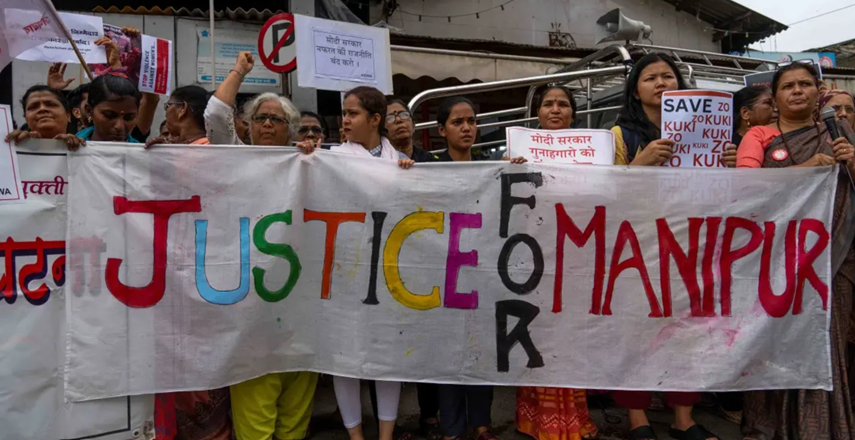
The United Nations’ High Commissioner for Human Rights also puts out a report and he said the following: “I am concerned by the use of restrictive laws and harassment against human rights defenders and independent journalists resulting in arbitrary detention and a diminished civic space, including in Kashmir. I also call for stepped-up efforts to address violence and displacement in Manipur, based on dialogue, peacebuilding and human rights.”
India’s response to this concern was to put out a Doordarshan story whose headline was “India Slams UN Human Rights for Unfounded and Baseless Comment on Kashmir and Manipur”.
[Aakar Patel is the chair of Amnesty International India. Courtesy: Deccan Chronicle, an English-language daily newspaper based in Hyderabad, India.]
❈ ❈ ❈
India’s Social Regression Under Modi’s Eleven Years May Not Be Mendable
Anand Teltumbde
There was a short-lived euphoria last month when Narendra Modi completed 11 years in office as prime minister. As expected, his bhakts hailed the occasion as the making of a “brave new India”. In the midst of mounting criticism – particularly over Modi’s conspicuous silence in the face of repeated humiliations by the president of the United States, who has consistently hyphenated India with Pakistan, claimed credit for the ceasefire, and publicly paraded illegal Indian migrants in handcuffs and leg chains – such triumphalism only underscored the sheer inversion of meaning that characterises his tenure. This inversion may well define his 11 years in power: a period during which a subcontinent-sized nation has been steadily reduced to geopolitical inconsequence.
While much has been written about the Modi regime’s economic failures and diplomatic missteps, the most insidious damage lies elsewhere – in the corrosion of India’s socio-cultural fabric. This damage is evident in the erosion of the country’s pluralistic ethos and the hardening of its deepest societal fault lines. A comparative glance at key social indicators from the pre-2014 era to the present reveals a sharp regression into communal majoritarianism, anti-intellectualism and institutionalised discrimination.
The socio-cultural tapestry – painstakingly woven over three centuries of colonial modernity, the egalitarian impulses of the freedom struggle, and the republican values enshrined in the Constitution – has been torn apart. What remains is a nation draped in the anachronistic garb of medievalism. Unlike the damage in other sectors, which may be reversible with time and will, the rupture in the socio-cultural domain presents a far more formidable challenge in today’s fast-paced, interconnected world.
Assessing the damage
One of the starkest transformations has been in the realm of communal harmony. During the UPA-era (2011–2014), India witnessed around 600 communal incidents per year, as per Ministry of Home Affairs data. Under Modi, that number surged to over 1,000 per year between 2017 and 2022, according to National Crime Records Bureau (NCRB). Even more chilling has been the rise of cow-related lynchings – from rare and scattered incidents earlier, to over 300 cases between 2014 and 2024. Hate speech cases have exploded fivefold, emboldened by weak police response and tacit political encouragement. Cases such as the Bulandshahr lynching of a police officer in 2018 or the Palghar mob killings in 2020 highlight how vigilante justice has replaced rule of law in many regions.
This surge in communal aggression is matched by the shrinking of the democratic space for dissent and expression. India’s global press freedom ranking fell from 140 in 2014 to 161 out of 180 countries in 2024, according to Reporters Without Borders. Sedition cases, once rarely invoked (25 cases/year pre-2014) have gone up by 160%, to over 70 cases annually. Universities have become ideological battlegrounds, with Mughal and peoples’ histories purged from curricula and dissenting students at institutions like Jawaharlal Nehru University (JNU) or Jamia Milia Islamia charged under anti-terror laws. The transformation from occasional censorship of dissenting research (e.g., economists critical of GDP data revisions facing backlash) to systematic erasure of liberal academia is unmistakable.
The status of minorities, especially Muslims, reveals further institutional exclusion. Muslim representation in the Lok Sabha declined from 30 MPs in 2009 to just 24 in 2024, and for the first time since Independence, Modi’s cabinet includes no Muslim ministers.
Anti-conversion laws, once limited to a few BJP-ruled states, have now spread to 12 states, further criminalising interfaith relationships and religious change. The Citizenship Amendment Act (CAA) and the push for a National Register of Citizens (NRC) signal a concerted effort to redraw the contours of Indian citizenship around Hindu identity. The “Hijab bans” in Karnataka and the Gyanvapi mosque dispute underscore a deepening siege on Muslim civil liberties.
Caste and gender justice, who had seen incremental progress in earlier decades, have also taken a hit. Atrocities against Dalits rose from 39,000 cases in 2013 to over 50,900 in 2022, per the NCRB. While the UPA avoided breaching the Supreme Court-mandated 50% reservation cap, the Modi government instituted a 10% quota for Economically Weaker Sections (EWS) among upper castes – effectively diluting affirmative action and possibly paving the way for abolition of caste-based reservations. Iconic incidents like the institutional murder of Rohith Vemula and the flogging of Dalits in Una (2016) marked a return of caste pride couched in euphemisms like “Samajik Samrasta” (social harmony), replacing the rhetoric of social justice.
Tribal rights, too, have faced a rollback. Forest land diversions rose from 1.5 lakh hectares (2009-14) to 3.5 lakh hectares post-2014, with corporate projects like POSCO and Vedanta prioritised over local consent. Lakhs of Adivasis have been displaced post-2014 due to unbridled development projects and anti-naxal operations. The dilution of the Forest Conservation Rules in 2022 bypassed the requirement for tribal consent under the Forest Rights Act, leading to what many activists term a “second dispossession.” The move to vacate mineral-rich forests of Adivasis by unleashing genocide in the name of eliminating naxalism has been an associated feature of the regime.
Even welfare schemes, once seen as neutral instruments of inclusion, have become vehicles for majoritarian signalling. While earlier governments maintained a universal approach to schemes like MNREGA and the public distribution system (PDS), recent years have seen exclusions – Muslim farmers being denied PM-KISAN benefits in several BJP-ruled states, for instance. Despite initial success, the Ujjwala scheme faltered, with 25% of beneficiaries reverting to firewood due to high refill costs. Welfare distribution has been openly communalised, as seen in vaccine campaigns tied to temples and slogans like “80 versus 20” in Uttar Pradesh, implicitly pitting Hindus against Muslims.
Culturally, the nation has undergone a profound homogenisation. The BJP’s aggressive push for Hindi as a national language led to fierce protests in the Northeast and Tamil Nadu. Folk cultures and regional traditions have been overshadowed by state-promoted Hindu festivals, while artists like M.F. Husain have been posthumously targeted and filmmakers like Pa Ranjith boycotted for their ideological stance. The shift from celebrating diversity to imposing cultural uniformity is emblematic of the regime’s “One Nation, One Culture” policy drive.
Alongside this cultural narrowing has come a rise in pseudoscience and anti-intellectualism. Scientific funding dropped from 0.8% of GDP in 2013 to 0.6% in 2023, while government-sponsored platforms saw bizarre claims – such as plastic surgery existing in Vedic times – gain official endorsement. The New Education Policy (NEP) 2020 promotes Sanskrit and “Indian Knowledge Systems” at the cost of critical thinking. The push for “Bharatiya Science” exemplifies the Rashtriya Swayamsevak Sangh’s long-held disdain for evidence-based rationality.
Perhaps most disturbingly, the Modi-era has witnessed the criminalisation of humanitarian compassion. Over 20,000 NGO licenses were revoked under the Foreign Contribution Regulation Act (FCRA), including for Amnesty International and CARE India. Christian community and institutions have been targeted in BJP-ruled states like Assam. Humanitarian work – especially in minority or tribal areas – is now frequently branded “anti-national.”
The public discourse has normalised previously taboo expressions of hatred. What were once isolated hate speech cases – such as Varun Gandhi’s inflammatory 2009 campaign speech – have now become routine. Public figures like Yati Narsinghanand and BJP leaders like Anurag Thakur have openly called for violence against Muslims, without facing legal consequences. Rather, such hate mongers have been immediately awarded by the regime. “Sabka Saath, Sabka Vikas” has devolved into dog-whistles like “Goli maaro saalon ko,” chanted by BJP supporters during the 2020 Delhi election rallies.
This normalisation of hate has led to urban segregation and ghettoisation. Discrimination in housing against Muslims, once confined to certain cities like Mumbai, has become systemic across India, where entire housing societies have barred Muslim tenants.
The bulldozer has become a political symbol, routinely deployed in BJP states like Uttar Pradesh and Madhya Pradesh to demolish Muslim-owned homes after communal unrest, often without due process. The infamous “Corona Jihad” narrative of 2020, which blamed Muslims for spreading COVID-19, further entrenched social apartheid.
Taken together, these trends indicate not merely a breakdown but a rewriting of India’s social contract. Where the pre-2014 era was marked by contested but intact constitutional values – such as secularism, social justice and pluralism – the past 11 years have seen a wholesale shift toward majoritarian dominance. Indicators point to a social order that is more exclusionary, more intolerant and more unequal.
Social Regression Table
| Pre-2014 (UPA era) | Post-2014 (Modi era) | Trend | |
| Academic & Cultural Freedom | Dissent existed (FTII protests, JNU debates). No institutional purges. Balanced syllabus content. | JNU, ICHR, CBFC, NCERT filled with RSS-aligned figures. Romila Thapar removed. Vedic pseudoscience promoted. Mughal history erased. | Hindutva-driven rewriting of education |
| Adivasi Rights & Forest Governance | FRA (2006) implementation began, forest clearance slower. Land acquisition faced NGO push-back. | 3.5 lakh ha forest diverted (MoEFCC). Forest Conservation Rules 2022 bypassed tribal consent. 4.2 million displaced. | Tribal rights undermined |
| Caste Atrocities & Dalit Rights | Atrocities existed (e.g., Khairlanji), but civil society mobilised; reservation upheld. | Dalit atrocities up 25 % (NCRB). Rohith Vemula suicide, Una flogging symbolic. EWS quota bypassed SC/ST cap, diluting reservation. | Rise in violence, rollback of gains |
| Civil Society & NGOs | NGOs flourished under regulation; 80 000 + FCRA-registered. | Over 20000 licences cancelled, including Amnesty, Oxfam, CARE India. “Anti-national” label used against missionaries & rights orgs. | Civic space severely restricted |
| Communal Harmony & Hate Crimes | Sporadic violence (e.g., 2002 Gujarat riots not repeated), communal incidents managed via political restraint. | Over 300 cow-related lynchings, open hate speech, “Love Jihad” laws in BJP states, Haridwar Dharma Sansad openly called for genocide without state action. | Increased polarisation and normalised hate |
| Freedom of Expression | India ranked 140–150 in Press Freedom Index (RSF). Few sedition cases. Protests tolerated (e.g., Anna Hazare movement). | India fell to 161/180 in RSF index (2024). Sedition & UAPA cases up 160%. Independent media (NDTV, Wire, Newslaundry) raided or harassed. | Sharp decline in free speech |
| Gender Justice | Sluggish but steady progress. Sexual violence condemned publicly (e.g., 2012 Nirbhaya case saw reforms). | “Beti Bachao” optics but rape cases up 32 %. BJP leaders trivialised rape, glorified child marriage. | Backlash against feminism |
| LGBTQ+ Rights | Homosexuality criminalised until 2018, but civil society pushing reform. | Decriminalisation (2018), but no marriage rights, Trans Act poorly implemented, and welfare delays continue. | Symbolic gain, no systemic support |
| Minority Rights | Inclusive welfare schemes (PDS, MNREGA, scholarships for minorities). Representation maintained (Muslim ministers in cabinet). | CAA-NRC excluded Muslims, zero Muslim ministers (2019, 2024). Hijab bans in Karnataka & MP. Bulldozer demolitions of Muslim homes. | Erosion of constitutional secularism |
| Pluralism in Public Life | Eid, Christmas, Onam, and Ganesh festivals celebrated officially. Minority languages and cultures encouraged. | Hindu festivals politicised, Eid marginalised. Push for Hindi in NE & TN sparked protests. Local traditions erased under “One Culture” agenda. | Cultural homogenisation |
| Use of State Power | State maintained institutional neutrality (e.g., police in 2008 Malegaon probe eventually arrested Hindutva actors). | State complicit in riots (e.g., 2020 Delhi), bulldozer politics used as punishment, sedition & UAPA abused to silence dissent. | Partisan state machinery |
The above assessment is just indicative of the damage inflicted by the Modi-regime to India’s social and cultural fabric. While economic or diplomatic blunders may be reversible with sound policy shifts and renewed international engagement, the social and cultural damage is far more intractable.
The deliberate reshaping of public morality, national identity and institutional impartiality has pushed India into a dangerous new phase – one where the idea of India as a secular, inclusive republic is not merely in retreat but actively under siege. Repairing this will take not just political will, but a cultural and moral renaissance of a scale unseen in India’s history. Until then, the social scars of the Modi years will continue to haunt the republic.
[Anand Teltumbde is former CEO of PIL, professor, IIT Kharagpur, and GIM, Goa. He is also a writer and civil rights activist. Courtesy: The Wire, an Indian nonprofit news and opinion website. It was founded in 2015 by Siddharth Varadarajan, Sidharth Bhatia and M. K. Venu.]