❈ ❈ ❈
Students Protest Continue in Indonesia
Max Lane
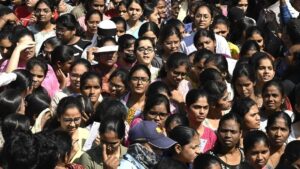
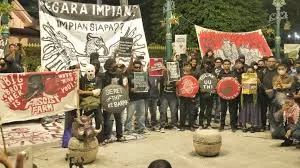
Over the last several weeks, demonstrations have erupted across Indonesia. They were reported in Medan (North Sumatra), Jakarta, Bandung, Yogyakarta, Solo, Malang, Surabaya, Makassar and, no doubt, they erupted in other towns as well. Although these demonstrations have not been massive,—ranging from a few hundred to one or two thousand people, they have been notably militant. The incidents include a police post being set on fire, street clashes between students and police, students breaking down gates of government buildings and shattering the Parliament’s compound walls, and the use of few Molotov cocktails. The police have used water cannons and resorted to beatings to disperse some demonstrations. Meanwhile, the government, unanimously backed by the Parliament, has been downplaying the unrest, yet it is unable to ignore the uprising. The demonstrations, which have been going on for several weeks, continue as we near the end of March.
The protests are not limited to students, they reflect the broader sentiment among the public. Coalitions of non-government organisations, trade unions, and other civil society groups have issued statements echoing the concerns of the students. Academics and public intellectuals have also articulated similar criticism.
The demonstrations were broadly held under the banner or slogan: “Indonesia Gelap” (Indonesia is Dark), reflecting the bitter and angry sentiments about the state of the country.
What has triggered the demonstrations? What lies behind this sentiment?
The demonstrations were triggered by the accelerated passing of a new law in the Parliament, regarding the Indonesian Army. The part of the new law that has attracted the most hostility is the expansion of the list of civil institutions where military officers can be appointed. While the list has not been drastically increased, to 16, it comes at a time when more military officials, often cronies of President Prabowo, are being placed key positions, both within and outside the scope of the Law. Some of the military cronies have also been placed in crucial economic of business positions. These moves are perceived by the protesters as the first steps towards returning to the military-backed crony capitalist rule, one that ruled Indonesia from 1965 until 1998. This period began with the mass slaughter of Indonesia’s communists and Sukarnoist leftists, it led to a near totalitarian rule for 32 years. It is under such a rule that a class of crony capitalists emerged throughout the country, with bog conglomerates at the top of the crony pyramid.
The students, NGOs and academics are protesting against the moves of the ruling elite who are turning back in that direction.
The banner “Indonesia is Dark” is not only a reflection of anger because people believe Indonesia is sliding back into the corrupt, militarist, crony capitalist period of the past. It is an expression that the “darkness” has already arrived for the mass of the people and for democracy. Over the past several weeks, many horrific corruption scandals have come to light. The scandals mount to hundreds of millions of dollars, involving the Pertamina (the state oil company) as well as operations in the banking sector, palm oil sector, import and export segments and others. These cases were suddenly exposed by the Attorney-General’s Department and by the Corruption Eradication Commission.
Being exposed one after the other, without any pause, over the past several weeks, these scandals have widely revealed the extent of corrupt relations between government officials and the private sector. In December, the Corruption Eradication Commission raided the residence of an official of the Supreme Court, who accused of taking bribes from business interests, and found tens of millions of dollars’ worth of cash and 51 kilograms of gold. The exposure of these cases 25 years after the fall of the notoriously corrupt President Suharto has deepened the sense of worsening “darkness” with absolutely no signs of lessening corruption.
The fear that the situation would worsen has intensified with President Prabowo’s announcement of the creation of a new state-holding company, Danantara which he will directly oversee. It would include a company owned by his own brother, and members of his cabinet and close business associates , will hold key positions within the Danantara. Former Presidents Yudhoyono and Widodo, and former British Prime Minister Tony Blair and former Thai Prime Minister Thaksin have been appointed as advisors. This includes the plan that dividends from all public companies, estimated to be US$980 billion, will need to be surrendered to the company. The company’s funds are supposed to be used to finance more upstream production projects in the country. Given that it is under the direct control of Prabowo and his close circle, however fantastic the idea may seem on paper, it is viewed as a situation of never-ending corruption and cronyism, and people do not trust the government’s plans. This decision comes after almost a year of the government, first under Widodo and then Prabowo, granting coal mining licences to secure political support from private players, including religious organisations and universities.
Meanwhile, Prabowo gains military backing by making the currently serving and ex-military officers in-charge of government project with large budgets. Such as the welfare program providing lunch to school students or a major Food Estate project in Papua.
At the same time, the feeling of engulfing “darkness” is exacerbated by the sudden announcement of huge budget cuts in the name of efficiency, which have affected the functioning of several ministries. It has worsened the working conditions of public servants who lose lighting and air-conditioning for some parts of the day or have fewer equipment to work with. The funds from these cuts have been diverted to some private sectors for their services to the ministries, such as the transport sector.
Meanwhile, the state has imposed more burdens on the people, such as increasing the application fee for two-wheeler license.. These trends are accompanied by increase in unemployment. There have been announcements of layoffs in manufacturing and textiles industries as the businesses are shutting shop due to loss. Media reports estimate 40,000 layoffs over the past several weeks.
The “Indonesia in Darkness” protests, petitions and statements are not the only manifestation of the sense of “darkness” and political despair. Another response that went viral on social media, was the cry “Kabur aja dulu” (Let’s Get of Here First), suggesting an escape overseas. Of course, this sentiment resonates with the millions of Indonesia’s poor who have been forced to seek work abroad, often working as maids or coolies in Singapore, Malaysia, Hong Kong and the Middle East for several decades. However, there is a positive side to “Indonesia in Darkness,” it is accompanied by a word popularised in the poetry of the disappeared poet of the 1990s, Wiji Thukul: “Lawan!” (Resist!). While one side of the darkness is answered with Escape, the other side bravely calls for Fight!
The most recent wave of demonstrations has shared the call: “The Army Should Stay in Their Barracks”. Notably, the first wave of the “Indonesia in Darkness” protests had no specific demands. But the following waves have so far raised nine demands under the Dark Indonesian banner, which include: review President Prabowo’s budget cuts; change the Mineral and Coal Mining Law that allowed arbitrary allocation of mining licences; reject the Army’s interference in civilian affairs, and more transparency in development projects and taxes and imposts on the common people.
A defining feature of these demonstrations is their largely spontaneous character, organised by local coalitions of students and NGOs, with each town having its distinct pattern. However, the slogans and demands are shared nationally, with no national organisation of mass resistance or opposition. The political opposition in the country remains dispersed, lacking unified organisation, strong leadership or a clear ideological perspective. Many are aware of this challenge, and the constructive discussions are unfolding among student groups, workers and farmers unions, democratic rights campaign organisations, feminist groups, political formations and others. Their discussions also focus on the unity of progressive forces. Some of this discussion is already formal, while others underway are informal in setting. The emergence of a national leadership and organisations would accelerate the current ferment and could alter the whole political framework. As of now, Indonesia, without a progressive opposition, is in a state of hiatus, waiting for the necessary jolt for the next step.
(Max Lane is an Australia based writer and activist. He is a Founding Member of the Red Spark. Dr Lane is also a Senior Fellow at the Tricontinental: Institute for Social Research. Courtesy: Tricontinental: Institute for Social Research, an international, movement-driven institution focused on stimulating intellectual debate that serves people’s aspirations.)
❈ ❈ ❈
International Solidarity Call by Indonesian Activists
We, Indonesian groups, organizations, activists, and individuals, raise our voices in outrage and condemnation as the Indonesian Parliament legalizes the revised Indonesian National Armed Forces Bill (UU TNI) today–20.03.2025. This law marks a devastating blow to democracy, human rights, and civilian supremacy in Indonesia, signaling a dangerous shift toward militarism and the rise of neo-fascist tendencies reminiscent of the dark days of the Suharto regime.
The revised UU TNI, now enacted, grants the military unprecedented powers to intervene in law enforcement, counter-terrorism, and civilian affairs. This blatant militarization of Indonesian society threatens to dismantle decades of democratic progress, suppress dissent, and institutionalize human rights violations. By eroding the boundary between military and civilian roles, this law entrenches authoritarianism and undermines the very foundations of democracy.
We cannot ignore the historical parallels. Under Suharto’s military-backed dictatorship (1966—1998), Indonesia endured a brutal regime characterized by widespread human rights abuses, corruption, and the suppression of democracy. The military, or TNI, was a central pillar of Suharto’s authoritarian rule, acting as both a political enforcer and a tool of repression. The regime’s fascist tendencies silenced dissent, exploited resources for personal gain, and entrenched systemic corruption, leaving a legacy of trauma and injustice that Indonesians are still grappling with today.
The revised UU TNI risks reviving this dark chapter. By expanding the military’s role in civilian affairs, the law paves the way for a return to the militarism, corruption, and authoritarianism of the Suharto era. This is not just a step backward—it is a leap toward neo-fascism, where the military becomes a tool of oppression.
A Dangerous Continuation of Militarism
The timing of this law is deeply alarming, given the political rise of Prabowo Subianto, a former military general with a controversial past. Prabowo, who served as a high-ranking officer under Suharto, has been implicated in numerous human rights abuses, including the kidnapping of pro-democracy activists in 1998 and atrocities in East Timor and Papua. His political ascension, now as Indonesia’s president, raises serious concerns about the resurgence of militarism and authoritarianism in the country.
Prabowo’s background as a military leader with close ties to the Suharto regime underscores the dangers of the revised UU TNI. His presidency, combined with the expanded powers granted to the military, creates a perfect storm for the erosion of democracy and the normalization of authoritarian practices. This law not only reflects Prabowo’s militaristic vision for Indonesia but also threatens to legitimize the use of military force against civilians, activists, and political opponents.
We stand in unwavering solidarity with the people of Indonesia—students, activists, human rights defenders, and civil society organizations—who have courageously opposed this law. Our voices represent the aspirations of a free and democratic Indonesia, have been ignored by a government that prioritizes militarization over the will of its people.
We Demand Immediate Action:
1. Repeal the Revised UU TNI Now: The Indonesian government must immediately revoke this dangerous law and halt all efforts to expand the military’s role in civilian life.
2. Restore Civilian Control: The military must be subordinated to civilian authority, as required in any democratic society. Its role must be strictly limited to defending the nation from external threats.
3. End Militarization and Protect Human Rights: The Indonesian government must ensure that the revised UU TNI is not used to suppress dissent, target activists, or violate human rights.
4. Respect the People’s Resistance: The government must listen and obey to the millions of Indonesians who have protested this law and reject any attempt to silence their voices.
5. Global Accountability: The international community must hold the Indonesian government accountable for the consequences of this law, including any human rights abuses or democratic backsliding.
Since this article was written, at least 19 cities have simultaneously held protest demonstrations following the enactment of the TNI Law on March 20, 2025: Jakarta, Bandung, Manado, Pekanbaru, Yogyakarta, Makassar, Padang, Pontianak, Semarang, Samarinda, Medan, Papua, Ambon, Surabaya, Malang, Lampung, Bali, Palembang, and Aceh. During these protests, there has also been excessive use of violence by the police. The targets of this violence were random, such as the general public, anarchists, students, journalists, and even online motorcycle drivers. Nearly every city that held protests experienced police violence. A news agency (TEMPO), known for its criticism of government policies and performance, was terrorized by receiving a package containing a severed pig’s head.
To the International Community:
The legalization of the revised UU TNI is not just an Indonesian problem—it is a global crisis. Indonesia plays a critical role in the fight for democracy and human rights in Southeast Asia and beyond, therefore, the rise of militarism and neo-fascism in Indonesia threatens regional stability and sets a dangerous precedent for authoritarian regimes worldwide.
The people of Indonesia have fought too hard and sacrificed too much for democracy to allow their country to slide back into the militarism, corruption, and authoritarianism of the Suharto era. We cannot remain silent as neo-fascism rises in Indonesia. Together, we must resist, fight back, and stand in solidarity with the people of Indonesia.
We call on the international community to:
- Condemn Indonesia’s Authoritarian Turn: Publicly denounce the revised UU TNI and its threat to democracy and human rights.
- Stand with Indonesian Civil Society: Support the brave activists, students, and organizations resisting militarization and fighting for democracy.
- Impose Consequences: Use diplomatic, economic, and political tools to pressure the Indonesian government to repeal this law and uphold democratic principles.
- Monitor and Expose Abuses: Document and expose any human rights violations or anti-democratic actions resulting from the implementation of this law.
Head over to the Indonesian embassy in your country and give them a heads-up, in whatever way you want.
We rise, not in silence, but in raging fire.
A wildfire of defiance, fueled by the love of freedom,
and the unyielding spirit of those who refuse to kneel.
This is not just a fight for Indonesia,
but a battle cry for every soul who dares to dream
of a world unchained, unbowed, unbroken.
We reject the chains of militarism,
the cold steel of authoritarianism,
and the suffocating grip of neo-fascism.
We are the voices of the oppressed,
the hands that build barricades,
the hearts that beat for anarchy—
the chaos, and the beautiful disorder of liberation.
We will not let the shadows of Suharto’s regime
darken the skies of tomorrow.
We will not let Prabowo’s militaristic dreams
trample the gardens of democracy.
We are the storm, the reckoning,
the ungovernable force that says:
Enough is enough.
To the tyrants, the enforcers, the architects of oppression:
Your walls will crumble,
Your laws will burn,
Your power will dissolve like ash in the wind.
For we are the people,
wild, untamed, and free.
And we will fight,
not just for Indonesia,
but for the boundless, anarchist love of freedom
that lives in us all.
In Rage and Solidarity,
Indonesia
20.03.2025
(Courtesy: The Left Berlin, a community of international progressives in Berlin.)