❈ ❈ ❈
Stalingrad and the Politics of Forgetting
Tunç Türel
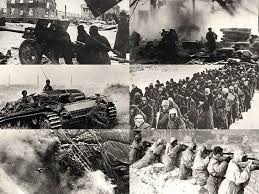
The year 2026 marks the eighty-third anniversary of the Battle of Stalingrad. The battle was not merely a decisive military engagement in the Second World War, but a historical rupture that reshaped the trajectory of the 20th century. Fought between August 1942 and February 1943, it marked the first total strategic defeat of Nazi Germany and shattered the myth of fascist invincibility upon which Hitler’s war of conquest depended. Yet in much of today’s dominant historical memory, particularly in the Anglophone world, Stalingrad is reduced to a dramatic episode, abstracted from its political meaning and severed from its consequences. This minimization is not accidental. To acknowledge Stalingrad as the turning point of the war is to acknowledge the centrality of the Soviet Union in the defeat of fascism, and, by extension, to confront the uncomfortable fact that the greatest victory over Nazism was achieved not by liberal capitalism, but by a socialist state fighting for its very survival.
In Western historiography and popular culture, the narrative of the Second World War has been persistently reorganized to center the United States and its allies as the principal agents of fascism’s defeat, while the Soviet contribution is treated as secondary, incidental, or morally compromised. Hollywood’s fixation on the Normandy landings in June 1944, the Battle of the Bulge in December 1944, and the Pacific theater stands in stark contrast to the relative silence surrounding the Eastern Front, where the war was decided. This imbalance is not a matter of oversight, but of ideology. From the early Cold War onward, the memory of the war was refashioned to reconcile two incompatible facts: that Nazism was the greatest crime of the 20th century, and that it was defeated primarily by a socialist state. The result has been a systematic downplaying of Soviet military, economic, and human sacrifice, replaced by a depoliticized narrative in which fascism collapses under the abstract weight of “Allied unity,” rather than being crushed through a protracted and devastating class war in the East.
Already in 1941, Operation Barbarossa was conceived not as a conventional military campaign, like those the Nazi war machine had conducted in the Low Countries or in France in 1940, but as a war of annihilation (Vernichtungskrieg), aimed at the physical destruction of the Soviet state and the biological, social, and political eradication of entire populations. Nazi strategy in the East fused military conquest with genocide: the planned starvation of tens of millions, the extermination of Jews, Roma, communists, and Soviet officials, and the reduction of Slavic peoples to a reservoir of slave labor.[1] As historian Stephen G. Fritz writes:
“Ostarbeiter (eastern workers), overwhelmingly young men and women, often just teenagers (their average age was twenty), were put to work, normally in deplorable conditions, in the Reich’s factories, mines, and fields. By the end of July, over 5 million foreign workers were employed in Germany, while, by the summer of 1943, the total foreign workforce had risen to 6.5 million, a figure that would increase by the end of 1944 to 7.9 million. By that time, foreign workers accounted for over 20 percent of the total German workforce, although, in the armaments sector, the figure topped 33 percent. In some specific factories and production lines, foreign workers routinely exceeded 40 percent of the total; indeed, by the summer of 1943, the Stuka dive bomber was, as Erhard Milch boasted, being “80% manufactured by Russians.” [2]
The Wehrmacht was not a neutral instrument dragged unwillingly into this project, but an active participant in it. Stalingrad must be situated within this context. It was not simply a battle for territory or supply routes, but a decisive moment in a war whose objectives were openly colonial and genocidal. To lose at Stalingrad was, for the Nazi leadership, to confront the first concrete limits of a project premised on unlimited violence.
The Eastern Front was not one theater of the war among others; it was the war. Between 1941 and 1944, the overwhelming majority of German military forces were deployed against the Soviet Union. “By October 1, 1943, some 2,565,000 soldiers—63 percent of the Wehrmacht’s total strength—were fighting in the East, as were the bulk of the 300,000 Waffen SS troops,” write historians David M. Glantz and Jonathan M. House. “On June 1, 1944, a total of 239 German division equivalents, or 62 percent of the entire force, were on the Eastern front.”[3] And it was there that the Wehrmacht suffered the vast bulk of its casualties. Approximately three-quarters of all German military deaths occurred on the Eastern Front, as did the destruction of entire armies whose loss could never be replaced. By comparison, the Western Front—while militarily and politically significant—opened only after the Red Army had already broken the backbone of Nazi military power. Stalingrad stands as the clearest expression of this asymmetry. It was on the banks of the Volga, not the beaches of Normandy, that the strategic initiative of the war was irreversibly seized from Hitler’s Germany.
The scale of the Soviet victory at Stalingrad cannot be understood without confronting the scale of the disaster that preceded it. When Nazi Germany invaded the Soviet Union in June 1941, the Red Army was caught profoundly unprepared for a war of such speed, coordination, and technological concentration. Entire formations were encircled and destroyed, millions of soldiers were killed or captured, and vast territories were overrun within months. This unpreparedness was not simply military, but structural: a rapidly industrializing socialist state faced an existential assault from the most advanced war machine capitalism had yet produced, backed by the resources of occupied Europe. Stalingrad therefore did not emerge from a position of strength, but from the edge of collapse. That the Soviet Union was able to absorb these blows, reorganize its economy, relocate its industry, and reconstruct its armed forces under conditions of total war is itself one of the most extraordinary, and least acknowledged, achievements of the twentieth century.
Stalingrad marked the moment when the Nazi war machine ceased to advance and began, irreversibly, to bleed. The German offensive toward the Volga in the summer of 1942 was intended to secure oil resources, sever Soviet transport routes, and deliver a symbolic blow to the heart of the Soviet state. Instead, it culminated in a protracted urban battle that nullified Germany’s operational advantages and drew its forces into a war of attrition it could not win. Street by street, factory by factory, the Red Army transformed Stalingrad into a killing ground that consumed entire German divisions. The encirclement and destruction of the Sixth Army was not merely a tactical defeat; it was the first time a full German field army was annihilated, rather than forced to withdraw. From this point forward, the strategic initiative passed decisively to the Soviet Union, and with it the fate of the war.
The victory at Stalingrad was purchased at a human cost almost without precedent, borne overwhelmingly by Soviet soldiers and civilians whose lives were subordinated to the imperatives of collective survival. Entire neighborhoods were reduced to rubble; hunger, exposure, and exhaustion were as lethal as artillery and bombs. Yet what distinguished Stalingrad was not simply endurance, but the social form that endurance took. The defense of the city relied on mass mobilization, political commitment, and a degree of collective discipline that cannot be explained through coercion alone. Workers fought in the ruins of the factories they had built; civilians sustained production and logistics under bombardment; soldiers held positions measured in meters, not kilometers. These were not abstract acts of patriotism, but expressions of a society fighting a war that threatened its very existence, and in which defeat meant not occupation, but annihilation.
The impact of Stalingrad extended far beyond the battlefield, reshaping the political and strategic landscape of the entire war. For the first time since 1939, fascist expansion was not merely slowed, but decisively reversed, sending shockwaves through Axis leaderships and occupied Europe alike. Just prior to the invasion Hitler had told to his generals, “We need only to kick the door in and the whole rotten structure will come crashing down.” For Hitler, and it should be said, for many of his generals and for large sections of the German population, the Soviet military was assumed to be incapable of matching the Wehrmacht. It was dismissed as rotten and weak, supposedly reflecting the inferiority of the peoples who made up the Soviet Union. This assumption, however, proved catastrophically false. The Red Army did not simply absorb defeat, it learned from it. Through bitter experience, it mastered the modern art of war, refining and applying the tactical and operational concepts of Deep Battle and Deep Operation with increasing effectiveness.[4] But not only that, resistance movements across the continent drew renewed confidence from the defeat of the German Sixth Army, while Allied strategic calculations were fundamentally altered by the realization that the Red Army would carry the war westward. Stalingrad also punctured the ideological aura of inevitability that had surrounded Nazi conquest, demonstrating that fascism could be defeated through sustained mass resistance rather than diplomatic maneuvering or technological superiority alone. From this point onward, the question was no longer whether Germany would lose the war, but how quickly and at what further human cost. That cost was determined by the increasingly fanatical resistance of Hitler’s army and the continued political and social support it received from large sections of German society.[5]
By the war’s end, the scale of the Soviet Union’s sacrifice dwarfed that of all other Allied powers. Approximately twenty-seven million Soviet citizens, soldiers and civilians alike, were killed, entire regions were devastated, and much of the country’s industrial and agricultural base lay in ruins. These losses were not incidental to victory; they were its material foundation. Yet in the postwar order that emerged under U.S. hegemony, this reality was increasingly obscured. As Cold War antagonisms hardened, Soviet suffering was detached from Soviet achievement, acknowledged in numbers but stripped of political meaning. Stalingrad was recast as a tragic episode rather than a decisive triumph, its significance diluted to accommodate a narrative in which socialism could not be credited with saving Europe from fascism. The debt owed to the Red Army was thus transformed into an ideological inconvenience—one to be minimized, relativized, or forgotten altogether.
This distortion of Stalingrad’s meaning is not confined to the past; it is an active political process in the present as well. Across Europe and North America, with the help of bourgeois historians and researchers; movies or video games, which form key components of the superstructure; the historical record of the Second World War is increasingly rewritten through the lens of anticommunism, equating fascism and socialism while obscuring the genocidal character of Nazi war aims. In this revisionist framework, the Red Army appears not as a force of liberation, but as a symmetrical oppressor, and the annihilation war waged against the Soviet Union is displaced by narratives of abstract “totalitarianism.” Such distortions serve contemporary imperial interests, legitimizing the rehabilitation of far-right movements, the militarization of historical memory, and the normalization of endless war. To remember Stalingrad accurately is therefore not an act of nostalgia, but an act of resistance against the political uses of forgetting.
Stalingrad offers no comfortingly simple lessons, but it does offer clarity. It demonstrates that fascism is not defeated by moral appeals, institutional gradualism, or abstract commitments to “democracy,” but through organized, collective struggle capable of confronting imperial violence at its roots. It reveals the scale of sacrifice demanded when capitalist crisis turns toward exterminatory war, and the price paid when such a war is allowed to advance unchecked. Above all, Stalingrad affirms that history is not moved by inevitability, but by mass action under conditions of extreme constraint. The Soviet victory was neither accidental nor preordained, it was forged through political will, social mobilization, and a readiness to endure losses that liberal societies—then and now—prefer not to imagine.
As the anniversary of the Battle of Stalingrad is marked, the question is not simply how the battle is remembered, but who controls its meaning. To treat Stalingrad as a distant tragedy or a neutral military episode is to evacuate it of the historical force it still carries. It was there that the Nazi project of annihilation was broken, and it was there that the fate of the war, and of millions beyond the battlefield, was decisively altered. At a moment when fascism is again normalized, imperial war once more presented as necessity, and socialism routinely dismissed as historical error, Stalingrad stands as an enduring counterpoint. It reminds us that the greatest defeat of fascism in history was achieved through collective resistance, social organization, and the uncompromising defense of a future that, at the time, could not yet be guaranteed.
Notes
[1] Stephen G. Fritz, Ostkrieg: Hitler’s War of Extermination in the East (Lexington: University Press of Kentucky, 2011), xx; Hans Heer and Christian Streit, Vernichtungskrieg im Osten: Judenmord, Kriegsgefangene und Hungerpolitik, 2020.
[2] Fritz, Ostkrieg, 222. Milch was the State Secretary in the Reich Ministry of Aviation from 1933 to 1944 and Inspector General of the Luftwaffe from 1939 to 1945.
[3] David M. Glantz and Jonathan M. House, When Titans Clashed: How the Red Army Stopped Hitler (Lawrence: University Press of Kansas, 2015), 357.
[4] David M. Glantz, Soviet Military Operational Art: In Pursuit of Deep Battle (New York: Frank Cass, 1991).
[5] Nicholas Stargardt, The German War: A Nation Under Arms, 1939–1945 (New York: Basic, 2015).
[Tunç Türel is an Ancient Historian and a member of the Workers’ Party of Türkiye. He writes for prominent Turkish Marxist and art and culture webzines, including Ayrım (www.ayrim.org) and Corpus (www.corpusdergi.com) and is currently working on a book that shifts the lens of Ancient Roman history away from the traditional narratives of emperors and rulers, instead centering the lives, struggles, and experiences of the peoples, the oppressed, and the ruled. Courtesy: MR Online, a forum for collaboration and communication between radical activists, writers, and scholars around the world, started by Monthly Review, the famed socialist magazine published from New York.]
❈ ❈ ❈
When the USSR and China Saved Humanity: How They Won the World Anti-Fascist War
Ben Norton
2025 marked the 80th anniversary of the defeat of fascism in World War Two. Unfortunately, the history of this extremely important conflict is not very well understood today.
It was not the United States and its Western allies that defeated fascism in WWII. That is a myth that is promoted by Hollywood movies.
In reality, it was the Soviet Union and China that defeated fascism in WWII. However, their heroic contribution was later erased by the West, when the U.S. waged the First Cold War against the global socialist movement.
The vast majority of Nazi casualties, approximately 80%, were on the Eastern Front, in the Third Reich’s savage, scorched-earth battles against the Soviet Red Army.
More than 26 million Soviets died in the Nazi empire’s genocidal war. Compare that to the just over 400,000 U.S. Americans who died, and the roughly 450,000 Brits who lost their lives.
This means that 62 Soviets were killed for every U.S. American who died in WWII. Yet, tragically, their sacrifice has been forgotten in the West—or, better said, erased from public consciousness for political reasons.
The fact that the USSR defeated Nazi Germany was even admitted by the inveterate anti-communist Winston Churchill, an explicit racist, colonialist, and erstwhile admirer of Hitler who oversaw the British empire’s extreme crimes, including a famine in Bengal in 1943.
In a speech in August 1944, Churchill acknowledged:
I have left the obvious, essential fact to this point, namely, that it is the Russian Armies who have done the main work in tearing the guts out of the German army. In the air and on the oceans we could maintain our place, but there was no force in the world which could have been called into being, except after several more years, that would have been able to maul and break the German army unless it had been subjected to the terrible slaughter and manhandling that has fallen to it through the strength of the Russian Soviet Armies.
Then, in October 1944, Churchill said, “I have always believed and I still believe that it is the Red Army that has torn the guts out of the filthy Nazis”.
In fact, the USSR wanted to crush fascism even earlier by proposing a surprise attack on Nazi Germany in 1939, weeks before Hitler invaded Poland. Soviet military officers made an official request to British and French officials to form an alliance against Nazi Germany in August 1939, but London and Paris were not interested. The USSR had a million troops ready to fight, but the Western European powers were not prepared.
What the capitalist countries in Western Europe and North America had hoped for was that Nazi Germany would attack the Soviet Union, which they considered their main enemy. This is why the Western imperial powers had long appeased Hitler, signing shameful deals like the 1938 Munich Agreement, which allowed the Nazi empire to expand in Europe.
What the Western capitalist “liberal democracies” and the fascist regimes shared in common was mutual hatred of communism. The rich oligarchs who controlled Western governments feared that they would lose their privileges if workers in their countries were inspired by the Bolshevik Revolution.
In the 1930s, the US State Department spoke positively of fascism as an alternative to communism, and the US chargé d’affaires in Germany praised the supposedly “more moderate section of the [Nazi] party, headed by Hitler himself … which appeal[s] to all civilized and reasonable people”.
It must be emphasized that, when the Japanese empire officially allied with Nazi Germany in 1936, the name of the deal they signed was the Agreement Against the Communist International, or the Anti-Comintern Pact. Benito Mussolini’s fascist regime in Italy subsequently signed the agreement in 1937, and the fascist regimes in Spain, Hungary, and other European countries joined in the following years. It was extreme, violent anti-communism that united all of these fascist powers.
While there is widespread ignorance about the Soviet Union’s leading role in crushing Nazi Germany in WWII, the heroic contribution that the people of China made to the defeat of the Japanese empire is even less well known.
For Europe, WWII began in 1939, when Nazi Germany invaded Poland. For the people of China, the war started much earlier, in 1931, when the Japanese empire invaded the Manchuria region of northern China.
For 14 years, the people of China resisted Japan’s aggression, as the imperial regime sought to colonize more and more Chinese territory.
By the end of the war in 1945, roughly 20 million Chinese had lost their lives. This means that approximately 48 Chinese were killed for every U.S. American who died in WWII.
In China, WWII is known as the Chinese People’s War of Resistance Against Japanese Aggression, and it was part of a larger conflict called the World Anti-Fascist War.
China held an important event on 3 September 2025 commemorating the 80th anniversary of the defeat of fascism. It featured key leaders of countries that are today, once again, fighting against imperialism and fascism, including China’s President Xi Jinping, Russia’s President Vladimir Putin, the DPRK’s leader Kim Jong-un, Iran’s President Masoud Pezeshkian, and officials from other countries in Asia, Africa, and Latin America, including Cuba’s President Miguel Díaz-Canel and Nicaragua’s representative Laureano Ortega Murillo.
The United States has long taken credit for the defeat of the fascist Japanese empire, but this erases the enormous, heroic, 14-year contribution made by the Chinese people.
Although it is true that the United States was briefly allied with the USSR and China during WWII, and it did provide significant military assistance through its 1941 Lend-Lease Act, Washington immediately terminated that partnership in 1945.
In fact, even before WWII officially ended, the United States had already started to recruit fascists to help them wage the First Cold War. U.S. intelligence agencies saved many Nazi war criminals in the infamous Operation Paperclip. Instead of facing justice, these genocidaires assisted Washington in its subsequent attacks on the Soviet Union and its communist allies in Eastern Europe.
Later, the CIA and NATO created Operation Gladio, in which they used fascist war criminals as foot soldiers of their new global imperialist war on socialism. The former top Nazi military officer Adolf Heusinger was appointed the chair of NATO’s military committee, and the ex Nazi Hans Speidel became commander of NATO’s land forces in Central Europe.
The United States even rehabilitated Nazi war criminal Reinhard Gehlen, who had directed Hitler’s military intelligence on the Eastern Front in WWII, and who later led the CIA-backed Gehlen Organization to help Washington wage its cold war against communists.
The United States did not defeat fascism; it rehabilitated and absorbed fascism into the capitalist empire that Washington built after WWII, centered in Wall Street and based on the dollar.
The contemporary German government published the results of a study in 2016, called the Rosenberg project, which sifted through classified documents from 1950 to 1973. It found that, at the height of the Cold War, the government of capitalist West Germany, which was a member of NATO, was full of former Nazis.
In fact, 77% of senior officials in West Germany’s Justice Ministry had been Nazis. Ironically, there had been a lower percentage of Nazi Party members in the Justice Ministry in Berlin when the genocidal dictator Adolf Hitler himself was in charge of the Third Reich.
Similarly, in Japan after WWII, U.S. occupation forces released Japanese war criminals from prison and used them to construct an imperial client regime. The CIA helped to create and fund the powerful Liberal Democratic Party (LDP), which has essentially governed Japan as a one-party state, with few exceptions, since 1955.
Notorious war criminal Nobusuke Kishi had overseen genocidal crimes against humanity against the Chinese people as an administrator of the Japanese empire’s puppet regime of Manchukuo, in Manchuria, during WWII. After the war ended, the United States strongly supported Kishi, who led the LDP, established the de facto one-party state, and became prime minister of the country.
Still today, the Kishi dynasty is one of the most powerful families in Japan. Kishi’s grandson Shinzo Abe also led the LDP and served as prime minister from 2012 and 2020, closely allying Japan with the United States, while antagonizing China and rewriting the history of WWII.
In short, after the Soviet Union and China led the fight to defeat fascism in WWII, the U.S. empire recruited fascists to fight its global war against socialism.
Today, it is extremely important to learn these facts and correct the historical record, because 2025 is the 80th anniversary of the end of WWII, and it is clear that the proper lessons have not been learned in the West.
The planet is still plagued by extreme imperial violence, and closer than ever to another world war.
The United States and Israel have been carrying out a genocide against the Palestinian people in Gaza, committing atrocities that are reminiscent of the fascists’ crimes against humanity in WWII.
Fascism has its roots in European colonialism. The genocidal tactics that the European empires used in Asia, Africa, and Latin America were later used by the fascists inside Europe.
Nazi leader Adolf Hitler was inspired by the genocidal crimes that the German empire had committed in southern Africa, and also by the genocide that the U.S. colonialists had carried out against indigenous peoples in North America. The Nazis were likewise influenced by the U.S. government’s racist laws against Black Americans, in its apartheid system known as Jim Crow.
Given the close links between fascism and Western imperialism, it is not surprising to see that, today, the U.S. regime has become increasingly fascist. Politicians in Washington scapegoat immigrants and foreigners for the many domestic problems in their country, including the significant growth in inequality, poverty, and homelessness. They have no solutions other than more violence, racism, and war.
The increasing political desperation and instability in Washington is combining in a toxic mixture with the greed of U.S. corporations in the military-industrial complex, which profit from war, and are thus incentivized to push for more conflict, not for peace.
The United States, as the leader of NATO, has already been waging a proxy war against Russia in Ukrainian territory, using the people of Ukraine as cannon fodder in an imperial war, tragically destroying an entire generation of Ukrainians in a vain attempt to maintain U.S. global hegemony.
The U.S. empire has also used its Israeli attack dog to wage war on the people of Iran, in an attempt to overthrow the revolutionary government in Tehran and impose a puppet regime, like the former king, the shah, who was propped up by Washington.
The number one target of the U.S. empire today, however, is the People’s Republic of China. U.S. imperialists fear that China is the only country powerful enough to not only challenge but to defeat Washington’s global hegemony.
The U.S. empire is waging a Second Cold War against China, and it has weaponized everything in this hybrid war, imposing sanctions and tariffs to wage economic war, using its control over the dollar system in a financial war, and exploiting the media to spread disinformation and fake news as part of an information war.
Part of the U.S. empire’s strategy in this information war is to erase the Chinese people’s major contribution to the defeat of fascism and imperialism in WWII.
This is why it is so crucial to defend the facts, and to teach the true history of WWII to people today. If we don’t correct the historical record, the fascists and imperialists of the 21st century will weaponize ignorance in order to carry out the same crimes that their ideological brethren committed in the 20th century.
[Ben Norton is a journalist, writer, and filmmaker. He is Editor-in-Chief of Geopolitical Economy Report. Courtesy: Geopolitical Economy Report, an independent news outlet that provides original journalism and analysis to understand the changing world.]