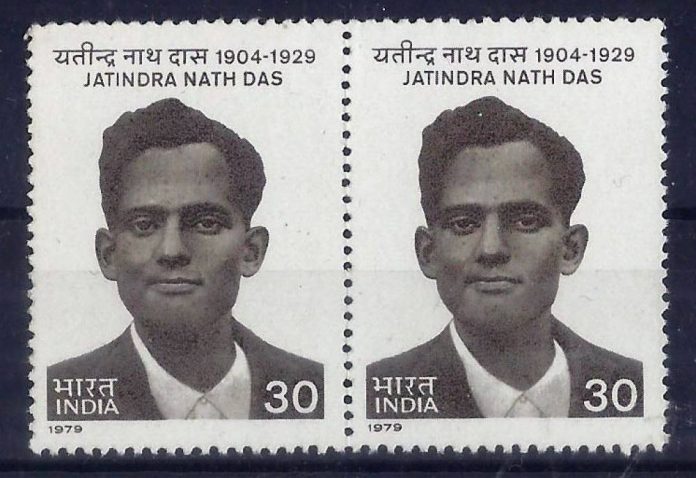
Jatindra Nath Das was a very courageous and determined freedom fighter who accepted the most painful sufferings with a smiling face for the ideal of freedom of India. He achieved martyrdom at the age of only 25 on September 13, 1929 in Lahore jail.
He was a brilliant student but chose to dedicate his life to freedom movement. While doing his BA he was arrested and sent to Mymensing Jail. Here he as well as other arrested freedom fighter prisoners were treated very badly. Even at this very young age Jatindra Nath mobilized freedom fighter prisoners and went on an indefinite fast. This had the desired impact in terms of the jail authorities agreeing to improve conditions for political prisoners.
Some time after his release Jatindra joined the Hindustan Republican Socialist Association. When Bhagat Singh and several other comrades were in Lahore jail, Jatindra too was arrested and together these freedom fighters started a fast for the rights of political prisoners. The fasting political prisoners were treated very harshly. As a result Jatindra became seriously ill. Paralysis started spreading to parts of his body. A jail committee recommended his release but the colonial government did not agree. Finally on 13 September 1929 he breathed his last after fasting for 63 days. As his dead body was taken to Calcutta, several hundred thousand people including several national leaders gathered to pay homage to him.
Thus although he had a very short life of only 25 years, he was jailed twice for fighting for a noble cause and on both occasions he converted his jail-stay into a struggle for the rights of political prisoners. Amazingly, keeping in view the hostile conditions, on both occasions the struggle made a big impact, in the second instance a huge national impact.
Hence it will be an appropriate tribute to the memory of Jatindra Nath Das ( as well as other comrades who participated in these fasts and struggles) if September 13, the martyrdom date of Jatindra Nath Das, is observed as Justice for Political Prisoners Day not just in India but also abroad, particularly in South Asia. There is certainly need for this as there are still many political prisoners who face injustice and atrocities.
In particular, it should be emphasized that there should be no capital punishment or death sentence for political prisoners. Those who face serious health problems should be released. This is all the more important now in Covid times.
Jatindra Nath Das would not have died if the recommendation of the Jail Committee for his release at the time of his deteriorating health had been accepted. Some of the noblest citizens and in particular youths died untimely death during colonial rule because of death sentence for freedom fighters and fast decline of health due to poor living conditions as well as torture and beatings in jail. Some of those who died in this way like Bhagat Singh, Ramprasad Bismil, Ashfaqullah Khan, Kartar Singh Sarabha and Jatindra Nath Das would potentially have become some of our greatest national leaders if they had not died at such a young age. To honour memories of freedom movement India should respect the human rights of political prisoners. This includes recognition as political prisoners and providing them special conditions of protecting health and dignity, contacts with the outside world as well as suitable conditions for study and reflection.
(The writer is a freelance journalist who has been involved with several social movements.)