On the night of May 16, 2026, police in Ahmedabad’s Vejalpur area arrested Zaheer Shaikh, a 70-year-old Muslim man, in connection with an alleged cattle slaughter case. Days later, he was dead. His family alleges he was beaten in custody, had his beard pulled, was verbally abused, and was made to consume an unknown liquid. Before he died at SVP Hospital, Zaheer reportedly recorded a statement naming the officers responsible. The police deny everything, attributing his death to pre-existing diabetes. The protests that erupted outside the hospital tell a different story, a story India has grown dangerously accustomed to telling.
Zaheer Shaikh is not an isolated case. He is a data point in a pattern that has become the defining feature of India’s majoritarian turn: the systematic targeting of Muslim men involved in the cattle and meat trade, under the cover of animal protection. Mob violence in the open fields of Rajasthan, lynchings on highways in Bihar, charred remains found in vehicles in Gujarat, and now a 70-year-old man dying in police custody in Ahmedabad. These are not aberrations; they are the policy.
Along with a precious human life, what is being destroyed is an entire way of living and, of course, the economy.
Bengal’s Unintended Mirror
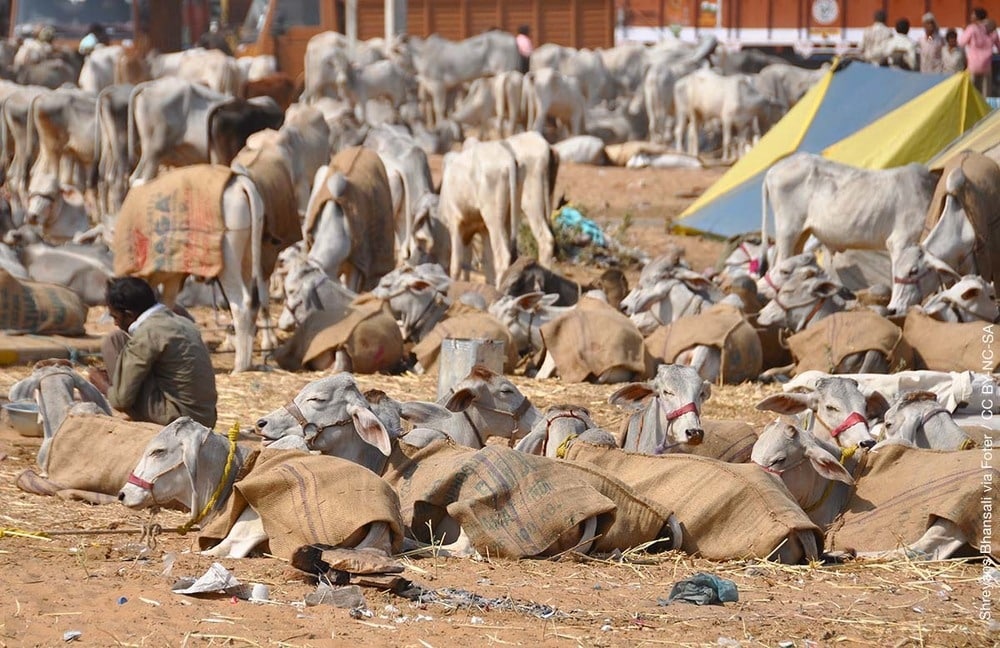
The West Bengal episode that unfolded this month, just days before Eid al-Adha (Bakri Eid), offers a rare and clarifying inversion. The newly elected BJP government, led by Suvendu Adhikari, chose to enforce the decades-old West Bengal Animal Slaughter Control Act, 1950, which mandates veterinary certification before cattle can be slaughtered. Almost immediately, cattle markets across the state went eerily silent. Last Sunday, at Haat, where 200 to 300 animals are typically sold before Eid, only two cows remained tethered. Muslim buyers had vanished, fearful of police action.
Those left behind were not the targets of the crackdown. They were Hindu cattle rearers, dairy farmers who had borrowed heavily to purchase and fatten cattle for the Eid market. Surajit Ghosh, a 42-year-old farmer, was widely quoted: “If we cannot sell, we are finished. Our family has survived on the milk business for generations. Once cows stop giving milk, we sell them.” The matter went to the Calcutta High Court, with TMC leaders arguing that the crackdown was not only unconstitutional but economically devastating and that it was not merely Muslims who would suffer, but the entire rural livestock economy.
The Bengal situation is an “UNO Reverse,” as younger commentators have called it, a moment where the machinery of Hindu nationalist cow politics consumed the very constituency it claimed to protect. But this reversal should not be a surprise. It was always structurally inevitable.
The Economics of What Is Being Destroyed
India’s livestock sector is not a footnote to the national economy. It accounts for roughly 4.5 percent of total GDP and approximately 30 percent of agricultural GDP, according to estimates from the Ministry of Agriculture and Farmers’ Welfare. Over 30 million people depend on livestock for their survival, with two-thirds of rural communities relying on it for their livelihoods (Venkateshwarlu, 2021). Livestock provides employment to approximately 18.8 percent of India’s population, while the meat sector alone contributes nearly a quarter of the total livestock sector’s output (Mohan et al., 2022).
India became the world’s largest bovine meat exporter in 2012, a distinction built almost entirely on buffalo meat and reliant on a vast supply chain of traders, transporters, processors, and laborers, most of them from Muslim and Dalit communities (M Muthukumar et al., 2021). India’s meat production reached 9.77 million tonnes in 2022–23. When cow vigilantism disrupts the supply chain, it is not just Muslim traders who lose income. It is the entire downstream industry, including leather workers, cold chain operators, food processors, truck drivers, and the millions of consumers of affordable animal protein (Alam, 2017).
The Informal Economy and Who Really Benefits
I understand this calculus from the inside. In my childhood, I worked in a dhaba, a small roadside eatery that served affordable non-vegetarian food to mill workers, factory hands, and daily wage laborers. Looking back at our cost structure, roughly 30 percent of our total expenses went to meat purchases. The remaining 70 percent — oil, rice, wheat, coal, vegetables, spices, electricity — flowed to traders and suppliers who were overwhelmingly from upper-caste Hindu communities. The wheat came from grain traders. The spices from established merchants. The coal and kerosene from fuel distributors. None of these beneficiaries was at risk of being pulled from a truck at night and beaten.
Our customers told a similar story. The people who ate our food were not wealthy. They were Dalit mill and factory workers, tribal migrant laborers, laborers from Denotified Tribes, and Pasmanda communities. The bulk of the consumers of low-cost non-vegetarian food in India are not Muslim. Beef and buffalo meat, among the cheapest sources of animal protein available, are consumed heavily by Dalit, tribal, and lower-caste Hindu populations for whom vegetarian protein sources are either too expensive or insufficient.
And then there were the butchers. In this informal economy, the Qureshi and other Pasmanda Muslim communities involved in slaughter received perhaps 20 to 30 percent of the economic value. But they absorbed almost all the risk. Hindu cattle traders frequently required them to collect animals directly from villages, often requiring travel at night, through unfamiliar roads, through areas where any Muslim man with a bovine animal becomes a suspect. The risk was theirs. The violence would be theirs. The profit distribution told a different story.
Cow vigilantism has particularly devastated these lower-caste Muslim communities, the Qureshis, the Kunjaras, the Mansooris, who form the labor backbone of the meat economy (Ali and Singh, 2024). The Hindutva political project treats all Muslims as a monolithic enemy, but its violence lands most heavily on those with the least recourse: working-class, occupationally vulnerable, spatially exposed Pasmanda Muslims who are simply trying to survive within the trade they have been consigned to by centuries of caste ordering.
Purity, Profit, and the Outsourcing of Risk
There is a structural logic to all of this that scholars of caste have long identified. In a seminal observation, writers on India’s political economy have noted that the cow is sacred in speech but profitable in practice. Upper-caste vegetarian rhetoric coexists with ownership of slaughterhouses, export firms, and cold chains. What is outsourced downward is not profit, it is stigma and physical danger. The “impure” work of slaughter is assigned to Muslims and Dalits, while the logistics, finance, and export facilitation that multiply the value of that labor remain in higher-caste hands.
Babasaheb Ambedkar understood this structure decades ago. His writing on the beef-eating taboo identified it not primarily as a religious observance, but as a mechanism of social control, a means by which the boundaries of caste were enforced, and the labor of lower-caste communities was disciplined. What we see today in the form of cow vigilantism is this mechanism made violent and state-adjacent.
The violence does not disrupt the animal economy. It reorganizes it, pushing the most vulnerable participants out, while leaving the superstructure of profit intact or even more concentrated. The butcher and transporter are beaten. The cold storage owner files no FIR.
What Must Be Named
The lynching of men like Zaheer Shaikh is not incidental to India’s economic order. It is functional to it. By terrorizing Muslim and Dalit participants in the cattle and meat economy, cow vigilantism cheapens their labor, criminalizes their presence in a sector they have served for generations, and strips them of bargaining power, all while the beneficiaries of that sector remain politically protected.
The Bengal episode should be read as a warning that this structure is ultimately self-defeating. When you criminalize the buyers, the sellers suffer too. When you terrorize the transporters, the supply chain collapses. When you beat a 70-year-old man to death in custody for allegedly possessing beef, you do not protect an animal; you announce the disposability of a citizen.
India cannot sustain this contradiction indefinitely: a government that promotes animal welfare while presiding over the murder of the people who make the animal economy function. The question is not whether Hindus should be allowed to protect what they hold sacred. The question is whether that protection will be built on the bodies of Pasmana Muslims and Dalit workers who had no say in the sacred order to which they were assigned.
In India’s political imagination, cattle have rights. The man who tends to them, transports them, or slaughters them, if he is Muslim or Dalit, apparently does not.
References:
Alam, A. (2017). “Cow economics are killing India’s working class”. The Conversation, 22. ‘Cow economics’ are killing India’s working class
Ali, M., & Singh, S. S. (2024). “Contemporary ‘Pasmanda’leadership and the Hindutva politics in Uttar Pradesh”. Studies in Indian Politics, 12(1), 33-47. https://doi.org/10.1177/23210230241235355
Mohan, K., Maheswarappa, N. B., & Banerjee, R. (2022). “Exploring the dynamics of women consumer preference, attitude and behaviour towards meat and meat products consumption in India.” Meat Science, 193, 108926. https://doi.org/10.1016/j.meatsci.2022.108926
Muthukumar, M., Naveena, B. M., Banerjee, R., Singh, V., & Barbuddhe, S. B. (2021). “An overview of Indian livestock and meat sector.” The Indian Journal of Animal Sciences, 91(4), 247–254. https://doi.org/10.56093/ijans.v91i4.114324
Venkateshwarlu, B. (2021). “Analysis of Livestock’s Economic Contribution to India’s GDP.” J Emerg Technol Innov Res, 8(12), 706-718. JETIR2112484.pdf
[Dr Ajazuddin Shaikh is a social activist and works on issues associated with substance use among adolescents and marginalized communities. Courtesy: Countercurrents.org, an India-based independent online journal founded in 2002, publishing articles on peace, democracy, social justice, ecology, secularism, and people’s movements. Edited by Binu Mathew, it is known for giving space to progressive, grassroots, and alternative voices often ignored by mainstream media.]