Of course, he will not respond to this article, despite his call for a national debate. Of course, his statement was just an ideological floater intended to tease and not a reasoned argument. But since he is the sarkaryavah (general secretary) of the Rashtriya Swayamsevak Sangh (RSS), which rules the country both directly and indirectly, we must take his statement seriously.
High officials of the Sangh Parivar do not make statements casually. That, however, is not the main reason for this response. The more important reason is that since 2004 he has been the sah baudhik pramukh (second in command) of the intellectual wing of the Sangh Parivar. That makes him one of the foremost intellectuals of the RSS.
In my experience, intellectuals choose their words very carefully. They think before they speak. Their language is measured, suggesting a universe of thought that exists behind what is spoken. This is a universe waiting to be discovered. Terry Eagleton, the Marxist theorist, described intellectuals as people who “seek to bring ideas to an entire culture”. That is what Dattatreya Hosabale was doing when he asked for “secular” and “socialist” to be removed from the Preamble of the Constitution.
There are two aspects to what he said that require our consideration. One is acceptable, the other debatable. Unfortunately, the public response has been mostly to the latter.
In the best traditions of purva paksha, I shall, therefore, respond to both aspects. (Purva paksha is a traditional approach involving deep familiarity with the opponent’s point of view before criticising it.)
Hosabale’s objections
Hosabale’s statement contains four objections. He is critical of (i) the context in which the words were introduced into the Preamble, (ii) the procedure that was followed, (iii) the constraints that they, especially “socialist”, would impose on future policymaking by government, and (iv) the impact the two words would have of diminishing the “eternal” aura of the Preamble.
All four are important points and must be considered. To do so, I have adopted the following method. I first re-read the Preamble. Then I revisited the Constituent Assembly debates on the Preamble that took place on October 17, 1949. And finally, going further back, I studied the discussion in the Constituent Assembly that took place on December 13, 1946, when the Objectives Resolution was introduced by Jawaharlal Nehru. (The Objectives Resolution was the ethical basis for the Preamble.)
All three steps were necessary to respond meaningfully to Hosabale’s discontent. Doing so added hugely to my understanding of the vision of India that was being shaped. In fact, I felt compelled to rededicate myself to the India being imagined. This is my rededication.
Debates on Preamble
The debates in the Constituent Assembly on the Preamble involved a diversity of members across gender, religion, caste, place, and perspective. Those who spoke were H.V. Kamath, K.M. Munshi, Hasrat Mohani, Deshbandhu Gupta, B. Pattabhi Sitaramayya, Jai Narain Vyas, K. Santhanam, A. Thanu Pillai, Rohini Kumar Chaudhuri, V.I. Muniswamy Pillai, Shibban Lal Saxena, M. Thirumala Rao, Mahavir Tyagi, Hriday Nath Kunzru, Satyanarayan Sinha, Govind Malaviya, B.R. Ambedkar, J.B. Kripalani, P.S. Deshmukh, Satish Chandra, Brajeshwar Prasad, Naziruddin Ahmad, and Purnima Banerji.
Rajendra Prasad conducted the proceedings. I have listed them here to acknowledge them and give them our gratitude. Although the discussions were intense—and some members were obstinate about their amendments—they were very cordial with each other and even showed a touch of humour. Munshi, for example, responded to a point of order raised by Hasrat Mohani, by saying: “Once in my life I support the Maulana Saheb!” That, sadly, was of a time long ago and far away.
Because Hosabale has an aversion to the word “secularism”, it is interesting to note the discussions on “god” in the Assembly. Saxena proposed the following amendment: “In the name of god the Almighty, under whose inspiration and guidance, the Father of our nation, Mahatma Gandhi, led the Nation…”
Mahatma Gandhi’s name was immediately opposed since this was not a Gandhian Constitution. But, more interestingly, having “god” was also opposed. Banerji said: “I appeal to Mr Kamath [who had originally proposed adding god] not to put us to the embarrassment of having to vote upon god.” In other words, do not bring god into this.
Chaudhuri wanted “In the name of god” to be changed to “In the name of goddess” because, as he said, he “belongs to Kamrup where Goddess Kamakhya is worshipped”. Both proposals were rejected, and nobody got offended.
Spirit of secularism
Further, Thanu Pillai argued against the compulsion implicit in the amendment by saying that “a man has a right to believe in god or not”. Note the phrase “or not”. He went on to say that even though he is a believer, the words make belief in god a compulsion. Thanu Pillai seemed to be equating the rights of atheists with those of believers. Amazing broad-mindedness. From these interventions, it is obvious that secularism was an idea that infused the spirit of the Preamble.
Another gem that emerged from these debates, and which supports Hosabale’s description of the Preamble as “eternal”, is the statement of Kripalani:
“Sir, I want, at this solemn hour to remind the House that what we have stated in this Preamble are not legal and political principles only. They are also great moral and spiritual principles and if I may say so, they are mystic principles.”
While describing the Preamble as “eternal”, Hosabale is making an important point. Something that is “eternal” stands beyond time, place, context, and regime. It cannot be amended or ignored. If it has to be amended, then it should only be done in the rarest of rare circumstances.
Eternal principles
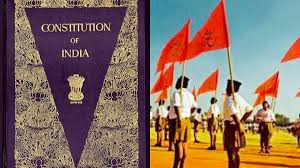
Is Hosabale, by his reference to “eternal”, asking his governments at the Union and State levels to commit themselves to “secure to all its citizens, justice (social, economic and political), liberty (of thought, expression, belief, faith and worship), equality (of status and opportunity) and fraternity (assuring the dignity of the individual and the unity and integrity of the nation)”?
These are eternal principles. Will Hosabale tell his governments in Assam, where citizenship is being undermined, and in Uttar Pradesh, where liberty is being eroded, and in the nation where fraternity is being degraded, that they are violating the Preamble, tarnishing its “eternal” glow? If Hosabale deliberately chose to use the word “eternal”, such deliberateness being the hallmark of an intellectual, then do we share a common understanding of the special status of the Preamble?
There are many things that one can also glean from a reading of the Objectives Resolution, but I shall mention just two. Nehru, on noticing that many members were absent from the session, advised those present to keep in the mind the interests of those absent and to “do nothing which may cause uneasiness in others or goes against any principle”.
Their absence, for him, “increases our responsibility”. Noble sentiments that I often feel are missing in our Parliament and State Assemblies. Another aspect I found inspiring was Nehru’s suggestion that the Resolution be endorsed not by a “raising of hands” but “by all of us standing up and thus taking this pledge anew”. Would Hosabale agree that it is time, in the 75th year of the Indian republic, for us to renew this pledge?
With this as background, let me now attend to the four discontents. On the first, the context: I agree with his general argument that constitutional changes introduced during a period of authoritarian rule have little legitimacy. During authoritarian periods, both during a declared or an undeclared emergency, fundamental changes that have been introduced have little normative value (although they may be legally correct), and therefore, if they are made, they should be reversed.
Changes in 42nd Amendment
The many changes of the 42nd Amendment, introduced during the Emergency period in 1976, were reversed by the 44th Amendment during the Janata Party rule in 1978.
It is a mystery why the words “secular” and “socialist” were retained. Perhaps Hosabale can enlighten us since the Jana Sangh (the precursor of the BJP) was an important constituent of the Janata Party. I also agree with Hosabale’s second objection: of the use of improper procedure in introducing the amendments to the Preamble. The words “secular” and “socialist” were part of the omnibus 42nd Amendment. If they were to be introduced, they merited a distinct and separate Amendment. Of course, I mean one introduced in non-Emergency times.
Let me state unequivocally here that it is my belief that no constitution is fixed in stone for all time. All sections can be amended using the procedures prescribed. But I have a caveat. Amendments to core ideas must be carefully done, with lots of hesitation, introspection, and also done very rarely, the rarest of the rare, because they are the core guiding aspects of our founding document. They should be like Ashoka pillars. They constitute the “basic structure” of the Constitution, an idea I like, since it accepts that core aspects are capacious, allowing for a different inhabiting as social mores of a society change.
That is why the right to life now includes the right to a clean environment. Core aspects must endure, must have long lives, and should only be changed in extreme circumstances. Legitimate changes to core aspects can be likened to apad dharma (moral principles during calamities) being applied to sadharana dharma (everyday moral principles). Perhaps that is why the Janata Party did not remove “secular” and “socialist” from the Preamble when it passed the 44th Amendment. I have a question for Hosabale here: How does abrogating Article 370 stand up to this rule?
‘Socialist’ constraint
His third anxiety, that the word “socialist” would constrain policymaking, is weak on at least three grounds. All founding principles—such as justice, liberty, equality, and fraternity—are supposed to constrain governments since such constraint is the measure of a constitutional order. Constraining policymaking is, therefore, not an anxiety worth worrying about.
Further, both Nehru and Ambedkar saw the Constitution as being socialist in spirit. That is why Nehru did not insist on introducing the word in the Constitution and Ambedkar saw many of the other provisions as being expressions of socialism. And, finally, which socialism is Hosabale uneasy about since we have, in India, many varieties, such as Gandhian, Lohiaite, and Nehruvian, and the socialistic ideas of Deen Dayal Upadhyay and S.A. Dange, among others? Is not the BJP’s Antyodaya concept a socialist idea by another name?
And finally, the fourth objection: of diminishing the “eternal” aura of the Preamble. Linguistically, “socialist” and “secular” are a bit cumbersome there. They do not have the same status as justice, liberty, equality, and fraternity. The former are ideologies. The latter are principles.
But Hosabale is not making a linguistic point about the loss in the aesthetics of the Preamble. His is a fluffy point, undefended by serious argument. It is a bias. He does not like secularism or socialism because that is the party line, not an intellectual formulation. It would be interesting to see why he thinks these words sully the “eternal” aura of the Preamble.
I hope this is the kind of discussion that he wanted. If not, he should let us know and we will begin anew.
[Peter Ronald deSouza is an independent scholar. He was formerly Director of the Indian Institute of Advanced Study, Shimla. Courtesy: Frontline magazine, a fortnightly English language magazine published by The Hindu Group of publications headquartered in Chennai, India.]