India is passing through a critical phase in its post-Independence history. On the one hand, there is material prosperity in some areas, albeit of an uneven kind. The country’s gross domestic product is growing rapidly. At the same time, our Muslim brethren, who are an integral part of our nation, have never felt more marginalised. To be sure, their marginalisation did not start with the BJP coming to power at the Centre in 2014 under Narendra Modi’s leadership. Nevertheless, the BJP’s promise of “Sabka Saath, Sabka Vikas, Sabka Vishwas” (support to everyone; everyone’s development; and gaining the trust of everyone) sounds hollow when one looks at the conduct of the Central government and BJP-led State governments towards Indian Muslims.
The BJP has perfected a formula of winning elections without Muslim support and, therefore, is under no pressure to be responsive to Muslim needs, concerns, and aspirations. The state machinery is biased. It routinely overlooks unlawful acts of Hindu extremists against Muslims. There is no fairness, objectivity, and dignity in the way the mass media projects the Muslim community.
The Congress, the Left parties, and various regional parties appear to be in no position to remedy the situation. These parties have lost the support of a large section of Hindus, who see “secularism”—as professed and practised since Independence—as a cover for “minorityism”.
The resultant situation has catalysed a tremendous churn in the country’s Muslim community. Many historical and contemporary issues are being critically discussed, and entrenched beliefs are being questioned. By no means is there any unanimity within the community on either the root causes of the problems it is facing or on the way forward. The national media has failed to capture this churning.
Muslim voices
There are many Muslim voices even today who favour building a better understanding with the Hindu community since such ties are seen as a more reliable protector and promoter of Muslim interests, especially among the poorer sections of Muslims who need state benefits from welfare and development schemes.
Many Muslims see the need for a sustained dialogue with the BJP’s ideological parent, the RSS, which has emerged as the largest and most influential Hindu organisation in the country.
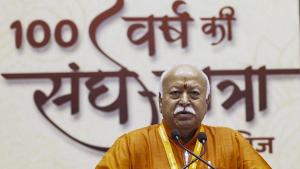
Equally, the need for such dialogue, aimed at building harmonious relations with the Muslim community and thereby strengthening national unity, is also being felt by some far-sighted RSS leaders and cadres. In recent years, RSS chief Mohan Bhagwat has made statements that Muslims have welcomed and has held a series of meetings with Muslim religious and social leaders.
However, these efforts have lacked consistency and have not produced a positive consensus yet. While they deserve to be supported by those who believe in communal harmony and inclusive national progress, a critical examination of such efforts is also in order. A dogmatic view of the RSS should be abjured. However, criticism of the RSS will not abate if Bhagwat’s statements are not matched by genuine peace-promoting actions of the Sangh Parivar’s cadres on the ground.
RSS’ genesis
If one looks at the historical context, one can say that circumstances made the RSS a Hindu nationalist organisation. One can hope that future circumstances turn it into a nationalist Hindu organisation. Pointing to the difference between a Hindu nationalist organisation and a nationalist Hindu organisation is not a jugglery in words. It has material significance.
The RSS was born 100 years ago, when the struggle for India’s freedom from British colonial rule was caught in great confusion and divergence, from which it never fully recovered. Mahatma Gandhi’s withdrawal of the Non-Cooperation Movement after the outbreak of violence in the Chauri Chaura incident in 1922 and the near-simultaneous evaporation of the spirit of the Khilafat Movement (which saw a high point in Muslim support to the national liberation struggle led by Mahatma Gandhi) resulted in deepening communal fissures.
The idea of Muslim separatism, based on a longing for pre-British Muslim rule and nursed by a section of Muslim elites since the time of Sir Syed Ahmad Khan (1817-98), began to take concrete shape. It later solidified as the Muslim League in 1906, and the separate Muslim electorate created by the Morley-Minto Reforms in 1909. The Hindu Mahasabha was created in 1915.
Communal violence broke out in several parts of India, with the participation of fanatic elements among both Muslims and the newly resurgent Hindus. Mahatma Gandhi asserted in the Young India of May 29, 1924: “My own experience but confirms the opinion that the Mussalman as a rule is a bully, and the Hindu as a rule is a coward.”
Many Hindus began to believe that their cowardice could be changed into strength only though organised unity. One such person was Keshav Baliram Hedgewar (1889-1940), who founded the RSS in 1925 in Nagpur. Both he and his successor, “Guruji” M.S. Golwalkar, kept the RSS largely aloof from the freedom movement, prioritising instead the building of an organisation of highly disciplined swayamsevaks (volunteers) dedicated to the ideology of Hindu nationalism.
Hindu unity
Three things are noteworthy here. First, many in the Congress at the time also believed that Muslim aggressiveness should be countered with Hindu unity. Sardar Vallabhbhai Patel was one of them, although he strongly disapproved of the RSS. Hedgewar himself was previously active in the Congress, having served as its general secretary in the Vidarbha provincial committee.
Independence Day celebration at a madrasa in Nagpur in 2016. The RSS must realise that Hindus and Muslims are both integral to the idea of India and work towards intercommunity amity.
Second, Hedgewar named his organisation Rashtriya Swayamsevak Sangh, and not Hindu Swayamsevak Sangh.
Third, even though the RSS regarded India as a Hindu rashtra (nation), a self-evidently flawed and divisive concept, it was not India’s pre-eminent Hindu nationalist organisation at the time. The Hindu Mahasabha was. Neither was the RSS India’s pre-eminent nationalist organisation at the time. The Congress was. Indeed, the voice of the RSS remained weak and marginal between 1925 and the 1947, when the British finally left after partitioning India.
Neither the phenomenal growth of the RSS in the post-1947 period nor the Hindu-Muslim tension and the attendant plight of Indian Muslims can be adequately understood without reference to the blood-soaked Partition. It remains the most tragic and most unnatural event in the millennia-old history of our civilisation. Tragic because it saw the worst communal holocaust in our history and the largest transborder migration in human history. And unnatural because the poisonous “two-nation theory”, which was the Muslim League’s basis for demanding Partition, led to the creation of an artificial nation called Pakistan.
Shared history and culture
The argument that Hindus and Muslims cannot live together since they constitute two separate nations flies in the face of the shared history, culture, ethnicity, and linguistic heritage of our two communities. Despite these common bonds, Partition could not be prevented because of two reasons.
One, Indians then were not in effective control of the state machinery. The British, who wanted to “divide and quit”, used the state machinery to favour Jinnah’s demand for Partition.
Two, weak Hindu-Muslim sociopolitical solidarity proved fatal at the most crucial stage in the anti-British struggle.
As Ram Manohar Lohia has shown in his brilliant book Guilty Men of India’s Partition (1960), the RSS too was responsible for debilitating Hindu-Muslim solidarity.
Golwalkar’s thoughts
After the trauma of Partition, there is evidence to show that the Sangh’s view on Indian Muslims has changed with time. In November 1972, the renowned author Khushwant Singh, who was then the editor of The Illustrated Weekly of India, interviewed Golwalkar, six months before the latter’s demise. (Reproduced in ‘Guruji’ Collected Works, volume 9, page 200). Here is an extract:
Khushwant Singh: What are your thoughts on Muslims’ issues?
Golwalkar: I have not the slightest doubt that historical factors alone are responsible for the divided loyalty that Muslims have towards India and Pakistan. Moreover, both Muslims and Hindus are equally to blame for this. The difficulties that Muslims had to face after the Partition, and the sense of insecurity that it created, also contributed to it. Nevertheless, it is not right to hold the entire community responsible for the guilt of some people.
Elsewhere in the interview, Golwalkar says: “We have to win over the loyalty of Muslims with love. This is the only right policy towards Muslims…. I am optimistic, and I believe that Hindutva and Islam will learn to coexist with one another” (emphasis mine).
Among the leaders of the Sangh I first interacted with was the late M.G. Vaidya, its prominent spokesman. He received me, in the early 1990s, at his modest house in Nagpur. Commenting on the history of Hindu-Muslim antagonism, he made a remark that I was not expecting from an RSS leader: “Had the British not come to rule India, Hindu-Muslim integration would have continued without disruption. India’s partition would not have taken place, and both communities would have prospered.” So true!
The whole world knows that India’s division created a wound that has not healed even after nearly eight decades. From a two-nation antagonism, the subcontinent is now witnessing a three-nation discord. Relations between India and Bangladesh have also soured. If these are allowed to worsen further, there is no saying what dangerous consequences the region may suffer in future.
Healing wounds of Partition
So, how is this wound to be healed? This is the most important question that all right-thinking people in the subcontinent, including the RSS and its critics, should reflect upon. Unless the three countries revisit 1947 and take major corrective action, there is likely to be no tangible cure for the pain all three are experiencing.
Let me elaborate on what I mean by revisiting 1947. Partition cannot be undone. That is for sure. However, can its negative consequences be undone through a bold Hindu-Muslim reconciliation within India and by an innovative India-Pakistan-Bangladesh reconciliation within the subcontinent? Most certainly.
I would like to imagine a larger South Asian union where India, Pakistan, and Bangladesh continue to be self-governing nation states but ensure collective security and promote the largest possible degree of mutually beneficial cooperation.
Reimagining ‘Akhand Bharat’
In short, I believe the concept of “Akhand Bharat” needs to be reformed and reimagined.
This was possibly the vision of Deendayal Upadhyaya, the RSS pracharak who became general secretary of the Bharatiya Jana Sangh (and is regarded by the BJP as its ideological guru), when he and Ram Manohar Lohia signed a historic joint statement on April 12, 1964, where they made an appeal for equal protection for Hindus and Muslims in the subcontinent.
More significantly, the two leaders urged the governments of India and Pakistan to hold frank (and not “piecemeal”) talks to create mutual goodwill and make a “beginning towards the formation of some sort of Indo-Pak Confederation”. Will Prime Minister Modi heed Upadhyaya’s appeal?
Questions will surely be asked: Is such a confederation possible? Is there any legitimate basis for it? Well, if it is legitimate for China to seek rectification of a historical wrong through reunification of Taiwan on the basis of a “One Nation, Two Systems” formula, why should it be illegitimate for India, Pakistan, and Bangladesh to pursue a similar goal?
Of course, in this imaginative reformulation of “Akhand Bharat” of an India-Pakistan-Bangladesh confederation—not reunification—the use of force will be completely ruled out. This confederal idea can be easily enlarged to envision a “South Asian Union” with the inclusion of other nations in the region, all of whom are members of a common multireligious civilisational family.
Such an initiative for a South Asian Union can take off only if four imperatives are met.
The idea of a South Asian Union
First, the RSS must rectify the obvious contradiction between its rejection of India’s Partition and its continuing advocacy of India as a “Hindu rashtra”. A future confederal union can never be called “Akhand Hindu Bharat”. Secularism (in the Indian meaning of equal respect for all faiths), democracy, and an egalitarian socioeconomic order are the only foundations on which a future South Asian Union can be built.
Second, if the RSS is sincere in its rejection of what happened in 1947, it must make bold and consistent efforts to promote Hindu-Muslim harmony in India. Sangh leaders do not seem to realise that India’s progress on the basis of Hindu-Muslim concord is the strongest and surest weapon to defeat the idea of a theocratic Pakistan built on the fraudulent foundation of the two-nation theory. RSS leaders must also speak out against another nonsensical goal, namely the dismemberment of Pakistan, which is currently being championed by some Hindutva extremists. Far from undoing the ill-effects of Partition, any disintegration of Pakistan can only gravely endanger India’s security, as also peace and stability in the region.
Third, Pakistan and Bangladesh must give up their unfriendly approach to India, while India must abandon its “Big Brother” approach towards its smaller neighbours. A South Asian Union is inconceivable if it is not founded on the principle of sovereign equality.
Fourth, both Hindus and Muslims in India, and in the rest of the subcontinent, should proudly and confidently acknowledge their roots in India’s syncretic civilisation. Ours is neither an exclusively Hindu civilisation nor an exclusively Muslim civilisation. Rather, it is the common heritage of all who have enriched it with their own contributions for thousands of years.
Is the RSS ready to adopt such an imaginative, progressive, and peaceful vision for our subcontinent as it peers into its own future for the next 100 years?
[Sudheendra Kulkarni served as a close aide to former Prime Minister Atal Bihari Vajpayee. He is the author of Music of the Spinning Wheel: Mahatma Gandhi’s Manifesto for the Internet Age. Courtesy: Frontline magazine, a fortnightly English language magazine published by The Hindu Group of publications headquartered in Chennai, India.]