❈ ❈ ❈
The Emergency and the Sangh Parivar’s Tacit Support to Indira Gandhi
Shivasundar
[This article was published on 25 June 2023. We are republishing it for its continued relevance.]
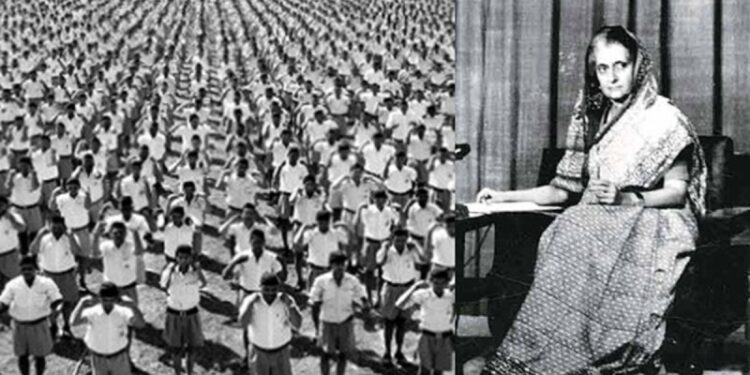
This June 25 marks 48 years since Indira Gandhi, the then Prime Minister of India, infamously declared a state of Emergency across the country. Before the incumbent PM Narendra Modi took office in 2014, the period of Emergency under Indira Gandhi’s regime was considered the worst chapter in the history of post-Independence India. Those 20 months, however, seem to pale in comparison to India’s nine years under Modi. It is evident to the world that over the past nine years, there has been a terrifying erosion of media freedom, religious freedom, freedom of speech, and the right to dissent in the country.
The Bharatiya Janata Party (BJP)-led Union government has been organising annual events every June 25, almost like a tradition, to remind the country of the dark days of the Emergency. It uses the occasion to portray itself as the only genuine democratic force that opposed Indira Gandhi’s dictatorship.
Of course, true proponents of democracy cannot forget the wrongs committed during the Emergency. They can forget neither the political and economic circumstances of the time, nor how the Constitution was abused to commit those excesses. But at the same time, it is also hard to forget that on all indices, India under the current government has either ranked lower than authoritarian countries, or is at the same level as them. The V-Dem Institute in Sweden, an organisation that studies global democracies, even declared that India has turned into an electoral autocracy.
It is true that the Rashtriya Swayamsevak Sangh (RSS), Jana Sangh, and their affiliate organisations have indeed played a role in the political protests that led to the declaration of a state of Emergency. But it also has to be acknowledged that once it was imposed, leaders of the RSS and the Jana Sangh made secret agreements supporting the Emergency with the very same Indira Gandhi, whom they called a dictator.
The BJP and the Sangh Parivar have been continually attempting to hide the pages of this very embarrassing history, and their opportunistic anti-people activities of the time. But historical records and the writings of their own leaders prove how the Sangh’s leaders covertly supported the Emergency. In fact, not only did they try to reach a compromise with Indira Gandhi, they also wrote surrender letters from jail, following in the footsteps of their icon VD Savarkar.
Vajpayee’s half-moment of jail time
Every year on June 25, the BJP and the RSS put up posts on Facebook praising themselves for saving India during the Emergency. Alongside appear images from front pages of newspapers dated June 26, 1975, which reported that Atal Bihari Vajpayee, Morarji Desai, and other leaders had been jailed.
Intelligence reports and the Union Home Ministry records from that time indicate that thousands of leaders and workers of the socialists, Lohiaites, and the communists had paid a heavier price than Jana Sangh leaders. Nevertheless, did Atal Bihari Vajpayee, whose name was carried on the frontpages of newspapers, ever spend any time in jail during Emergency? Barely any.
Vajpyee spent most of those 20 months in his house on parole, for which he gave an undertaking stating that he would not oppose the Emergency!
It was neither the communists nor the socialists who brought these facts — along with proof — into the public domain, but senior BJP leader Subramanian Swamy. In an article titled ‘The Unlearnt Lessons of Emergency’ published in The Hindu on June 13, 2000, Swamy revealed in detail how several RSS and Jana Sangh leaders held covert talks with Indira Gandhi.
He wrote that within a few days of being jailed, Vajpayee came to an agreement with Indira Gandhi. He gave an undertaking that if he was released on parole, he would not participate in activities against the government. Swamy wrote that Vajpayee did what the government told him to do for the duration of the time he spent outside on parole.
The document of surrender
In the same article, Swamy also details how RSS leaders, around December 1976, made the decision to sign a document declaring full and open support to Indira Gandhi’s Emergency.
After the Emergency was declared, senior RSS leader Madhavrao Mule was tasked with the responsibility of carrying out organisational activities without opposing the government, while Eknath Ranade was asked to reach an agreement with the government. Swamy himself, meanwhile, was told to garner support for anti-Emergency movements from the governments of other countries including the United States. But in November 1976, Mule advised Swamy to stop his efforts, because “the RSS had finalised the document of surrender to be signed at the end of January.”
The then head of the Intelligence Bureau TV Rajeswar has chronicled the RSS leaders’ decision to surrender in his book India – The Crucial Years. Ravi Visveswaraya Sharada Prasad, the son of Indira Gandhi’s then information adviser HY Sharada Prasad, also documents these developments in an article for The Print.
Sarsanghchalak’s surrender letters
Even more important are the letters that RSS’ highest leader Sarsanghchalak Madhukar Deoras, also known as Balasaheb Deoras, wrote to Indira Gandhi from Yerwada jail. He had also written to Vinobha Bhave, pleading with him to persuade Indira Gandhi to consider his release. These letters help us understand the truth of the role played by the RSS and the Jana Sangh during Emergency, and their subsequent hypocrisy.
These letters are attached as appendices at the end of the book Hindu Sangathan aur Sattavadi Rajneeti, that Deoras himself wrote in Hindi. Scholar and political activist Yogendra Yadav has provided links to the book on his Twitter account.
Full text (from his book) of two letters written by RSS chief Balasaheb Deoras to Indira Gandhi during emergency.
Note he appreciates her speech (for emergency), congrats her on (infamous) SC verdict!
Do you notice any criticism of emergency, any defence of democratic rights? pic.twitter.com/rJhQZFQZoY
— Yogendra Yadav (@_YogendraYadav) October 9, 2018
The English translations of these letters can be found in a book titled Five Headed Monster: A Factual Narrative of the Genesis of Janata Party by Brahm Dutt, then leader of the Bharatiya Lok Dal. They are also available in the 2021 book India’s First Dictatorship authored by Pratinav Anil and Christophe Jafrelot, a scholar who has studied and published several books on India’s socio-political trajectories at the grassroot level.
The first letter on August 22, 1975
Indira Gandhi declared Emergency on June 25, 1975. During the Independence Day address delivered from Red Fort, she said, like all dictators do, that her actions were necessary for the country’s security and that those opposing it were traitors. All across the country, pro-democracy activists condemned both her speech and her authoritarianism.
However, in his first letter to Indira Gandhi on August 22, 1975, Deoras openly praised her August 15 speech! He went even further, lauding the speech for its timeliness and balance. He also said that he was writing to her to dispel misconceptions about the RSS and assured her that the RSS was trying to build an organisation of Hindus but was never against her government. Towards the end, he said: “I request you to keep this in mind and revoke the ban on the RSS. It would give me great happiness to meet you in person if you deem it appropriate.”
Thus, in the first letter, he not only expressed his agreement with the imposition of Emergency, but towards the end, he was seeking an end to the ban on the RSS and not to the Emergency.
The second letter on November 10, 1975
Indira Gandhi never acknowledged Deoras’s letter. In the meantime, the media was prepared to crawl when she asked them to bend, and the Supreme Court did as she asked. Due to this, a five judge-bench of the Supreme Court overturned the Allahabad High Court’s order invalidating Indira Gandhi’s election. Calling this sorry state of an independent judiciary an extension of authoritarianism, pro-democracy activists across the country — in jail and outside — roundly condemned this development.
And what did the Sarasanghchalak do?
In his second letter to Indira Gandhi dated November 10, 1975, Deoras began by congratulating her on the Supreme Court victory: “Let me congratulate you as five judges of the Supreme Court have declared the validity of your election.”
Throughout the letter, he proceeded to try and convince her that the RSS was not against the government or the Emergency. Towards the end, he once again asked her to lift the ban on the RSS: “The selfless endeavours of lakhs of RSS workers can be used to further the government’s development programmes.” This was a blatant assurance that RSS workers would join hands with Indira Gandhi’s authoritarian government if the ban on them was lifted.
The third letter on February 24, 1976
Indira Gandhi ignored this second letter too. She was scheduled to visit Vinobha Bhave’s ashram towards the end of February, when Deoras wrote a third letter begging Bhave — who was both a friend of the RSS and held some influence over Indira Gandhi — to intervene in favour of the RSS and persuade Gandhi to lift the ban. If this happened, “a condition will prevail as to enable the volunteers of the Sangh to participate in the planned programme of action relating to the country’s progress and prosperity under the leadership of the prime minister”.
This was the true face of the RSS during Emergency. While Indira Gandhi was systematically trampling on people’s rights, when democracy was being killed, the RSS and the Jana Sangh were trying to secure their release from jail by giving an undertaking stating that they would covertly participate in that clampdown.
As an extension of this, the Uttar Pradesh Jana Sangh announced total support for the Indira Gandhi government on June 25, 1976 — the first anniversary of its declaration — and also pledged not to participate in any anti-government activities. As many as 34 leaders of the Jana Sangh in Uttar Pradesh and Madhya Pradesh joined the Congress.
All this culminated in the RSS reaching an agreement with the government and deciding to sign a surrender document at the end of January 1977. But since Indira Gandhi withdrew the Emergency before that, the necessity of actually signing the surrender document did not arise.
Even after the Emergency, Balasaheb Deoras thought favourably of Indira Gandhi. After she returned to power in 1980, Indira Gandhi rejected her previous “socialist-secular” policies in favour of a dangerous Hindutva politics, with the rhetoric that in Kashmir and Punjab “Hindus are in danger, and if Hindus are in danger then the country is in danger and therefore a strong leadership is necessary.” Deoras openly began to praise her for this stance.
Even as she began to implement the RSS agendas herself, the Sarasanghachalak declared that when Indira Gandhi herself is implementing the Hindu agenda so daringly, they don’t need a BJP. The RSS repaid its debt to her by participating in the anti-Sikh carnage after she was assassinated.
When we remember the Emergency this year, let us not forget this historical treason and the subterfuge.
[This article has been excerpted and translated from a Kannada article that appeared on Vartha Bharati. Shivasundar is an activist and freelance journalist. Translated from Kannada by Anisha Sheth. We have made minor editions in it. English article courtesy: The News Minute, an Indian digital news platform based in Bangalore, Karnataka.]
❈ ❈ ❈
RSS and the Emergency
A.G. Noorani
Every year on the anniversary of the Emergency, the Rashtriya Swayamsewak Sangh (RSS) and its foot soldiers, especially those in its political wing, the Bharatiya Janata Party (BJP), go to town denouncing sin. It boasts of the “sacrifices” made by it and its political front, the Jana Sangh, ancestor of the BJP, during the Emergency.
Prime Minister Indira Gandhi’s imposition of the Emergency was no mere mistake; it was a sin, a constitutional crime committed for purely personal reasons, namely, to nullify the judgment of the Allahabad High Court on June 12, 1975, declaring her election to the Lok Sabha to be void. She put her political opponents behind bars; imposed press censorship; suspended the fundamental rights; extended the life of the Lok Sabha; rushed through Parliament the 42nd Constitutional amendment to undermine our democracy; attempted to give herself immunity from criminal proceedings; nullified the High Court judgment; and even made serious moves to discard the Constitution itself by convening a Constituent Assembly to establish a presidential system.
But, in his correspondence with Indira Gandhi during the Emergency, the RSS boss, M.D. Deoras, never criticised those sordid moves or called for a return to the democratic order. Instead, on his advice and instructions, his men from the RSS gave unconditional undertakings to get out of prison.
The government prepared a standard form, which RSS detenus happily signed. Some of them did not wait for the form. They gave unqualified undertakings in their own language, if only to get out.
The Government’s printed draft read thus:
“PRO-FORMA OF UNDERTAKING
I, Shri…………………. Detenu Class I …………….. prisoner agree on affidavit that in case of my release I shall not do anything which is detrimental to internal security and public peace. Similarly, I shall not do anything which would hamper the distribution of essential goods. So also I shall not participate in any illegal activities. I shall not indulge in any activities which is prejudicial to the present emergency.”
D.R. Goyal records: “The Maharashtra government had demanded written undertaking for conditional release of the detenus. The RSS and Sangh detenus had independently decided to sign such undertakings. This caused a stir in the jail and socialist leaders like Bagaitkar, Babu Rao Samant and Dasrath Patil went to meet the Jana Sangh leader Mhalgi to dissuade his party people from signing this undertaking. Mr. Mhalgi pleaded that the decision to sign the undertaking was taken by the top leaders of the RSS and Jana Sangh not confined to jail ” (Rashtriya Swayamsevak Sangh; Radha Krishna Prakashan, 2000; page 141). The RSS did not oppose the Emergency. It collaborated with its perpetrators to save its own skin.
Since the Bangladesh War, particularly, the RSS had developed a soft corner for Indira Gandhi and the Congress. It did not oppose her Congress in the 1984 election to the Lok Sabha. Its prime strategist Nanaji Deshmukh openly advocated support to Rajiv Gandhi.
On December 22, 1971, the then RSS boss, M.S. Golwalkar, wrote a congratulatory letter to the Prime Minister reeking of fulsome praise. “The biggest measure of credit for this achievement goes to you” (Organiser, June 16, 1973). Hers was a formal reply.
The RSS men did not opt for prison. They were thrown into prison. The Emergency was declared on June 25, 1975. Deoras was arrested and put into prison on June 30. The RSS was banned, along with 23 other bodies, on July 4. The RSS initial response was to wait and watch. Two scholarly works describe that policy.
s, training camps, parades and other activities were stopped. Soon some leading s, after consulting imprisoned Balasaheb Deoras, met at Bombay in late July to chart out the action plan for their banned organisation. They decided that the RSS would work closely with the LSS [Lok Sangharsh Samiti], thus breaking the RSS tradition of keeping the organisation aloof from political movements. The coordinating work of the RSS with the LSS would be carried out by the four zonal s. Yadavrao Joshi (South), Rajendra Singh (North), Moropant Pingale (West), and Bhaorao Deoras (East). In addition, while Rambahu Godbole was entrusted with the task of contacting the opposition party leaders, Eknath Ranade was to liaison with the government. Incidentally, Ranade was assigned the same job during the previous ban of 1948-49. This meeting also charted the following course of action for the banned organisation: (a) to keep up the morale of the s by arranging some form of congregations; (b) to establish an underground press; (c) prepare for a nationwide , establishing contact with significant non-political figures and with prominent representatives of the minority communities; and (d) solicit overseas Indian support for the RSS in the underground activities of the LSS. However, many critics believe that the RSS was keen on a compromise rather than fight Indira Gandhi” (Pralay Kanungo;
Another account based on an interview with Deoras’ successor, Rajendra Singh, records in detail: “The initial reaction of the RSS leadership was to take a cautious wait-and-see approach. When the government began to arrest RSS workers on a large scale, the RSS committed itself to working closely with the LSS set up in support of Jayaprakash Narayan, thus breaking the RSS tradition of keeping the organisation aloof from political movements. This decision was taken at a meeting of leading pracharaks at Bombay in late July, after consultation with the incarcerated Balasaheb Deoras. Holding primary responsibility for coordinating RSS work with the LSS were four zonal pracharaks: Yadavrao Joshi (South), Rajendra Singh (North), Moropant Pingale (West), and Bhaorao Deoras (East). In addition, Rambahu Godbole, the Jana Sangh’s organising secretary for Bihar and West Bengal, was instructed to establish contact with opposition party leaders; Moropant Pingale to coordinate activities with the LSS and to organise a nationwide satyagraha; Eknath Ranade, head of the Vivekananda Kendra, to handle discussions with the government.
“The July meeting in Bombay established a set of goals for the underground RSS organisation: It would (1) maintain the morale of the swayamsewaks by providing them opportunities to meet together (eg., prayer meetings, sporting events, etc.); (2) establish an underground press and distribution system for it; (3) prepare for a nationwide satyagraha, establishing contact with significant non-political figures and with prominent representatives of the minority communities; and (4) solicit overseas Indian support for the RSS in the underground activities of the LSS. Regarding this last goal, the RSS made use of Indians for Democracy, an organisation established in the U.S. immediately after the Emergency. In November 1976 the Friends of India Society International was formed in England to mobilise overseas swayamsevak s for the same purpose” (Walter K. Andersen and Shridhar D. Damle; The Brotherhood in Saffron; Vistaar Publications, SAGE, 1987; page 212).
Deoras’ letters to Indira Gandhi
This is the context in which Deoras began shooting letters to Indira Gandhi, S.B. Chavan, Chief Minister of Maharashtra, and that “Sarkari Sant” Vinoba Bhave. These letters, along with letters by others, were placed on the table of the Maharashtra Assembly by Chavan.
The very first para of Deoras’ first letter to Indira Gandhi, dated August 22, 1975, read: “I have heard the speech you delivered on August 15, 1975, from the Red Fort, Delhi on A.I.R. The speech was balanced and befitting to the occasion and has prompted me to write this letter to you.” Unctuous and false, as ever.
“The aim of the RSS is to unify and organise Hindu society….. There are people who allege that R.S.S. is a communal organisation. This also is a baseless charge. Although at present the activities of the Sangh are confined to the Hindu society, the Sangh never preaches anything against any non-Hindu. It is absolutely wrong that the Sangh is anti-Muslim. We don’t even use an improper word regarding Islam, Mohammad, Kuran, Christianity, Christ or the Bible.” M.S. Golwalkar’s books We or the Nation Defined and Bunch of Thoughts expose the falsity of the denial.
The concluding para of Deoras’ letter read: “I request you to please reconsider the case of the Sangh without any prejudice. In the light of the democratic right of freedom to organise, I beseech you to rescind the ban imposed upon the RSS.” And no more. Not a word about lifting the Emergency or releasing others from prisons.
This letter, indeed, the entire correspondence, was conducted behind the back of the members of the LSS, with whom the RSS and its pointsman, Nanaji Deshmukh, professed (pretended?) to be associated. They were all stabbed in the back by the RSS’ cowardly betrayal. Indira Gandhi ignored him and his letters. Deoras’ first letter to S.B. Chavan, dated July 15, 1975, said: “The Sangh has done nothing against the government or society even remotely. There is no place for such things in the Sangh’s programme. The Sangh is engaged only in social and cultural activities.”
Ripping the veneer of pretence
However, a telltale letter by an advocate, an RSS man, a lawyer who evidently acted on his supremo’s instructions, rips off the veneer of pretence. It is by V.N. Bhide, Detenu No.2181, Nasik Central Jail, dated July 12, 1976, and addressed to Chief Minister Chavan: “About seven months ago you expressed the view that detenus over 60 and those who are not in good health should be released. Accordingly, a list of such detenus was prepared. Also, after making due enquiries they were made to give an undertaking that they would not do anything against the Emergency. Of the 150 detenus of over 60 years of age, only 10 to 12 were released. On my suggestion a similar concession was made to some detenus under 60 years. As I said in my previous letter the fact that a beginning in releasing detenus on the basis of an undertaking has been made should satisfy both sides. As regards the wording of the undertaking, it will not be proper to use the expression ‘good behaviour’. I hope you will agree and delete this expression.
“On July 6, 1975, Rule No.33 under the Defence of India Act was applied to the R.S.S. Following this the office-bearers of the Sangh have notified suspension of all activities of the Sangh. Therefore, there is no need to make non-participation in R.S.S. activities a condition for the release. This indeed is the purpose of this letter. I hope you will give due thought to this question.
“Our stand should be clear from what I have written above. I have made this request without any ill-feeling against the government. The government should make the best use of the urge to work for the good of the society felt by many people. The country will benefit immensely from this.”
The RSS was very ready to give an undertaking. Only the words remained to be settled—shades of V.D. Savarkar’s many and abject undertakings to the colonial government.
Deoras wrote to Vinoba Bhave (“at the feet of Respected Acharya Vinobaji”) on the eve of Vinoba’s meeting with the Prime Minister: “This is my prayer to you that you kindly try to remove the wrong notion of the Prime Minister about the Sangh, and as a result of which the RSS volunteers will be set free, the ban on the Sangh will be lifted and such a condition will prevail as to enable the volunteers of the Sangh to participate in the planned programme of action relating to country’s progress and prosperity under the leadership of the Prime Minister” (D.R. Goyal; Rashtriya Swayamsevak Sangh; Radhakrishna Prakashan, New Delhi; 2000; page 279). Again, not a word about lifting the Emergency, releasing Jayaprakash Narayan and other prisoners.
Baba Adhav exposed the RSS still further in Janata, a weekly founded by Jayaprakash Narayan in 1946 and now edited by his devoted socialist follower Dr. G.G. Parikh. At 94, he edits Janata and actively oversees the Yusuf Meherally Centre for tribal people in Tara, Panvel in Maharashtra. Baba Adhav’s disclosures appeared in Secular Democracy (August 1977, pages 40-41) and in Janata on September 16, 1979, on pages 3, 4, 15 and 16, from which the following excerpts are quoted. Adhav himself was in prison. So was Dr. G.G. Parikh, in the Yerawada Jail. He was witness to the RSS’ undertakings from prison.
Baba Adhav wrote: “Written queries were circulated in the Yerawada Central Jail in Maharashtra three or four times, asking detenus if they would be prepared to sign an undertaking or a memorandum. I have seen with my own eyes majority of the RSS detenus signing their assent to do so. … During the Emergency, Tarun Bharat, a Poona daily, brought out a ‘Sanjay Gandhi Special Number’.”
Yet another witness was Brahm Dutt, a member of Charan Singh’s Bharatiya Lok Dal. He also was in prison during the Emergency and a witness to the RSS renegades’ behaviour. His book Five Headed Monster (Surge Publications, New Delhi, 1978) has a Chapter (IV) on “Dual Role of RSS”. He wrote: “On April 4, 1976 Panch Janya published the report of a speech made by Sanjay Gandhi at Lucknow in which he gave a call to the youth to free the downtrodden from the exploitation of the rich. On the same day, the Editor of the paper congratulated N.D. Tiwari, the Chief Minister of Uttar Pradesh, for the various steps taken by him. …
“An important document which included three letters, two of which were those of Sar Sanghchalak, Balasaheb Deoras, addressed to Indiraji from Yarvada Central Jail, Pune, was received in jails. In one of these letters Balasaheb had offered the co-operation of the RSS volunteers to the government and had sought the removal of the ban on the organisation and release of its members from the jails. It is significant that the highest authority in RSS was writing on behalf of this organisation only and had nothing to say about the other parties. Balasaheb had also written to Vinobaji to ask Indiraji to remove her misunderstanding about the RSS so that the RSS volunteers were released from the jails and they could participate in the developmental activities launched by Indiraji. Subsequently, it was revealed that he had also written to the Maharashtra Chief Minister, S.B. Chavan. Balasaheb had urged Mr. Chavan to use his good offices with Indiraji to get the ban on RSS lifted. This information was given and the copies of the letters were placed on the table of the Maharashtra Legislative Assembly on October 18, 1977. … Bapu Rao Moghe confirmed the writing of these letters in Panch Janya, dated July 24, 1977. He had written that the RSS wanted a dialogue but the government had not replied to the letters of Balasaheb Deoras.”
On July 8, 1976, leaders of the opposition parties met in New Delhi. Para 4 of the minutes read: “Choudhary Charan Singh raised the question of the RSS. He stated his firm belief that no RSS volunteers can join the new party and no member of the new party can join the RSS. It was a question of dual membership which could not be allowed and there should be no scope in the new party for surreptitious work.” It was a direct challenge. O.P. Tyagi spoke for the Jana Sangh: “Shri Tyagi said that the new party can lay down whatever conditions it sees fit. Currently the RSS was banned and it stood dissolved.” A year later, the RSS and the Jana Sangh leaders resiled from this “assurance”—and began claiming a heroic role during the Emergency.
The RSS’ minions talk of fascism today. Read this from the Italian scholar Marzia Casolari’s book based on archival material: “On March 31, 1934, a meeting was arranged between Moonje, Hedgewar, and Laloo Gokhale. The subject was, again, how to militarily organise the Hindus along Italian and German lines: Laloo – ‘Well you are the President of the Hindu Sabha and you are preaching Sanghathan of Hindus. It is ever possible for Hindus to be organised?’
“I said—You have asked me a question of which exactly I was thinking of late. I have thought out a scheme based on Hindu Dharm Shastra which provides for standardisation of Hinduism throughout India. … But the point is that this ideal cannot be brought to effect unless we have our own swaraj with a Hindu as a dictator like Shivaji of old or Mussolini or Hitler of the present day in Italy and Germany. But this does not mean that we have to sit with folded hands until [ sic ] some such dictator arises in India. We should formulate a scientific scheme and carry on propaganda for it” (Marzia Casolari; In the Shade of the Swastika, 2011, page 78).
It does not lie in the mouth of the RSS or its creature, the BJP, to cry “fascism” when Article 12 of the RSS Constitution itself makes the Sar Sanghchalak its dictator (“guide and philosopher”) with power to “nominate his successor”. Same chalaki (cleverness), this.
[A.G. Noorani (1930-2024) is an Indian lawyer, constitutional expert and political commentator. Article courtesy: Frontline, a fortnightly English language magazine published by The Hindu Group of publications headquartered in Chennai, India. This article was published in the 18 July 2018 issue of Frontline.]
❈ ❈ ❈
Amid Preamble Debate, a Review of Jana Sangh’s Role in Retaining Emergency-Era Amendments
Ajay K. Mehra
Dattatreya Hosabale, the Rashtriya Swayamsevak Sangh (RSS)’s ‘sarkaryavah’ since 2021 and close to Prime Minister Narendra Modi, has raised a red herring on the inclusion of ‘secular’ and ‘socialist’ in the preamble of the Constitution of India.
As if to please him – and of course Prime Minister Modi – Vice President Jagdeep Dhankhar and several BJP leaders have jumped into this well of controversy without looking at the constitutional reality of the three Emergency amendments and the participation of the Jana Sangh and the RSS in them from 1976-1978. Especially for Dhankhar, this is below the dignity of his office.
June 25 reminds every democratic Indian of the horrendous internal Emergency declared 50 years ago by then-Prime Minister Indira Gandhi under Article 352 of the constitution. She resorted to this constitutional provision in order to get past the Allahabad high court’s judgment on the election petition of Raj Narain, her rival from the Raebareli constituency in Uttar Pradesh, from where she had been elected as MP.
Justice Jagmohan Lal Sinha had unseated her from the Lok Sabha on certain technical grounds of misuse of the official machinery during her campaign. The judgment was preceded by the Nav Nirman and JP movements in Gujarat and Bihar. She used the ferment caused as a pretext to impose an internal emergency.
Indeed, the arrests of leaders of opposition parties and dissenting leaders made during the Emergency were bad enough and violative of the spirit of the constitution. However, the 42nd amendment of the constitution passed in November 1976 and assented to by the president in December 1976 was definitely a darker dimension of the Emergency.
The amendment was made to the preamble, which in its original form was a close replica of the Objectives Resolution drafted and moved by her father in the Constituent Assembly three decades prior on December 13, 1946 and several other provisions.
Significantly, the 42nd amendment extended the duration of the Lok Sabha and the state legislative assemblies – originally fixed for five years – by a year. Normally, in case of such a constitutional change, implementation is deferred till a new House is elected, but in this case, the change not only extended the duration of the existing Houses, but also extended the duration of the future assemblies.
This controversial amendment made 59 changes in the constitution, impacting the executive, the legislature, the judiciary and the citizens’ rights alike. According to Granville Austin,
“Building on the Swaran Singh Committee proposals, the Amendment’s … clauses had four main purposes: to further protect from legal challenges Mrs Gandhi’s 1971 election to parliament and future elections of her followers; to strengthen the [Union] government vis-a-vis the state governments and its capability to rule the country as a unitary, not federal, system; to give maximum protection from judicial challenge to social revolutionary legislation whether intended sincerely or to cloak authoritarian purpose; ‘to trim’ the judiciary, as one Congressman put it, so as to ‘make it difficult for the Court to upset her policy in regard to many matters’.”
So, the additions of “Secular Socialist” to “Sovereign Democratic Republic” and an assurance of the “unity and integrity” of the nation in the preamble – elements that were integral to and implicit in the constitution – were to create the impression of emerging threats to the nation. They were in line with Indira Gandhi’s resolve to strengthen and safeguard the ‘nation’ against them.
However, the statutory safeguards for the leader impacted both institutions and citizens’ rights.
The use of threats to national unity and integrity as the raison d’etre for imposing the Emergency and constitutional changes was an attempt to create a political and civic atmosphere of suspicion, giving credence to the hyperbole of increasing ‘anti-national’ activities.
However, in light of the red herring being created on amendments in the preamble, a study of the 43rd and 44th amendments brought by the Janata Party, of which the Jana Sangh – represented in the government by Atal Bihari Vajpayee and Lal Krishna Advani, and which was the the BJP’s predecessor party – was an integral part, is essential (the Jana Sangh reincarnated as the BJP in 1980).
The 43rd amendment revised the 42nd on 11 counts. It strengthened citizens by removing Article 31D, which gave parliament power to make laws on ‘anti-national activities’ and associations, and by bringing state laws that impacted fundamental rights under judicial scrutiny. Moreover, the deletion of Article 131A restored the original jurisdiction of the Supreme Court and that of the high courts.
The 44th amendment, passed in the Lok Sabha in December 1978, made 45 changes to do away with the tampering by the 42nd amendment.
Noise makers such as the RSS’s Hosabale and Vice President Dhankhar must especially read the objectives of the 44th amendment. The second ‘Statement of Objects and Reasons’ says, “It is, therefore, proposed to provide that certain changes in the Constitution which would have the effect of impairing its secular or democratic character…”
In order to protect the ‘secular and democratic’ character of the constitution, it proposed a referendum in order to check any arbitrary move by any regime. The Jana Sangh had no issue with the objective of India’s ‘secular’ character.
Significantly, after all these amendments, the preamble was left with the additional words, while the fundamental duties were retained.
Article 74, amended by the 42nd amendment to make the council of ministers’ advice explicitly mandatory for the president to follow, was qualified with the proviso that the president can return the council of ministers’ advice for reconsideration but was bound by it if it is resent unchanged; this was an unstated qualified endorsement of the earlier amendment.
Even the amended Seventh Schedule Lists 1 and 2 that strengthened the Union government’s role in public security, were retained. However, Article 257A, that provided for deployment of the Union government forces in a state, was deleted because it was “not found in accordance with the scheme of things … laid down in the Constitution”.
Also, protection provided to the bureaucracy and the provision for more all-India services in Articles 311 and 312 as well as Part XIV, and Article 323 pertaining to administrative tribunals, were retained.
The retentions are as significant as the major changes introduced, but neither the Statement of Objects and Reasons, nor the discussions on the Bill, reveal much about them.
[Ajay K. Mehra is a political scientist and a visiting senior fellow at the Centre for Multilevel Federalism. He was Atal Bihari Vajpayee Senior Fellow, Nehru Memorial Museum and Library, New Delhi, 2019-21 and Principal, Shaheed Bhagat Singh Evening College, Delhi University (2018). Courtesy: The Wire, an Indian nonprofit news and opinion website. It was founded in 2015 by Siddharth Varadarajan, Sidharth Bhatia, and M. K. Venu.]