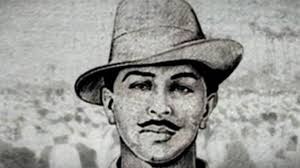
The RSS, which consciously kept aloof from the glorious freedom struggle, finds itself in a peculiar bind: it has to brandish itself as the sole repository of nationalism, but it lacks an authentic icon of freedom to call its own. To rid itself of this embarrassing lacuna, it resorts to appropriating figures like Bhagat Singh, who had nothing whatsoever to do with the ideology the Sangh espouses. In fact, at multiple instances, the RSS ideologues traduced Bhagat Singh and the revolutionary tradition that he and his companions heralded.
There is substantial evidence in the documents of the RSS that demonstrates the organization’s categorical repudiation of revolutionary movements led by Bhagat Singh, Chandrashekar Azad, and their associates. Golwalkar’s book “Bunch of Thoughts” is replete with passages that denigrate the entire tradition of martyrs: “…All the same, such persons are not held up as ideals in our society. We have not looked upon their martyrdom as the highest point of greatness to which men should aspire. For, after all, they failed in achieving their ideal, and failure implies some fatal flaw in them.”[1]
Golwalkar fiercely warned the RSS cadres that we should not waste our admiration on those who have failed to achieve success, insinuating that people like Bhagat Singh were not worth emulating: “It is obvious that those who were failures in life must have had some serious drawback in them. How can one, who is defeated, give light and lead others to success?”[2] RSS upheld such a myopic and skewed worldview that if efforts did not materialize into immediate, tangible success, those efforts were ultimately in vain. In light of this, Shamsul Islam quite pithily argues: “[…]since Bhagat Singh and his companions did not succeed in achieving their goal, they did not deserve any respect. According to his [Golwalkar’s] formula, the British rulers would be the natural object of worship as they were able to kill revolutionaries like Bhagat Singh.”[3]
In yet another instance, Golwalkar had the audacity to question the very value of sacrifice made by our revolutionaries: “But one should think whether complete national interest is accomplished by that? Sacrifice does not lead to increase in the thinking of the society of giving all for the interest of the nation.”[4] For an organization that repeatedly betrayed India’s freedom struggle, it is hardly surprising that selflessness and heroism were trivialized as ineffectual and meaningless.
Mocking the supreme sacrifice of our revolutionaries was not Golwalkar’s preserve alone. Hedgewar, too, was not to be left behind in belittling their martyrdom. Dismissing acts of revolutionary defiance of the likes of Bhagat Singh as shallow, Hedgewar argued, “Patriotism is not only going to prison. It is not correct to be carried away by such superficial patriotism.”[5] Thus for the RSS risking one’s life against colonial oppression was naïve, while cozying up to the Britishers was the pinnacle of profundity.
Not only was the RSS opposed to the methods adopted by our revolutionaries, it actively dissuaded people from following the path of Bhagat Singh and his companions. Madhukar Dattatreya Deoras, the third chief of the RSS, narrated one such incident. Inspired by the legacy of Bhagat Singh, they “vowed to do something directly and planned something terrible and in order to make it succeed decided to run away from homes.” However, once they told Hedgewar about their plan, he grew agitated and strongly discouraged them. Madhukar Dattatreya Deoras later described in detail how Hedgewar redirected their youthful zeal away from revolutionary action: “Doctorji took a meeting of ours for discarding this foolish plan and making us to realize the superiority of the work of Sangh. This meeting continued for seven days, and in the night from ten to three. The brilliant ideas of Doctorji and his valuable leadership brought fundamental change in our ideas and ideals of life.”[6]
Today the RSS shamelessly tries to hijack the legacy of Bhagat Singh, however, the historical truth is that when Bhagat Singh and his comrades were sent to the gallows by the British, organisations like the Hindu Mahasabha, RSS, and the Muslim League not only remained alien to the ideals of these revolutionaries but also maintained a criminal silence as the noose tightened around their necks.
Apart from casting aspersions on the ideology of revolutionaries, the RSS stands in absolute opposition to everything Bhagat Singh lived and died for. A careful perusal of the writings of Bhagat Singh establishes this beyond doubt: he was a communist who abhorred casteism and communalism, and sought to create an egalitarian society. On the other hand, the RSS is a deeply casteist, communal organization that dreams of replacing the Constitution with the Manusmriti. By its own admission, the RSS has championed caste hierarchy and communal division.
When the RSS tries to appropriate Bhagat Singh, a communist, it becomes pertinent to mention that Golwalkar declared the communists, along with Muslims and Christians, to be “internal enemies” of the country. The passage has now been truncated from Golwalkar’s book; however, its veracity can be established by Sangh’s own admission. In fact, their later explanations inadvertently acknowledge what they seek to obfuscate. Journalist Varghese K. George highlights how the RSS has tried to reframe Golwalkar’s stance in recent years: “In 2018, during a three-part lecture series as he did last week, Mr. Bhagwat publicly distanced the RSS from certain views of M.S. Golwalkar, particularly those concerning Muslims, as found in the book Bunch of Thoughts. Golwalkar, the second chief of the Sangh, had labelled Muslims, Christians, and Communists as “internal enemies” of India, and suggested that Muslims be denied citizenship rights. The Sangh now explains that they were said in the heat and anxiety of Partition violence, and the organisation does not follow those beliefs.”[7]
Such is the record of the RSS’s hypocrisy. The RSS neither participated in the freedom struggle nor respected those who laid down their lives for it. Their ideological fountainheads derided Bhagat Singh and his comrades, pigeonholing their martyrdom as failure. Yet today, in a desperate attempt to gain some legitimacy, it perfunctorily embraces the very people it once heaped scorn upon. However, this cannot withstand historical scrutiny. Bhagat Singh was a visionary thinker who rejected caste, communalism, and reactionary politics — the very foundations on which the RSS is built. To invoke his name while championing the Manusmriti is tantamount to a desecration of his legacy.
Notes
[1] M. S. Golwalkar, Bunch of Thoughts, Sahitya Sindhu, Bangalore, 1996, p. 283, as quoted in Shamsul Islam, “86th Martyrdom Anniversary: Hindutva Gang’s Documented Hatred for Martyrs, Bhagat Singh, Rajguru, Sukhdev.” Sabrang India, March 2018, https://sabrangindia.in.
[2] M. S. Golwalkar, Bunch of Thoughts, Sahitya Sindhu, Bangalore, 1996, p. 282, as quoted in Shamsul Islam, ibid.
[3] Shamsul Islam, “Bhagat Singh, Martyrdom Tradition and the Hindutva Gang.” Countercurrents, 2016, https://countercurrents.org.
[4] M. S. Golwalkar, Shri Guruji Samagr Darshan (Collected works of Golwalkar in Hindi), Vol. 1, Bhartiya Vichar Sadhna, Nagpur, 1981, pp. 61-62, as quoted in Shamsul Islam, “86th Martyrdom Anniversary: Hindutva Gang’s Documented Hatred for Martyrs, Bhagat Singh, Rajguru, Sukhdev.”, op. cit.
[5] C.P. Bhishikar, Sangh-Viraksh ke Beej: Dr. Keshavvrao Hedgewar, Suruch Prakashan, Delhi, 1994. p. 21, as quoted in Shamsul Islam, ibid.
[6] H. V. Pingle (ed.), Smritikan-Param Pujiye Dr. Hedgewar Ke Jeewan Kee Vibhin Gahtnaon Ka Sankalan (a collection of memoirs of persons close to Hedgewar – in Hindi), RSS Prakashan Vibhag, Nagpur, 1962, pp. 47-48, as quoted in Shamsul Islam, ibid.
[7] Varghese K. George, “Walking a Thin Saffron Line.” The Hindu, Sept. 2025, https://www.thehindu.com.
[Shashi Singh is a Research Consultant. Courtesy: Countercurrents.org, an India-based news, views and analysis website, that describes itself as non-partisan and taking “the Side of the People!” It is edited by Binu Mathew.]