❈ ❈ ❈
Remembering Yusuf Meherally, the Muslim Socialist Mayor of Mumbai
Ramachandra Guha
Back in 2006, I wrote a column in the now defunct Time Out Mumbai setting out the criteria for an urban agglomeration to be considered a “world city”. To qualify for that appellation, I argued, a city had to be massive in size, have historical depth, a thriving cultural life, appreciable social (including linguistic and religious) diversity, and be an economic powerhouse. I concluded that there were only three world cities: London, New York, and Mumbai.
I remembered that piece when reading about Zohran Mamdani’s campaign for the mayoralty of New York. Christian-dominated London, remarkably, already has a Muslim mayor; might New York, known so far for being Christian and Jewish (and atheist), also soon have one? In considering this question, it struck me that our third world city, Mumbai, comfortably beat them in this race, for it has had as many as six Muslim mayors, the first in 1934 and the last in 1963.
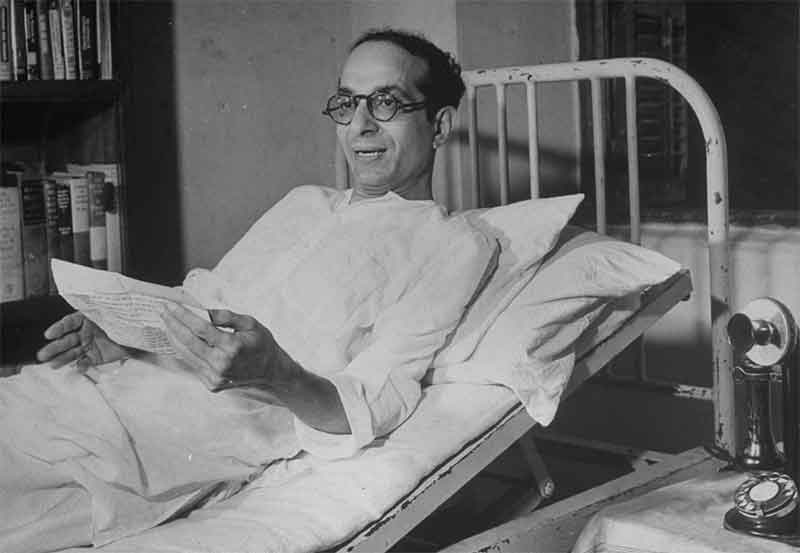
This column focuses on one of these Muslim mayors of Bombay, for whom his brief stint in that post was not his only or even his most important distinction. His name was Yusuf Meherally, and among the reasons for writing about him now is that he died 75 years ago this month.
An articulate leader
Born in Bombay in 1903, Meherally studied at the Bharda High School and at Elphinstone College, where he acquired a formidable reputation as a debater. He also took a law degree, but was denied a licence to practice on account of his political views. For he had thrown himself into the freedom struggle, playing an active part in the protests against the all-White Simon Commission in 1928, and being jailed in the Salt Satyagraha two years later.
In 1934, the Congress Socialist Party was formed, seeking to give an egalitarian direction to the parent party led by Gandhi. Meherally became one of the CSP’s most articulate leaders, with a particular interest in workers’ rights and in anti-colonial movements in other parts of Asia and Africa. Through the 1930s he travelled tirelessly across India promoting the credo of grassroots socialism, while also visiting Europe and America to build bridges with democratic socialists there.
In April 1942, Yusuf Meherally was elected mayor of Bombay. In August of the same year, Gandhi launched the Quit India movement. In his capacity as mayor, it fell to Meherally to formally welcome Gandhi when he arrived by train in Bombay for the All Indian Congress Committee session which passed that historic resolution.
Folklore has it that Yusuf Meherally came up with the slogan “Quit India”; this may be a misattribution, though it was indeed Meherally who came up, in 1928, with that other resonant slogan, “Simon Go Back!”
Notably, Madhu Dandavate’s biography, published in 1986, does not make the claim, merely writing that “with the blessings of Mahatma Gandhi, Meherally’s Padma Publications, brought out on the eve of the 1942 August Revolution a booklet with the caption, Quit India.”
In one of his jail terms, Meherally was incarcerated in Lahore, far away from his native city. He noted in his prison diary that it moved him to be so close to the barracks in which Lala Lajpat Rai was imprisoned, so close to the yard where Bhagat Singh and his companions, Sukhdev and Rajguru, were executed, so close to “the famous well whose water Maharaja Ranjit Singh loved so much and which today [1942] serves the entire jail population”.
I myself first heard of Yusuf Meherally in the early 1980s, when a friend worked at a centre for urban studies named for him. Some years later, I bought, in a New York bookshop, a collection of essays by the American journalist and historian, Bertram D Wolfe. The book was called Strange Communists I Have Known, and it had an essay on Meherally, intriguingly titled: “Gandhi versus Lenin”.
Wolfe and Meherally became friends in the mid 1930s, on the latter’s first visit to the United States of America. Before he met Meherally, the species of Leftists Wolfe was most familiar with were American communists, who swore a blind fealty to the Soviet dictators, Lenin and Stalin, and fanatically believed that allegedly worthy ends justified using the most immoral means. Speaking to Meherally, Wolfe was struck by the compassionate humanism of his socialism and came to understand how “it was the influence of Gandhi within the Congress Socialist Party which had immunized it against the moral corruption of the communists”.
Wolfe tells a lovely story of taking Yusuf Meherally to the tip of Cape Cod, where the waters of the Atlantic Ocean and the Massachusetts Bay meet. Meherally got out of the car, leaving his sandals behind, and waded into the waters. When Meherally walked back to the road, recalled Wolfe, “his face was lit up with an expression of happiness that I had not seen before. ‘We Indians believe that every confluence of waters is a sacred place’, he explained to me.”
On Meherally’s first visit to the US, Wolfe found him full of righteous indignation against the horrors of British colonial rule. However, on his second trip, made in 1946 when it was clear that India would soon be independent, Meherally was heard speaking in fonder terms of the oppressor, telling his American friend “of the good things the British had contributed to Indian civilisation and culture, above all the safeguarding of individual and civil rights that are inherent in the British tradition”.
Wolfe was taken aback by this change of heart. He asked Meherally how he could now praise “the British sense of justice” when it had kept him in jail for so long. Meherally answered: “Even while they oppressed us, they were uncomfortable about it. A hunger strike in a British jail could get me… your book or other books to read. In Hitler’s jails or in Stalin’s it would only have gotten me before a firing squad…If Gandhi had been in the Soviet Union, he would have disappeared forever from view after his first word of protest. The English at least at least felt that they had to report his defiance, even while they ridiculed it and imprisoned him. That is why he taught us to hate the evil things the English did but not to hate the English or ever despair of their regeneration or our own.”
In his introduction to Madhu Dandavate’s biography, Meherally’s former colleague in the Congress Socialist Party, Achyut Patwardhan, described him as “a great Humanist. Not for him any narrow religious affiliation. He was nurtured on a deep love of India’s past culture.” Meherally’s lifelong quest for mitigating human suffering went alongside a keen interest in art and literature, as well as a precocious environmentalism. His friend, recalled Patwardhan, “had stood entranced before the Himalayan range, and he had caught the secrets whispered by the vast skies to the ageless snow ranges where man had never set foot”.
Elsewhere in the book, Dandavate quotes another old associate, the great socialist-feminist, Kamaladevi Chattopadhyay, as writing after Yusuf Meherally’s death in July 1950: “Fearless yet tender, daring yet considerate; ready for any sacrifice, yet full of love and affection, Meherally was unique among men. He claimed devoted friends and loyal comrades, cutting across politics and religion.”
A third comrade, the trade union leader and Goan freedom-fighter, Peter Alvarez, said in his tribute in the Bombay assembly that Meherally “was a mingled fire and honey whose only concern was every human interest except his own”.
It was this selflessness, this absolute commitment to the welfare and happiness of others, that led Meherally to neglect his own health, hastening his early death. During his last illness, he was shifted to a well-known Bombay clinic, but when the treatment provided no relief, Meherally told Jayaprakash Narayan to take him back home so that he could die there since “he did not want to spoil the good name of the doctors who attended on him.” In this manner, writes Dandavate, “even at the last moment of his life, Yusuf’s concern was for others”. His death brought together people from across the political spectrum, with conservative Congressmen walking side by side with radical socialists in the funeral procession.
For Mumbai to have had a mayor who was born Muslim was once both commonplace and characteristic. Tragically, while London and New York have become more open-minded in recent decades, more welcoming of religious and linguistic diversity, Mumbai has turned more chauvinistic. It is hard to see how, or when, it will ever again elect a mayor like Yusuf Meherally, that socialist, scholar, patriot and internationalist, truly a man who ennobled his city, his country, and the world.
[Courtesy: The Telegraph.]
❈ ❈ ❈
Remembering Yusuf Meherally on His 75th Death Anniversary
Suresh Khairnar
Humble greetings on the 75th death anniversary of comrade Yusuf Meherally, the father of apt slogans like QUIT INDIA, SIMON GO BACK and one of the founders of Socialist Party. In all, he got a life of 47 years to live. (1903-1950)
The beginning of the twentieth century can be considered as the year of events that shook the entire world. Lenin came to power ending the Czarism in Russia, the end of Tilak era in India and the beginning of change in the Gandhi era and with it the rise of secularism with the global meaning that all humans are one. Yusuf Meherally was growing up in an environment of contempt and intense anger against the British due to the resistance against the Partition of Bengal in 1905, which was annulled, the First World War and the death of Lala Lajpat Rai in the protest against Simon Go Back, the inhuman massacre of Jallianwala Bagh and the martyrdom of Bhagat Singh and his comrades against it.
However, the changes happening within him did not match with his family. His family was an Islamic Khoja Shia business family. This is why his name was Yusuf Merchant. Merchant got deleted because his college classmates started calling him Yusuf Meherally. His classmates included great men like Minoo Masani, Soli Batliwala, etc.
Yusuf had the good fortune of listening to the speeches of Subhash Chandra Bose and Jawaharlal Nehru at the Opera House meeting in Mumbai on 20 May 1928. And the direction of his life was decided. And he devoted himself to the Youth League working among the youth by joining it. Along with that, he was involved in the movement regarding the problems of the workers of the textile mills of Mumbai. That means he has participated actively in the freedom movement as well as the student and worker movements. And along with that, he completed his BA and LLB studies. But on 10 August 1928, the Mumbai High Court refused to give him the certificate (license to practice law in the court) to practice law, saying that “you work to inspire the youth in the freedom movement.” In a way, it gave a certificate to his work in the freedom movement.
In this way, Yusuf, who was trained in the youth movement through his dedication and hard work during his student life, was emerging as a shining star on the horizon of India’s independence as an extraordinary leader of the Indian freedom movement, at the age of just twenty-five years.
And the British government, in view of the explosive situation spread across the country after 1919, asked whether a responsible system of government and administration could be resumed in India. For this, a committee was formed to study the situation here. Its chairman was Sir John Simon and some other members of the British Parliament were nominated. Against the fact that there was not a single Indian member in the committee, the Indian National Congress passed a resolution of non-cooperation with the Simon Commission in December 1927. Following its example, the Muslim League, Hindu Mahasabha and All India Liberal Federation and other organizations striving for the independence of the country also passed resolutions of non-cooperation. The ship was to arrive at the port of Mumbai on the morning of 3 February. Even before that, under the leadership of Yusuf Meherally, Youth League volunteers were taking out a procession from 3 am and roaming the streets of Mumbai shouting slogans of ‘Simon Go Back’. As soon as Simon and other members of his commission stepped into Mumbai port from the ship, Yusuf and his companions welcomed them with slogans of ‘Simon Go Back’ while entering like a lightning bolt. The police got angry and brutally lathicharged all the protesting Youth League volunteers. But the protesters were not ready to leave. Seeing this, all the members of the Simon Commission had to be taken out from the back door of the port.
The slogan coined by Yusuf Meherally against the Simon Commission and the echo of the Youth League movement led by him had spread across the country. But the way he protested in front of the Simon Commission on the second day at Grant Road in Mumbai without caring for his life. At that time, after identifying him, the police stuffed him in an iron drum and threw that drum under the Grant Road Bridge. But even after that, seeing the courage of Yusuf coming out of the drum and taking over the leadership of the protest, other Youth League comrades got inspired. Yusuf Meherally had guessed that after this protest in Mumbai, Simon Commission would do public relations in other parts of the country while avoiding people. At that time, Yusuf Meherally had a strong belief that protests should be held against the Simon Commission in all parts of the country. Because the atmosphere in the country seemed quite cold. Therefore, Yusuf Meherally telegrammed Lala Lajpat Rai in Lahore requesting him to stage a massive protest. But the Amritsar police had erected a compound of barbed wires on both sides of the road up to two kilometers from Lahore station. So that no protestor could reach the Simon Commission. But a massive protest was carried out under the leadership of Lala Lajpat Rai without caring about the barbed wires. Enraged by this, the police resorted to a fierce lathi charge. Lala ji was hit hard on the chest with a lathi and suffered a heart injury. And even after that, the doctors had forbidden him from addressing a public meeting against police atrocities. But Lala ji did not listen to them and roared in the meeting that every lathi wound on us is the last nail to be hammered on the shroud of the British Empire. And Punjab Kesari Lala ji, who roared like this, died on the same day (17 November 1928). Bhagat Singh and his comrades had carried out a bomb blast in the Delhi Assembly in resentment against the martyrdom of one of the biggest leaders of our country in the Simon Commission. And after that they faced the death sentence with courage. All these incidents had a very deep impact on the heart of the sensitive Yusuf Meherally.
Yusuf Meherally was one of the cultured leaders of the socialist movement. He was a keen watchdog of the events happening in India as well as in the world. And he used those events for the Indian freedom movement. For example, he designed a very inspiring poster to celebrate ten years of Egypt’s independence –
Whatever Egypt can do, India can also do it. Giving this title, he further wrote that-
The people of Egypt shunned the Miller Commission like the plague.
When the members of that commission entered the court, the presiding Egyptian judge walked out of the court in protest.
When Miller went to the Commission gift shop, the waiter there refused to serve him.
When the Commission needed a taxi, the taxi driver refused to take them.
Wherever the Miller Commission went, it had to face the non-cooperation of the Egyptian people. And they were forced to return to their country empty handed.
So, young friends of Mumbai, due to whom has there been such awakening among the people of Egypt? Obviously because of the youth of Egypt. So wake up my friends and teach the Simonists a lesson.
The face of Yusuf Meherally’s socialist philosophy was humanitarian. It was not just about socio-economic change. In one of his speeches to his friends, he once said, “I dislike ugliness and cruelty. That is why I am a socialist. My socialism is based on the values of beauty and morality. Not just economics.”
He was the Mayor of Mumbai Municipal Corporation on 8th August 1942. And in his capacity as Mayor, he welcomed Mahatma Gandhi who had come for the Congress session. And on that day, it was Yusuf Meherally who gave the title of ‘Quit India’ proposal to the British. And he had anticipated that arrests would be made after this proposal. Therefore, he had advised the socialists to go underground much earlier and had also written a blueprint of the underground work. And during the Quit India Movement, all the Congress leaders were put in jail. And from Jayaprakash Narayan to Dr. Ram Manohar Lohia, Achyutrao Patwardhan, Saneguruji S.M. Joshi, Aruna Asaf Ali, Usha Mehta, Sunita Thakur, and thousands of people from the socialist party across the country have contributed to running the Quit India Movement in the true sense. And some people have also become martyrs. That is why Yusuf Meherally is remembered even today for making the Quit India Movement of 1942 successful.
On 2 July 1950, at dawn before sunrise, he died of heart disease at the age of 47 in Mumbai’s Jasawala Nursing Home. At that time, Jayaprakash Narayan sat at his bedside and watched with teary eyes as he went on his last journey. After that, Jayaprakash said, “The manifestation of Yusuf Meherally’s dedicated life will be the biggest manifestation after the invention of Mahatma Gandhi’s life. I will always feel this way.”
(Dr Suresh Khairnar is Ex. President of Rashtra Sewa Dal.)