❈ ❈ ❈
How the Murder of Trade Union Leader Shankar Guha Niyogi Hurt India
Ramachandra Guha
The history of independent India is peppered with the violent deaths of prominent politicians. Indira Gandhi was murdered in her late sixties, Rajiv Gandhi in his mid-forties, Pramod Mahajan in his mid-fifties. Now add those whose lives were cut off in mid-stream by plane or road accidents – Sanjay Gandhi, Rajesh Pilot, Madhavrao Scindia, YS Rajasekhara Reddy. How might their subsequent careers have turned out had they lived another 20 years?
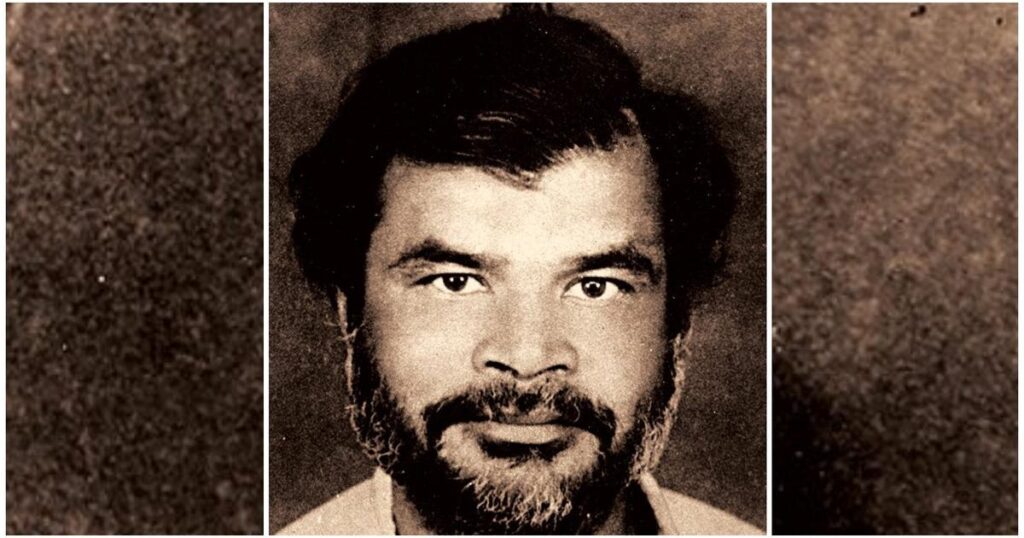
In my view, the premature death of the remarkable thinker and trade union leader, Shankar Guha Niyogi, arguably hurt India more than any of the deaths of the politicians mentioned in the previous paragraph. It dealt a body blow to the civil society movement in India, from which it has perhaps not yet recovered. Guha Niyogi was murdered in 1991, when he was still in his forties, killed by hired goons of the capitalists who hated him for giving workers self-respect and the belief that they could be equal citizens of the land.
I have written an anecdotal piece about Guha Niyogi before. I must now write about him again, and in a more analytical vein. This is because the sociologist, Radhika Krishnan, has just published a fine book about what his life and work once meant and might still mean. Entitled Shankar Guha Niyogi: A Politics in Red and Green, the book draws extensively on personal interviews as well as on fugitive sources in Hindi.
Born in 1943 in a Bengali home, Guha Niyogi arrived at the age of 19 to work in the Bhilai Steel Plant, that iconic marker of India’s road to modernity. He soon left paid employment to embrace full-time activism. He married an Adivasi lady and started organising mineworkers. He also became interested in issues of environmental justice, seeking to make state water and forest policies more responsive to the needs of local peasant and tribal communities instead of catering narrowly to commercial and industrial interests.
In 1977, Guha Niyogi helped found the Chhattisgarh Mines Shramik Sangh, its name signalling its primary concern with the rights of mineworkers. Two years later, he catalysed the formation of a more broad-based organisation, the Chhattisgarh Mukti Morcha. Apart from the trade union, CMSS, the CMM had a women’s wing, a youth wing, and a cultural wing. It also came to run a pioneering hospital funded by mineworkers.
From then till Guha Niyogi’s murder, the CMM and the CMSS worked tirelessly on behalf of workers’ rights, social reform, and environmental sustainability. A stream of idealistic middle-class Indian youths gave up the prospect of comfortable professional careers to join Niyogi and work with his organisations. They included such well-known names as Binayak Sen, a graduate of the Christian Medical College in Vellore, and Sudha Bharadwaj, a graduate of the equally prestigious Indian Institute of Technology in Kanpur.
An original thinker
Notably, Guha Niyogi and the CMM went well beyond the traditional trade union focus on fair wages, decent working conditions, adequate leave and provision of provident fund facilities, though, of course, they made sure that these were properly taken care of too. One key concern was occupational health and safety. The organisation took the help of socially conscious scientists and engineers to set up a laboratory to measure pollution and safety measures at the workplace.
Though Guha Niyogi was a highly original thinker, the conditions of his life meant that he rarely had time to put pen to paper. One of the few extended pieces of writing that he left behind was called Hamara Paryavaran (Our Environment). It has been sensitively translated from Hindi by Rajni Bakshi.
Here is a representative passage: “We have no right to destroy the air which our ancestors breathed and the crystal-clear waters with which they quenched their thirst. This river, this air, this mountain, this jungle, these chirping birds – this is our land. We will take the help of science to move our world forward, but we will also ensure that the rivers remain clean and flow freely and there is pure invigorating air. We will always need to hear the melodies of birds which kept our ancestors one with nature.”
In her book, Krishnan informs us that in the CMM’s policy documents there is much attention to the damage to human life and livelihoods caused by water and air pollution, soil degradation, and overexploitation of natural resources by large industries wanting to make super-normal profits. This environmental abuse was externalised by public and private sector factories, leaving farmers, labourers, women and children to bear the costs.
Guha Niyogi had a keen interest in technologies of production that were better suited to Indian conditions. He recognised that the unthinking import of large machines from Europe and North America would further polarise society on lines of class and gender. As Krishnan observes, “the CMM also realised through its experiences that the brunt of mechanisation was inevitably borne by women. … In the manual mines of Dalli, women constituted at least half of the workforce, and yet in the fully mechanised mines they were deemed ‘unskilled’ and not competent enough to be employed… The CMM saw this loss of employment and economic independence as a systematic assault on the dignity of women.”
Guha Niyogi and his organisation were working to nurture “an alternative model of production, wherein the emphasis would be on safeguarding livelihoods, cashing in on labour power, and building the purchasing power of labour in order to sustain a thriving economy.”
Krishnan also quotes Guha Niyogi as writing: “The Chipko movement enthuses us and we recognize it as a revolutionary movement.” Reading her book, I was struck by the parallels between Guha Niyogi and the great Chipko leader, Chandi Prasad Bhatt. Guha Niyogi was a green Marxist, Bhatt (who is happily still with us), a left-wing Gandhian. Both made it their life’s work to blend ecology and equity. Both were true grassroots intellectuals, who immersed themselves among workers and peasants, while simultaneously articulating a wider vision for their country and the world.
Krishnan reproduces a CMM song, originally in Chhattisgarhi, which is evocative enough in translation:
Where there is water to slake every parched throat,
Where every field is irrigated and green,
Where every hand gets work to do,
Where the farmer gets a fair price for his produce,
Where every village has a hospital,
Where every child gets a good education,
Where none is deprived of land and home,
All trace of poverty, oppression, and capitalism removed,
O when will such a Chhattisgarh be?
Where the peasant and worker will rule!
Guha Niyogi was murdered more than 30 years ago. Yet in at least five major ways his life and work speak powerfully to the India of today:
First, it highlights the precarious plight of unorganised labour (so visible now especially in the construction sector and the gig economy);
Second, it underlines the vital role in sustaining democracy of independent civil society organisations. The need for such organisations is keenly felt in India today, when the Bharatiya Janata Party intimidates and persecutes civil society groups that do not conform to their own Hindutva ideology;
Third, it shows the vital importance of integrating environmental sustainability in the development process. The alarming air pollution in our cities, the depletion of aquifers and the pollution of our rivers, the savage attacks on the Himalaya, the Western Ghats, and the Aravallis by infrastructure and mining corporations close to politicians in power – all show how costly it is for present and future generations to ignore the warnings of Shankar Guha Niyogi (and of Chandi Prasad Bhatt too);
Fourth, Guha Niyogi’s work offers a pathway for a more meaningful, that is to say, less exploitative and less destructive, development model for smaller, resource-rich states, such as Chhattisgarh, Jharkhand, and Uttarakhand;
Fifth, it warns us not to have an excessively rosy view of the long-term impacts of the ‘latest’ technologies. Automation and Artificial Intelligence may render millions of Indians jobless, the males then turning to watching porn or hate videos on their phones. Guha Niyogi understood, far better than the boosters of Silicon Valley or Bengaluru, that new technologies, while increasing productivity and profit for private firms on the one hand, could have dangerously divisive and harmful effects for society and nature on the other.
This column is being published on the eve of Republic Day. The timing is not accidental. For few Indians in the history of our Republic have embodied the values of liberty, equality and (especially) fraternity as admirably as Shankar Guha Niyogi.
[Ramachandra Guha is an Indian historian and writer. Courtesy: The Telegraph, an Indian English daily newspaper founded and continuously published in Kolkata since 7 July 1982.]
❈ ❈ ❈
Remembering Visionary Trade Unionist Shankar Guha Niyogi: Labour’s Unfinished Struggle in Neoliberal India
Rashi
India’s workers’ movement, like much of the world, is at its weakest point in modern history. Neoliberal reforms have concentrated power in ways that increasingly marginalise labour. Collective bargaining which is the foundation of trade unionism is now frequently cast as a “law and order” issue rather than a democratic right. Strikes are often portrayed as disruptive, protections painstakingly won over decades are being rolled back, and protests regularly face restrictions or suppression.
A Union Beyond the Factory Gates
After independence, the labour movement in India was a formidable political force. By the late 1960s and 1970s, cracks in India’s development model became visible: private capital entered new sectors, workers faced unsafe conditions, erratic wages, and contract labour became increasingly common in factories and mines. Nowhere was this more visible than in central India, where the Chhattisgarh Mukti Morcha (CMM) emerged under Shankar Guha Niyogi in the 1970s and 1980s. Operating across Dalli Rajhara, Rajnandgaon, Bhilai, and Raipur, the CMM combined militant trade unionism with a deeply political vision.
The erosion of labour rights reflects a broader policy shift, where successive governments have tended to prioritise industrial and corporate growth. In this climate, workers’ struggles are frequently managed through policing and regulation rather than recognised as matters of rights and justice. In Chhattisgarh, where the legacy of militant unionism still lingers, this hostility is felt in everyday battles over wages, land, and dignity. At a recent rally in Rajnandgaon, Chhattisgarh, Kaladas Dehariya, a CMM activist, poignantly captures today’s situation in his song:
Din kaisan aa gaye ga
Gundagardi ke raaj chalat, din kaisan aa gaye ga
Ae bhuiyan ke malik manha, dar-dar thokar khavat he ga
Kisan ke ga kheti nangathe mazdoor ke ha kaam
Desh ke jammo janta manla
Meethi meethi Mehar piyathe ga
Din kaisan aa gaye ga
Gundagardi ke raaj chalat, din kaisan aa gaye ga
[How have the days come
Goons and extortionists are ruling
The real owners of this land are stumbling
Peasants don’t have land to cultivate, and labourers don’t have work
How have the days come
People of this country
Are drinking sweet-sweet poison
How have the days come
Goons and extortionists are ruling…]
For Niyogi, unionism was not confined to factory gates. He imagined a “24-hour union,” a collective that engaged with every facet of workers’ lives. His politics rested on the twin principles of sangharsh (struggle) and nirman (construction): “Struggle to build and build to struggle” (sangharsh ke liye nirman aur nirman ke liye sangharsh). He believed that socialism mustn’t wait for capitalism to ripen, arguing instead that elements of a just society had to be built inside the movement against capitalism.
Under his leadership, the CMM laid out its agenda of nirman through seventeen departments- covering trade unions, peasants, arrears and fallback wages, savings, education, women’s liberation, sports, health, alcohol rehabilitation, culture, housing, mess management, and the environment. It was a union in the form of a living experiment in reclaiming dignity, knowledge, and agency under an exploitative order.
Red and Green
Unlike today’s depoliticised talk of “sustainability,” the CMM linked workers’ rights directly to ecological defence. Its lal–hara (red–green) framework fused labour struggle with environmental protection: red for the fight of workers and peasants, green for the forests sustaining Adivasi life.
Niyogi insisted that culture was not a decorative element or sheer entertainment but a battlefield embedded in every aspect of working-class life. The movement went beyond economism, building schools, health centres, and cultural institutions while organising workers, peasants, Adivasis, women, youth, and progressive intellectuals.
CMM’s inclusive approach to identity also challenged today’s toxic insider–outsider politics. Niyogi envisioned a Chhattisgarhi identity not as an ethnic claim but as a political commitment: anyone who lived, laboured, and joined the struggle against capitalist and feudal exploitation belonged to the region. Its 1981 statement imagined a “new India” formed through a federation of small, egalitarian nationalities. Migrants, local Adivasis, and non-indigenous communities organised together, defusing tensions that dominant politics now exploits.
From Hope to Crisis: Martyrdom and Neoliberal Assault
The CMM’s early years promised an alternative labour politics. But on 28th September 1991, Shankar Guha Niyogi was brutally murdered in Bhilai a killing sponsored by the capitalist lobby. His assassination came at the same moment that India embarked on far-reaching neoliberal reforms. Contractualisation rapidly expanded, strikes faced legal hurdles, and labour protections were steadily weakened. Restrictions on collective organising grew, and the broader democratic space for dissent narrowed.
The struggle for workers’ rights has exacted a heavy toll. Many CMM activists and workers were martyred in police shootings across Dalli-Rajhara, Rajnandgaon, and Bhilai during the 1980s and 1990s. And in Bhilai alone, over 4,200 workers were retrenched for demanding fair wages and opposing contractualisation. These purges were part of a deliberate assault on worker solidarity, serving as a warning to all who dared challenge exploitation.
By the late 1990s and early 2000s, the promises of the newly formed state of Chhattisgarh began to unravel. After 2003, successive governments oversaw a gradual shrinking of democratic space, where workers’ and other marginalised communities found it increasingly difficult to articulate their rights. From the 2010s to today, pressures have intensified—not only on organised labour but also on land rights struggles, anti-displacement campaigns, and environmental movements challenging large-scale mining and industrial projects across Chhattisgarh. The ongoing resistance to coal mining in the Hasdeo Arand forests, opposition to mining and industrial projects in Bastar region including Rowghat area, and local protests in Raigarh where Adivasi communities resisting corporate-backed projects have often encountered police action are emblematic of this new phase of conflict.
In this climate, the CMM has widened its scope beyond trade unionism, forging alliances with Adivasi groups, farmers’ organisations, and other grassroots collectives resisting corporate land grabs and ecological devastation. Today, the union is fighting simultaneous battles in the courts and on the streets: defending the right to unionise, opposing hazardous mining leases, and demanding accountability for unsafe workplaces. In today’s atmosphere, even peaceful workers’ meetings often face restrictions, surveillance, or punitive consequences such as dismissal or blacklisting. In such conditions, the very act of gathering collectively has become a form of resistance.
The Unfinished Struggle: Hindutva and the New Challenges to the Working Class
The rise of majoritarian politics adds a difficult dimension to India’s labour crisis. As labour protections weaken, communal divisions are often deepened in ways that fragment worker solidarity. Public spectacle increasingly overshadows the politics of livelihood and dignity.
In Chhattisgarh, campaigns of violence and intimidation against Adivasi Christians in Bastar and Durg districts, and incidents of communal violence and polarisation across India have created a climate of fear, further weakening worker solidarity. This was not always the case: during the 1984 anti-Sikh riots, Niyogi and the CMM sheltered Sikh families fleeing violence, demonstrating that workers’ organisations could actively resist communalisation. Today, trade unions face the dual challenge of resisting economic exploitation and confronting a political project that draws strength from division and fear against which Niyogi’s inclusive, anti-communal vision remains a powerful counterpoint.
This is not merely tactical; it is existential. Can India’s workers build alliances strong enough to withstand both neoliberal capitalism and Hindutva authoritarianism? Are current strategies sufficient, or must new forms of solidarity that are regional, national, even international—emerge to counter a global tide of anti-worker forces?
Niyogi’s assassination in 1991 aimed to crush a movement fighting for workers’ and peasants’ rights, yet his vision continues to inspire struggle. In various parts of Chhattisgarh, many of the 4,200 Bhilai workers retrenched for opposing contractualisation still attend the annual memorial, bearing witness to the struggles of their generation. Their children now enter newer factories in the region where workplaces stripped of the protections their parents won through CMM’s campaigns. His insistence that workers’ movements embrace culture, environment, and institution-building remains a radical challenge to a regime that seeks to reduce all life to profit and control. The question he posed, how to build a society where workers and peasants are the true owners of the land grows more urgent as India’s democratic spaces shrink.
Niyogi’s legacy lights the way for collective resistance and offers direction. To remember Niyogi today is not nostalgia. It is a call to struggle.
[Rashi is a Doctoral student at the Centre for the Study of Law and Governance, Jawaharlal Nehru University, and an activist associated with the Chhattisgarh Mukti Morcha (CMM). Courtesy: Countercurrents.org, an India-based news, views and analysis website, that describes itself as non-partisan and taking “the Side of the People!” It is edited by Binu Mathew.]