❈ ❈ ❈
Remember Hiroshima–Nagasaki, Resist Nuclear Colonialism: Say No to India’s Corporate Nuclear Agenda
Friends of the Earth, India
Press Release, 11/08/2025
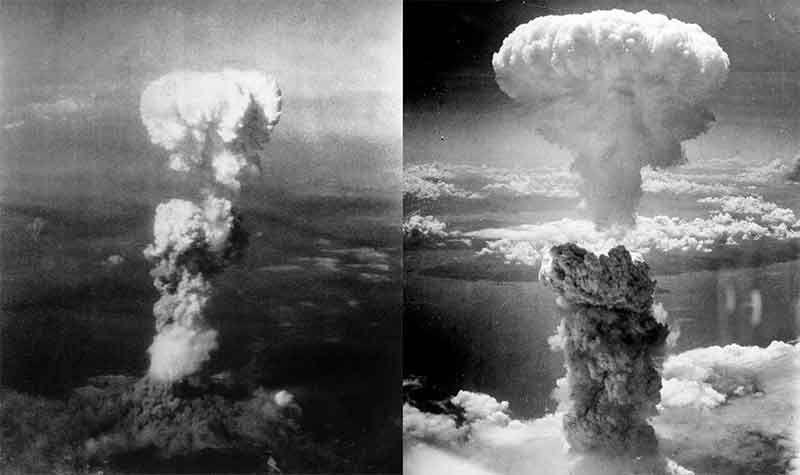
On this important day marking 80 years since the atomic bombings of Hiroshima and Nagasaki, and as the world honours the resilience and rights of Indigenous Peoples, Friends of the Earth India raises its voice in strong opposition to the Indian government’s dangerous and undemocratic push to expand nuclear power projects and dilute nuclear liability laws. Eight decades ago, nuclear horrors scorched humanity in Hiroshima and Nagasaki. Today, India risks repeating history’s gravest mistakes- not through war, but through irresponsible, expansion of nuclear energy through entry of private entities in the field and corporate-driven policies that risk the lives, lands, and futures of its people.
Eighty years later, the world has yet to recover from the trauma and consequences of nuclear weapons and energy. From Hiroshima and Nagasaki to Three Mile Island in 1979, Chernobyl in 1986 and Fukushima in 2011, the multiple risks associated with nuclear power are clear- devastated communities, poisoned ecosystems, and health impacts that persist for generations. The radioactive legacy of nuclear ambition is one the world still struggles to contain. Beyond the multiple risks associated with nuclear power, its ecological footprint is severe- radioactive waste remains hazardous for thousands of years, contaminating soil, water, and air, while plant construction and operation destroy forests, rivers, coasts, and fragile ecosystems. In India, many proposed nuclear sites are located in biodiversity-rich and climate-sensitive areas, threatening species and the livelihoods of Indigenous and rural communities.
Attempts to present nuclear energy as clean and safe energy, and to expand its use under the banner of renewable energy, are false solutions being imposed on the people. Investment should focus on decentralised and truly sustainable energy options, rather than placing present and future generations in danger. The Nuclear Energy Mission’s target of achieving 100 GW of nuclear power capacity by 2047 through Bharat small modular reactors must be viewed in this context. Efforts to facilitate private sector entry by amending existing laws and diluting liability provisions pose a serious threat to both people and the environment.
Despite global warnings and strong local resistance, the Government of India is moving to amend the Atomic Energy Act, 1962, and weaken the Civil Liability for Nuclear Damage Act, 2010- laws meant to safeguard people from the multiple risks associated with nuclear power. These amendments are being pursued to favour corporate players, including foreign reactor suppliers who refuse to take accountability for their technology. In the Union Budget 2025–26, the Department of Atomic Energy received a record ₹24,661 crore- over 20% more than last year- with ₹11,650 crore earmarked for expanding nuclear power capacity, including new projects and Small Modular Reactors (SMRs). Plans are underway for new reactors in Jharkhand, Andhra Pradesh, Gujarat, and Tamil Nadu, many in tribal and ecologically fragile areas, without public consultation or informed consent. These decisions place Indigenous communities, fisherfolk, farmers, and future generations at severe and irreversible risk.
Financially, nuclear energy is deeply unviable for a country like ours: the costs of construction, decommissioning, and long-term waste management run into billions, with frequent delays and budget overruns making electricity from nuclear plants far more expensive than solar, wind, or decentralised renewable systems. Yet the government continues to market nuclear energy as a “green,” “safe,” and “clean” solution to the climate crisis- claims that collapse under scrutiny. Nuclear power is neither carbon-neutral over its full lifecycle, nor free from catastrophic risks. Chasing this illusion diverts scarce public funds away from proven, affordable, and genuinely Friends of the Earth, IndiaFriends of the Earth, Indiasustainable energy pathways that India urgently needs. In light of these realities, we put forward our urgent demands to stop this dangerous diversion and secure a truly sustainable energy future for India.
Our Demands
Reject Amendments Allowing Private Operators in Nuclear Projects
The Atomic Energy Act rightly limits nuclear facility operations to government entities. Allowing private operators, including for SMRs, undermines accountability and increases the risk of catastrophic, irreversible accidents.
Ensure Supplier Liability – No Dilution of the Civil Liability for Nuclear Damage Act, 2010
Weakening liability provisions shields reactor suppliers from accountability, even if their technology is faulty or unsafe. Supplier liability must be strengthened, not diluted.
Revise and Increase the Nuclear Liability Cap
India’s current liability caps are far below the real cost of major nuclear disasters. These must be raised to meet international safety and compensation standards.
No Legal Amendments Without Public Consultation
Nuclear policy affects millions for generations. Any change in law must be preceded by transparent, inclusive, and democratic consultations.
Halt the Aggressive Push for New Nuclear Projects – Invest in Safer, Green Alternatives
Nuclear power is neither clean nor cheap. The multiple risks associated with nuclear power outweigh its benefits. India should prioritise safer, renewable energy systems like solar, wind, and decentralised grids.
This is more than a policy dispute- it is a battle for our democracy, our communities, and our ecosystems. On this day of remembrance and resistance, we call on civil society groups, political parties, youth movements, trade unions, religious institutions, and concerned citizens to unite. We must not let the memory of Hiroshima and Nagasaki fade, nor mortgage India’s future to radioactive danger.
No More Nuclear Accidents. No More Corporate Impunity. No More Silence.
In Solidarity,
Friends of the Earth, India
[Friends of the Earth India (FoE India) is a membership based “not-for-profit”, “non- government”, “non-party” and “autonomous entity” without specific ethnic, religious or political character, working primarily for the protection of environment and mother earth rights. Courtesy: Countercurrents.org, an India-based news, views and analysis website, that describes itself as non-partisan and taking “the Side of the People!” It is edited by Binu Mathew.]
❈ ❈ ❈
What Do We Forget When We Remember Hiroshima?
Eric Ross
On August 6, 2025, the world marked the 80th anniversary of the American destruction of Hiroshima. As in decades past, Hiroshima Day served to honor the first victims of atomic warfare and to reaffirm the enduring promise that their suffering would not be in vain, that they and the residents of Nagasaki, devastated three days later in 1945, would be the last places to endure such a fate.
Within that commemorative framework, Hiroshima has been effectively rendered an abstraction and reduced to a cautionary tale. With the involuntary sacrifice of that city and its inhabitants, humanity was offered a profound lesson. In the ruins of Hiroshima, the world confronted a vision of nothing less than its own potential end. And awareness of that apocalyptic possibility emerged almost immediately. The very next day, in fact, the American newspaper PM, based in New York, ran an article speculating on the catastrophic consequences of an atomic bomb detonating in the heart of that very city.
For the first time, thanks to Hiroshima, human beings became an endangered species. People everywhere were presented with an existential choice between the quick and the dead, between one world and none. Humanity could recover its moral bearings and pursue the abolition of nuclear weapons and the renunciation of war, or accept the inevitability that such man-made forces would ultimately abolish most or all of us. (Think “nuclear winter.”) Only through the former could we hope for collective redemption rather than collective suicide.
In our annual ritual of remembrance, Hiroshima is recalled not so much as a site of mass slaughter, but as a symbol of peace, hope, and resilience, a testament to our professed commitment to “never again.” Yet this year, such sanitized appeals of official memory rang increasingly hollow. After all, eight decades later, humanity (or at least its leadership) continues to demonstrate that it learned remarkably little from the horrors of Hiroshima.
What, after all, could it mean to commemorate such a moment in a world where today not one, but nine nuclear-armed states hold humanity hostage to the threat of sudden, total annihilation? Worse yet, today’s arsenals contain thousands of thermonuclear weapons, some of them up to 1,000 times more powerful than those dropped on Hiroshima and Nagasaki. Worse yet, those arsenals are being “modernized” regularly, the American one to the tune of $1.5 trillion or more as a significant portion of our national resources continues to be siphoned away from meeting human needs and redirected toward preparations for (in)human destruction.
Worse yet, all too many of those weapons remain on hair-trigger alert, poised to extinguish life on Earth in what Daniel Ellsberg, the man who long ago released the top-secret Pentagon Papers, once described as a “single, immense hammer-blow to be executed with the automaticity of a mousetrap at almost any provocation.”
Under this country’s current launch-on-warning posture, President Donald Trump (and any president who follows him) holds sole, unquestioned authority to initiate a retaliatory nuclear strike, with as little as six minutes to decide following an alert about a possible nuclear attack (despite a well-documented history of false alarms). This scenario also presumes that the U.S. would only be acting in “self-defense” in response to a nuclear strike by another nation, although mutually assured destruction renders such concepts obsolete. In reality, that assumption is far from certain. Washington (unlike, for example, Beijing) has never adopted a no-first-use policy and continues to reserve the right to initiate a nuclear strike preemptively.
Moreover, what does it mean to remember Hiroshima in a world where, while no atomic bomb has been dropped on Gaza, the tonnage of “conventional” explosives unleashed there is already equivalent to six Hiroshima bombings? As the nuclear abolitionist organization Nihon Hidankyo, composed of Japanese atomic bomb survivors, warned in the lead-up to being awarded the Nobel Peace Prize in 2024, the suffering of Gaza’s children all too eerily mirrors their own experiences in Hiroshima.
That city is therefore not merely a past atrocity but an open wound, not simply a lesson of history but an ongoing nightmare. There is, in short, no true way to meaningfully honor its memory while so many countries (my own included) actively prepare for future nuclear war.
At this moment, the history of the bomb needs to be reconsidered, not as an isolated development in an increasingly distant past but as inextricably linked to broader questions of mass violence now, including in Gaza. Such an approach, in fact, would reflect the way the bomb was originally understood by many of the scientists who built it, sensing that it would prove to be what some of them would soon describe as “a weapon of genocide.”
Destroying Cities and Calling it Peace
After those two atomic bombs leveled Hiroshima and Nagasaki, slaughtering up to 210,000 people, the vast majority of them civilians by deliberate design, most Americans responded with relief. Echoing the official narrative, they celebrated the bomb as a triumph of scientific ingenuity and a “winning weapon” associated with bringing a swift and decisive end to World War II, the bloodiest conflict in human history.
Decades of historical scholarship have demonstrated that such a narrative is largely a myth. In the aftermath of those two bombings, a carefully constructed postwar consensus quickly emerged, bolstered by inflated claims that those two bombs were used only as a last resort, that they saved half a million American lives, and, perversely enough, that they constituted a form of “mercy killing” that spared many Japanese civilians. In reality, clear alternatives were then available, rendering the use of nuclear weapons unnecessary and immoral as well as, given the future nuclearization of the planet, strategically self-defeating.
Nonetheless, a war-weary American public overwhelmingly endorsed the bombings. Postwar polls indicated that 85% of them supported a decision made without their knowledge, input, or any form of democratic oversight. Notably, nearly a quarter of respondents expressed a further vengeful, even genocidal disappointment that Japan had surrendered so quickly, denying the United States the opportunity to drop “many more” atomic bombs (although no additional atomic weapons were then available).
It remains unclear whether, had they been ready, Washington would have used them. Despite President Harry Truman’s public posture of steely resolve, his private reflections suggest a deep unease, even horror over their use. As Secretary of Commerce Henry Wallace recorded in his diary, Truman had “given orders to stop atomic bombing. He said the thought of wiping out another 100,000 people was too horrible. He didn’t like the idea of killing, as he said, all those kids.”
Why, then, were most Americans not similarly horrified? As historians John Dower and Ronald Takaki have shown, such exterminationist sentiments were fueled by anti-Asian racism, which framed the Pacific War in the American imagination as a race war. But perhaps more important, the way had been paved for them by the normalization of the practice of devastating area bombing, or more accurately, the terror bombing of both Nazi Germany and Japan.
Over the course of the war, the United States and Great Britain had “perfected” that indiscriminate method of destruction, targeting civilian morale and the collective will and capacity of a nation to sustain its war effort. This came despite the fact that President Franklin D. Roosevelt publicly condemned the aerial bombardment of civilian infrastructure before the U.S. entry into the war as “inhuman barbarism.”
As Daniel Ellsberg observed, when it came to the rapid erosion of ethical restraints under the exigencies of an existential war, “liberal democracies… in fighting an evil enemy, picked up the methods of that enemy and made them into a private ethic that was indistinguishable really from Hitler’s ethic.” That moral collapse would be evident in the devastation wrought upon the German cities of Hamburg and Dresden, as well as in the similar destruction inflicted by the firebombing of Tokyo and other Japanese cities.
That descent into “barbarism” was not lost on contemporary observers. Reflecting on the 1943 Allied bombing of Hamburg, outspoken pacifist Vera Brittain described the destruction as a scene from “the evil nightmare of a homicidal maniac” and as “irrefutable evidence of the moral and spiritual abyss into which Britain and her rulers have descended.” She warned that such actions stemmed from a selective and hypocritical blindness, observing that, “in the Nazis and the Japanese we recognize cruelty when we see it, yet that same cruelty is being created, unperceived, amongst ourselves.”
And such a recognition wasn’t confined to pacifists but extended to policymakers. In response to the devastation caused by the “conventional” bombing campaign against Japan, including the burning to death of as many as 130,000 people in Tokyo in a single night in March 1945, Secretary of War Henry Stimson warned that, if such attacks continued, “we might get the reputation of outdoing Hitler in atrocities.” (The New York Times reported that the bombing of Tokyo may have killed as many as one to two million people. While not necessarily accurate, such reporting reflected a broader desensitization to mass death that had come to define the logic of total war, as well as a growing public tolerance among Americans for urbicide, the city-scale slaughter of civilians.)
On Nazi and Nuclear Holocausts
Not everyone in the Allied nations shared in the prevailing atmosphere of apathy or even jubilation over those nuclear bombings. Before the second bomb struck Nagasaki, French philosopher Albert Camus expressed his horror that even in a war defined by unprecedented, industrialized slaughter, Hiroshima stood apart. The destruction of that city, he observed, marked the moment when “mechanistic civilization has come to its final stage of savagery.” Soon after, American cultural critic Dwight Macdonald condemned the bombings in Politics, arguing that they placed Americans “on the same moral plane” as the Nazis, rendering the American people as complicit in the crimes of their government as the German people had been in theirs.
American scholar Lewis Mumford likewise regarded that moment as a profound moral collapse. It marked, he argued in 1959, the point at which the U.S. decided to commit the better part of its national energies to preparation for wholesale human extermination. With the advent of the bomb, Americans accepted their role as “moral monsters,” legitimizing technological slaughter as a permissible instrument of state power. “In principle,” he wrote, “the extermination camps where the Nazis incinerated over six million helpless Jews were no different from the urban crematoriums our air force improvised in its attacks by napalm bombs on Tokyo,” laying the groundwork for the destruction of Hiroshima and Nagasaki.
The specter of Nazism has always loomed large over the atomic bomb. It was, after all, the fear of a Nazi bomb that first catalyzed the Manhattan Project that would create the American bombs. While the fall of the Nazi regime preceded the use of atomic weapons on Japan by nearly three months, as soft-spoken astronomer Carl Sagan once observed, the ideological imprint of Nazism was etched into the littered landscape of charred bodies and scorched earth of Hiroshima and Nagasaki. It endured in the brutal logic of total war carried forward through the ensuing Cold War arms race with the Soviet Union and culminated in the grotesque accumulation of nuclear arsenals with tens of thousands of world-destroying weapons poised to obliterate humanity.
In a 1986 keynote address before the World Jewish Congress in Jerusalem, “The Final Solution to the Human Problem,” Sagan argued that Hitler “haunts our century… [as] he has shattered our confidence that civilized societies can impose limits on human destructiveness.” In their mutually reinforcing preparations to annihilate one another, erase the past, and foreclose the possibility of future generations, he concluded, “the superpowers have dutifully embraced this legacy… Adolf Hitler lives on.”
Lacking Hitler, Sagan suggested, Washington and Moscow imposed his image on each other. This was necessary because “nuclear weapons represent such a surpassing evil that they can be justified only by an equally evil adversary.” Humanity, he warned, was then locked in a downward spiral into a moral abyss reminiscent of a Greek tragedy. “When we engage in a death struggle with a monster, there is a real danger that we ourselves will, by slow and imperceptible changes, become transmogrified into monsters. We may be the last to notice what is happening to us.”
This influence was evident in the fact that fear of a Nazi bomb had served as the initial impetus for the Manhattan Project and that the future nuclear state would share certain characteristics of the Nazi regime. As psychiatrist Robert Jay Lifton described it, such a state would rely on “the genocidal mentality,” a psychological willingness, combined with the technological capacity and institutional planning necessary to, under certain circumstances, deliberately destroy entire human populations.
No More Hiroshimas
In concluding his 1986 address, Carl Sagan warned that World War II had never truly ended. And in a sense, it hasn’t ended even today, given that nine countries now possess such world-destroying weaponry. After all, were a nuclear war to happen in the years to come, a scenario the most powerful states have spent the past 80 years preparing for and making ever more likely, the Allies will have retroactively lost the war. In the radioactive ruins of what was once Washington and New York, Leningrad, Moscow, and Beijing, New Delhi, and Islamabad, no less potentially across much of the rest of this planet, we would witness “the fulfillment of Hitler’s last and maddest vision.”
Such a future is anything but hypothetical. It may, in some sense, already be unfolding around us. It takes no great imagination to envision Hiroshima in the wreckage of Gaza or in the increasingly bombed-out cities of Ukraine. And that’s just a hint of the future, were nuclear weapons ever to be used. If we don’t dedicate ourselves to building a world without war and without nuclear weapons, sooner or later we will undoubtedly witness just such devastation on a global and irreversible scale.
To survive as a species and preserve our humanity, we must, as Dwight Macdonald urged us in August 1945, begin to think “dangerous” thoughts “of sabotage, resistance, rebellion, and the fraternity of all [people] everywhere.” Only then could we commemorate Hiroshima Day without the hypocrisy of talking peace while endlessly preparing for a world-ending war. Only then could we begin to fulfill the enduring promise of never again, no more Hiroshimas.
[Eric Ross is an organizer, educator, and PhD candidate in the history department at the University of Massachusetts Amherst. Courtesy: TomDispatch, a web-based publication, founded and edited by Tom Engelhardt, aimed at providing “a regular antidote to the mainstream media”.]
❈ ❈ ❈
U.S. Atomic Bombings Didn’t Save Lives or End the War
John Laforge
August 6 and 9 are the 80th anniversaries of the U.S. atomic bombings of Hiroshima and Nagasaki. The killing of 140,000 civilians at Hiroshima was the effect of detonating a 60-million-degree Celsius explosion (ten thousand times hotter than the surface of the sun) over the city. Richard Rhodes’ The Making of the Atomic Bomb reported, “People exposed within half a mile of the … fireball were seared to bundles of smoking black char in a fraction of a second as their internal organs boiled away…”
The use of atomic bombs was rationalized after-the-fact using myths that transformed the burning of children into a positive good. President Truman and government propagandists justified the attacks claiming they “ended the war” and “saved lives” ⸺ stories still believed today ⸺ but, as historian Gar Alperovitz has demonstrated in The Decision to Use the Atomic Bomb, and the Architecture of an American Myth the pretext of “saving lives” was fabricated.
General Dwight Eisenhower, who had been the Supreme Allied Commander in Europe, notes in his book Mandate for Change that he told Secretary of War Henry Stimson at the July 1945 Potsdam Conference that he opposed using the bomb because it was “no longer mandatory as a measure to save American lives.” Ike told Stimson, “Japan was already defeated and that dropping the bomb was completely unnecessary.”
Broad declassification of wartime documents and personal diaries has made it possible to learn the facts. One key example, reported by Gar Alperovitz reports in The Decision to Use the Atomic Bomb, is the April 30, 1946 report by the Intelligence Group of the War Department’s Military Intelligence Division (“Use of Atomic Bomb on Japan”), first discovered in 1989, which concluded “almost certainly that the Japanese would have capitulated upon the entry of Russia into the war…” which occurred on August 8. Japan surrendered a week later.
Researchers have found so much that refutes official propaganda, that the historian of the U.S. Nuclear Regulatory Commission, J. Samuel Walker, reported in the winter 1990 edition of the journal Diplomatic History: “The consensus among scholars is that the bomb was not needed to avoid an invasion of Japan and to end the war within a relatively short time.”
Dozens of leaders who ran the war agree. Winston Churchill wrote in his history of WWII, “It would be a mistake to suppose that the fate of Japan was settled by the atomic bomb. Her defeat was certain before the first bomb fell.”
Admiral William Leahy, the Chief of Staff to Presidents Roosevelt and Truman, declared in his memoir I was there, “The Japanese were already defeated and ready to surrender. The use of this barbarous weapon at Hiroshima and Nagasaki was of no material assistance in our war against Japan. I was not taught to make war in that fashion, and wars cannot be won by destroying women and children.”
Major General Curtis LeMay, who directed the devastating incendiary destruction of Japan’s 67 largest cities prior to August 1945, was more emphatic. Asked by a reporter at a Sept. 20, 1945 press conference, “Had they [Japan] not surrendered because of the atomic bomb?” Gen. LeMay declared, “The atomic bomb had nothing to do with the end of the war at all.”
Gen. “Hap” Arnold, commander of the Army Air Force, wrote in Global Mission (1949), “It always appeared to us that atomic bomb or no atomic bomb the Japanese were already on the verge of collapse.”
Likewise, Brig. Gen. Bonner Fellers reported in Reader’s Digest, “Obviously … the atomic bomb neither induced the emperor’s decision to surrender nor had any effect on the ultimate outcome of the war.” And the renown Gen. Douglas MacArthur, said “he saw no military justification for the dropping of the bomb.”
Religious and cultural leaders contemporaneously condemned the attacks, as on March 5, 1946, when the Federal Council of Churches issued a statement signed by 22 prominent Protestant religious leaders saying in part, “the surprise bombings of Hiroshima and Nagasaki are morally indefensible. … Both bombings, moreover, must be judged to have been unnecessary for winning the war.”
Nuclear weapons are still protected by lies like “limited nuclear war.” This month’s anniversaries remind us to rebel against them, to demand that the United States apologize to Japanese and Korean survivors and their descendants for the crime; that the U.S. abandon its nuclear attack plans and preparations (deterrence); and that it finally stands-down and eliminates the crown jewels and poisoned foundation of all government waste, fraud, and abuse ⸺ nuclear weapons.
[John LaForge is a Co-director of Nukewatch, a peace and environmental justice group in Wisconsin, and edits its newsletter. Courtesy: CounterPunch, an online magazine based in the United States that covers politics in a manner its editors describe as “muckraking with a radical attitude”. It is edited by Jeffrey St. Clair and Joshua Frank.]