❈ ❈ ❈
Hollowing Out the Uniform of the Armed Forces
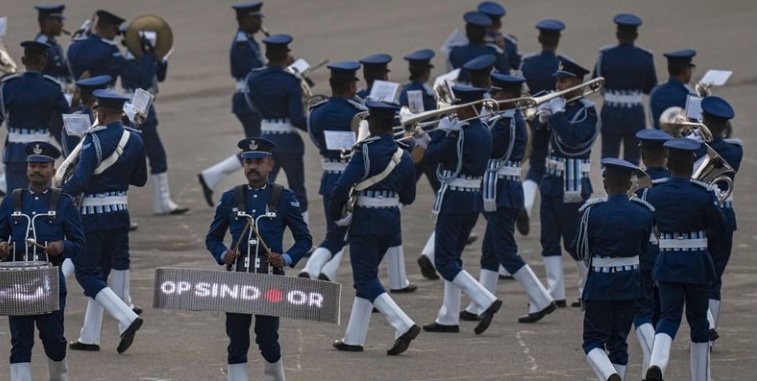
The online spectacle of Defence Minister Rajnath Singh presenting religious medallions and certificates to a trio of three-star military officers for their respective services’ role in Operation Sindoor at the Maha Shivratri gathering hosted by Sadhguru Jaggi Vasudev at his Isha Yoga Centre in Coimbatore on Sunday, has triggered pronounced disquiet in veteran military circles. According to video clips in circulation on social media, these senior commanders from the army, navy and air force were called up individually before a festival crowd of thousands, handed non-statutory medallions created outside the formal honours system, and decorated under religious iconography rather than regimental or unit colours, as is the norm.
Veteran critics said such a format effectively relocated military recognition from a service institution to a guru-led platform, shamelessly inserting devotional imagery and political presence into what was exclusively a military operation. And, in doing so, they said Singh and the military had bluntly converted operational credit over successfully executing Operation Sindoor into little more than televised religious pageantry.
Event footage portrayed these three military officers being individually summoned on stage to be conferred with their ‘presentations’, which were handed to Singh by Vasudev in the midst of a large, grand gathering, also attended by senior political figures. These included Maharashtra Chief Minister Devendra Fadnavis, junior parliamentary affairs minister Dr L. Murugan and assorted film actors from Bollywood and beyond.
Thereafter, video clips captured all three officers preening proudly with medallions around their necks and their framed Bhavya Bharat Bhushan – “Glorious Pride of the Nation” – scrolls held prominently before them. Reportedly conceived and designed by Vasudev, these awards supposedly symbolised national grandeur and distinguished service, recognising the Indian military’s collective operational role in last year’s operation against Pakistan.
In his address at the event, Singh drew an explicit line between spirituality and soldiering, invoking Lord Shiva as both humanitarian guide and destructive force – benevolent in relief work, Rudra or destructive in combat. According to TV News 18, he spoke of cultural inspiration, divine presence and sacred blessing attached to the venue itself. For many veterans, however, such rhetoric crossed an unwritten line by recasting professional military achievement in overtly devotional and religious terms.
TV News 18 further reported that Singh credited the armed forces with providing humanitarian assistance during times of crisis with the spirit of Shiva. But when duty demanded, they executed missions like Op Sindoor with the intensity of Rudra, associated in the Hindu pantheon of gods with fierce destruction. “The spirit within our soldiers comes from our culture, from the inspiration of Lord Shiva,” Singh was reported as having said by the television news channel.
“The divinity I am experiencing here makes it clear, even without anyone telling me, that this place is blessed by Mahadeva, the Lord of Lords,” he added in reference to Vadudev’s ashram.
Meanwhile, a retired three-star Army officer said such honours as were doled out by Vasudev were traditionally bestowed within military spaces shaped by service ethos and chain-of-command legitimacy, not at religious mega-events. He stressed that these were nothing more than “privately created awards, amounting to a parallel recognition track” outside the armed forces’ formal honours architecture, and needed to be strongly challenged, if the services’ ethos was to be maintained and perpetuated.
Another two-star Indian Navy veteran said the deeper concern was perception. India’s armed forces, he added, requesting anonymity, have long guarded their apolitical and non-sectarian character with painstaking care. While officers remain free to practise personal faith, senior commanders appearing at personality-driven religious platforms risk projecting institutional endorsement of the individual, the ritualised ceremony and the public spectacle – rather than expressing private belief.
“Optics at these levels can easily be read as institutional endorsement of such platforms,” he caustically added. Beyond the optics, he warned, the longer-term consequences for morale and public trust are profound: when the line between personal devotion and the uniform blurs, the services risk politicisation, and decades of painstakingly built professional neutrality begin to erode.
Advertisement
Moreover, this gradual erosion of professional distance set the stage for the military’s visible acquiescence in Sunday’s episode at Vasudev’s Isha Yoga Centre. Veterans noted that the service headquarters maintained total, deliberate silence: no public clarification was offered on the status of the medallions, no institutional note drew a boundary between official honours and privately instituted awards, and no senior military spokesperson invoked the long-standing norms governing where and how operational recognition should properly be conferred.
“By appearing on stage while Singh and Vasudev conducted the honouring ceremony, all three senior military officers effectively lent uniformed legitimacy to a privately framed religious event,” said a retired senior Air Force officer. He added that no protest was voiced by any of the three service headquarters, and no institutional line was drawn. In doing so, the armed forces quietly allowed a stage-managed religious endorsement to take place under the guise of official recognition.
What is equally striking is that such episodes are no longer isolated.
Over the past decade, highly public religious participation by senior uniformed leadership – including serving chiefs and their commanders – has become more frequent, more visible and more publicly celebrated.
Temple visits, ritual observances, televised blessings of new platforms, ceremonial offerings before materiel inductions and participation in sectarian spiritual gatherings are now routinely photographed, amplified and circulated as institutional moments, rather than private acts of faith.
Individually, none of these actions is unlawful or unprecedented. Armed forces everywhere accommodate personal belief and regimental religious tradition. But what was once low-key and inward-looking is now stage-managed, publicly flaunted and officially encouraged by both the administration and the services hierarchy.
Senior commanders are no longer merely present at such events; they are active participants –performing rituals, receiving blessings and delivering remarks that merge religiosity with operational identity. Such a cumulative effect erodes the principled separation between uniform and faith, transforming the military’s apolitical stature into a spectacle of performative devotion to India’s majority religion.
In conclusion, the risk is not that military officers are religious, but that the institutions they man are beginning to look religiously positioned. By stepping onto a stage to receive medallions and Bhavya Bharat Bhushan awards at Vasudev’s centre, senior commanders have allowed ritual and spectacle to dominate their uniforms.
If left unchecked from within, the uniform risks being hollowed out – turned into a ceremonial prop for devotional pageantry, its authority stamped not by duty or discipline, but by devotional blessing and amid priestly applause.
[Rahul Bedi is a New Delhi-based journalist reporting for over 30 years on strategic, military, and security matters. Courtesy: The Wire, an Indian nonprofit news and opinion website. It was founded in 2015 by Siddharth Varadarajan, Sidharth Bhatia and M. K. Venu.]
❈ ❈ ❈
Military Veterans Express Concern Over Serving Officers Publicly Associating with Godmen, Religious Events
A broad cross-section of Indian military veterans has expressed concern over what they describe as an “enduring and troubling” trend of serving officers – including those in senior ranks – publicly associating with godmen, spiritual leaders, and religious congregations linked to the majority community.
These veterans argue that what was once strictly a matter of private belief has, over the past decade, increasingly spilled over into the institutional domain, with potentially ‘corrosive’ consequences for the armed forces’ apolitical and secular character.
“When officers in uniform appear at religious events, it sends the wrong signal that the armed forces are endorsing particular religions and religious leaders,” said Major General (Dr) Yash Mor (retired), one of the few veterans willing to speak out openly by name, despite prevailing fear of possible official reprisals.
Over time, this can erode trust, weaken service cohesion, and compromise the perception of the military as an impartial institution, the two-star officer told The Wire. He also called upon the Chief of Defence Staff, General Anil Chauhan, and the service chiefs to take decisive action to halt the burgeoning trend of uniformed officers publicly aligning with controversial spiritual figures and participating in overtly religious events.
In his latest rebuke, posted on Facebook on February 17, the 63-year-old third-generation Indian Army infantry officer from Haryana railed against the participation of senior serving officers in the Maha Shivaratri celebrations, hosted two days earlier by Sadhguru Jaggi Vasudev at his Isha Yoga Center in Coimbatore, describing it as a “dangerous precedent.”
During the event, widely publicised on social media, a trio of three-star uniformed officers from the Indian Army, Navy, and Air Force was presented with medallions and ostentatious Bhavya Bharat Bhushan (“Glorious Pride of the Nation”) scrolls by Defence Minister Rajnath Singh, ostensibly in recognition of their respective services’ roles in last May’s Operation Sindoor.
Thereafter, the officers stood displaying their baubles under the approving gaze of Jaggi Vasudev, turning their uniforms into a backdrop for religious pageantry. In doing so, Gen Mor said, they diminished the uniform’s dignity, reducing a symbol of service and sacrifice to ceremonial embellishment at the feet of a spiritual figure rather than within a military or formal state setting.
“What kind of award is this? What is it valued at? Why are service personnel in uniform receiving it?” said a visibly agitated Gen Mor. He further declared that the services needed to immediately stop officers in uniform from attending such events, as the Indian military did not need any publicity or favours from such self-styled holy men. He also questioned whether the services would behave similarly if the event involved Muslim faqirs or Christian holy men.
“The services do not require validation from such individuals,” Gen Mor said, “and certainly do not need their counsel.” He warned that such highly visible appearances by officers in uniform were incrementally but tangibly reshaping future service conventions, rendering them the ‘new normal’.
“Once the uniform becomes a stage prop for religious spectacle, the line between personal belief and institutional endorsement is erased, and the armed forces risk being perceived as partisan rather than professional,” he said. All religious observances, the officer maintained, must remain confined to individual units and conducted in private – whether involving the battalion pandit, granthi, maulvi, padre, or all four. That long-standing convention, Gen Mor stressed, must be upheld and enforced in perpetuity, particularly within the Army, to safeguard the military’s secular ethos. It has always been the proper norm and, he emphasised, should remain so.
Traditionally, regimental war cries in the Indian Army have served as expressions of collective spirit, battlefield motivation and shared heritage rather than instruments of religious assertion. Drawn from a unit’s history, region or martial tradition, they are intended to forge cohesion under fire and evoke courage in moments of extreme stress.
While some incorporate religious or cultural exhortations reflective of a regiment’s composition, their purpose has historically been functional and unifying – binding soldiers to one another and to their unit’s legacy. They were never conceived as political statements, but as affirmations of regimental identity and combat solidarity. In recent years, however, there have been attempts in some quarters in the army to recast or reinterpret them through a more overtly religious lens, subtly altering their traditional, inclusive character.
It is this gradual but perceptible shift in institutional culture that has deepened unease among scores of other veterans who share Gen Mor’s concerns but remain reluctant to be identified, citing fear of official retaliation from either their service headquarters, the Ministry of Defence (MoD), or other national security authorities.
Many seasoned officers, including some former service chiefs, believe that speaking candidly to the press on matters relating to godmen, spiritual figures, or religion within the armed forces – particularly when linked to the majority faith – could, in the current social and political climate, jeopardise what matters most to them: their pensions. And, though any withholding of pension benefits would be legally untenable and unenforceable, the perception of such risk has proved powerful enough to silence many ex-servicemen, compelling them to avoid public comment on the issue altogether.
However, over the past decade, these veterans have privately voiced concern over the “alarming” incidence of serving officers publicly appearing at religious events, often alongside high-profile spiritual leaders, in ways that blur the line between personal faith and institutional endorsement. Alongside, the growing practice of circulating images and videos of such appearances online has further magnified their impact, reinforcing the impression that the armed forces are aligning themselves – however unintentionally – with specific religious figures or ideological currents.
Recalling a few such instances is instructive.
Veterans said the Army’s involvement in the Dharma Dwaj saffron-flag hoisting at the Ram Mandir in Ayodhya last November, marking the completion of the temple’s construction, exemplified this blurring of military and political-religious roles. Senior officers in uniform had assisted the Ram Mandir Trust with technical preparations, rehearsals and the installation of the 22-foot saffron flag atop the 161-foot spire, ensuring structural stability and safety.
And though Prime Minister Narendra Modi performed the ceremonial hoisting, video clips showed Army personnel actively facilitating the ritual. Earlier that year, Army personnel, including one- and two-star officers in uniform, had played major logistical and security roles at the Kumbh Mela, raising questions about the force’s role in religious symbolism and public ceremonies with overt political overtones.
Retired Lieutenant General D. S. Hooda, one of the few veterans willing to publicly criticise such trends, noted in The Tribune last December that while officers were free to visit religious institutions in a private capacity, there was no justification for images of such visits being posted on social media. For a force that expects its members to subsume personal identity in service of the nation, even the appearance of endorsing a particular faith, he warned, could wound the quiet trust that binds a diverse military together.
Gen. Hooda’s observations condemning social media circulation of such religious activity by senior officers, paralleled footage of Army Chief General Manoj Dwivedi in saffron attire, offering prayers at the Mahakaleshwar Jyotirlinga temple in Ujjain, Madhya Pradesh, last December, alongside Defence Minister Singh.
While the event drew criticism from several opposition leaders and commentators, the Bharatiya Janata Party (BJP) defended it vociferously. “Nobody should have a problem with the raksha mantri or the Army Chief, or anybody celebrating their own faith,’ former BJP MP and central minister Rajeev Chandrashekhar told Times Now. Anyone who has a problem with that should look for a hole and bury themselves in it, he contemptuously added.
Undermining the Army’s legitimacy as a secular, inclusive and politically neutral force
A few months later, shortly after Op Sindoor Gen Dwivedi visited the spiritual leader Jagadguru Rambhadracharya at his ashram in Chitrakoot – also in Madhya Pradesh and just 130km north of the Army Chief’s hometown of Rewa – once again publicising it and prompting questions about undertaking a personal religious visit in uniform.
Following the meeting, Rambhadracharya said that he had initiated the Army Chief into the Ram Mantra, “the same mantra Hanuman received from Sita before his victory over Lanka. When the matter of dakshina arose,” the priest said, “I told him I would ask for a dakshina no teacher has ever sought. I said I want PoK – Pakistan-occupied Kashmir – as my dakshina. The Army Chief, he said, accepted his request, saying that India was prepared to give Pakistan an ‘appropriate response’.
Meanwhile, a more recent incident, videos circulated widely on social media showing soldiers from the 14 Sikh unit stationed in Kota attending a religious ceremony on the eve of Republic Day, presided over by self-styled godman Dhirendra Krishna Shastri, popularly known as Baba Bageshwar.
The footage showed uniformed soldiers offering obeisance, presenting ceremonial offerings, and seated reverentially at Shastri’s feet, while the unit’s commanding officer appeared to publicly facilitate the event – creating optics that were difficult to dismiss: a military unit, in uniform, visibly participating in a personality-driven religious gathering on the cusp of a national secular celebration.
The Indian Army later clarified that the ceremony had not been officially organised, though it maintained that personnel visiting places of worship in uniform is not prohibited. Yet Shastri – whose prominence rests on spectacle, claims of “divine” mind-reading, and overt political advocacy – addressed a crowd largely comprising army personnel, urging citizens to salute the forces, further entangling the imagery of the military with his own carefully cultivated public persona.
It was precisely this blurring of lines that Gen Mor had cautioned against.
“The strength of the Indian Army has always lain in subsuming individual identities into a shared national purpose,” he said. Left unchecked, such episodes risk normalising a conflation of personal faith with institutional sanction, quietly eroding decades of professional restraint and undermining the Army’s legitimacy as a secular, inclusive and politically neutral force.
Gen Mor’s admonition reflects a deeper anxiety: that what may begin as individual expressions of faith by officers in positions of public authority can, over time, shift organisational culture in ways that are hard to reverse.
“The uniform should not be seen at events where there is a perception of endorsement of particular religious identities,” he said. What begins as symbolism, he warned, can harden into precedent – and precedents, once set in uniform, are rarely easy to undo.
[Rahul Bedi is a New Delhi-based journalist reporting for over 30 years on strategic, military, and security matters. Courtesy: The Wire, an Indian nonprofit news and opinion website. It was founded in 2015 by Siddharth Varadarajan, Sidharth Bhatia and M. K. Venu.]