❈ ❈ ❈
The Yatra of Ranjha’s Resolve: Rahul Gandhi’s Quest for India’s Soul in Bihar
Nalin Verma
29 August 2025: In the monsoon-soaked plains of Bihar, where the Ganges murmurs timeless tales of struggle and resilience, a modern epic unfolds – a clash between two titans: one, a crusader driven by zeal to restore the ideals that forged India as a democratic republic rooted in justice and ‘sarva dharma sambhav’ (equal respect for all religions), and the other, accused of deploying cunning stratagems to dismantle these very principles.
The Voter Adhikar Yatra, launched by Rahul Gandhi on August 17, 2025, in Sasaram, Bihar, has traversed three-quarters of the state, spanning the north and south banks of the Ganga, drawing a stark battle line between, on one hand, the scion of the Nehru-Gandhi lineage, and on the other, Prime Minister Narendra Modi, a former Rashtriya Swayamsevak Sangh pracharak.
This is not merely a contest for the INDIA bloc to supplant Nitish Kumar’s NDA in Bihar or for Rahul Gandhi to challenge Modi’s premiership. It is a profound struggle to preserve the “Idea of India” – inclusive, embracing diverse thoughts and actions, anchored in fairness – against what critics describe as a ruthless machinery bent on erasing the legacy shaped by freedom fighters who resisted British rule, and the saint-poets, Sufi folklorists and bards who wove verses of love, harmony and coexistence.
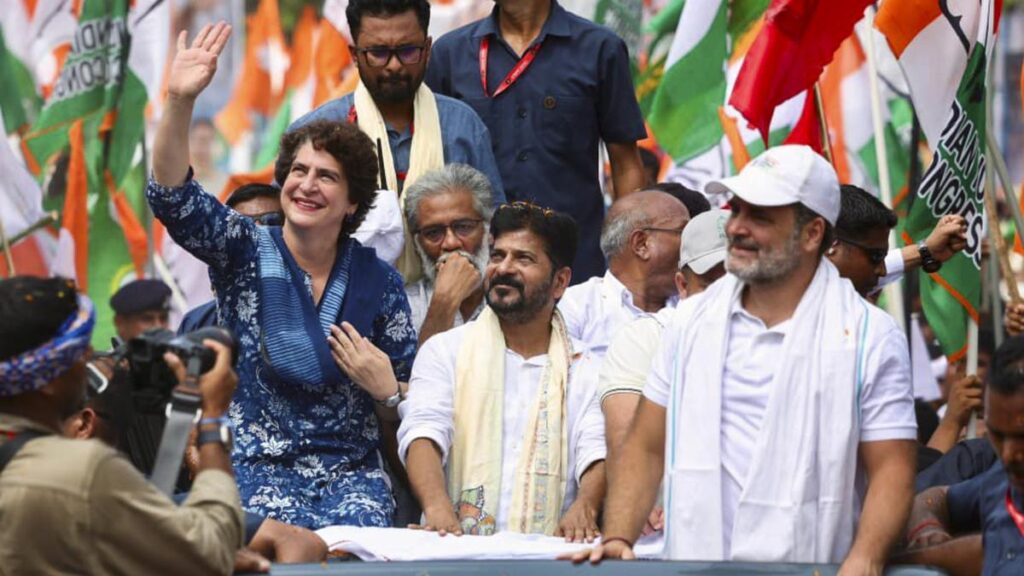
Riding a motorcycle with his sister Priyanka Gandhi or Rashtriya Janata Dal leader Tejashwi Yadav by his side, or meeting a former Agniveer maimed in battle and discarded without compensation, Rahul Gandhi engages with farmers, unemployed youth and impoverished villagers. Clad in his signature white t-shirt, trousers and polo cap, the Congress leader exudes the spirit of a crusader.
From Sasaram, Aurangabad, Lakhisarai, Munger, and Bhagalpur south of the Ganga to Katihar, Purnia, Madhubani, Darbhanga, Muzaffarpur, and Motihari north of the river, his approach remains consistent: spreading love, forging connections, visiting religious shrines to seek divine blessings, and sharing the joys and sorrows of ordinary people.
A poignant example of bridge-building was Rahul’s role in uniting Purnia MP Rajesh Ranjan, alias Pappu Yadav, with Tejashwi Yadav. This reconciliation, beyond strengthening the Mahagathbandhan’s electoral prospects, sparked joy among voters in Seemanchal, a region encompassing Purnia, Katihar, Kishanganj and Araria districts.
With a significant Muslim population, Seemanchal is fertile ground for parties championing secularism, justice, and equality. Yet, vote fragmentation along communal lines has often favoured the BJP and its allies. In the 2024 Lok Sabha polls, secular candidates – Pappu Yadav (Independent) in Purnia, Dr. Javed (Congress) in Kishanganj, and Tariq Anwar (Congress) in Katihar – triumphed, but the BJP secured Araria despite secular voters outnumbering its base, underscoring the impact of vote division.
Stalin’s resonant voice
The Voter Adhikar Yatra thrives on spontaneity, with Rahul Gandhi magnetic disposition despite the Congress party’s weakened state in Bihar. Far from arrogance, he displays humility, sharing space and spotlight with allies like Tejashwi Yadav, CPI(ML)-Liberation’s Dipankar Bhattacharya – a tireless advocate for the marginalised – and Vikassheel Insaan Party chief Mukesh Sahni, an emerging voice for the Mallah (fishermen) community.
A powerful moment was on August 27, 2025, in Muzaffarpur, when Tamil Nadu chief minister M.K. Stalin joined Gandhi on the yatra to protest alleged voter suppression. Speaking in Tamil, Stalin invoked the legacy of Periyar, the Dravidian movement’s icon, to champion unity, justice, and democratic values. His presence symbolised a bridge between India’s north and south, linking the Ganga and Kosi with the Krishna and Kaveri rivers, reinforcing a shared fight for voting rights.
Some second-tier Bihar BJP leaders criticised the Rahul-Stalin alliance, citing alleged mistreatment of Bihar’s migrant workers in Tamil Nadu. Yet, they overlooked the vibrant tapestry of Bihar’s migrants, who journey from Jammu and Kashmir to Tamil Nadu, Gujarat to Assam, building infrastructure and enriching their folklore with multilingual songs and stories. Places like Madras (now Chennai), Kolkata, Guwahati, Surat and Bombay (Mumbai) resonate in their ballads with equal affection, a cultural bridge that merits its own telling. The BJP’s selective outrage ignores this shared heritage, while Rahul’s Yatra continues to weave a narrative of unity and resilience across Bihar’s heartland.
While Prime Minister Narendra Modi had chosen to address a rally in Madhubani in English, following the terrorist attack on tourists in Kashmir earlier in 2025, diverging from his usual Hindi-centric oratory, Tamil Nadu chief minister M.K. Stalin, speaking at the Voter Adhikar Yatra in Muzaffarpur on August 27 chose his native Tamil, weaving a message of love and pride for his language to resonate with Bihar’s diverse populace, fostering a sense of cultural unity.
“Rahul Gandhi is not merely battling Modi; he is fighting to resurrect the soul of India,” remarked a Delhi-based senior academic, who holds a key university administrative post and requested anonymity, fearing reprisal for his candour. “He isn’t chasing power. He is striving to revive the legacy of Mahatma Gandhi, Jawaharlal Nehru, B.R. Ambedkar, Bhagat Singh and Subhas Chandra Bose, alongside saint-poets like Kabir, Nanak, Jayasi, and Raskhan, whose verses sang of love, harmony, and coexistence.”
Instances of Unease
Tensions have surfaced during the Yatra. Rahul Gandhi’s sharp accusation in Motihari on August 28, 2025, where he called Modi a “vote chor” (vote thief), sparked outrage among BJP leaders. He stated: “If I am accusing the prime minister of being a ‘vote chor,’ why is he silent? Why is the prime minister not uttering a single word? Kyuki pradhan mantri vote chor hai aur wo jaanta hai… (Because the prime minister is a vote thief and he knows…)”
The term “vote chor” ignited fierce backlash, with BJP leaders decrying it as derogatory and disrespectful, a narrative amplified by mainstream media. Yet, the same media largely overlooked Modi’s 2013 remarks in Gujarat, where he reportedly called Sonia Gandhi a “Jersey cow” and Rahul her “bachhera” (calf), as quoted by The Wire in previous reports:
“Soniya ben is a Jersey cow. And Rahul is a hybrid calf.”
This selective outrage underscores a disparity in media scrutiny, with Modi’s comments fading from public discourse, possibly due to the BJP’s robust media management A section of vernacular media highlighted “fissures” in the Mahagathbandhan, citing skirmishes between RJD and Congress cadres over party posters in Motihari.
However, RJD leader Tejashwi Yadav dismissed these as overblown, stating, “Don’t make a mountain out of a molehill. After Stalin, Samajwadi Party leader Akhilesh Yadav will join the Voter Adhikar Yatra. We are united and resolute.” Indeed, Akhilesh Yadav’s planned participation signals the coalition’s growing strength.
Who is the Real Chanakya?
Modern media often liken cunning leaders to the legendary Chanakya, with Amit Shah frequently dubbed “Modi’s Chanakya” and Nitish Kumar once called Lalu Prasad Yadav’s “Chanakya” in the late 1980s and early 1990s. Such comparisons misrepresent Chanakya’s legacy.
While his historical existence is debated, Chanakya is celebrated as a sage who journeyed from Taxila (Takshashila) (now in Pakistan) to Magadha, challenging the despotic Nanda dynasty. He mentored a low-caste boy, Chandragupta, training him in valour to overthrow the Nandas. Chandragupta’s successor, Ashoka the Great, embraced Buddhism, spreading Gautama Buddha’s teachings of peace, non-violence, love and compassion.
If anyone embodies Chanakya’s spirit today, it is Rahul Gandhi. Through the Voter Adhikar Yatra, he seeks to liberate India from arrogance, despotism and the subjugation of democratic institutions. Like the selfless lovers, Ranjha for Heer, or Brijbhar for Sorthi in Indian folklore, Rahul treads a crusader’s path, not for electoral triumph but to uphold India’s pluralistic ethos.
Whether he succeeds against Modi electorally matters less than his emerging role as a hero in India’s rich folkloric tradition, championing unity and justice.
[Nalin Verma is a journalist, author and media educator. His latest book, ‘Lores of Love and Saint Gorakhnath’, is co-authored with Lalu Prasad Yadav. Courtesy: The Wire, an Indian nonprofit news and opinion website. It was founded in 2015 by Siddharth Varadarajan, Sidharth Bhatia, and M. K. Venu.]
❈ ❈ ❈
In Bihar, ‘Voter Adhikar Yatra’ Spurs Discussion on Issues Beyond Just Voting Rights
Faiyaz Ahmad Wajeeh
29 August 25, Darbhanga: The date is August 26, the tenth day of the ‘Voter Adhikar Yatra’ spearheaded by Lok Sabha leader of opposition Rahul Gandhi and Bihar leader of opposition Tejashwi Yadav in Bihar. According to the itinerary, the grand alliance or ‘mahagathbandhan’ convoy is scheduled to arrive in Darbhanga at 3:30 pm, entering from the Raje Toll Plaza situated on National Highway 27 in Manigachhi.
A throng of children, elderly individuals and youth, all eager to catch a glimpse of Gandhi and his sister Priyanka Gandhi Vadra, began assembling along the highway at 2 pm under the scorching sun. The presence of women is noticeably sparse. Upon inquiry, it was revealed that today marks the festival of Chaurchand, which married women in Mithila observe by fasting.
Workers from the Rashtriya Janata Dal (RJD), the Vikassheel Insaan Party (VIP) and the Congress chant the slogan ‘Vote chor–gaddi chhod’ (‘vote thief, give up the throne’), while some senior members of the Communist Party of India (Marxist-Leninist) Liberation (CPI(ML)) are also stationed here like sentinels.
The array of party flags and banners is visible from a considerable distance, yet Mukesh Sahani’s VIP, in its distinct camp, appears to be learning from the other parties in the alliance about crowd mobilisation and slogan-chanting.
Probed about the VIP having its own camp, party workers say, “Everyone is united and our goal is to protect democracy. Voting is our right and we will not let anyone snatch it…”
However, when The Wire sought to understand the narrative surrounding this distinct camp, we are told that in light of Sahani’s ‘claim and demand’ for the position of deputy chief minister, it ought to be interpreted as ‘pressure politics’.
If one is to take the public’s word for it, Sahani’s message is unequivocal, and in some manner, he aims to convey to the RJD specifically through this ‘show of strength’ that he not only demands an increased number of seats (with discussions revolving around 60 seats), but also aspires for a more substantial role in governance as deputy chief minister.
Amidst this unseen tension at the Raje Toll Plaza, aside from the internal divisions among the factions of the Mahagathbandhan, the most striking observation is that the RJD has struggled to mobilise the masses of this stronghold for the Voter Adhikar Yatra in significant numbers, while the VIP is demonstrating a facade of unity contrary to expectations.
However, it will become evident in the forthcoming days what type of turmoil is expected to occur among the Mahagathbandhan parties concerning its chief ministerial candidate, the deputy chief minister’s aspirations and the distribution of seats prior to the elections.
In addition to party members, certain individuals converse among themselves in Maithili, stating, ‘Modi has but one remaining strategy – offer rations and keep the populace in subjugation. He has led the nation to the edge of ruin. They are removing our names from the electoral roll, who knows what’s coming next.’
They further add: ‘If the people continue to barter their rights for bags of subsidies, it is inevitable that they will forfeit both their dignity and their future in this nation. The ‘ration system’ will replace democracy.’
Amidst ongoing discussions, Arun Das, who joined Gandhi’s yatra, states in response to a query from The Wire: “The masses are distressed, which is why the yatra is experiencing such success. Just look at the level of crime in Bihar and the state of inflation. The gas cylinder remains empty in households.”
Indeed, while those attending this yatra are discussing a potential change in government in Bihar, they are also sharing stories about the Election Commission’s special intensive revision (SIR) and the various rights that have been denied to the people.
Viewed in this light, this Voter Adhikar Yatra has undoubtedly compelled individuals to reconsider their perspectives on the politics of both the country and the state, extending beyond mere voting rights. The turnout here serves as evidence that Gandhi’s message has resonated in every household across Bihar.
Consequently, perhaps the street politics of the opposition parties, which has arisen in response to the irregularities in the SIR, has found a place in the hearts of the people.
Currently, it is almost 6:21 pm at the Raje Toll Plaza, and the activity has suddenly intensified as Gandhi and Yadav arrive amidst slogans that resonate through the air. Vadra has yet to make her appearance.
The youth eagerly rush to greet their cherished leader, filled with joy as they manage to capture a photograph on their smartphones.
The vehicle progresses slowly, with Gandhi and Yadav waving in their customary manner. Pappu Yadav’s vehicle is clearly visible just behind, and the youth are hurrying towards him with equal fervour. The entire toll plaza reverberates with slogans: ‘Vote chor, gaddi chhod…’
The convoy continues onward, with Sakri as its next destination. Upon exiting the toll plaza, one feels as though they have entered a Congress bastion, surrounded by large hoardings and impressive cutouts of Gandhi, Vadra and Congress president Mallikarjun Kharge, looking as if they are striving to reach the heavens.
From this point onward, it appears that this yatra has transformed into a rally solely for the Congress and Gandhi.
Women are also significantly represented here, despite it already being evening.
Numerous bulldozers, which have come to symbolise the politics of animosity, can be seen from afar, heading towards Sakri, where flowers are being showered upon the leaders. The once black roads have now taken on a yellow hue.
In fact, as the procession progresses towards Sakri, a thematic display is evident on both sides of the road, featuring the grand cut-out of Kharge alongside those of Gandhi and Vadra. Here, it seems there is an effort to convey that the Congress is not only revitalised within its long-standing stronghold, but that its youthful members are also prepared to take to the streets.
Upon inquiring with individuals about this, it became apparent that Gandhi’s yatra could serve as a ‘sanjeevani booti’ (healing salve) for the Congress in Bihar. The people have begun to comprehend his political stance and are recognising him as their leader.
Undoubtedly, in recent times, the perception of the Congress among the people of Bihar has been shifting, and the engagement of both new and seasoned workers is a positive sign for the party in numerous respects.
Before the vast assembly gathered in Sakri, Yadav, CPI (ML) general secretary Dipankar Bhattacharya, Vadra, Gandhi and other leaders deliver their speeches.
While Gandhi critiques the BJP’s claim of being in power for 50 years and accuses them of ‘vote theft’, he also engages with the public on matters such as a caste census and reservation.
Meanwhile, Vadra encourages the crowd to chant ‘vote chor-gaddi chhod’. She asserts, “Your vote is your identity, the foundation of your citizenship; if you permit vote theft, you will lose your identity, all your rights will be stripped away and your citizenship will be revoked.”
The public echoes Vadra’s statements with their slogans interspersed. She remarks, “Narendra Modi claimed during the Lok Sabha elections that the Congress would steal your buffalo. However, they are the ones who are actually stealing your votes.”
In this gathering in Sakri, at various locations, some young individuals brandishing posters of the All India Majlis-e-Ittehadul Muslimeen (AIMIM) are seen advocating for the party’s inclusion in the Mahagathbandhan so that they can contest the election collectively. These youths have also attempted to express their dissent in front of Gandhi and Vadra.
In this context, the party’s national spokesperson Adil Hasan Azad, speaking to The Wire via phone, says, “Wherever Rahul ji travels during his tour in Bihar, AIMIM supporters and the public are conveying this message to him. This is their own choice. This reflects the public’s desire; they wish for the AIMIM to be part of the alliance. If we can collaborate with the Congress in Telangana, then, given our significant population in Bihar, why is our party being sidelined? We stand with you on every matter, so why is there such negativity directed towards us?”
Azad further says, “We have made efforts on our part and have sent letters to everyone. However, I believe the RJD is not inclined to include us in the alliance … The RJD appears unwilling to allocate a share to Muslims and Seemanchal. We did not impose any conditions, yet you chose to align with those who were associated with the BJP, while the AIMIM has consistently opposed the BJP; so why are we being excluded to such an extent?”
He urges, “Even now, our request to the Congress-RJD is to contest the elections together. What can be said if there is no willingness to learn from past experiences? If we compete separately, victory will elude you. Not collaborating implies that you wish to aid the BJP. If the Mahagathbandhan aligns with us, the BJP will not have a foothold in Mithila-Seemanchal.”
Echoing similar sentiments, the state president of the party, Akhtarul Iman, states, “We have informed all the constituent parties that secular votes must not be allowed to disperse, and that our party should be part of the coalition.
“However, these individuals did not take our proposal seriously. Currently, the party’s supporters are voicing their discontent. We stood by them ideologically for five years, during which they severed ties with four of our MLAs; yet we continued to support them. Even now, with a heavy heart, we assert that an alliance is necessary to ensure that secularism remains strong in Bihar.
“We have made our efforts, and now people are protesting during the yatra, so these individuals should read the writing on the wall themselves.”
In this context, a significant question arises: is the opposition making a mistake by excluding the AIMIM from the Mahagathbandhan?
While a definitive answer to this question cannot be provided at this time, it is believed that in addition to Seemanchal, the party’s presence has significantly increased in the Mithila region as well. This could influence election outcomes.
Regardless, during the 19-20 km journey from the Raje Toll Plaza to Jeevach Ghat, the gathering of people and their curiosity are remarkable, revealing various facets of the state’s political landscape during this brief trip.
A renewed vigour is visible in the Congress, and there have been discussions suggesting that the party should endeavour to reclaim its former stronghold in Bihar.
As the yatra approaches its final stages, the caravan continues to engage with the crowd gathered along the roadside in Adalpur and Muria. The sight of flower petals raining from the bulldozer just before the conclusion of the yatra at around 8:30 pm contrasts the prevalent politics of hatred. Here, even the tar roads are not black.
(Faiyaz Ahmad Wajeeh is a bilingual journalist with an inclination towards arts and culture. He is currently Assistant Editor at The Wire Urdu. Courtesy: The Wire, an Indian nonprofit news and opinion website. It was founded in 2015 by Siddharth Varadarajan, Sidharth Bhatia, and M. K. Venu.)
❈ ❈ ❈
A Common Bihari’s Words Capture India’s Struggle to Save Democracy
S.N. Sahu
23 August 2025: Ponder over the irresistibly powerful ideas of the following passage:
“Ever since the Modi government came to power, we have been fighting to save one thing or the other. The 2015 Bihar assembly election was the first after Modi took office. [RSS chief] Mohan Bhagwat’s remarks on reviewing reservations figured prominently then, and the election became a battle to save reservations.
“By the final phase of the 2024 Lok Sabha polls in Bihar, the ‘Save the Constitution’ issue [after BJP leaders said they needed a huge majority to amend it] had grown so intense that the NDA was wiped out in southwest Bihar. The INDIA alliance swept almost all the seats fought in that last phase.
“So sometimes it is ‘Save Reservations’, sometimes it is ‘Save the Constitution’, and now it is ‘Save the Right to Vote’. To save the right to be a voter, the right to be a citizen. Since Modi came to power, we have had to struggle to save one thing or another, forget receiving Rs 15 lakh.”
These are not the words of some opposition leader, but of an anonymous man from an ‘Extremely Backward Class’ in Bihar. Journalist Abhishek Kumar cited him in a discussion on the satyahindi.com YouTube channel during the ongoing Voter Adhikar Yatra spearheaded by Rahul Gandhi, Tejashwi Yadav and Dipankar Bhattacharya. Hundreds of thousands in Bihar have walked in this yatra, but it is this ordinary man who summed up their fears and hopes.
His anguish reflects the clarity of an intensely conscious citizen with no political affiliation. He sees, with devastating simplicity, how the Modi regime has repeatedly assaulted the architecture of governance anchored in the constitution, in affirmative action, and above all in the principle of “one person, one vote.” His words deserve a salute, for they distill the predicament of Indian democracy under Modi, where citizens must constantly launch movements just to defend their basic rights.
Gandhi and Ambedkar as the Anchor
What this ordinary Bihari said resonates deeply with the visions of Gandhi and Ambedkar. Gandhi wrote in Young India in January 1925:
“Real Swaraj will come, not by the acquisition of authority by a few, but by the acquisition of the capacity by all to resist authority when it is abused. In other words, Swaraj is to be attained by educating the masses to a sense of their capacity to regulate and control authority.”
Ambedkar’s call to “Educate, Organise and Agitate” in the 1940s was a revolutionary summons to collective struggle, remarkably close to Gandhi’s insistence that Swaraj required mass resistance. And in July 1931, Gandhi underlined that adult suffrage itself was a form of direct action: “People without political power could directly act upon the powers that be… One form of direct action is adult suffrage.”
Thus, the anonymous Bihari citizen is aligned with Gandhi’s formulation of the vote as a weapon of resistance and Ambedkar’s call for organised agitation.
The Vote Adhikar Rally in Bihar is part of this long continuum of popular struggles. It seeks to protect the right to vote from what Rahul Gandhi has alleged is systematic theft that benefitted the BJP. In this sense, it stands alongside the great non-violent mass movements of the last decade:
- The anti-CAA movement, where lakhs mobilised to defend the secular basis of Indian citizenship enshrined in the constitution.
- The farmers’ movement of 2020-21, which forced Modi to repeal the farm laws passed without consultation.
Each was mocked by the prime minister, who derided protesters as “Andolanjivees”, or agitationists. Yet, each represented the same instinct – the resolve of ordinary people to resist arbitrary power.
The Vote Adhikar Rally is unprecedented in Indian history. Even under British rule, neither Gandhi nor the Congress launched a satyagraha specifically to demand adult suffrage. There were resolutions, speeches and demands, but never a mass movement. That such a movement is now necessary in independent India, to secure the integrity of the voter list and ensure the franchise is not stolen, is a measure of the democratic backsliding of the Modi years.
Former President K.R. Narayanan reminded the nation in his Republic Day address of 2001 that universal suffrage meant governance would not rest with an elite but with the people as a whole. It guaranteed that their voice would be heard in the affairs of the state and their representatives elected directly. He stressed that universal franchise facilitated a democratic consensus in the midst of India’s vast diversities.
It is precisely this consensus that is endangered today. Allegations of vote theft, and the Election Commission’s reluctance to investigate them, strike at the core of Narayanan’s vision. That is why the Vote Adhikar Rally has assumed such significance: it is a defence of the principle that the mandate cannot be snatched.
The Bihari citizen’s lament – that people have been forced to fight endlessly to “save something or the other” since Modi took power – captures the reality of Indian democracy in the past 11 years. First it was reservations, then the constitution, now the right to vote. These are life-and-death struggles for ordinary people, while the government sneers at them from above.
In the voice of this anonymous man, we hear the echo of Gandhi’s Swaraj and Ambedkar’s agitation. He spoke for millions: ordinary citizens who know that democracy can survive only if they defend it themselves.
[S.N. Sahu served as officer on special duty to President of India K R Narayanan. Courtesy: The Wire, an Indian nonprofit news and opinion website. It was founded in 2015 by Siddharth Varadarajan, Sidharth Bhatia, and M. K. Venu.]