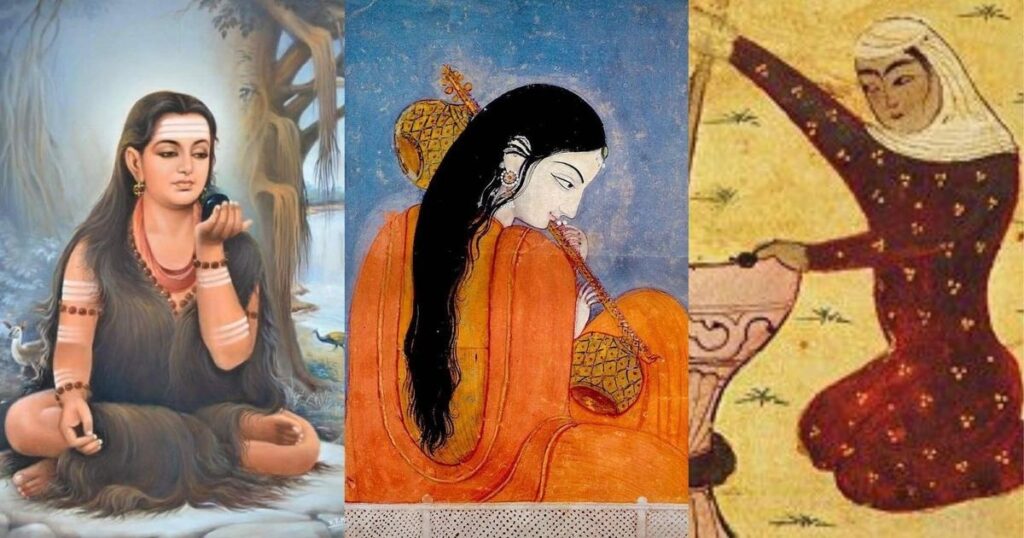
We often think of the past as regressive, a time when women stayed home to cook and sew while men went out to fight. But starting in about the 8th century CE, women across the world began engaging in daring new forms of writing and oral composition. They wrote moving songs, poems, and prose accounts of ecstatic and often erotic contact with God. They described losing themselves in God and marrying a divine lord. The women who composed these accounts came from a wide variety of cultural and religious backgrounds, and yet their writings share surprising commonalities: from Bhakti and Sufi saints in South Asia to Christian mystics in Europe, these women from the past articulated their special relationships with the divine and announced themselves as speaking subjects.
I first noticed resonances across women’s devotional writing from different cultures when I began teaching in India. Trained as a specialist in medieval English literature, I was teaching a course in which we read the well-known Christian mystic Margery Kempe. Margery, whose life dates roughly from 1373 to after 1438 CE, is a fascinating figure: after 14 children and two failed commercial businesses, she decided to devote herself to God. She experienced intense visions, including one of her mystical marriage to God. She rejected sex with her husband, wore white, which was usually a symbol of virginity, and embarked on pilgrimages. She preached, an activity that women were generally barred from, and wept incessantly as an outlet for her religious fervour.
Students in my classroom in India immediately noticed a parallel with a familiar figure. A century or more after Margery, on a different continent, Mirabai, too, longed to leave earthly life to commit herself to her God, Krishna. Like Margery, this legendary Rajput princess faced strong opposition, which included attempts by her in-laws to kill her. She, too, wore white, went on pilgrimages, and cried from deep devotion to her beloved Lord.
Union with god
What can we make of such parallels? These women clearly did not know about each other. Their cultural and religious backgrounds were entirely different. This isn’t a Kumbaya moment in which women around the world are intuitively channelling the same spirit. There are many differences between, for instance, the Sufi poems of writers like Zebunissa, the Mughal princess who wrote under the pseudonym “Makhfi” (Hidden One) about abstract ideals of inner purity and the suffering of separation, and the visions of the English Christian Julian of Norwich, who saw a cross dripping with blood at her bedside. These women were, of course, shaped by their distinct theological and cultural backgrounds. Even the term mysticism, which I have used in the title, is contested, as it comes from a specifically Christian context.
And yet, Mira, Margery, and many others – including Sufi authors like Rābiʼa al-ʼAdawiyya and ʼAʼisha al-Baʼuniyya, Christian mystics such as Julian as well as Catherine of Sienna, and Mechthild of Magdeburg, and Bhakti saints from Andal to Bahinabai – wrote in surprisingly parallel terms about intense longing for union with God. Men, of course, also wrote about these themes, but for women, intimacy with God offered an unprecedented pretext for transgressing gender norms and evading restrictions placed on women.
The best way I can begin to explain the rise of this form of women’s devotion between around 800 and 1600 CE – a period referred to as “medieval” in Western history, but which I prefer to refer to in more globally-applicable terms as “pre-modern” – is that similar modes of oppression can produce similar means of resistance. Women around the world were generally (though not always) barred from direct access to authority within organised religion. They were not typically given the most respected roles in religious life, were not often taught to read sacred texts, and were generally not included within public, devotional life. By expressing reciprocal intense love for God, women from a variety of faiths accrued authority – they became writers, preachers, and spiritual guides. Some of these visionaries rejected marriage and motherhood and instead claimed god as a spouse; some, like Lal Ded and Akka Mahadevi, are known for wandering naked; Joan of Arc justified her dressing as a man by saying that she had received visions from God; many questioned the assumed inferiority of women in their writings or oral compositions.
This does not, of course, mean that their visions were fabricated, only that the expression of these visions was necessarily shaped by the gendered constructs that pervaded their societies. Sharing these visions with the public offered a unique means for women to make a case for their own agency. Reading pre-modern women’s writing about their relationships with God not only reveals histories of feminist thought that extend back long before the official start of feminism but also gives a fresh perspective on our most intimate relationships today: romantic love, friendship, and family.
When 12th-century Kannada poet, Akka Mahadevi, called with erotic longing to Chennamallikarjuna (“Lord white as jasmine,” her name for Shiva), or when the 13th-century German Mechthild of Magdeburg wrote about her burning desire for a God who kisses her passionately, these women reimagined love. Their love for the divine was bodily and erotic. Some women imagined themselves entering into or being penetrated by God. God often revealed himself – or even herself in the cases of Hadewijch of Antwerp and Janabai, who both imagined feminised forms of God – in physical form. For instance, Jesus appears dressed in an alluring purple robe at Margery’s bedside, while Krishna is an enchanting cowherd for Mira. And yet this erotic love is also spiritual, joining two realms of experience that modern readers often assume to be opposite.
This all-consuming, erotic, even selfish love was, according to these women, not incompatible with a selfless love for God. Rabi’a famously wrote to God:
I love You a double love: I love You for Yourself
Loving You passionately has put me off others.
— (trans. Abdullah al-Udhari, Classical Poems By Arab Women)
She describes here loving God both for her own sake, passionately, and as well as for God’s sake alone, at once announcing her personal desire and emptying out that desire. Mechthild, who is known for her use of courtly love and bridal mysticism, also saw God’s presence as reflected in kindness: “Justice demands that we seek and find the stranger, the broken, the prisoner and comfort them and offer them our help”.
Mira’s erotic love for Krishna also became a call for caste equality, as her guru, according to legend, Ravidas, had been born into the Chamar caste and she mingled with people from a wide variety of social stations during her wanderings. Later on, her vakhs empowered the lower-caste performers who sang them in rural Rajasthan. Such accounts complicate easy divides between erotic and other forms of love. They model the possibility of deep self-fulfilment coupled with loving service to the world.
A capacious model of friendship
Along with offering new paradigms for love, pre-modern women visionaries also expand our notion of friendship. Today, we think of friendship as a personal and private relationship, but in the past, it was a bond overwhelmingly associated with men in the public sphere. The dominant image of friendship in medieval Europe, as well as, to some degree, other parts of the world, was one of elite men who were like mirror-images of each other. Women visionaries, however, supply us with a vastly different and more capacious model of friendship.
For a start, these women often subverted the assumption that friends had to be equals, a belief emphasised by philosophers from Aristotle to Michel Montaigne. Instead, they depicted friendships between themselves and divine figures. The Spanish Saint Teresa of Avila, for instance, saw herself as friends with God, writing famously, “For prayer is nothing else than being on terms of friendship with God”. In the 13th century, Janabai described intimate friendship with Vitthal, whom she feminised as Vithabai, who, in her abhangs, lovingly bathes and dresses her:
Sitting among the basil plants, Jani undoes her hair.
God takes some butter and oils her hair,
Says “My Jani has no one” and pours water on her.
Jani tells everyone: “My friend is bathing me.”
— Ruth Vanita, “God as Sakhi”
These holy women also model friendships with other women in the world. Predating the other figures I have cited here, the first Buddhist women saints in the Therigatha (c. 6th–3rd century BCE) talk about friendship as a transformative part of spiritual life and champion the supportive nature of the female monastic community. In this collection of poems, one nun writes, “With no peace in my heart, dripping with sexual desire, I entered the monastery, wailing, my arms outstretched. I approached the nun. She seemed like someone I could trust.”
These same-sex female friendships expand traditional theories of friendship by defying the traditional emphasis on social equality and avoiding the rigid insistence on exact reciprocity that we get in men’s philosophical writing. For instance, Margery, who came from the merchant class, develops close relationships with both aristocratic and lower-class women. Sometimes she helps these women with prayers; at other times, they provide her with food, creating a kind of network of communal reciprocity. The nuns in the Therigatha come from all walks of life – from sex workers to princesses.
Friendships for many of these visionaries are not limited to the traditional dyad. In her vakhs, Mira frequently speaks to a Sakhi: “O Sakhi, without Hari I cannot live” and “Sakhi, Hari has hardened his heart!” This female friend could be a single imagined addressee, but it more likely speaks to a generalisable female friend, envisioning a network of women stretching outside the poems across time. While many of these women might appear isolated in their intimate relationships with the divine, they also constructed communities of women that help us imagine a friendship that is not singular or possessive but rather infinitely expansive.
Reimaging the family unit
Pre-modern mystics also reimagine the family unit. Many of these women, like Margery, Akka Mahadevi, and Lal Ded, abandoned traditional marriages or, like Andal and Julian, rejected marriage to begin with. Others, including several prominent Sufi women like Fakhrawayh bint ‘Ali and Fatima of Nishapur, stayed married but achieved a spiritual status that rivalled or surpassed that of their husbands. In the monastic communities of Buddhism and Christianity, such as the ones that the nuns of the Therigatha formed, or the abbeys that the German visionary Hildegard of Bingen founded, women left their biological families to create new chosen ones, long anticipating the modern conception of this term in queer communities.
Women visionaries frequently attributed familial characteristics to God. Julian of Norwich is especially known for writing about God as a loving maternal presence. In her Revelations of Divine Love, she asserts, “Our Saviour is our true Mother in whom we are endlessly born and out of whom we shall never come”. If God is a female friend for Janabai, she is also a mother and a father as the saint exclaims, “Mother is dead, father is dead – now take care of me Vitthala! Don’t neglect me, I’m your child!” (trans. John Stratton Hawley and Mark Juergensmeyer, Songs of the Saints of India). These women thus mine traditional models of the families and repurpose these to enrich their relationships with God as well as to claim their own power as women outside the restrictions families often impose.
Far from confining visionary women to the spiritual realm, this diverse and challenging set of writings shows how they acted in public and political aspects of pre-modern life. They help us imagine more expansive versions of human relationships and think about how love, friendship, and family figure in our own lives. Their writings challenge us not just to remember a feminist past but also to interrogate our assumptions about possibilities for being with ourselves and others in the present.
[Alexandra Verini is Associate Professor of English at Ashoka University. Her research focuses on medieval and early modern literature and visual culture, gender and sexuality, friendship, religion and utopia. Courtesy: Scroll.in, an Indian digital news publication, whose English edition is edited by Naresh Fernandes.]