❈ ❈ ❈
Beyond an Archive of Suffering, PUCL’s Manipur Report is a Challenge to India’s Conscience
Ranjan Solomon
At the very outset, the author of this critical appreciation affirms that the People’s Union for Civil Liberties (PUCL)’s report on Manipur is a remarkable labour of commitment. It painstakingly documents voices often silenced by state power and places them on public record. In doing so, it strengthens democracy’s conscience and asserts the principle that citizens are witnesses, not bystanders.
Executive summary
The PUCL has produced one of the most comprehensive documents to date on the ongoing violence in Manipur, running over 674 pages in length. The sheer scale of the report, its painstaking documentation and its attempt to hold a mirror to the Indian state make it indispensable.
This appraisal does not summarise every detail, but reflects on the political, social and constitutional implications of the report, while assessing its strengths, limitations and its contribution to public discourse.
At its heart, the PUCL report is an indictment of the Indian state for its dereliction of duty in Manipur. It demonstrates how law enforcement collapsed, how the state government abdicated responsibility and how the Union government remained complicit.
It records in harrowing detail the violence against communities, the destruction of villages and churches, the forced displacement of tens of thousands, and the breakdown of trust between communities.
Yet the report is not merely an archive of suffering – it is also a challenge to India’s democratic conscience. It asks whether the Constitution still protects the marginalised, whether justice is still possible in the face of militarisation and whether communities can live with dignity amidst such engineered chaos.
This critique affirms the report’s monumental importance while also reflecting on where it can be sharpened: its engagement with corporate interests, its analysis of the international dimension and its need to connect Manipur’s story to the wider collapse of democracy in India.
Context of the report
PUCL has historically been India’s conscience-keeper, documenting human rights abuses where state institutions prefer silence.
In Manipur, PUCL stepped into a space of deliberate neglect. The violence that erupted in May 2023 was not unforeseen; it was the culmination of simmering grievances, political manipulations and deep-seated distrust between communities.
Where mainstream media reduced the conflict to ethnic binaries – Meitei versus Kuki – the PUCL report situates the crisis in its structural and political dimensions. It demonstrates how the state failed in its constitutional mandate, and how institutions that should have protected life and liberty either stood paralysed or became complicit.
By investing in fieldwork, testimonies and legal analysis, PUCL performs the role that should have been performed by commissions of inquiry or parliamentary debate. That in itself is a telling commentary on the degeneration of governance in India.
Major findings of the report
The PUCL report records the crisis in four interlinked domains:
- Collapse of constitutional order: The state government failed to act as the custodian of law. Administrative neutrality gave way to partisan mobilisation. The Union government remained inert, allowing violence to spiral for weeks before responding inadequately.
- Targeted violence and displacement: Hundreds were killed, churches destroyed, homes burnt and more than 60,000 people displaced. Camps sprang up in deplorable conditions, with little state support.
- Militarisation and state complicity: Security forces were either absent, biased, or overwhelmed. The Armed Forces (Special Powers) Act created an atmosphere of impunity. In many testimonies, survivors described forces watching as mobs destroyed property.
- Social fragmentation: Communities that once coexisted were driven apart by the violence. Narratives of fear, mistrust and betrayal now dominate. The scale of trauma may take generations to heal.
These findings alone make the PUCL report a historic record. It insists that this violence was enabled by state paralysis and political opportunism.
Critical appreciation
The report is to be valued for three major contributions:
- Documentation of suffering: The report is exhaustive in its collection of testimonies, photographs and data. It gives voice to survivors who have otherwise been silenced by media neglect or political spin. These testimonies remind us that statistics are not abstractions – they are lives torn apart.
- Legal and constitutional framing: PUCL consistently grounds its findings in the language of constitutional rights – Article 21’s guarantee of life and liberty, Article 25’s guarantee of freedom of religion, and India’s obligations under international covenants. By doing so, it transforms survivor testimonies into legal claims that demand accountability.
- Political courage: By naming the failures of both the state and Union governments, PUCL resists the temptation of neutrality. It demonstrates that human rights work is not about “balance” but about siding with the oppressed. In an era where civil society is criminalised, this courage must be commended.
Limitations and blind spots
No report of such magnitude is without its limitations. The critique here is not to diminish PUCL’s contribution, but to identify areas where further analysis is needed.
- Corporate interests and resource politics: While the report notes land, forest and identity politics, it could go deeper into how corporate interests – especially extractive industries and infrastructure projects – shape the conflict. Manipur’s resources are not incidental to the violence; they are central to it. Big corporations loom as silent beneficiaries of displaced communities and militarised spaces.
- International dimensions: The report rightly focuses on domestic accountability, but it underplays the international dimension. Manipur borders Myanmar, a region destabilised by military rule. The spillover of refugees, arms and insurgencies complicates the picture. Additionally, India’s obligations under UN conventions should have been more forcefully emphasised.
- Bifurcation debate: The report documents the ethnic divide but is cautious about addressing the growing demand for the bifurcation of Manipur into separate administrative units. A sharper political analysis of whether bifurcation would deepen or alleviate the crisis is required.
- Systemic collapse of democracy: While the report critiques the government’s failures in Manipur, it could have contextualised them within the wider collapse of democratic institutions across India – the judiciary’s complicity, media capture and the criminalisation of dissent. Manipur is not an aberration; it is a symptom of a larger malaise.
Analytical reflection
The PUCL report is not just about Manipur – it is a lens into India’s democratic breakdown. The constitutional promise of equality and secularism stands shattered when a state government can preside over such bloodletting without consequence.
The violence in Manipur exposes the fragility of India’s federalism. When the Union government chooses selective intervention, communities are left to the mercy of political expediency. The inability of institutions – the courts, the National Human Rights Commission, the Election Commission – to act decisively signals a collapse of checks and balances.
From an analytical standpoint, the report affirms what rights advocates have long warned: that when impunity becomes normalised in Kashmir, Chhattisgarh or the Northeast, it eventually corrodes the entire republic.
Recommendations and commentary
PUCL offers recommendations, including:
- An independent judicial inquiry into the violence
- The rehabilitation and return of displaced communities
- Accountability of security forces
- The restoration of democratic processes and dialogue
These recommendations are sound, but this critique adds:
- Truth and reconciliation mechanisms: Beyond legal accountability, Manipur needs structured spaces for dialogue and healing.
- Protection from corporate land grabs: Rehabilitation must include guarantees against displacement for resource exploitation.
- UN and international oversight: Given the scale of state complicity, international monitoring cannot be ruled out.
- Rethinking federalism: The crisis should reopen debates on autonomy, self-governance and power-sharing to prevent majoritarian domination.
Conclusion: Why this report matters
The PUCL report is not just a document; it is a call to conscience. It prevents the state from burying its crimes under the rubble of silence. It preserves the voices of the displaced and the dead, ensuring history cannot be rewritten by official narratives.
This appraisal affirms the report’s historical significance while urging deeper engagement with certain aspects surrounding Manipur’s collapse.
For scholars, activists and policymakers, it is a resource and a challenge. For the people of Manipur, it is an affirmation that their suffering has been witnessed and recorded.
If ignored, this report will become another file gathering dust. If acted upon, it can become a cornerstone for justice, reconciliation and a reimagined democratic order.
[Ranjan Solomon is a human rights defender, writer, and recognises that without active interventions and challenges by civil society movements, democracy is at peril. Courtesy: The Wire, an Indian nonprofit news and opinion website. It was founded in 2015 by Siddharth Varadarajan, Sidharth Bhatia and M. K. Venu.]
❈ ❈ ❈
Dear Prime Minister, Please Answer These Painful Questions for Manipur
Yaqut Ali
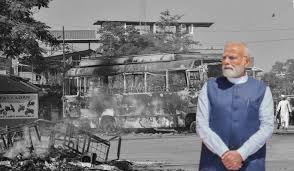
On January 4, 2022, Prime Minister Narendra Modi told the people of Manipur that he knew the “pain in your hearts” and that after 2014, he had brought “the entire Government of India to your doorstep.” More than two years after an ethnic violence erupted in the state on May 3, 2023, he has finally returned. But the Manipur he visits today is no longer the one he once invoked. It is a house of mourning, fractured on his government’s watch.
The design of Modi’s visit itself reflects that fracture. According to the Press Information Bureau (PIB) itinerary, he will meet the Kuki-Zo community in the hills of Churachandpur, and separately the Meitei community in Imphal. The segregated schedule is a powerful admission of failure: the gulf between the two communities has become so wide that even the prime minister cannot bring them into the same umbrella. The visit underscores Manipur’s de facto partition.
Even the secrecy surrounding the trip signaled unease. Under President’s Rule, the administration referred only to a “VVIP visit”, revealing Modi’s name at the last moment. Then, on the eve of September 11, posters and decorations of his visit were set ablaze in Churachandpur.
The message was clear: Manipur is not celebrating, it is grieving.
The BJP’s claim of a “double engine sarkar”, centre and state in harmony, has only meant double silence for Manipur. When violence broke out in May 2023, Police were widely seen as partisan, and mobs on both sides acted with impunity. In the first week alone, at least 50 people were killed.
Delhi remained silent. It took 80 days, and the viral circulation of a video showing two Kuki women stripped and paraded, for the Prime Minister to speak. On July 20, 2023, he said his heart was “filled with sorrow and anger” and that what happened to the “daughters of Manipur can never be forgiven.” Later, he promised in Parliament that “peace will definitely prevail.
But the killings continued. By July 2024, the official toll had reached 221. Today, it has crossed 260. Biren Singh eventually resigned on February 9, 2025, and four days later, the state was placed under President’s Rule.
The Union government has since claimed that violence has decreased, while militant groups continued to occupy abandoned homes and property.
Camps of betrayed promises
Over 60,000 people remain displaced across Manipur. Relief camps, which the government once promised would be temporary, have become prisons of despair. Families live in stinking halls, separated by worn-out curtains, sharing just a handful of toilets.
When Union home minister Amit Shah visited in June 2023, he promised healthcare, housing and education. Two years later, those promises remain unfulfilled. Kuki organisations reported 35 deaths by August 2023 due to lack of medicines, and at least 13 more since late 2024. Private hospitals have threatened to halt dialysis under the government’s PMJAY scheme because dues remain unpaid.
Despite repeated assurances, most displaced families cannot return to their villages. Suicides in Meitei camps highlight the despair: men unable to provide for their families took their own lives. Education too has collapsed. Kuki children once studying in Imphal can no longer return.
The questions PM must answer
Modi’s long-delayed visit will be remembered less for its announcements than for the questions it leaves unanswered.
- Why did it take 865 days for the Prime Minister to step into a state burning with violence?
- Why are over 60,000 people still trapped in camps despite repeated promises of rehabilitation?
- Can development succeed when the justice system has collapsed so completely that trials must be shifted outside the state?
- And is this visit the tacit acceptance that Manipur now exists as a permanently divided land?
Manipur has not asked for parades or photo opportunities. Its people have asked for dignity, justice, and peace. After nearly two and a half years of silence, the prime minister’s visit does little to convince them that those demands will finally be met.
[Courtesy: The Wire, an Indian nonprofit news and opinion website. It was founded in 2015 by Siddharth Varadarajan, Sidharth Bhatia and M. K. Venu.]
❈ ❈ ❈
Nine Issues in Manipur That Remain Unresolved Despite Modi’s Belated Visit
The Wire Analysis
Prime Minister Narendra Modi’s fleeting visit to Manipur comes more than two years after violence ripped through the border state in May 2023.
The BJP wants this fleeting appearance to be seen as a gesture of concern, but the record is clear. Lok Sabha leader of opposition Rahul Gandhi was on the ground within weeks, visiting relief camps and meeting victims. Modi, by contrast, remained silent for months as the state burned, making no attempt to visit or even acknowledge the spiralling emergency.
Voters noticed, when in the 2024 Lok Sabha polls, the BJP was routed in Manipur, losing both seats to the Congress. The defeat was resounding and left no room for spin or excuses.
Modi’s aloofness stands in stark hypocrisy with his high-minded pronouncements of 2017, when he declared in Manipur that “those who cannot ensure peace in the state have no right to govern”. These words now sound hollow, as his government’s deliberate inaction has allowed the crisis to metastasise, with the prime minister only emerging from self-imposed exile once it became politically inescapable. His belated visit to the divided state only underscores the unresolved questions that continue to plague Manipur.
1. Unreturned weapons to state armouries
The problem of weapons taken from state armouries in the state capital by majoritarian militia groups at the onset of violence remains unresolved. More than 6,000 sophisticated weapons, from AK-47s to mortars, were plundered in May 2023. Despite loud assurances, much of these arms have not been recovered, and they now fuel an entrenched culture of violence that undermines the authority of the Indian state.
The Modi government’s failure to restore state control over its weaponry ensures any meaningful peace remains a mirage.
2. Justice for victims of majoritarian violence
Victims, especially among the Kuki-Zo communities, see justice as an empty slogan. Few convictions have emerged, even with video evidence of atrocities like sexual violence and arson in the public domain.
Union government investigative agencies have been reluctant, slow and selective in pursuing perpetrators. “Strict action” is promised in parliament, but those responsible for the worst excesses remain untouched, forcing grieving families to beg for even minimal recognition.
The quest for peace without justice will remain futile in Manipur, which can’t be compensated by a few so-called development projects announced by Modi.
3. Divided state on ethnic lines
Manipur today resembles a state under partition. Central Reserve Police Force and Assam Rifles personnel now police an ethnic border between the predominantly Meitei Imphal valley and the surrounding hills where Kukis form a majority. Instead of restoring civil order, this de facto partition has become the norm, and parallel administrations are entrenched.
The Modi government has surrendered to this balkanisation, with the prime minister himself sanctioning the divided state by visiting two separate places instead of making a bold political move to bring all the communities together first.
4. Biren Singh audio sample case
The Supreme Court will next hear the N. Biren Singh audio recording case in November. Allegedly, the tapes reveal the former chief minister’s role in abetting violence and permitting Meitei groups to loot armouries. Forensic delays and the Union government’s constant foot-dragging suggest a protection racket designed to insulate BJP loyalists at any cost, even as the highest court signals its frustration.
This partisan politics remains a major obstacle in moving towards genuine reconciliation in strife-torn Manipur.
5. Free movement regime and border fencing
India’s border with Myanmar, with the Free Movement Regime allowing ethnic and cultural ties within communities divided by the colonial border, has been a recurring theme of targeting by majoritarian groups. Despite protests by the states of Nagaland and Mizoram, and pleas by the Nagas and Kuki-Zos in Manipur, the Modi government sounds determined to fence the border and tighten controls on movement of the locals, all under the cover of its “national security” bravado.
Instead of winning over these ethnic groups, it reverses a major step of decriminalising the movement of people and petty trade across an artificial border bequeathed by the British colonial rulers.
6. Naga Accord implementation
Nagas are the second-biggest ethnic group in Manipur and have been loudly voicing their discontent in recent weeks. Modi’s much-trumpeted Framework Agreement with Naga groups of 2015 is now a cautionary tale of failure. Nearly a decade after a supposed breakthrough, no settlement is in sight. Instead, negotiations meander pointlessly, feeding disillusionment and stoking unrest among Nagas, who now see no incentive for moderation or trust in Modi’s word.
7. Poppy cultivation crisis
The region’s entanglement in the transnational drug trade has only deepened. Rather than devising real solutions for communities dependent on poppy cultivation, the government’s response has been clumsy and incendiary. It has branded entire ethnic groups as “illegals” and criminalised poverty.
Such scapegoating has converted a developmental challenge into an inflammatory ethnic wedge, fuelling the violence witnessed over the past 28 months.
8. Systematic internet shutdowns
Manipur has endured India’s longest internet blackout, making it a digital pariah. Blanket shutdowns have crippled communications, gagged journalists and ensured that human rights abuses remain hidden.
These actions are about repression, not order, exposing the government’s comfort with colonial tools of control even in the 21st century. It affects education and the provision of government services, besides taking away all means of alleviating the psychological trauma undergone by the people of the state.
9. Rehabilitation and resettlement crisis
Over 60,000 people remain stranded in relief camps, with no clear path home. Villages stand razed or permanently altered; hundreds of churches have been burnt and destroyed. The government’s response is primarily bureaucratic, devoid of any coherent policy for large-scale rehabilitation or reconciliation. Citizens are left in limbo, victims twice over – first of violence, then of poor governance.
To conclude, Modi’s first visit since the violence began in Manipur is an exercise in political optics, not a response to the humanitarian catastrophe. For months, silence was his only message to Manipur, which proved untenable after electoral debacle and relentless criticism.
The state needs leadership that values its people as citizens, not pawns. The wounds and failures listed above will not heal with staged visits or hollow pronouncements. They demand accountability and genuine action, neither of which the Modi government has yet shown any capacity for.
[Courtesy: The Wire, an Indian nonprofit news and opinion website. It was founded in 2015 by Siddharth Varadarajan, Sidharth Bhatia and M. K. Venu.]