❈ ❈ ❈
Precarious Workers are Employees Without Stability, Not “Entrepreneurs”
Pete Dolack
A belief that the rise of so-called “platform capitalism” and the classification of working people in those sectors as “independent contractors” means that the concepts of employer and employee are out of date appears to be on the rise.
But a working person is still a working person, no matter the legal arrangement.
The basic binary of capitalist society, whichever way one wishes to describe it, remains capitalists and workers, bourgeoisie and proletariat, employers and employees. It is certainly true that the working class today is not primarily blue-collar manual workers, but that wasn’t necessarily true even in the early 20th century, when white-collar work was already becoming common. Just because you sit in an office in front of a computer it doesn’t mean you aren’t a worker having surplus value extracted from you.
An argument I have read asserts that people who work for “platforms” such as Uber, Doordash or Lyft are not simply workers but have a dual status, as workers and at the same time as “entrepreneurs.” As workers these people scramble to make ends meet in a fragmented labor market but as entrepreneurs are continually branding themselves and marketing their skills. This “dual identity” supposedly blurs the distinction between employer and employee and between labor and capital. That is simply an unfortunate retreat from reality. Precarious workers — precarious is precisely the condition of platform workers and freelancers — are not part “entrepreneurs,” they are workers, plain and simple, but workers without regular employment.
The precarious freelancer or gig worker does not own any means of production, does not control his or her work and is answerable to an employer, even if for the short term or temporarily. The relationship of worker to employer does not change in any way. What is different is that the employer, or capitalist, can much more easily remove an employee than the employer could a regular employee.
An exploited worker is an exploited worker
That a workforce that is scattered and remote, rather than sharing the same space as was common until recently, undoubtedly makes organizing more difficult. That is a challenge to be faced. The conception being critiqued here would have us believe that precarious workers are “not Marx’s proletariat” but rather something new.
There is nothing new about it. What is new is that precarious work has spread to what we commonly think of as “middle class” or “white collar” work. And being a precarious worker has always been the norm when we look at the working class on a global basis. An Uber driver or any other platform worker is immediately subject to an algorithm rather than a direct boss, but that algorithm offers no accountability and no explanation. The algorithm is not some neutral entity that fell out of the skies; it is connected to a faceless corporation seeking to maximize profitability. The boss — the capitalist — is still there. The “algorithm” replaces nothing.
Uber, like other platforms, is not a disembodied entity somewhere in the clouds, it is a capitalist enterprise that ruthlessly exploits its workers. That those workers who are called “independent contractors” have some control over their working hours in no way changes their status. The app is controlled and owned by Uber, not by the driver, nor does the driver have control; Uber can take the app away at any time at its discretion. Thus the means of production are firmly in the hands of the capitalist and the worker is selling their labor power and in this case selling their labor power for an uncertain and ever changing amount — a variable they also have no control over.
“Sharing economy” is the euphemism often used to designate the phenomenon of working people obtaining work through apps. “Sharing economy” enterprises designate employees as “independent contractors” so that workers are left without legal protections, while competition is undercut through insisting that laws and regulations don’t apply to them. This is not new or “innovative.” But it is Silicon Valley companies that are doing this — so, hurray!, it’s now exciting and, oh yes, disruptive! Quaint, archaic standards such as minimum wages and labor- and consumer-law protections are so old-fashioned that Silicon Valley billionaires are doing us all a favor by disrupting our ability to keep them. High-tech exploitation is still exploitation.
A precarious worker is in the same class as a salaried worker in a stable, formal job. They are exploited in the same way through the extraction of surplus value, the basis on which the capitalist system rests. Divisions among workers have always existed and propaganda designed to foster divisions and alienation have always existed; indeed, it must exist from the perspective of capitalists because a united working class would overthrow the system. Capitalists — financiers and industrialists — know this, which is why so much effort is always put into dividing workers. There is nothing new here.
All the workers who are in this situation are workers — proletarians, to use the traditional technical term. They are all, again, people without possession of the means of production who must sell their labor power and in these cases sell their labor power under conditions heavily weighted toward employers — the bourgeoisie who own the means of production, or, in the case of these platforms, who own and profit from the app. The Uber driver is getting only a small portion of the revenue generated — the driver has surplus value extracted from them exactly as a regularly employed worker in a formal setting does. That is how capitalism operates. The capitalist pays the worker only a fraction of the value of what he or she produces. From that surplus value extracted comes profit. A capitalist who didn’t extract surplus value wouldn’t be a capitalist.
Informal workers outnumber those with regular jobs
The belief that the traditional framework of class no longer applies is a fallacy on its face: A precarious worker is still a worker, still an employee or a proletarian, simply one without a regular paycheck. Most of the world’s workers are precarious workers. It is those with full-time, regular employment who constitute a minority of the world’s workers.
A 2016 report by the International Labour Organization (ILO) estimated that nearly half of the world’s workers — 1.5 billion people — hold “vulnerable employment.” This total includes subsistence and informal workers, and unpaid family workers. This vast cohort (the “reserve army of labor” although the ILO never uses such direct terminology) will not be getting smaller in the foreseeable future. In one-third of the world’s countries, the “precariat” constitutes at least two-thirds of the total workforce.
The number of precarious workers, however, is likely higher than what the ILO calculates. In their book The Endless Crisis, John Bellamy Foster and Robert W. McChesney estimate that the true size of the precariat is actually significantly larger than those with regular employment. Adding together the categories of the unemployed, the vulnerably employed, and the economically inactive population in prime working ages (25-54) and add them together, they calculate that the global reserve army could be as large as 2.4 billion in contrast to the 1.4 billion who have regular employment.
There has never been a time when working people haven’t been divided along various lines, including a minuscule percentage of workers with relative privilege in terms of job security and wages, such as the “labor aristocracy” Lenin spoke of at the dawn of the 20th century. Capitalists have always tried to divide us on the basis of sex, race, ethnicity, immigration status, religion, etc.
Stand up, fight back together
How do we fight back against these developments? Do we throw away the tools of past labor struggles or, as those arguing that concepts of workers and employers are somehow relics of the past, form “decentralized, flexible, networked forms of organizing that reflect the fragmented reality of modern class dynamics” that would eschew leaders or a centralized structure. Organizing in this way “does not seek to recreate the industrial strikes or union halls of the past.”
The strike and the union hall have been two key tools enabling workers to defend themselves. The answer to the decline of union membership is to rebuild unions as fighting instruments rather than the collaborationist “business unionism” of past decades. It is not to see unions as somehow passé. The strike is a potent weapon in the hands of workers. Throwing away this tool means throwing away the tool that capitalists most fear and that has brought the most results. And when a strike raises wages and working conditions at one company, then competing companies are compelled to match that at risk of losing employees. A strike elevates whole groups of workers, not only those who struck.
Small groups of people without leadership can’t create, much less sustain, the level of organization necessary to prevail over what will be a very long struggle. Effectively, this “decentralized” organizing is not a model for a united front, but rather an anarchist approach of small groups each doing their own thing. That has never worked. There is a reason there has never been an anarchist revolution. There is a reason that the union movements of the 1930s were organized by socialists and communists who understood that organization is the key to a successful movement.
The solution to the atomization of working people is not to have an atomization of small groups but to find ways to organize these atomized and precarious workers into a solid movement, an organized movement with powerful numbers behind them that understand its common class status and subordination with those with regular, formal employment, and that those with regular, formal employment understand they are part of the same working class as the precarious. Such leadership should largely come from within. Giving in to atomization means giving in to the bosses.
The object of a capitalist corporation is to extract the maximum amount of profit, whether it is a traditional business or a platform, and underpaying workers is a primary method toward that maximization. High-tech wrapping does not, and should not, disguise that reality. Organize!
(Pete Dolack is an activist, writer, poet and photographer. He writes the Systemic Disorder blog and has been an activist with several groups. Courtesy: Systemic Order Blog.)
❈ ❈ ❈
The Plight of Gig Workers in India
Naina Bhargava and Madhumita Sharma
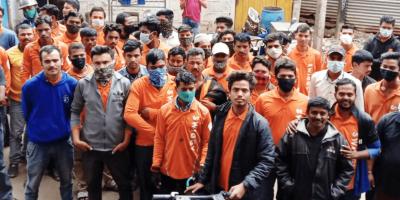
In The Precariat: The New Dangerous Class, Guy Standing paints a stark picture of the growing workforce trapped in unstable, insecure employment without basic labour protections. His analysis resonates deeply with the condition of India’s gig workers – the millions powering platforms like Swiggy, Zomato, Uber and Ola, yet largely excluded from fundamental labour rights.
The rise of the gig economy in India
The gig economy in India has expanded at an unprecedented pace, driven by the rapid growth of digital platforms and consumer demand for on-demand services. According to a NITI Aayog report, there were 7.7 million gig workers in India in 2020–21, and this figure is projected to surge to 23.5 million by 2029–30. Gig work, often celebrated for its flexibility, hides a grim reality – the absence of job security, social security benefits and legal protections.
Unlike regular employees, gig workers are classified as “independent contractors”, making them ineligible for essential rights such as minimum wage, paid leave, accident compensation and health benefits. Their dependence on algorithmic ratings and customer reviews means that their employment is perpetually unstable.
Ken Loach’s 2019 film, Sorry We Missed You, powerfully captures this reality. Its protagonist, Ricky Turner, a delivery driver, struggles with mounting debt and emotional strain due to the exploitative conditions of gig work. A more recent film which illustrates the daily struggle of gig workers is Nandita Das’s Zwigato, a slice-of-life drama which came out in 2023. Set in Bhubaneswar, Odisha, the protagonist, Manas Mahto, signs up as a rider for a food delivery app to make ends meet after losing his job as a factory supervisor during the pandemic. We see him struggling with the algorithm at his new job. The uncertainty of ratings and incentives is an every day anxiety for him. And the chipping away of dignity that comes with it.
Turner and Mahto’s stories mirror that of tens of thousands of gig workers in India, who endure long hours, fluctuating earnings, and the constant fear of deactivation – the industry’s euphemism for termination.
Legal protections: A fragmented framework
In response to the expanding gig economy, the Indian government introduced four labour codes in 2020, including the Code on Social Security, 2020, to extend welfare benefits to unorganised and gig workers. The code defines platform workers under Section 2(61) as individuals performing work through online platforms, while Section 2(86) classifies unorganised workers as those engaged in irregular or self-employment.
Under Section 6 , the code mandates the formation of a National Social Security Board, tasked with recommending welfare schemes for gig and platform workers. However, implementation has been sluggish , and most gig workers are yet to see any tangible benefits. The ambiguous language and fragmented enforcement mechanisms allow platforms to sidestep accountability, leaving workers without recourse.
A notable exception is the Rajasthan Platform-Based Gig Workers Act, 2023 – India’s first state-level legislation specifically addressing gig worker rights. It mandates platform registration, data-sharing obligations and the establishment of a welfare board. However, the absence of national-level legislation means that gig workers in other states remain vulnerable to exploitation.
Despite existing laws such as the Contract Labour Act, 1970, and the Employment Compensation Act, 1923, gig workers continue to be denied protections. These laws, designed for traditional employment, fail to address the fluid, transient and decentralised nature of platform work.
The human cost of flexibility
For many gig workers, the promise of flexibility has translated into financial precarity and insecurity. Ravi Kumar, a Swiggy delivery rider in Haridwar, highlights the fragile nature of gig work.
“If I fall sick, I lose my entire income for the day. There’s no backup. My job depends on my app rating. If a customer gives me a low rating – even unfairly – I risk getting deactivated. It’s scary because I have a family to support.”
Deactivation – an abrupt removal of a worker from the platform – has become a constant threat. With no notice or explanation, workers are left without income and with no legal recourse.
The All India Gig Workers Union v. Uber India Systems Pvt. Ltd. case exemplifies the legal battle for gig worker rights. In this case, gig workers challenged Uber’s refusal to provide minimum wages and social security benefits, seeking recognition as employees. However, the absence of clear legal classifications for gig workers means the fight for fair wages and protections continues.
Gendered disparities in the gig economy
Women gig workers face even greater challenges in the already precarious gig economy. Seema Sharma, a beauty service provider on UrbanClap in Delhi, shares her experience with harassment and the lack of grievance mechanisms.
“There have been times when clients made me feel unsafe, but when I complained, the app just told me to block them. There is no proper mechanism for reporting harassment. I feel vulnerable and alone.”
Research by Damini Kain reveals that women in the gig economy are more likely to be underpaid, denied opportunities and exposed to harassment. The absence of gender-specific protections makes women workers even more vulnerable.
The mental health toll
While the financial instability of gig work is well-documented, its mental health consequences are often overlooked. Akash Singh, a Zomato delivery agent in Delhi NCR, describes the emotional strain of working under constant pressure.
“I’m always worried about my ratings. One bad review means fewer orders. I often work 14-16 hours a day i just to make ends meet. The stress is constant – I’ve started having anxiety attacks.”
A survey by the All India Gig Workers Union found that over 60% of gig workers reported symptoms of anxiety and depression, driven by financial instability, long hours and algorithmic surveillance. However, lacking formal employment status, they remain excluded from employee assistance programs or mental health support.
Algorithmic control and the power imbalance
One of the most concerning aspects of gig work is algorithmic control, where platforms dictate how much a worker earns, the orders they receive, and even whether they remain employed. The lack of algorithmic transparency leaves workers vulnerable to arbitrary deactivations.
Pawan Verma, an Ola driver in Multai, recalls his sudden deactivation.
“One day, my account just stopped working. No message, no call – nothing. When I contacted customer support, they said I had ‘violated guidelines’, but they didn’t specify how. It took me four days of constant calls and emails to get my account reactivated.”
Such deactivations, often automated, reflect the unregulated power platforms wield, with no accountability or grievance redressal mechanisms in place.
A call for comprehensive reform
The stories of Ravi, Seema, Akash and Pawan underscore the human cost of platform-based labour. Despite the introduction of labour codes, weak enforcement leaves gig workers exposed to exploitation.
As Guy Standing argues, the rise of the precariat demands a new social contract. India must implement comprehensive reforms that:
- Recognise gig workers as employees, granting them access to minimum wage, accident insurance and paid leave.
- Introduce algorithmic transparency laws to prevent arbitrary deactivations.
- Ensure gender-specific protections to safeguard women workers.
- Establish mental health support programmes for gig workers.
The Rajasthan Platform-Based Gig Workers Act offers a promising model, but a nationwide framework is necessary to ensure consistent protections. Without such reforms, the gig economy will continue to thrive at the cost of its most vulnerable workers, reducing flexibility to a euphemism for exploitation.
As Zwigato illustrates, the problem with the gig economy and of gig work is not merely that of wages. It is about dignity and survival. India’s policymakers must recognise this and act decisively to safeguard the rights and humanity of its gig workforce. India’s policymakers must recognize this and act decisively to safeguard the rights and
humanity of its gig workforce.
(Naina Bhargava is a lawyer and founder-editor of The Philosophy Project. Madhumita Sharma is a Consultant at Network18, who has been published in The Hindu, Indian Express, Newslaundry, The Quint, Outlook and FII. Courtesy: The Wire, an Indian nonprofit news and opinion website. It was founded in 2015 by Siddharth Varadarajan, Sidharth Bhatia, and M. K. Venu.)