On Monday, Bihar Chief Minister Nitish Kumar pulled down a Muslim doctor’s hijab leading to an uproar. Opposition leaders from the Congress criticised Kumar while some politicians from the Bharatiya Janata Party have defended him. Kumar’s Janata Dal (United) is part of the BJP-led National Democratic Alliance at the Centre and in the state.
A BJP politician immediately made a comparison with Ashok Gehlot of the Congress who had done the same with a Hindu woman’s ghoonghat a few years ago.
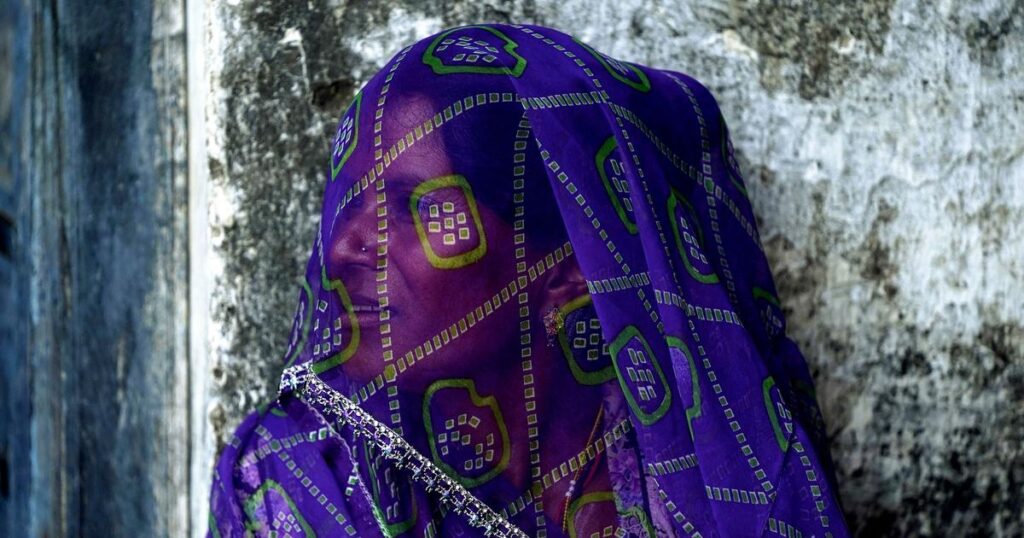
It is true that both the Islamic veil in all its forms and the Hindu ghoonghat are patriarchal tools with the sole function of creating submissive women. There is one difference though: unlike the Islamic veil, the ghoonghat is politically benign. The ghoonghat is deemed socially oppressive, and rightly so. But the hijab and the burqa are not only seen as socially oppressive but also part of some diabolical Islamic stratagy that will, one day, overthrow Hindu civilisation.
If there is pity for the Hindu woman in the ghoonghat, there is contempt for the Muslim woman in burqa or hijab.
It is this difference that makes the Gehlot example deceptive. In 2019, when Gehlot set out on his anti-ghoonghat campaign, he had targeted the practice itself. The BJP, however, targets the very identity of the Muslim: what they wear, what they eat, where they live, whom they marry, everything begets suspicion.
When identity is targeted, the actual culprit – patriarchy – gets brushed under the carpet.
A couple of years ago during research for my book on purdah, I had met several Hindu women in cities in Rajasthan. Many had voiced their protest against the ghoonghat. In a beautiful Hindi poem, Mamta Jaitley, an activist from Jaipur, lamented how late she was to realise that “the purdah you hurled over my face obscured my mind too… made me see things as you wanted me to see, hear things as you wanted me to hear”.
For the Muslim woman, even voicing an opinion, let alone protest, is not as straightforward. In the shadow of Hindutva, she encounters a much deeper struggle than her ghoonghat-clad counterpart. She is not dealing merely with a social norm or religious practice within her community, but a political leviathan that seeks to codify prejudice against the entire community.
Yes, patriarchy must be resisted. But when women’s reforms are steeped in malicious intent, they cause more harm to the very women they seek to help. For example, the Indian government’s ban on triple talaq only added to the woes of Muslim women. Muslim men who could no longer divorce their wife quickly began to abandon them. These women could neither ask for maintenance nor remarry.
When dress codes are attacked, regardless of how patriarchal they are, often women willingly bypass their own subordination and adopt visible symbols that bind them to a collective identity. The hijab and the burqa are the perfect visual signals of Muslim solidarity and belonging. I met Muslim women in various cities who had taken up some or the other form of the Islamic veil to signal defiance against prejudice, although they acknowledged the patriarchal purpose of hijab.
A young abaya-clad forensic sciences student I met in Mangaluru last year had adeptly explained the catch-22: “If I abandon the veil, I please the government (which I would never do); if I adopt the veil, I abide by my religion but also lose a part of myself, my own identity.”
Besides, patriarchy as an institution is old. Very old. Its origins date back 300,000 years. The practice of veiling itself is 4,000 years old. One cannot simply will away deeply-embedded practices through sudden expurgations: change has to come from within society. Veiling is part of the system of purdah (seclusion), a system so normalised that even Mohandas Gandhi, as a young married man, would refuse to allow his wife, Kasturba, to go anywhere without his permission.
He had been made a jealous husband by the thought, “If I should be pledged to be faithful to my wife, she also should be pledged to be faithful to me” – a fallibility he later regretted. So, at a public address in Fatehpur in 1947, when he said, “True purdah should be of the heart. What is the value of the outer veil?”, it is likely that his words ordained a focus on the inequality of sexes rather than just a sanction against a dress code.
Whether a woman wears a veil out of coercion, which is very common, or willingly adopts it in political protest or piety, paternalistic bans and attacks are likely to fail. Just as paternalistic mandates that make hijab compulsory have failed – as in Iran. The problem is that the woman in whose name bans and abstruse verdicts are passed is universally ignored.
Unless there is a political ideology targeting an entire group of people, leading to defiance, mainstream education can significantly help in breaking harmful practices. Most Muslim women I met in India who had rejected the veil were educated and financially independent. But forcing students to remove their veils stops this progress midway.
Many girls and women who went to school and college in Karnataka in their hijab dropped out when forced to remove it. The French hijab ban in 2004, too, led to increased perceptions of discrimination, which hindered Muslim girls from finishing school.
Attacks on the hijab will likely worsen the status of Muslim women because the only option that would leave for many is religious education. It is more accessible, less restrictive – and patriarchal. Is that the objective?
[Raheel Dhattiwala is a sociologist. Courtesy: Scroll.in, an Indian digital news publication, whose English edition is edited by Naresh Fernandes.]