❈ ❈ ❈
Panamanian Unionists Reject US Claim on Canal, Government Wavers
W.T. Whitney
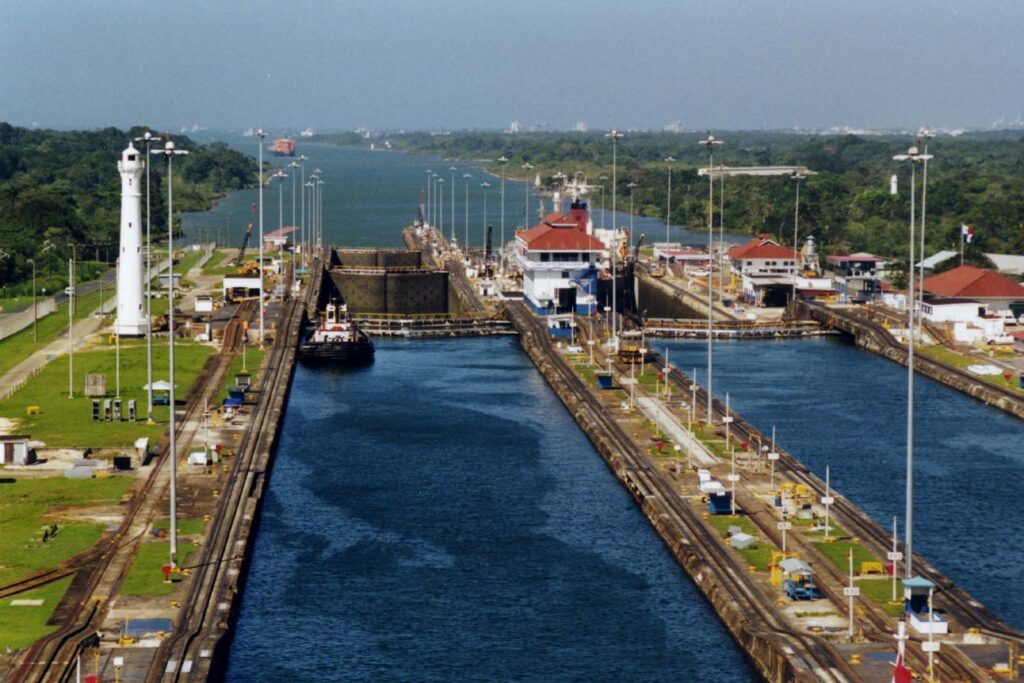
President Trump mentioned Panama in his inaugural address on January 20. He indicated the Canal “has foolishly been given to the country of Panama.” And “China is operating the Panama Canal. And we didn’t give it to China.” He added that, “the spirit of our treaty has been totally violated. American ships are being severely overcharged and not treated fairly in any way, shape, or form.”
The treaty in question is one of the two Torrijos-Carter Treaties of 1977 that guided the transfer of the Panama Canal to Panamanian ownership in 1999.
Addressing the Congress on March 5, Trump announced, “My administration will be reclaiming the Panama Canal, and we’ve already started doing it … “Just today, a large American company announced they are buying both ports around the Panama Canal.”
That company is the privately-owned, Hong Kong-based CK Hutchinson company, which operates ports in 23 countries, among them ports in Balboa and Cristobal, entry-way cities to the Canal. At the Trump administration’s urging, the U.S.-based BlackRock investment firm would purchase Hutchinson – that is, until China’s government expressed displeasure at the $19 billion deal and the plans died.
U.S. Defense Secretary Pete Hegseth and the Panamanian Minister of Public Security Frank Abrego met in Panama City on April 8. They signed a Memorandum of Understanding that established terms of U.S. military involvement in Panama and of U.S.-friendly operations of the Canal. Two themes emerged:
- Cooperation between the armed forces of the two countries in “professional education and development of capacities” with training and bilateral exercises taking place in Panama.
- Arrangements for security and defense of the Canal and for compensating the U.S. Navy for tolls and other charges its warships incur passing through the Canal – and compliance of those arrangements with the Treaty of Neutrality of 1977, one of the two Torrijos-Carter treaties.
Secretary Hegseth and Panamanian President José Raúl Mulino issued a Joint Declaration. There, the two officials accept the Memorandum of Understanding and Secretary Hegseth congratulates Panama as “the first country in our hemisphere to abandon [China’s] Belt and Road initiative” and for its success in stemming the flow of migrants across the Darien Gap.
The Panamanian version of the Declaration includes Hegseth’s “recognition [of] Panama’s leadership and inalienable sovereignty over the Panama Canal and its adjacent areas.” The U.S. version of the agreement leaves out those words.
The Memorandum of Understanding authorizes the U.S. government to deploy troops to three Panamanian bases built by the U.S. government when it occupied the now defunct Canal Zone. U.S. troops may soon be using a fourth base being constructed by Panama near the Darien Gap, one well-suited for discouraging migrants heading north.
U.S. troops already deploy to Panama. According to a U.S. Southern Command announcement, Airmen and Marines from Joint Task Force-Bravo were in Panama from March 24 to April 4, 2025 engaging with counterparts there “to strengthen relationships in security, humanitarian and logistical fields.” U.S. Marines arrived in Panama on June 5 to conduct “forest operations” with Panamanian troops. Joint air and naval exercises took place on July 13-18.
Panama’s continued control of the Canal and her national independence are under siege. In the background are serious U.S. interventions. In 1903 The U.S. government under President Theodore Roosevelt engineered the secession of Colombia’s most northern province and thereby arranged for the newly independent state to authorize the U.S. to build the Canal.
On December 20, 1989, the U.S. military invaded Panama in order to capture President Manuel Noriega, the onetime CIA asset accused of drug-dealing and money laundering. According to NACLA, “The U.S. invading forces destroyed 20,000 homes and killed hundreds of innocent Panamanians, dumping bodies into mass graves.”
Panama’s government shows signs of a dependency relationship with the United States that may portend significant U.S. authority over the Canal. An aroused anti-government people’s movement rejects that possibility.
José Raúl Mulino, veteran rightwing politician and former minister of public security, became president in 2024 with 34% of the vote. Analyst Abdiel Rodríguez Reyes indicates Mulino “has no charisma … and no [political] base … [H]e is fundamentally supported by an important group of Panamanian businessmen and by US interests.” Mulino has dutifully spoken out against Trump’s declarations on the Canal.
Distractions prevail that are likely to weaken any resolve Mulino might muster to block U.S. ambitions. His government undoubtedly attends to what is described as “the most modern and successful international banking center in Latin America.” It co-exists with Panama’s well-known problems of money laundering and terrorist financing, although these have eased recently. Panama’s great wealth inequalities and social class divisions serve powerbrokers wanting to block a united front capable of taking on U.S. power.
Commentator Francisco Javier Bonilla reports that “Trump’s declarations [on the Canal] have split the country. There has historically been a section of the country, populated mainly by the upper and upper-middle classes, that has been an ally of the most recalcitrant U.S. chauvinism”. Bonilla describes labor unions as “the only active anti-imperialist organizations in the country.”
Actions taken by Mulino’s government have provoked a popular uprising consisting of strikes, street protests, and mobilization of a vigorous, multi-sector labor movement. Responding, the government has resorted to police actions, arrests, and a state of exception applied to Bocas del Toro. That’s a poverty-stricken province in northwest Panama, given over to Banana monoculture and intense worker confrontations with Chiquita company. Chiquita recently dismissed 5000 workers.
These labor-led protests target three measures advanced by the Mulino government. One is a package of pension reforms with elements of privatization. Another is Mulino’s plan to revive the Cobre Panamá open-pit mine in Donoso district, the largest copper mine in Central America. Massive street marches in 2023 and an adverse Supreme Court ruling forced the mine’s closing.
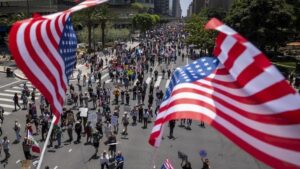
Street actions greeted the April agreement on the Canal between the Mulino government and the Trump administration. Protesters were reacting also to the prospect of an increased U.S. military presence throughout Panama and, specifically, to the prospect of U.S. troops returning to their old bases.
Writing for Deutscher Welle on June 4, reporter Sandra Weiss paints a picture of “the biggest protests in Panama in 30 years”:
“Battles with people wounded, entire provinces blockaded and economic losses in the millions: Panama seems these days like a country at war. On the one hand, there is the government, discredited but supported by the security forces; on the other hand, trade unionists, environmentalists, students, women, teachers and indigenous people are in the streets, fed up with a political-business class seen as corrupt and inept.”
Analyst José Eugenio Stoute, quoted by Weiss, claims that, “The government has lost control of two provinces, Bocas del Toro, controlled by the strikers, and Darien, controlled by the indigenous. And in the capital, there are marches every 24 hours”.
Introducing a petition, the International Trade Union Confederation declares that the Panamanian construction workers’ union SUNTRACS “is facing an unprecedented attack on the right to organize, represent its members, and engage in collective action … SUNTRACS has been on strike alongside teachers and banana workers, defending pensions, the environment, and conditions for workers. … The union’s general secretary … Saúl Méndez, was forced to seek political asylum at the Bolivian Embassy in Panama.”
Saúl Méndez told a reporter that, “What we have here is a setback to national sovereignty … What the Panamanian government has done is an act of treason. They are traitors and must be tried.” He was responding to the “Memorandum of Understanding” that U.S. Defense Secretary Pete Hegseth had signed in April.
[W.T. Whitney Jr. is a retired pediatrician and political journalist living in Maine. Courtesy: CounterPunch, an online magazine based in the United States that covers politics in a manner its editors describe as “muckraking with a radical attitude”. It is edited by Jeffrey St. Clair and Joshua Frank.]
❈ ❈ ❈
Panama’s National Strike, State Repression and US Imperial Interests: An Interview with Union Leader José Cambra
Ben Radford
Large sections of Panama’s working class have been mobilising since April in nationwide strikes and protests against the José Raúl Mulino government. Teachers were the first to walk off and have maintained an indefinite national strike for more than 11 weeks.
José Cambra is an executive committee member of the Panama Teachers’ Association (ASOPROF), which has played a leading role in the strikes. In this interview with Ben Radford for LINKS International Journal of Socialist Renewal, Cambra explains the origins and dynamics of the ongoing national strike, the Mulino government’s heavy-handed response and the need for international solidarity with Panamanian workers.
● ●
Ben Radford: What sparked the most recent national strike?
José Cambra: On May 5, 2024, a government was elected in Panama which, unbeknown to the population at the time, is part of the global far-right Trumpist current advancing across the planet. It is a government in the style of [United States President] Donald Trump, [Argentine President] Javier Milei, [former Brazilian President] Jair Bolsonaro [and former Colombian President] Iván Duque.
Mulino did not present himself as such in the election campaign; rather, he ran as the chosen successor of former President Ricardo Martinelli, who governed about fifteen years earlier during a time of economic boom and high employment.
Martinelli faced strong resistance over attempts to open a copper mine on Indigenous territory in the Ngäbe-Buglé comarca [a legally recognised semi-autonomous Indigenous region], located in Chiriquí on the Costa Rica border. He was also challenged by banana workers in Bocas del Toro [province] when he tried to take away their right to unionise, and by residents of Colón when he attempted to evict them from the city centre.
These three episodes between 2010-13 led to the electoral defeat of Martinelli’s political project in the 2014 elections. Despite that, what lingered in public memory was that there had been jobs under Martinelli, because the two subsequent neoliberal governments failed to create any; on the contrary, unemployment rose.
Martinelli was later charged and found guilty of receiving bribes in the Odebrecht corruption scandal, which is why he could not run for president in 2024. So, he handpicked a successor: Mulino. He handed over his political capital and votes to Mulino, who won with 880,000 votes, beating the next candidate, who received 550,000. In reality, he only received 34% of the votes cast — equivalent to just 27% of the population. In other words, more than 70% of Panamanians did not vote for him.
During the presidential campaign, Mulino never outlined his position on major issues, avoided all debates and simply repeated that he would give “chen chen” — a very Panamanian term meaning he would put money in people’s pockets, that is, create jobs. He appealed to the memory of prosperity during Martinelli’s time to secure votes.
However, once in office, he laid out three main objectives. First, to deal with a longstanding issue in the social security system. Four previous neoliberal governments had blocked new contributors from entering the solidarity-based pension scheme going as far back as 2008, effectively setting the system on a path of programmed obsolescence.
Now, Mulino has introduced a law that privatises pension funds, eliminates the solidarity system and replaces it with individual accounts. Worse still, pensions will be slashed in half. Currently, retirees receive 60% of their salary; from now on, it will only be 30%. So, someone earning US$1000 a month would retire with just $300 — well below the poverty line. Moreover, Mulino has promised the oligarchy that he will hand over $9 billion from social security reserves so they can invest it — including in US debt bonds.
Forty-eight MPs voted in favour of this disastrous law; 23 voted against it. Ten of those 23 are from a new bloc of independent MPs who ran on anti-corruption platforms, chose to side with us and even presented our alternative proposals. The others aligned themselves with the system, just like the rest of the traditional parties.
Mulino’s second objective was to reopen the [First Quantum Minerals’ Cobre Panama] copper mine — a project that was defeated in 2023 following a major civilian uprising. Panama, a country of 4.2 million people, saw marches in the capital involving about a quarter of a million youth, residents and middle-class sectors who opposed the mine.
Although the mine existed for decades, Panama’s Supreme Court consistently ruled against it. In 2023, a new law attempted to legalise the mine’s operations, sparking mass protests — just before the end of President [Laurentino] Cortizo’s term and the 2024 elections. Mulino remained silent on the mine during his campaign, but once in office declared he would reopen it.
This is a mine from which 48% of [FQM’] global profits come from, yet Panama has never received a single dollar in return. The company is backed by an international alliance of Canadian, US, Korean and Chinese capital.
But what truly ignited the fire was an agreement between Trump’s administration and Mulino’s government to bring back three US military bases in Panama. This violates the historic treaty signed in 1977 between General [Omar] Torrijos and President [James] Carter, which stipulated that for 23 years there would be no US soldiers in Panama, and that the Panama Canal would return under Panamanian control.
For 25 years, Panama’s oligarchy has run the canal for its own benefit, sharing little with the people. So, when it came out that Mulino had agreed to reopen three US military bases and that there were already 1000 US troops in Panama, this was the final straw — a betrayal of everything Panamanians had fought for throughout the 20th century.
Ben Radford: How did workers respond?
José Cambra: Teachers began an indefinite strike on April 23. Five days later, construction workers joined with their own indefinite strike. Their union [SUNTRACS] has been under attack since 2023, when the previous government froze their bank accounts, which hold workers’ contributions. This government has declared it will never return that money.
There is now an all-out assault on trade union freedom and the right to strike. Teachers are being dismissed, despite Article 69 of Panama’s constitution guaranteeing the right to strike. No capitalist government has wanted to abide by it, but, historically, teachers have gone on strike under this constitutional protection. This is the first government to begin dismissing us for “abandoning our posts”. Striking teachers have gone four pay periods without salaries — their wages have been withheld. They have been placed on permanent unpaid leave and served dismissal notices accompanied by police officers.
From day one, the government has repressed us with riot police, tear gas and rubber bullets. Not a single protest has gone by without repression. The government has moved from persuasion to outright violence, but daily mobilisations persist across the nation. This is an extreme mano dura [iron fist] government.
It has imprisoned people and targeted the [SUNTRACS] leadership with false charges. The comrade who led that union, Saúl Méndez, had to seek refuge in the Bolivian embassy, because they were planning to imprison him with common criminals to have him killed — plain and simple.
In Bocas del Toro, a military siege began [in late June]. Even though the army is officially banned in Panama, there is a militarised police force: the border guards. They, along with riot police, have carried out attacks. There have been clashes, people have been killed, some disappeared, others tortured. The state of emergency in Bocas del Toro was lifted [on June 30], but the roadblocks continue. The struggle continues. They have not been defeated — but the repression is savage.
They have paraded prisoners around, flown them across the country in planes wearing nothing but underwear — Bukele-style [in reference to El Salvador’s far-right president Nayib Bukele]. We are now hearing more details from the lawyers supporting them. Tear gas was fired into Indigenous communities’ homes. The same has happened to women teachers across the country.
Unlike in 2023, when the country was practically shut down for two months, there has not yet been a full-scale social explosion with nationwide roadblocks. From October to November that year, the country was completely shut down. Indigenous communities shut down the Ngäbe-Buglé comarca in the eastern Chiriquí region. Bocas del Toro was shut down. Communities all along the Pan-American Highway blocked roads.
This time, there have been sporadic roadblocks here and there, but police have cracked down hard. The level of repression is far beyond what we saw in 2023.
Ben Radford: In the face of this repression, how have you managed to maintain momentum?
José Cambra: All this is part of a broader wave of mobilisation that began in 2019, when the previous neoliberal government was elected. It came into office in May, and by September/October, there was a mass mobilisation of thousands of young women against proposed constitutional reforms and attempts to slash the public university education budget.
The pandemic interrupted that movement, but when we emerged from it, in 2022, there was another month-long teachers’ strike, with protests and roadblocks across the country. In 2023, the movement grew even stronger, with mass marches, particularly led by youth. So, we are part of a broader upsurge in popular struggle — and that is exactly what the oligarchy and the government want to crush.
But people are holding firm, because they have collective memory. Across the country, people are joining the teachers’ protests. The majority of the population supports the strike. What is helping keep the movement alive is the tradition of struggle. There is a social vanguard: the construction workers’ union in the labour sphere, and us teachers — that is precisely what [the government and oligarchy] want to destroy.
They are willing to sack 7000–10,000 teachers — the radical core of the 60,000 teachers in the country. When the strike began, probably 50% of us were taking part. In the following week, participation grew. In many areas, it was parents who kept the strike going; they met and held massive assemblies, agreeing not to send their children to school. For a time, they did not send them. But when the trimester ended, students began to return because, unfortunately, there were some teachers who stayed in class, some under threat, others as scabs.
Something important to note is that in Panama, those who retire have the right to keep working, due to a court ruling recognising that pensions are so low that people have to continue working to survive. In education, of the 60,000 teachers, probably 15,000 are over retirement age and drawing a pension.
If they lose their current salary — which they won thanks to previous strikes — they will fall below the poverty line. So, they stay and die working. But they are afraid. Some of them are still out on the streets, but others have backed off, especially because the education minister — who returned under this government — is threatening to sack them.
Ben Radford: Does the current government maintain any support?
José Cambra: This strike has completely alienated civil society from the government. Among working-class communities, informal workers, Indigenous peoples, poor women, teachers, professionals, there is deep anger at the government. The latest poll shows that 86% of the population is openly opposed to the government — only 5% still support it. No government has reached such a level of rejection.
We are not calling it a fascist government, because fascist regimes such as [Adolf] Hitler in Germany or [Benito] Mussolini in Italy, have a social base of support. This is a dictatorship — a dictatorship backed by the economic oligarchy.
There are even sectors of the bourgeoisie who are now worried and looking for a way out that will not lead to a social explosion. We face a catastrophic stalemate.
Some MPs who voted for the pension law are afraid because strike workers have gone to their homes, something that in Argentina they call an escrache. These lawmakers can clearly see they are politically finished, barely a year into the government’s term.
So, some are now trying to backtrack — not to repeal the law entirely, but to modify a few articles. There are six key articles that, if you remove those, the law falls apart. We are working to bring in other social forces to pressure for changes to the law. If that happens, we would be ready to lift the indefinite strike because, right now, only teachers are still on strike.
Construction workers lost their ability to keep striking. In the past, they would walk off sites and shut down the whole country. This time they could not, because the police entered worksites; if a worker did not comply, they were forced to work or were arrested. Many construction workers chose to stay home to avoid arrest or forced labour — this reduced their capacity to mobilise.
They have gone back to work but daily protests continue. They are not on indefinite strike, which is hard to sustain, especially since their union has no money after the government froze their funds. They cannot even support their own members.
We are in the same boat. We have exhausted our resources and are now collecting food and money from the public to support the most vulnerable. The [International Labour Organisation]’s denunciations have been very important. But we must maintain pressure to get the Supreme Court to rule in favour of our legal challenges and convince the National Assembly to act. There is no negotiation with the executive. The president has said he will not negotiate. But he is not the only power in this country. There are other powers, and that is where we are applying pressure.
As teachers’ unions — grouped in the Teachers’ Action Front, which brings together the largest and most militant unions, along with smaller but highly committed ones — we launched a public campaign back in March [last year] warning people that Mulino was the greatest danger, that he was the real threat.
We supported and helped gather 167,000 signatures for a progressive, anti-oligarchy female candidate. But the key issue for us was stopping Mulino from winning, because he posed the gravest threat — as has now been proven. His is a Milei-style project: a “shock doctrine” operation to reorganise society and crush the social movements that have defended us in the streets.
Ben Radford: Could you expand on the role US imperialism is playing in Panama?
José Cambra: Trump, on the very day he took office, announced he would take back the Panama Canal. He sent both his secretary of state [Marco Rubio] and defence secretary [Pete Hegseth] to Panama.
Panama’s security minister [Frank Abrego] — the same man responsible for the repression — signed a memorandum of understanding with Hegseth to re-establish three US military bases. The agreement uses the US names for these bases — Rothman Air Base, Sherman Base, and Howard Air and Naval Base — and does not even mention their Panamanian names. The Spanish and English versions make no mention of the US recognising Panama’s sovereignty.
Panama’s constitution explicitly states that any matter related to the canal or its adjacent areas must go through the National Assembly and, if approved there, must then be subjected to a nationwide referendum. The government refuses to do this, claiming it is merely a “memorandum”.
The fact is, Panama and the US have signed two treaties, known as the Torrijos-Carter Treaties. One of them has now expired — it ended on December 31, 1999 — and through it, the canal and all surrounding lands and buildings were returned to Panama.
What remains in force is the Permanent Neutrality Treaty, which, in Article 5, states that after December 31, 1999, only Panama may have military bases or forces on its territory. In other words, it prohibits foreign military forces — yet the US has now managed to re-establish three military bases through a memorandum.
Mulino openly repeats the colonial mindset of the Monroe Doctrine. Early in his term, he declared that the US’ southern border lies in the Darién Gap, in Panamanian territory. He has cooperated with deportation flights — planes carrying migrants deported from the US now land in Panama, from where migrants are sent back to their home countries. In this way, he is serving US interests against our Latin American brothers and sisters.
The US is also behind the push to reopen the copper mine. But it will not end there. Trump is insatiable. Once he gets one thing, he moves on to the next. It would not surprise us in the slightest to see Trump send troops to take over operations of the Panama Canal.
This current struggle is the greatest threat to those imperial ambitions.
Ben Radford: Are there concrete links between Panama’s government and far-right governments in Latin America, such as Milei’s or Bukele’s, or are they mostly ideological connections?
José Cambra: The links are primarily ideological — Mulino admires Milei, he follows Milei’s lead. Mulino is not part of the far-right international network that recently met in Madrid under the coordination of [Isabel Díaz] Ayuso, but, ideologically, he is.
What we are seeing is an attempt to present himself to the oligarchy as the strongman who can defend their interests with an iron fist. That is why this is going to be a government in constant crisis. Because there is a deep, entrenched distrust among the people towards the political class and the oligarchy. There is a widespread class consciousness that this government rules for the rich.
By the way, in Panama people rarely talk in terms of left and right. People speak more about those at the top and those at the bottom. When the government accused us teachers of being Communists, nobody cared. They use that old smear, which in other times might have stuck, but the government is so discredited that the accusation meant nothing.
Sadly, when it came to the election, people were guided by their urgent need for work and voted for Mulino. What we have not yet managed to do is direct this strong political class consciousness towards a real political alternative. We, as teachers — who have been at the forefront of the social movement — believe we should help build a teachers’ party that can link up with other popular forces and offer a genuine electoral alternative for 2029.
It is worth mentioning that Mulino has committed the only crime that allows the National Assembly to put him on trial and remove him from office: by signing that agreement with the US, he has violated the Treaty of Neutrality and violated the Constitution in the service of a foreign power, which is grounds for impeachment.
Four social movement leaders have signed a formal petition for impeachment, but that petition is collecting dust in the assembly. They will not touch it — because if they did, they would have to remove the president, and they do not have the political strength to do that.
Ben Radford: How can people in other countries support the struggle?
José Cambra: It is a very difficult situation, and international solidarity has been essential. On June 9, an action was organised by the World Congress Against Neoliberalism in Education. Visits were made to Panamanian embassies and consulates across Latin America and Europe. This gives heart to those on the frontline.
There is also the example of the CNTE, the National Coordinator of Education Workers in Mexico — not the SNTE [National Educational Workers Union], which is a bureaucratic union. From places such as Chiapas, Oaxaca and others, they called a strike to demand that a promise made by AMLO’s [Andrés Manuel López Obrador] previous government be fulfilled: to roll back a neoliberal reform that privatised workers’ pensions. They launched a movement to demand new President Claudia Sheinbaum keep that promise, because, unlike AMLO, she has a parliamentary majority.
The CNTE mobilised an estimated 20,000 teachers and professors, who camped out in Zócalo [the main square in Mexico City]. In the middle of that encampment, the comrades from the World Congress Against Neoliberalism in Education, who were meeting in Mexico, held a solidarity rally with the 100 general secretaries of the CNTE present. They gave their full solidarity to the CNTE struggle and the struggle in Panama.
What we are asking for is this: wherever there are struggles, explain what is happening in Panama. Talk about the ways we have fought, because what is happening here has already happened, or will happen, in other Latin American countries. These vultures want to pocket the pension funds that we, the workers of Latin America, have paid into with our own labour. We must stop them and reverse what has already been done, in countries such as Chile and Mexico, where it has already happened, and in Panama, where they are doing it now.
This must become an international movement — a movement to reclaim our pensions. The World Congress Against Neoliberalism in Education held a virtual forum on July 2 with people from many countries discussing the pension crisis in Latin America and how we are being attacked by the oligarchies.
We believe these kinds of solidarity actions are needed — just as we stand in solidarity with teachers, workers, women, the poor and the marginalised around the world.
[Courtesy: Links – International Journal for Socialist Renewal, a journal that seeks to be a forum for open and constructive dialogue between active socialists from different political traditions.]