❈ ❈ ❈
Persecuted in the Land of the Pure: The Ahmadiyya Community’s Struggle in Pakistan
Introduction
In the Islamic Republic of Pakistan, a nation founded on the promise of religious freedom and protection for minorities, one community has persistently borne the brunt of systemic persecution: the Ahmadis. Officially declared non-Muslims in 1974 and further ostracized by harsh constitutional and legal amendments, the Ahmadiyya community has been subjected to decades of social exclusion, legal discrimination, mob violence, and state-sanctioned suppression. Their plight represents a grim chapter in Pakistan’s complex relationship with religious pluralism, majoritarian politics, and the politicization of faith.
Origins of the Ahmadiyya Movement
The Ahmadiyya movement was founded in 1889 by Mirza Ghulam Ahmad in Qadian (then British India, now in India’s Punjab state). Ahmadis consider Ghulam Ahmad to be the promised messiah and mahdi — a reformer within Islam — but do not believe him to be a law-bearing prophet. However, the mainstream Sunni and Shia Muslim communities view any such claim as blasphemous, maintaining that Muhammad is the final prophet. This theological dispute, though deeply doctrinal, became a flashpoint for political marginalization once Pakistan was formed.
The 1953 Lahore Riots: A Turning Point
The persecution of Ahmadis in Pakistan began not with the creation of the state in 1947, but with a growing movement among Islamist groups such as Majlis-e-Ahrar and Jamaat-e-Islami that sought to define Pakistan as an explicitly Sunni Muslim state. Tensions erupted in 1953 when widespread anti-Ahmadi riots broke out in Lahore, leading to dozens of deaths and the imposition of martial law. The government responded by establishing the Munir Commission, which famously concluded that defining a “true Muslim” was impossible without excluding others. Despite the commission’s warnings, the seeds of exclusion had been sown.
Constitutional Exclusion: The Second Amendment (1974)
The real institutional blow came in 1974 under the leadership of Prime Minister Zulfikar Ali Bhutto. Following student-led anti-Ahmadi demonstrations and pressure from Islamist parties, the Pakistani Parliament amended the Constitution to declare Ahmadis as non-Muslims. This Second Amendment was celebrated by religious hardliners and marked a turning point: a shift from social discrimination to formal legal marginalization. This constitutional amendment did not merely exclude Ahmadis from the Muslim identity — it legitimized their exclusion and emboldened further state-sponsored restrictions.
Ordinance XX and the Legal Ghettoization of Ahmadis
The military regime of General Zia-ul-Haq took anti-Ahmadi policies to new heights. In 1984, he promulgated Ordinance XX, which criminalized Ahmadi religious practices. Under this law, Ahmadis were prohibited from referring to themselves as Muslims, calling their places of worship “mosques,” using Islamic greetings (e.g., “As-salamu Alaikum”), or preaching and propagating their faith. Violations could lead to imprisonment for up to three years. Effectively, this law forced Ahmadis into a religious ghetto, where practicing their faith in any recognizable form was a crime.
Even their right to vote was segregated. Ahmadis were placed on a separate electoral roll, requiring them to renounce Mirza Ghulam Ahmad to qualify for voting as Muslims. Most refused, resulting in practical disenfranchisement.
According to the 2023 Pakistani census, Ahmadis constitute approximately 0.07% of the national population — around 162,000 individuals. However, Ahmadi sources estimate their numbers to be between 400,000 and 600,000, with some claiming as many as four million Ahmadis may reside in the country, many unregistered due to fear of persecution.
Violence, Intimidation, and Impunity
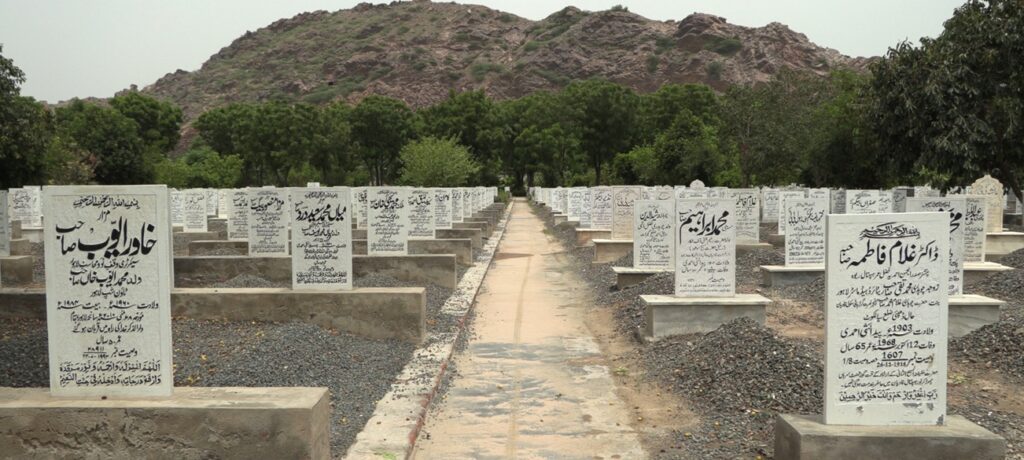
The legal discrimination paved the way for unchecked societal violence. Mosques belonging to the Ahmadiyya community have been attacked, desecrated, or forcibly seized. Cemeteries have been vandalized. Ahmadi publications are banned, and any attempt to distribute religious literature is prosecuted under anti-blasphemy laws.
Some of the most notorious incidents include the Lahore mosque attacks in May 2010, when two Ahmadi mosques in Lahore were attacked by Taliban-affiliated militants, killing 86 worshippers and injuring over 100. Targeted killings have become frequent, with over 250 Ahmadis murdered in targeted attacks since 1984, according to Ahmadi sources. Grave desecrations have become routine, with authorities destroying Ahmadi gravestones inscribed with Quranic verses, claiming such inscriptions are “exclusive” to Muslims.
Recent incidents underscore the continued vulnerability of the community. On April 18, 2025, in Karachi, an Ahmadi man named Laeeq Cheema was allegedly beaten to death by a mob of Islamists near an Ahmadi place of worship. Just a week later, on April 25, gunmen attacked members of the Ahmadi community in Bhulair, Punjab, killing Muhammad Asif and injuring another.
Perpetrators of these attacks are rarely arrested or prosecuted. When community members seek police protection, they are often met with indifference or accused of blasphemy themselves.
Social Ostracism and Economic Marginalization
Beyond legal and physical violence, Ahmadis face intense social exclusion. They are often denied admission to universities, jobs in government, and opportunities in business unless they hide or renounce their faith. Teachers have been dismissed, doctors boycotted, and businesses destroyed through coordinated campaigns of hate.
In rural Punjab and Sindh, mobs often force entire Ahmadi families to flee their homes, taking over property with tacit approval from local authorities. In cities, they are shunned from professional circles and vilified in the media. The Pakistani media, especially Urdu-language outlets, has played a troubling role by amplifying anti-Ahmadi rhetoric, labeling them as “agents of the West,” “traitors,” or even “enemies of Islam.” Religious television preachers have repeatedly issued open threats or incited violence against them with impunity.
Exile, Asylum, and Diaspora
Given the severity of the persecution, many Ahmadis have fled Pakistan in search of asylum. Countries like the United Kingdom, Canada, Germany, and the United States host thousands of Ahmadi refugees. In 2019, UNHCR categorized Pakistani Ahmadis as a “religious group at risk,” reinforcing their legitimate claim to refugee protection.
Yet, even in exile, Ahmadis face challenges. In some cases, Pakistani embassies abroad have reportedly monitored or harassed Ahmadi activists. Furthermore, Islamist groups in the diaspora have sought to export anti-Ahmadi sentiment into Western communities.
International Reactions and the Silence of the Pakistani State
Human rights organizations such as Amnesty International, Human Rights Watch, and the U.S. Commission on International Religious Freedom (USCIRF) have consistently highlighted the persecution of Ahmadis as a violation of basic human rights and religious freedom. The European Union has also raised concerns about Pakistan’s treatment of Ahmadis, sometimes linking it to trade and aid negotiations.
However, the Pakistani state has largely ignored such criticism. Politicians across the spectrum, including secular parties, are reluctant to defend Ahmadis for fear of backlash. Even in cases of outright violence, official statements are rare, and sympathy is muted. The state’s policy has, at best, been one of studied silence — and at worst, complicity.
The Blasphemy Law Nexus
Pakistan’s blasphemy laws — especially Section 295-C of the Pakistan Penal Code — disproportionately affect Ahmadis. Accusations of blasphemy are often leveled with little evidence and are used as a tool of personal vengeance or communal harassment. Dozens of Ahmadis have been charged or imprisoned under these laws, and even those acquitted by courts often remain in hiding or are forced to flee the country. In a society where blasphemy accusations can lead to lynchings, mere suspicion of being an Ahmadi is enough to endanger one’s life.
A Bleak Future?
The future for Ahmadis in Pakistan appears uncertain. There is no political will to revisit the Second Amendment or Ordinance XX. On the contrary, public sentiment remains largely hostile, and any political figure attempting to speak out risks their career — or life. The case of Punjab Governor Salman Taseer, who was assassinated in 2011 for defending a Christian woman accused of blasphemy, has cast a long shadow.
At present, there is no major political party advocating for Ahmadi rights. The military remains indifferent, and the judiciary has often sided with hardliners. Civil society, while occasionally vocal, is largely silenced by fear.
The persecution of Ahmadis in Pakistan is not just a minority rights issue — it is a litmus test for the country’s commitment to human dignity, religious freedom, and constitutional justice. It reflects a society where faith has been weaponized, where the boundaries of citizenship are policed by theocrats, and where silence equals survival. Until Pakistan reckons with its own laws and the narratives that support them, the Ahmadiyya community will continue to live as second-class citizens — punished not for crimes, but for belief.
(Ashish Singh has finished his Ph.D. coursework in political science from the NRU-HSE, Moscow, Russia. He has previously studied at Oslo Metropolitan University, Norway; and TISS, Mumbai. Courtesy: Countercurrents.org, an India-based news, views and analysis website, that describes itself as non-partisan and taking “the Side of the People!” It is edited by Binu Mathew.)
❈ ❈ ❈
Demands of Secession within Pakistan: A History of Fractured Nationhood
From its inception in 1947, Pakistan has grappled with the contradictions of building a unified nation-state from deeply diverse parts. While religion was positioned as the glue that could hold the new polity together, this assumption masked profound ethnic, linguistic, and regional differences. The promise of federalism was quickly replaced by a centralized, often authoritarian structure dominated by military and bureaucratic elites — mostly from Punjab. This centralization, justified through the language of national security and Islamic unity, steadily alienated Pakistan’s peripheries.
What followed was not just political unrest but a recurring cycle of rebellion, repression, and resentment. These movements did not emerge in a vacuum; they were deeply rooted in empirical realities — broken political agreements, unfulfilled promises of autonomy, economic extraction, and violent suppression. The demands for secession that have punctuated Pakistan’s history are best understood as a consequence of the state’s persistent failure to build inclusive institutions.
East Pakistan: A Majority Treated as a Colony
East Pakistan (now Bangladesh) was home to the majority of Pakistan’s population at independence. Yet this demographic fact did not translate into political power. The first major fracture appeared in 1948 when Muhammad Ali Jinnah insisted on making Urdu — spoken by a minority — the sole national language. The Bengali Language Movement (Bhasha Andolon), which began in earnest in 1952, saw students killed by police during protests in Dhaka. This was not merely a cultural grievance; it was a harbinger of deeper political disenfranchisement.
In 1970, the Awami League, led by Sheikh Mujibur Rahman, won 160 out of 162 seats in East Pakistan — a clear majority in the 313-member National Assembly. However, the West Pakistani leadership, dominated by Zulfikar Ali Bhutto and General Yahya Khan, refused to hand over power. The state responded with Operation Searchlight in March 1971, unleashing mass violence, including rape, massacres, and the displacement of approximately 10 million refugees into India.
According to declassified Indian and U.S. intelligence reports, the death toll ranged from 300,000 to over 1 million. The war ended in Pakistan’s defeat and the creation of Bangladesh in December 1971. This was not secession in the conventional sense; it was the result of a majoritarian region breaking free from a state that had refused to accept its electoral verdict. The very foundation of Pakistan’s ideological unity — religion — crumbled under the weight of political suppression and military violence.
Balochistan: Insurgency as Response to Extraction
Balochistan was incorporated into Pakistan in 1948 through a controversial and contested annexation of the Khanate of Kalat. Despite multiple accords promising autonomy, including the 1948 agreement and the 1973 Constitution, the central government repeatedly failed to honor these commitments.
There have been five Baloch insurgencies since 1948 — in 1948, 1958, 1963-69, 1973-77, and the ongoing uprising since 2004. The military’s response has consistently involved large-scale operations, enforced disappearances, and extrajudicial killings. According to the Human Rights Commission of Pakistan (HRCP), over 2,000 Baloch individuals have gone missing in the past two decades alone.
Economic marginalization has fueled the rebellion. Balochistan accounts for 43% of Pakistan’s natural gas production but receives less than 10% of national energy revenues. Projects like the Saindak copper-gold mine and the China-Pakistan Economic Corridor (CPEC) have further intensified grievances. While touted as development projects, these ventures are seen locally as extractive enterprises with little benefit to the native population. The state’s repeated militarization of dissent — rather than dialogue or inclusion — has pushed even moderate voices toward separatist narratives.
Sindh and the Mohajir Question: Urban Discontent Weaponized
Sindh’s experience with the Pakistani state has been shaped by two parallel trends: the marginalization of ethnic Sindhis and the political manipulation of Mohajir grievances. After Partition, millions of Urdu-speaking migrants from India (Mohajirs) settled in Karachi and Hyderabad, becoming a new urban elite. While initially favored by the state for their bureaucratic skills and loyalty, tensions grew as indigenous Sindhis demanded greater representation.
The language riots of 1972, sparked by the Sindh Assembly’s bill making Sindhi the official language of the province, exposed deep fractures. The rise of the Muttahida Qaumi Movement (MQM) in the 1980s was a direct response to the declining power of Mohajirs and their exclusion from provincial politics. MQM quickly became a powerful force in Karachi, but the state’s response — Operation Clean-up in 1992 and later paramilitary crackdowns — relied on extrajudicial killings, enforced disappearances, and ghettoization.
In 2016, HRCP reported over 1,000 MQM workers killed in security operations since 1992. Simultaneously, Sindhi nationalist movements like Jeay Sindh continue to call for “Sindhudesh,” citing economic deprivation and cultural erasure. Though lacking a militant wing, these movements are consistently harassed, with leaders like Shafi Burfat forced into exile. The state’s refusal to negotiate with legitimate provincial actors has ensured that demands for autonomy are viewed through the prism of sedition.
Pashtun Regions: From Buffer Zones to Battlegrounds
Pashtun regions have been treated less as constituents of a nation-state and more as geopolitical tools. During the Soviet-Afghan War (1979–1989), Pakistan’s military regime turned the tribal areas into recruitment grounds for jihad. Post-2001, these same areas became targets of drone strikes, military operations, and counterterror campaigns.
The Federally Administered Tribal Areas (FATA), merged into Khyber Pakhtunkhwa in 2018, remained under colonial-era laws like the Frontier Crimes Regulation (FCR) until recently. These areas had no representation in regular courts and were ruled through collective punishment doctrines. According to UNDP data, FATA had Pakistan’s lowest human development indicators before the merger.
The emergence of the Pashtun Tahafuz Movement (PTM) in 2018 brought to light systemic abuses: disappearances, minefield injuries, and harassment by the military. Leaders like Manzoor Pashteen have repeatedly called for constitutional rights and an end to the militarization of civilian spaces. While the PTM does not advocate secession, the state’s labeling of its peaceful demands as “anti-national” reveals a deep paranoia about its own peripheries.
Gilgit-Baltistan and Kashmir: Citizens Without a State
Gilgit-Baltistan (GB) and Pakistan-administered Kashmir are territories without constitutional status. While claimed as integral parts of Pakistan, they lack representation in the National Assembly and Senate. GB, despite being the site of massive infrastructure investment under CPEC, remains governed by presidential orders rather than a provincial constitution.
In 2020, the Imran Khan government proposed giving GB provisional provincial status — a move quickly opposed by nationalist groups who saw it as symbolic rather than structural. The people of GB have demanded full citizenship rights, including judicial access and political representation, but have been denied under the guise of the Kashmir dispute.
Security forces have cracked down on activists like Baba Jan, who was sentenced to life imprisonment for leading protests after a deadly landslide in 2010. The state’s strategic interests have consistently trumped human rights or democratic inclusion, turning these regions into administrative colonies governed by Islamabad’s directives, not their own representatives.
Punjab: The Power Core of the Federation
Punjab, home to more than 50% of Pakistan’s population, dominates the armed forces, civil service, and economic policymaking. According to the Pakistan Bureau of Statistics, over 70% of senior military officers hail from Punjab. Despite being the beneficiary of disproportionate state resources, Punjab is rarely the subject of scrutiny in national discourse.
This imbalance has created a federation where peripheries are governed by a core that claims national identity as its own. When dissent erupts — whether in Balochistan, Sindh, or the tribal areas — it is often dismissed as “foreign-backed” rather than introspected as a failure of governance. The state’s unwillingness to confront this internal asymmetry turns federalism into a fiction.
A Nation in Permanent Crisis
Secessionist demands in Pakistan are not random eruptions — they are patterned outcomes of structural exclusion. When a state consistently refuses to listen, governs through fear, and treats its own citizens as threats, rebellion becomes a rational response. These movements have varied in ideology, scope, and tactics, but they share a common origin: the state’s refusal to accommodate pluralism.
Unless Pakistan reimagines itself as a truly federal, inclusive polity — with equity in representation, rights, and resources — the cycle of discontent will endure. The fracture lines are not hypothetical. They are real, and unless addressed, they threaten to redraw the very map that once promised unity through faith alone.
(Ashish Singh has finished his Ph.D. coursework in political science from the NRU-HSE, Moscow, Russia. He has previously studied at Oslo Metropolitan University, Norway; and TISS, Mumbai. Courtesy: Countercurrents.org, an India-based news, views and analysis website, that describes itself as non-partisan and taking “the Side of the People!” It is edited by Binu Mathew.)