❈ ❈ ❈
‘Top 1% Own 43.8%’: Oxfam’s Is the Latest of Global Reports That Link Inequality to Political Power Asymmetry
Jahnavi Sen
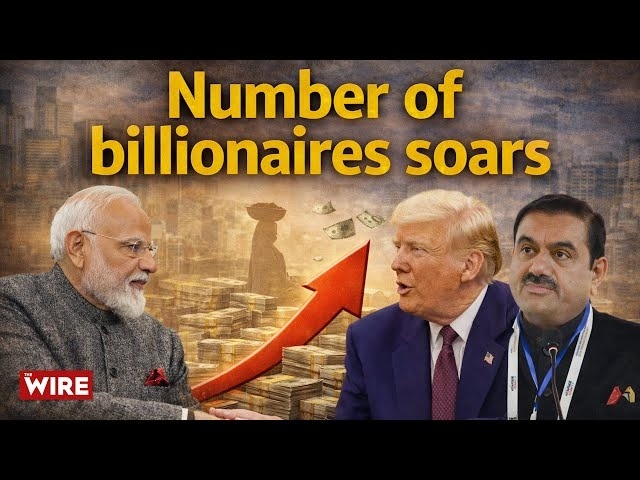
The level of billionaire wealth today is the highest it’s ever been. For the first time, the number of billionaires in the world has crossed 3,000.
One in four people across the world face hunger and food insecurity.
On average, a person in the richest 1% owns 8,251 times more wealth than someone in the bottom 50%, and the poorest half of humanity holds just 0.52% of the world’s wealth. The richest 1% own close to half, or 43.8%.
That all of these facts are true, the new Oxfam report titled ‘Resisting the Rule of the Rich: Defending Freedom Against Billionaire Power’ released in Davos points out, is not an accident – it is by design, as governments across the world choose to defend wealth over rights and freedoms. Not only has billionaire wealth grown, so has their political power – a fact most easily summarised when one notes that “Billionaire fortunes have grown at a rate three times faster than the average annual rate in the previous five years since the election of Donald Trump in November 2024.”
Meanwhile, poverty reduction has stalled as well: “The reduction in poverty has largely ground to a halt, with poverty rising again in Africa. In 2022, nearly half of the world population (48%), or 3.83 billion people, lived in poverty,” the report notes.
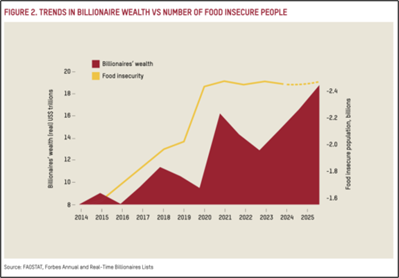
Source: Oxfam report.
The rise in authoritarianism globally, the Oxfam report notes, is tied directly to deepening income inequality. As the rich are getting richer, they’re also getting more politically powerful: “Data from 136 countries confirms that as economic resources become more unequally distributed, so too does political power. This leads to policy outcomes that reflect the preferences of upper-income groups more than those of lower-income groups.”
“The super-rich have built their political power in three main ways: by buying politics, investing in legitimizing elite power, and directly accessing institutions,” the report continues. This concentration of political power means that economic inequality is breeding political inequality, as elite classes further systems that benefit their own interests. And when people have come together to speak out against these systems, governments have reacted with suppression and repression – cracking down on any voices seen to undermine or question their authority.
Another way in which the economic and political elite have worked to retain control is by diverting public anger – from millionaires to migrants, as the report puts it. “While the majority see through the lies and many fight back, the sad truth is that these dirty tactics serve as a distraction from the real cause of hardship for the many – extreme levels of
inequality,” the report notes.
Growing recognition of the inequality problem
That income and wealth inequality is at an all-time high has become more widely accepted and talked about of late. While the Oxfam report focuses on how economic inequality fuels political inequality, and the dangers of that, other research has also pointed out how current global systems are reinforcing gender inequality, forcing the most marginalised to bear the brunt of climate change, and deepening regional divides
Under South Africa’s G20 presidency, for instance, an Extraordinary Committee of Inequality Experts headed by Nobel Prize-winning economist Joseph Stiglitz was formed to study global wealth inequality. The committee’s report stated that inequality has reached “emergency” levels and posed a threat to democracy, economic stability and climate progress. The committee has recommended setting up an ‘Independent Panel on Inequality’, a body similar to the Intergovernmental Panel on Climate Change.
The World Inequality Report 2026, published by the World Inequality Lab based in Paris, also brought out some alarming facts: The top 10% of the world’s income earners earn more than the other 90% combined. Additionally, less than 60,000 people in the world control three times more wealth than the combined wealth of half of the world’s population.
Within India too, this is an increasingly recognised issue. The World Inequality Report named India as one of the most unequal countries in the world; Oxfam too has seconded that. This statement would have come as a surprise for those who had taken the Press Information Bureau seriously when it said, in July 2025, that India is the fourth most equal country in the world. As economist Surbhi Kesar pointed out then, this claim was based on a grave misinterpretation of a World Bank brief. Economist Dipa Sinha also showed how tracking food consumption reveals the extent of India’s inequality: to put it briefly, it’s very high.
What next?
All of these studies and reports have an important thing in common: the recognition that not only does inequality exist and persist, it is a political choice. That means that people and governments across the world must stop accepting (or even exacerbating) the current situation, and instead take active steps to change systems that breed inequality. This means taking active measures to reduce economic inequality, Oxfam points out, and says that “All countries should put in place realistic and time-bound National Inequality Reduction Plans to reduce inequality, with regular monitoring of progress.”
A common thread running through several reports on this issue – including the Oxfam report, the World Inequality Report and the report of the Extraordinary Committee of Inequality Experts – have stated that there is one relatively simple and quick way to work towards a more equitable future: changing taxation systems. By taxing the super-rich a small fraction of their wealth and income, governments can raise money to invest in health, education, sustainable energy and other public goods. “Even a moderate 3% global tax on fewer than 100,000 centi-millionaires and billionaires — a group small enough to fit inside a single stadium — would raise over $750 billion per year, an amount comparable to the total education budgets of low- and middle-income countries,” the World Inequality Report had noted, for instance.
Perhaps surprisingly, support for this cause has also come from some of those who would be facing this tax. Nearly 400 millionaires and billionaires from 24 countries across the world have called on global leaders to tax the super-rich in a way that helps reduce the gap between them and the rest of the world.
“When even millionaires, like us, recognise that extreme wealth has cost everyone else everything else, there can be no doubt that society is dangerously teetering off the edge of a precipice. We are worn out watching this happen. We want our democracies back. We want our communities back. We want our future back,” the signatories including actor Mark Ruffalo, producer Abigail Disney and musician Brian Eno have said. “…We can win back power from those who capture it; win back our democracies from those who abuse them; reclaim health, education, and safe homes from those who have bottomed out our infrastructure and public services. We can win back our shared wealth.”
Recognition of the problem exists; so do possible solutions. Whatever happens next, nobody could say ignorance was responsible for the lack of action.
[Jahnavi Sen is Deputy Editor and Executive News Producer at The Wire. Courtesy: The Wire, an Indian nonprofit news and opinion website. It was founded in 2015 by Siddharth Varadarajan, Sidharth Bhatia and M. K. Venu.]
❈ ❈ ❈
‘Tax Us. Tax the Super Rich,’ Say Nearly 400 Millionaires and Billionaires
The Wire Staff
Nearly 400 millionaires and billionaires from 24 countries across the world have called on global leaders to tax the super-rich in a way that helps reduce the gap between them and the rest of the world.
The letter titled ‘We must win back our future. Leaders at Davos, tax the super rich,’ is signed by the likes of actor Mark Ruffalo, producer Abigail Disney and musician Brian Eno.
The letter comes as the World Economic Forum is underway at Davos in Switzerland.
It is a part of Time to Win, a campaign by the Patriotic Millionaires, Patriotic Millionaires Canada, Patriotic Millionaires UK, Millionaires for Humanity, and Oxfam.
The full text of the letter is below.
● ● ●
We Must Win Back Our Future. Leaders at Davos, Tax the Super Rich
Fifty-five years ago, when the World Economic Forum first met, humanity stood at the dawn of remarkable progress. In the last fifty years, we have taken giant leaps in technology, medicine, communication, and global trade to create huge potential opportunities for humankind.
Today, we are more connected than ever—but at the same time, we have never been more divided. Decades of innovation have gone hand in hand with decades of inequality, environmental destruction, and wasted opportunity. The richest 1% now own more than 95% of the world’s population put together.
The gap between the super rich and everyone else grows larger every day, stretching across neighbourhoods, nations, and, perhaps most of all, generations. A handful of global oligarchs with extreme wealth have bought up our democracies; taken over our governments; gagged the freedom of our media; placed a stranglehold on technology and innovation; deepened poverty and social exclusion; and accelerated the breakdown of our planet. What we treasure, rich and poor alike, is being eaten away by those intent on growing the gulf between their vast power and everyone else.
We all know this. When even millionaires, like us, recognise that extreme wealth has cost everyone else everything else, there can be no doubt that society is dangerously teetering off the edge of a precipice.
We are worn out watching this happen. We want our democracies back. We want our communities back. We want our future back.
In 2026, we must do more than hope for a future we want. We must win it.
You already have a simple and effective solution, supported by millionaires and the public alike. Stop squandering the time we have—tax the super rich.
As millionaires who stand shoulder to shoulder with all people, we demand it. And as our elected representatives—whether it’s those of you at Davos, local councillors, city mayors, or regional leaders—it’s your duty to deliver it. So tax us. Tax the super rich.
We can win back power from those who capture it; win back our democracies from those who abuse them; reclaim health, education, and safe homes from those who have bottomed out our infrastructure and public services. We can win back our shared wealth.
Extreme wealth has led to extreme control for those who gamble with our safe future for their obscene gains. Now is the time to end that control and win back our future.
Millionaires like us refuse to be silent. It is time to be counted. Tax us and make sure the next fifty years meet the promise of progress for everyone.
[Courtesy: The Wire, an Indian nonprofit news and opinion website. It was founded in 2015 by Siddharth Varadarajan, Sidharth Bhatia and M. K. Venu.]