❈ ❈ ❈
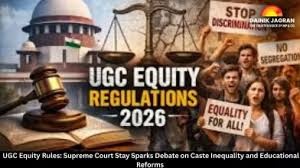
UGC Equity Rules: SC Stay Triggers Nationwide Student Outrage
Mukund Jha
In what many student organisations, social justice advocates and legal scholars are calling a “deeply regressive moment” for Indian higher education, the Supreme Court on Thursday imposed an interim stay on the University Grants Commission (Promotion of Equity in Higher Education Institutions) Regulations, 2026. The stay has triggered protests across campuses, particularly in Delhi University, and reopened fundamental questions about caste discrimination, and the judiciary’s approach to social justice.
The apex court’s intervention has effectively halted the implementation of regulations that were intended—however imperfectly—to address caste-based, gender-based, and disability-based discrimination in universities and colleges.
For critics, the episode represents a familiar pattern: symbolic gestures toward social justice followed by capitulation to the entrenched privileged sections. As one student protester put it, “This is the politics of ‘heads I win, tails I win’—rules are announced, and then quietly buried.”
What Were UGC Equity Regulations, 2026?
On January 13, 2026, the UGC notified the Promotion of Equity in Higher Education Institutions Regulations, 2026, which were deemed to have come into force from January 15. These regulations were meant to replace the 2012 UGC guidelines on preventing discrimination in higher education institutions.
The stated objective of the new regulations was to curb discrimination on the basis of: caste, religion, gender, place of birth, and disability.
The constitution of Equity Committees in universities, mechanisms for grievance redressal, and institutional responsibility to prevent discriminatory practices on campus was proposed.
Importantly, these regulations did not emerge in a vacuum. They were the outcome of years of sustained struggles by students, teachers, and families of victims of institutional discrimination—most notably following the death of research scholar Rohith Vemula at the University of Hyderabad and the death of Dr Payal Tadvi. The demand for a comprehensive Rohith Vemula Act to address caste discrimination in higher education has been central to these movements.
Ironically, even before the SC stay, many progressive scholars and student organisations had criticised the 2026 regulations as inadequate and diluted. They argued that the rules lacked enforceable punitive provisions, failed to guarantee independence of complaint committees, and excluded premier institutions, such as IITs, IIMs, and private universities from their ambit.
Yet, despite being widely viewed as weak and insufficient, the regulations provoked fierce opposition from groups identifying themselves as defenders of “merit” and “academic freedom”—a rhetoric long associated with upper-caste privilege in Indian higher education.
SC Stay: What Did the Court Say?
According to LiveLaw, a bench comprising Chief Justice of India Justice Surya Kant and Justice Joymalya Bagchi took up the matter for urgent hearing on January 29, 2026. The court imposed an interim stay on the regulations and raised a series of questions directed at the UGC and the Union government.
Among the key observations and questions recorded by LiveLaw were: Why is caste-based discrimination defined separately, when the definition of discrimination already covers multiple grounds? Are the provisions sufficiently clear, or do they risk misuse and arbitrariness? Could the regulations, if improperly implemented, deepen social divisions rather than reduce discrimination? Why was ragging not explicitly included, given that it remains a serious problem on campuses?
The SC directed the Centre and UGC to file detailed responses and asked UGC to consider redrafting the regulations. It fixed the next date of hearing for March 19, 2026. Until then, the court ordered that the 2012 UGC guidelines would continue to apply nationwide.
During the hearing, the CJI also made remarks questioning whether India’s progress toward a “casteless society” was being reversed, noting that sections of Scheduled Castes (SCs) had become economically well-off.
The Problem with ‘Castelessness’
These remarks immediately drew criticism. Student groups and social justice advocates pointed out that invoking the idea of a “casteless society” while caste-based discrimination remains structurally embedded amounts to denial of lived realities.
Critics also recalled a recent incident in which former CJI B.R. Gavai was targeted with casteist abuse, including the throwing of a shoe by a lawyer—an incident that starkly illustrated how caste prejudice persists even at the highest levels of the judiciary.
For many, the contradiction was glaring: if caste discrimination were truly receding, why would complaints of caste-based discrimination in universities rise sharply?
According to UGC data cited by student organisations, complaints of caste-based discrimination increased by 118.4% over the past five years.
Govt Silence and Selective Outrage
The SC’s stay has also exposed the selective outrage of the political establishment and large sections of the corporate media.
In recent years, minor slogans raised on campuses like Jawaharlal Nehru University (JNU) have been portrayed as existential threats to the nation, triggering police cases, television trials, and branding of students as “anti-national.” In contrast, protests against the UGC Equity Regulations witnessed slogans such as “Modi teri qabr khudegi” and defacement of images of the Prime Minister and Home Minister—yet no police action, no outrage, and no media hysteria followed.
Observers argue that the difference lies in who is protesting. When dissent comes from marginalised students demanding dignity and equality, it is criminalised. When it comes from socially dominant groups defending privilege, it is treated with remarkable tolerance.
Students Protest
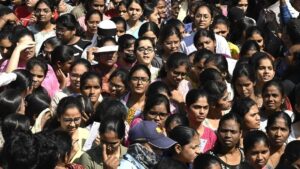
The most visible resistance to the Supreme Court’s stay came from Delhi University, where hundreds of students marched on Thursday.
Students marched from the Arts Faculty, condemning what they described as a “judicial rollback of social justice.” The protest foregrounded the alarming rise in caste-based discrimination complaints and argued that the UGC regulations, while flawed, were a necessary step in addressing entrenched institutional bias.
The students demanded:
- Immediate implementation of the UGC Equity Regulations
- Extension of the regulations to IITs, IIMs, and private universities
- Democratic selection of student representatives in Equity Committees
- Inclusion of gender minorities in grievance redressal mechanisms
The All-India Students’ Association (AISA) issued a scathing statement, describing the SC stay as “reprehensible but predictable.”
AISA highlighted what it called a “pattern of judicial deference to dominant caste interests.” The organisation pointed out that no stay was granted during hearings on: The 10% EWS reservation, The abrogation of Jammu and Kashmir’s statehood, The controversial Special Intensive Revision (SIR) of electoral rolls, Yet, in the case of the UGC Equity Regulations, a stay was imposed even before detailed hearings could begin.
“What else is this, if not a clear display of Brahmanism at work?” AISA asked, calling for a nationwide movement to enact the Rohith Act. The organisation endorsed the draft prepared by the Karnataka government as a more comprehensive framework to address institutional violence against SC, ST, and OBC students.
A Familiar Pattern: Symbolism Without Substance
For many observers, the episode fits neatly into a broader political pattern under the current regime. The government can claim that it introduced equity regulations, thereby signalling concern for social justice. Simultaneously, by failing to defend them robustly in court—and by remaining silent when they are stayed—it reassures dominant social groups that their interests remain secure.
Critics allege that the Centre did not argue forcefully in defence of the regulations before the SC, contrasting this with the aggressive legal posture adopted by the government in other politically sensitive cases.
The Larger Question
The controversy surrounding the UGC Equity Regulations is not merely a legal dispute. It is a political and social confrontation over the meaning of equality in Indian higher education.
Are anti-discrimination measures inherently divisive, or is it discrimination itself that fractures society? Are universities neutral spaces, or are they shaped by historical hierarchies of caste and power? And finally, will the judiciary act as a guarantor of substantive equality, or retreat into abstract notions of neutrality that leave structural injustice untouched?
As protests spread and student organisations mobilise, one thing is clear: the stay on the UGC Equity Regulations has not ended the debate. Instead, it has pushed it out of courtrooms and back onto the streets.
For thousands of marginalised students, the struggle is no longer just about one set of regulations—it is about the right to dignity, safety, and equal belonging in India’s universities.
(Courtesy: Newsclick, an Indian news website founded by Prabir Purkayastha in 2009, who also serves as the Editor-in-Chief.)
❈ ❈ ❈
Refusal to See Caste Discrimination, Not ‘False Complaints’, is the Real Crisis on Campus
Shainal Verma
The University Grants Commission’s updated rules to address caste discrimination in higher education institutes have sparked outrage among Savarna commentators and students. They claim that they will become victims of false complaints and that the provisions will be weaponised against them.
But this reflects a continuing refusal to listen to experiences of caste discrimination on campuses, something I have witnessed closely since 2022 when I became the first elected student representative of the Equal Opportunity Cell at the Indian Institute of Technology, Delhi.
As part of student committees and through my research on caste injustice, I have seen how the claim that Dalit, Adivasi and OBC students misuse guidelines against general category students is invoked when a caste discrimination complaint is filed. This negative framing favours the student or professor accused of casteism and rarely accounts for the humiliation or insensitive behaviour faced by the student making the complaint.
Over the past few days, Savarna students have framed themselves as potential victims of the UGC rules, issued on January 13, recentering the issue of casteist discrimination around their anxieties. On January 29, the Supreme Court stayed the new rules after hearing a public interest litigation which claimed that the guidelines were vague and could be misused.
Akhil Kang, a queer Dalit scholar who has extensively written about “upper-caste victimhood”, argues that claims of upper-caste victimhood are not about actual harm. Instead, they are about preserving moral innocence in the face of caste accountability.
Illustrating Kang’s observation, upper-caste students are floating hypothetical situations in which they could be victimised by the UGC guidelines. For example, one Instagram post claims that a general category female student is now afraid of being accused of caste discrimination if she rejects the advances of a male student from the Scheduled Caste/Scheduled Tribe category.
Such claims displace attention from the everyday experiences of discrimination of Dalit and Adivasi students, who remain unacknowledged in classrooms and are rendered invisible on campuses where merit is routinely read through caste.
Caste on campus
As part of a meeting called by the National Task Force set up by the Supreme Court on January 12, I highlighted three crucial observations based on my experience of observing casteism on campus. The meeting was attended by anti-caste intellectuals, academics, activists and student representatives from universities in Delhi.
First, caste is seemingly invisible and so it is difficult to prove that it exists. But the discriminatory effects of caste are primarily experienced by Dalit, Adivasi and OBC students.
For example, a professor may make a student wait outside their office hours every day just to address one concern or speak to them. The student could wait for days on end, often feeling humiliated. But this will not be recognised as “casteism”.
This same professor could ask about the student’s rank in the entrance exam – using the phrase “hawa kya hai?”, or what’s the AIR, or all India rank. Ambedkarite student collectives across the IITs have stressed that asking a student’s rank should be counted as caste discrimination. Rank indicates whether a student was admitted in the general or Dalit, Adivasi and OBC students.
The student might then be labelled incompetent and underperforming, and the professor could suggest that they be expelled from IIT Delhi for not being meritorious.
The student could find their admission and place at the institute being attacked and so end up writing to the administration and Equal Opportunity Cell, or SC/ST cell, seeking legal recourse. The Equal Opportunity Cell registers the student’s complaint, and thereafter, a committee is set up to inquire into caste discrimination. This illustrates how faculty and resource persons in an institution refuse to listen to a student who feels neglected or socially excluded.
Second, caste reveals itself through networks and support systems.
A general category student might instantly feel a sense of belonging in the classroom while a Dalit, Adivasi or OBC student may continuously invest energy in proving or defending their merit.
As a student representative, I have observed that the network of Savarna scholars does not easily offer support to Dalit, Adivasi and OBC students and often has preconceived notions about who is meritorious or deserving.
Savarna students travel easily through these networks, receiving guidance on scholarships abroad, building academic connections, seeking funding and finding opportunities to get published. But Dalit students have to hustle merely to get signatures on recommendation letters.
Even if students have got admission on merit, they are always made to feel inadequate. “No matter how I perform, I feel invisible in the classroom,” a Dalit BTech student told me off the record on campus. “The Savarna professor never acknowledges my greeting.”
Such an environment attacks the confidence of Dalit, Adivasi and OBC students. The demoralisation shows itself in lesser grades, poor progress reports and lonely or isolated students in campus spaces.
It is a challenge to define this experience of being made to feel invisible, but what can be defined are broader actions – the implicit or explicit bias on the campus.
Many Dalit and Adivasi scholars report feeling depressed, which I believe is a result of an uncaring institutional structure that does not provide motivation, appreciation nor respond to their efforts properly.
In 2022, I emailed the IIT-Delhi mental health team asking why caste-based trauma was missing from the counselling options of gender, LGBTQ+, violence, relationship problems and campus problems. It was aimed at making the institute recognise the reality of the trauma of caste. IIT-Delhi positively implemented this, by adding “caste-based trauma” as an option on its YourDost website, which provides counselling to enrolled students.
The third observation was the challenge Dalit Adivasi students face to “prove” casteist discrimination. Students resort to methods such as recording verbal encounters with the perpetrators. Committees view this suspiciously, furthering the narrative that the complainant has “misused” their freedom as a student. I highlighted this concern to convey the need for camera surveillance inside hostel lobbies, as deaths often occur in hostel rooms.
The unheard testimony
The refusal to acknowledge casteism is a structural response to Dalit assertion, an indignation sparked by outspoken Dalit, Adivasi and OBC students. Students who file caste discrimination complaints are seen as “troublemakers” rather than lonely, isolated individuals who had no other recourse.
Listening demands acknowledging the testimony of the narrator. But the benefit of the doubt is largely given to the accused student in these instances since it is assumed that the perpetrator was “unaware that their behavior was casteist”.
Despite the complainant narrating that they were made to feel socially excluded or discriminated against through certain actions, words, or behaviour, the perpetrator is likely to dismiss such claims.
The events that follow the filing of such a complaint are rarely discussed.
Social redressal largely depends on the equity committee and how it is formed. The UGC had told the Supreme Court that 90% of caste complaints were “resolved”, but it does not state what the resolution entails. Committees often bargain to ensure that the accused apologises to the survivor, recognising discrimination. There are many instances when the complainant never receives an apology and the case is closed.
Finally, caste consciousness may differ among students as well: based on friendships or other ties, Dalit, Adivasi and OBC students can also disagree about whether an incident counts as caste discrimination.
Together, it shows how ending caste discrimination on campus is an enormous social challenge.
But until individuals and institutions embedded in caste privilege are willing to listen and extend care through listening, caste will continue to reproduce itself through denial and deepening divisions in universities.
Any equity policy, including the UGC’s latest guidelines, will do little to eradicate casteism unless there is an institutional commitment to listen to testimonies of discrimination without suspicion or dismissal.
[Shainal Verma is a sociologist trained at IIT-Delhi, researching gender, labour, and caste, and was a former student representative of the SC/ST Cell. Courtesy: Scroll.in, an Indian digital news publication, whose English edition is edited by Naresh Fernandes.]
❈ ❈ ❈
Language of Balance Recourse of the Powerful: Satish Deshpande on Opposition to UGC Equity Rules
Sravasti Dasgupta
The Supreme Court has stayed the University Grants Commission (UGC) (Promotion of Equity in Higher Education Institutions) Regulations, 2026, calling the rules that were brought to tackle caste discrimination in higher education institutions as “capable of misuse”.
The stay came just days after the rules, which were notified on January 13, were challenged in the apex court, as the Bharatiya Janata Party (BJP) faced widespread opposition from upper caste groups who alleged that the regulations were discriminatory against them.
From resignations within the BJP including office bearers in Uttar Pradesh, to protests by students across campuses and outside the UGC’s office in Delhi, the saffron party faced fire from the ‘general’ category or upper castes from which the party has drawn continued support.
Sociologist Satish Deshpande, who has worked extensively on the issue of caste and education, said that the Supreme Court’s stay is “disappointing” and sends out the “wrong message”.
In an interview with The Wire, Deshpande said the 2026 regulations were bound to face problems in their implementation as with any measure that goes against the power gradient of society, but that their potential for misuse, which exists with any law, cannot mean that there should be no law.
“This concern of the upper caste that they might be discriminated against is the classic ‘man bites dog’ story. Yes it can happen, and occasionally does happen, but what is the frequency and what is the preponderance of events in society? What are the power equations in society – that’s what we have to consider,” he said.
The widespread protests by upper caste groups have also put into question the sustainability of the BJP’s brand of Hindutva politics that is essentially Brahminical.
Read edited excerpts of the interview below.
● ● ●
Sravasti Dasgupta: How do you see the 2026 regulations that have now been stayed by the Supreme Court?
Satish Deshpande: I am deeply disappointed that this regulation has been stayed. I think the stay sends out the wrong message. But I was surprised that the regulation was announced in the first place. I can only hope that there will be such positive surprises in future also.
The 2026 regulations publicly acknowledged that discrimination is now here to stay as a public issue. This was not the case before – until the 2010s, discrimination in higher education was never really acknowledged officially. The 2012 regulations brought it up but those regulations were largely ignored by HEIs [higher education institutions]. So there was a process of the regulations being killed by neglect. Due to pressure from the public and PILs and the courts, the current regime has thought it fit to issue regulations to acknowledge discrimination.
There are certainly going to be enormous problems with implementation. With any measure that goes against the power gradient of society, there is always trouble and problems with implementation. But the step forward was the acknowledgement of the reality and presence of discrimination.
Sravasti Dasgupta: Is the outpouring of upper caste anger that we saw particularly against misuse of the 2026 UGC Rules to be expected?
Satish Deshpande: The potential for misuse exists with any legislation.
When there is a law against robbery, we don’t immediately start worrying about protecting the interests of robbers, though there is a possibility that there might be some misuse of the law. False cases of theft are sometimes put, particularly against domestic workers. But this doesn’t mean there should be no law.
If you transplant this concern into other contexts, the absurdity of it being the first and primary concern becomes apparent.
The language of balance is a very familiar argument and it is the recourse of the powerful. Appeals for balance between completely unequal forces is a very old argument. And in fact, the constitutional liberal idea of formal equality is also a major weapon in the hands of the powerful.
The first amendment of the Indian Constitution was precisely to counter charges of reverse discrimination. This notion of equality was used to attack any kind of affirmative action or compensatory justice schemes. So this is a very old tactic. But it is true that implementation will be a challenge.
This is really the new phase of social justice we’re entering now where we will be forced to deal with complex intersectionalities. There will be few cases of the ideal victim or even the perfect perpetrator, all neatly black and white, good and evil. Especially with the entry of the OBCs, the social justice struggle has entered a very challenging phase where groups that have been clubbed together under this very large and unwieldy label can be both oppressor and oppressed.
This concern of the upper caste that they might be discriminated against is the classic ‘man bites dog’ story. Yes it can happen, and occasionally does happen, but what is the frequency and what is the preponderance of events in society? What are the power equations in society – that’s what we have to consider.
Theoretically, the Constitution should be a sufficient condition to ensure that we live in paradise. But that does not happen, and the need for special laws is forced upon us by social conditions, which make it impossible for the vulnerable to get justice. Then special laws have also to be introduced for newly recognised crimes. Special laws are meant to strengthen existing laws. So while there is a potential for misuse, that should not be the first thing that strikes us. There also checks and balances built into the due process part of regulations.
Sravasti Dasgupta: Given that the BJP has drawn its largest support from upper caste groups, how do you foresee the political implications for the party in such a scenario?
Satish Deshpande: This has always been the central question since the rise of Hindutva politics and its success in the past 20 years. The central question has been: Can the standard edition of Hindutva, which is essentially Brahminical, sustain an electoral balancing act which will require it to appeal to the large majority of lower castes while retaining its upper caste core?
This has been handled successfully so far in electoral terms by the Modi regime, but that game plan cannot work forever. Any plan is subject to the contingencies of historical events and changes in the levels of consciousness.
They have been riding two horses all this while and suddenly it’s testing time. Can this regime continue to appeal to the large masses while at the same time signalling that its heart is in the right place as far as the upper castes are concerned?
The overwhelming victory of Hindutva politics in recent times makes us forget that any politics, however dominant, is still vulnerable to events and social changes which are beyond their control. For instance, the challenge of climate change or the direction that the world economy is taking are global events which change the local playing field. That’s what is happening and, in that sense, this is the implicit pressure of riding two horses at once being made explicit.
[Courtesy: The Wire, an Indian nonprofit news and opinion website. It was founded in 2015 by Siddharth Varadarajan, Sidharth Bhatia and M. K. Venu.]
❈ ❈ ❈
What Is ‘Reverse Discrimination’ and Why Is It Being Brought Up for the UGC’s 2026 Rules?
Sukanya Shantha
This interview was conducted before the Supreme Court stayed the UGC’s 2026 Equity Rules.
● ● ●
Sukanya Shantha: Hello and welcome to The Wire. My name is Sukanya Shantha. Following the Supreme Court’s direction in the petitions filed by two mothers, Radhika Vemula and Abeda Tadvi, the university’s grants commission issued guidelines to address discrimination against the students from scheduled caste, scheduled tribes, other backward classes, the economically weaker section and also other forms of discrimination on the basis of gender, disabilities which are rampant on Indian campus. The university’s grant commission promotion of equity in higher education institutions regulation of 2026 were notified on January 13 and now it applies to all higher education institutions in India. Since the notification, protests first online and now gradually moving offline have been building up across the country. As expected, the protesting communities are the savarnas who have curiously positioned themselves as victims and feel that the regulations will indiscriminately target them. Memes, reels, video interviews, all very wild and casteist are flooding social media platforms. As expected, they are steeped in baseless claims and are factually incorrect. A plea has now been filed before the Supreme Court challenging the recently notified rules. The Supreme Court observing that it is aware of what is happening in the country has agreed to hear the plea. To unpack the details of these regulations, the concerns raised and what this means for campuses nationwide, we are now joined by advocate Disha Wadekar who represents both Radhika Vemula and Abeda Tadvi in the court. Thank you for joining us, Disha, today.
Disha Wadekar: Thank you, Sukanya. Thanks for having me.
Sukanya Shantha: Can you please tell us what exactly do these regulations actually say and more importantly, what they do not say?
Disha Wadekar: Yeah. So, Sukanya, these regulations, the UGC equity regulations of 2026 clearly have set out in its objective three things. It says that the objective of these regulations is A, to eradicate discrimination based on various access, caste, gender, disabilities, place of birth and other forms of discrimination. So, it is to A, to eradicate these forms of discrimination from campuses. And secondly, it talks about bringing in equity and inclusion in campus spaces. So, this is mainly the objective of the regulations, to eradicate discrimination and to promote equity and inclusion in higher educational institutions. So, this is what the regulations are about. Now, what do these regulations do? These are firstly, regulations that operate in the civil realm. They are not a criminal law. There is not going to be any punishment or any incarceration based on these regulations. They are only giving civil remedies for cases of discrimination based on caste, gender, disabilities, etc. They actually set out a mechanism to deal with complaints of discrimination based on all these access.
Now, what is this committee? It says that an equity committee needs to be set up. It is a multi-member body and that committee has representation from student community, from professors of the college. It even has the head of the institution on the committee, which is something that we have been opposing. But the head of the institution is the chairperson of the committee. It has representatives from the civil society as well. And this is an equity committee, which forms the core of these regulations. This equity committee is supposed to look into complaints of discrimination based on caste, gender, etc. And it is this committee which will make recommendations based on its findings in various complaints about the punishments that need to be given. Now, the punishment section of these regulations is also important because we are not talking about some kind of criminal action. The punishment actually talks about UGC regulations, existing ministry guidelines, as well as university bylaws that prescribe various forms of punishment. What are these punishments? These punishments could be as simple as giving the respondent or the person who has been found to be guilty by the committee a simple warning, right? Or asking the person to even say, write an apology saying that I have done this and I do not wish to further, I will, I take an undertaking that I will not engage in these kinds of discriminatory acts, right? It can be as simple as that. If it is a teacher, a professor, a non-teaching staff member, their promotions can be withheld, right? If they are found to be guilty, or they could be suspended in the interim, or say in an extreme case, in extreme forms of discriminatory acts, that person can, the respondent can be rusticated, the student can be rusticated.
So these are all civil remedies that are not new to this nation. We have obviously seen this already in the POSH Act, the Sexual Harassment Act, right? And the ICCs that we see. These are the kind of remedies that are available with any kind of inquiry committee within a university space, right? So these are what the regulations say. What they do not say is very important. Like I already pointed out, it is not talking about any kind of criminal action. That is not the power that either the UGC or the college administration has, right? So it is not a criminal law. These are not regulations to target a particular group or community. These are protective laws. They are actually meant to protect vulnerable communities, marginalized communities that do not just enjoy protection in the regulations, but in our constitution itself. If you look at Article 15 of the constitution, if you look at Article 17 of the constitution, you see that these are the same communities that have been given protection under our constitutional scheme. So this is more about protection, and it is not at all about targeting any particular group.
Sukanya Shantha: Right, right. Disha, as I understand that this is not a new regulation, like the UGC regulations against discriminations have existed and they have existed since 2012. Could you then walk us through what those earlier regulations were and explain what are the recent ones are, like the differences between the two?
Disha Wadekar: Yes.
Sukanya Shantha: And also like, I understand like there are like new categories that have been actually included. So if you could actually go through each one of it and just in some time actually explain it to us, the difference between the two regulations.
Disha Wadekar: Definitely. Yeah. So firstly, these, like you said, you know, you pointed out rightly that these are not new regulations. They’ve existed since 2012 and they go by the same name. They’re called the Promotion of Equity in Higher Education regulations. These regulations, again, had the same objective of eradicating or preventing caste-based, gender-based discrimination or discrimination against persons with disabilities, etc. And this kind of mechanism that was suggested and that we now have through these equity committee in the new regulations that has also existed in the previous regulations. Of course, it varies in form because there you had a one-member body in the equity committee. There was an anti-discrimination officer who was supposed to be an associate professor. Now you have in the new regulations a multi-member body with representation from all stakeholders, etc. But clearly, these regulations have always existed. The new additions of groups in these regulations, let’s talk about the OBC community, for instance. When the 2012 regulations came, they specifically mentioned only scheduled caste and scheduled tribe communities. But one also needs to understand that it came in the context of Mandal too, when OBC reservation, the question of OBC reservation was under discussion and OBC reservation was not being implemented. Now we see so many years later, 15, 10, 15 years later, we are seeing that OBCs are increasingly entering these spaces by a constitutional amendment, which has been held by the court to be valid, where OBCs are now getting admissions and reservations and higher education institutions as well. So in that light, the new regulations have also included the OBC community. So that is one major difference between the older regulations and who the aggrieved person in the older regulations could be and who the aggrieved person in the new regulations could be. The second inclusion again is the EWS category, the economic weaker section. Again, in the older regulations, you did not have the EWS category because EWS reservation was not a thing at that time, right? And we saw this after the case where the EWS reservation came and the 103rd amendment was held to be valid, that now this country also has EWS reservation, then you will have EWS candidates who are all non-STOBC, this is important to say, because EWS is a category that is exclusively upper caste, right, or general category. So that category also finds mention in the new regulations, the 2026 regulations as a protected category alongside the OBCs.
Sukanya Shantha: Right. So according to the new UGC rules, the objective is very clear, like I’ll just quote what it says, eradicate discrimination only on the basis of religion, race, gender, place of birth, caste, or disability, particularly against the members of SC, ST, socially and economically backward classes, the EWS, persons with disability or any of them, and to promote full equity and inclusion amongst the stakeholders in the higher education institution. So like you mentioned in your response to the earlier question, so it is the SC, STs, OBCs, and the other categories very clearly also includes the upper caste, what we understand in the governmental category as the general category. So why is then the right seeing this as a betrayal rather than the equity, like how do you understand this entire, the debate that has actually been, that’s broken out and the way, the kind of pushback that is coming from the right and invariably from the southern identities?
Disha Wadekar: So like we already talked about, Sukanya, it’s not that these regulations are new, they’ve always been there, why is this selective outrage happening now? I believe one major answer to this could be that now the new regulations have an enforcement clause. So let me tell you, so when we had filed this petition for Abeda Tadvi and Radhika Vemula in the Supreme Court, we did it, we filed multiple RTIs, we filed two RTIs in 2018 and 2019 because we filed the petition in 2019. And the RTIs, from the RTI responses, we saw that around 10,000 universities, colleges, there was complete institutional, there was no awareness, institutional awareness about these regulations. So these equal opportunity cells or equity committees mandated under the regulations did not exist in any of these colleges and universities. Rohit’s death and Payal’s death happened much after, right, like in 2016, 2019. There were already 2012 regulations that were in place, but they were just formally there on paper. They were not being implemented by the institutions. There was a complete institutional apathy, is what I would like to call it, from the institutions end. Now the new regulations have an interesting clause and this was the reason why we had filed the petition.
We said, we told the court that these regulations, even though they formally exist, they are not being implemented. So there is a need to have an inbuilt enforcement mechanism, enforcement clause, where the UGC, which is a statutory body that has certain powers under the UGC Act to ensure enforcement of its regulations. And how do they do that? So in the UGC Act, UGC has the power to withdraw the grants. It’s a grants commission. So it gives grants to institutions, especially government institutions. So it can withdraw the grants if a certain university is not implementing its rules and regulations.
It also has the power to de-recognize affiliations. UGC also gives affiliations to certain colleges. A college is affiliated to A university, B university, etc. So those affiliations can be withdrawn if a college or university does not implement its rules. Thirdly, UGC also has the power to de-recognize courses. UGC gives recognition to so many courses. So it has those powers. So the new regulations, after our intervention, and this was our major demand, our foremost demand, I would say, that you need to have an enforcement mechanism and they have now included that enforcement mechanism in the form of a non-compliance clause, which means that any non-compliant university will have to face the consequences from UGC. So going back to your question, so this is the reason why I believe that there is this outrage, because now there is a real threat, a so-called threat, of the regulations being implemented and enforced, because till now they have only existed on paper. Neither Payal Tadvi’s college nor Rohit Vemula’s college or university had these regulations or these equal opportunity cells when they were facing these forms of discrimination. Right?
Sukanya Shantha: Right, right. Very interesting. Yeah. So the anger that has been pouring out is very clear. It’s actually targeting the BJP as if the BJP is the one which has betrayed them. They are actually doing reverse casteism, discrimination against the upper caste. The entire discourse at this moment is framed in such a way that it’s the government which came up with this rule on its own. But a lot actually went into this petition, right? The petition, like you said, was filed many years ago and the fight has actually taken so many years before the regulations were finally actually notified. So could you just walk us through the journey of this petition? How did you convince both mothers, Rohit Vemula’s mother, Radhika Vemula, and also Payal’s mother, Abeda Tadvi, to fight this case in the Supreme Court?
Disha Wadekar: So rather than me convincing them, I was already representing Abeda ji in the Payal Tadvi case, the suicide case that has happened. And I think it was the mothers who were very much convinced that this is not merely about suicides, but this is about discrimination. I think they were very clear about what their kids had gone through, right? And both of them felt that both Payal, especially in Payal’s case, because the mother and the husband, Payal’s husband, had been consistently approaching the authorities, the college authorities, about these instances of harassment and discrimination that Payal was facing. And they did not find any
Sukanya Shantha: I would say, recourse in the college, because they were…
Disha Wadekar: Right? So Payal’s mother had, in fact, in one of the conversations that we had, and it was like an online meeting like this, where she spoke about this, that we did not have any recourse. And that is when we started looking at the equity regulation, started looking at the UGC regulations, whether there are any legal safeguards that already exist, because there is no point in going to court with some new regulations or new guidelines or directions, if there already exists a mechanism. And we found that these equity regulations of 2012 had existed all along. And in fact, I, myself, being a lawyer, having worked in all of these cases, was not aware of these regulations. Many people that I talked to, many academics, many sociologists, educationists, were not aware. Colleges and universities were completely apathetic. They were not at all worried or concerned about these regulations, even if they knew about them. So we thought that there is a need to file this case. And the two mothers, in fact, based on their experience, decided that we actually need to focus on the root cause, that is discrimination, which is why the suicides of their kids happened. And then we went to the court and we took the UGC regulations, that was the crux of our petition, the UGC 2012 regulations. And we had two prayers before the court. One prayer, like I said, was to bring in an inbuilt mechanism of enforcement of these regulations through a non-compliance clause. So that was the implementation part.
But we also felt that there was some lacunae in the regulation, in the 2012 regulations. What were these lacunae? One of the lacunae that we found was that the equity committee or the inquiry committee was a one-member body. We thought that that is not fair because it does not include all stakeholders. And that inquiry is to be conducted by an associate professor. So we thought that that is an extremely problematic provision. No person will get any justice before a committee which only has a professor in it. Secondly, the regulation said that the appeals mechanism, so if once the complaint is decided by the anti-discrimination officer, if someone wants to appeal, there was an appeal mechanism. But the appeal was in the older regulations supposed to go to the head of the institution. Now that again we thought is extremely problematic because that creates a conflict of interest, right, situation. Yeah, where the head of the institution will actually be interested in protecting the institution’s image, as we have seen in so many cases. So that was another problematic provision. We also felt that the punishments clause in these regulations was not well defined. There was another issue with regards to monitoring mechanisms. So there was no monitoring mechanism for any of these equity committees. So equity committees only operate at college or university level, right. Now the college can do whatever it wants. They can make them non-functional also. They can make them extremely ineffective if they want to. They can just have paper committees if they want. So there needs to be an oversight on these committees and there needs to be an oversight monitoring mechanism, right.
So we thought that that mechanism also did not exist in these regulations. We also felt that OBCs now were excluded, right, and we have come this far and OBCs are now slowly entering college spaces, university spaces through the reservation policy and they themselves are facing some forms of systemic discrimination. One major form of discrimination OBCs are consistently facing and OBC category has been facing is that in the admissions the OBC reservation is not even being implemented in most colleges and universities. As far back as, you know, four years, two years back national law schools, big national law schools had, did not have a policy reservation policy for OBCs. OBCs also get scholarships from the government. There is a delay in disbursal of these scholarships and universities and administration harass the students because they do not, because these scholarships do not come in time. So either they will say that we will suspend you because we’ve not received your fees or you both take a loan and, you know, you pay the fees of the college. So all of this kind of harassment or systemic harassment is also now happening with the OBC community, right? On top of that, OBCs are also victims of stereotyping, right? Even if there is no violence of that form or an atrocity of that form that is being committed against OBC and there may not be that kind of evidence or even if there is, we are not aware of it as yet. But these forms of stereotyping and stigmatization of OBC communities based on their caste identity continues to happen, right? And campuses and university spaces are not an exception. It happens there as well. So it was, we also thought that it is important to have OBC communities included in the regulations. So some of these aspects we brought before the court in our petition and we thought that the court should look into this and the court should give guidelines or directions to UGC to strengthen the regulations.
Sukanya Shantha: Right. So now that we are actually trying to debunk all these misinterpretations and misrepresentation of what the petitions are.
Disha Wadekar: Sorry, I’ll just interject. So this was the petition. How the regulations came about is also important because again, like you said, you know, the credit is going somewhere else or the discredit for that matter is going somewhere else and mostly the target is UGC. But UGC on its own has not done this. The regulations have existed since 2012. 2019, we filed the petition with these prayers, like I said, and the court issued directions to UGC to respond to our petition. UGC in response said that we want to work on this. We want to strengthen the regulations. They set up a committee, their internal committee to draft revised regulations with strengthened mechanisms and the draft regulations were brought by the UGC before court. Those draft regulations came in February of 2025. We were not happy with those draft regulations. We submitted to the court, we made submissions to the court saying that many changes need to be made in the draft regulations. They are quite problematic. Those suggestions of ours were recorded by the court in September 2025. These were 10 point suggestions on the draft regulations that we had made. And interestingly, the court also asked UGC to consider those suggestions and notify the regulations as soon as possible. Four months later, UGC works on those suggestions, works on those recommendations, considers them. Some of the it accepts, some of course it has not accepted. And then in January of 2026, 13 January 2026, to be specific, these regulations are notified by the UGC by a court order, pursuant to a court order.
Sukanya Shantha: Right, right. Thanks. Thanks for adding this bit. So what I was trying to ask is, so there is, we’re trying like, this whole attempt here now we’re making is to debunk all the misinformation that has been very intentionally been spread and like how the new regulation is looked at as a threat by a certain section of the society and clearly the upper caste, the so-called general categories. So just to make like, just to understand a few things, if I were to actually cite an example, if a woman who happens to be from a sovereign actually faces gender-based discrimination, or if a person with disability faces discrimination on the basis of the disability that he is, he has, he or she has, and in the hands of somebody who comes from a Bahujan caste, from a SC or ST caste. So what happens then? Like, does this rule then apply and can it be used against even the ones who are actually from SC, ST, in that case?
Disha Wadekar: 100%.These are not regulations only based on caste, right. They, like we said, you know, there is gender, there is disability, there are other forms of discrimination that have been included. And if an upper caste woman has a complaint of gender-based discrimination against, the basis of discrimination is important, gender-based discrimination against a schedule caste man, let’s say, right. She can definitely file a complaint of gender-based discrimination, right. The regulations do not prevent an upper caste woman to file a complaint, a gender-based discrimination complaint against a lower caste or Dalit or Adivasi man, right. In fact, the regulations are actually protecting such a woman, right, such an upper caste woman against gender-based discrimination by schedule caste, schedule tribe men. So let’s be very clear, this is not, you know, these are not regulations that are only meant to target upper castes. These are regulations,
Sukanya Shantha: Right, right, yeah.
Disha Wadekar: So for instance, there can be an upper caste person with disability and they may have a complaint against the schedule caste, schedule tribe able-bodied person that they are discriminating against me based on my disability. That complaint is also enunciated, explicitly mentioned and has space in these regulations and that protection very much there in the regulations. It’s very explicit there, there’s no question, one really has to read the regulations properly and not go around this sort of rumour-mongering that is happening around the regulations. That is not what the regulations say.
Sukanya Shantha: Right, right. So the government’s own data that was provided in the Rajya Sabha in 2023, it states that between 2019 and 2021, 98 students from Dalit, Adivasi and from the OBC communities died by suicide in central universities and other top institutions like the IITs, the IIMs, the NITs, the IICRs. Also, the caste-based discrimination complaints in universities and colleges, according to the data that the UGC has submitted to the parliamentary panel and the Supreme Court, has jumped 118.4% from 2019-2020 to 2020-24. So these are government data. These are the data that the government bodies have actually collated, they have actually presented it before the committees, the parliamentary committees, the Supreme Court. And yet you have BJP leaders who are very clearly speaking against the UGC rules. Some have even actually gone about resigning from whatever the party positions that they were holding. So how to understand these contradictions, these contradictory responses that are actually coming out? How do you see it as a lawyer, a lawyer who is actually taking care of these cases in the Supreme Court?
Disha Wadekar: I mean, in our country, it’s not like this is happening for the first time. It’s happened every time there has been any attempt by the government to bring in a protective legislation for marginalised communities, whether it’s women, whether it’s SEST people, whether it’s with disabilities, the narrative around misuse has always existed. And it will exist as long, and I’m not saying that it’s just a narrative, laws are misused. They are prone to being misused. Any lawyer, any legal academic will tell you every law you go with the consideration when you are working with the law, that laws will be misused. So for instance, it is not just protective legislatures that are misused, right?
Sukanya Shantha: Right, yeah, yeah
Disha Wadekar: We have something as elementary the IPC which can be used. So, the theft provision is misused against so many times, against people from poor backgrounds, people from nomadic communities and denotified communities. Where they are targeted in the theft cases, right? There are even so many cases of custodial torture and custodial violence and murders, with respect to theft offenses. So something as basic and elementary as a theft offence in an IPC can also be misused. Does that mean that you refrain from having any kind of law? We still have laws, right?
Sukanya Shantha: Yes, yes, yeah.
Disha Wadekar: We still need to have laws. So, misuse cann0t be the logic of, you know, not having a protective legislation, let alone an IPC sort of legislation, right? So, so, the way I understand this is that there is somewhere in some sections this sort of narrative that you know upper castes will be targeted by the legislations. Let me tell you one thing, law when it is made, and we are living in a democratic country which has the rule of law, right, which means there is due process of law, which means that law in itself has safeguards for respondents. What do these safeguards- or accused parties, right- what are these safeguards? It is not like you are going to file a complaint and a person is going to be sent behind the bars in the equity, as far as the equity regulations are concerned. Firstly, like I said these are civil regulations, so nobody, let me clear this once and for all, nobody’s going behind the bars. Secondly, let me tell you, the equity regulations, once you file a complaint, there is an entire procedure that has been laid out in the regulations itself on how that inquiry is to be conducted. Now, how does an inquiry happen? A complaint is files, a committee is set up, the committee looks at the complaint. They prima facie, the committee finds the complaint has no merit, it is a frivolous complaint. They can just dismiss the complaint, then and there, right? But if the committee thinks that there is some validity to that complaint, the committee will then initiate its procedure. Now what is that procedure- the committee will call upon the respondent, or the person against whom the complaint is made, issue notice to that person, asking to that person to put forth their say on that complaint. So, that person, the respondent, will actually have to submit their response on the complaint, so they will be heard. Secondly, the committee will look at all the evidence, both from complainant’s side and the respondent’s, both are allowed to bring their evidence, right? One will defend, the respondent will defend himself, herself, and the complainant will of course make allegations and then produce evidence supporting their allegations. So this evidence will be looked at. One will also be allowed to get their own witnesses if they want to. So all this due process, all the principles of natural justice, have to be followed. We are living in a country that has rule of law, at least as far as I know, right, uh, I’d like to believe we do – so, let’s say that you know, you know, this is not something, some situation where suddenly the complaint is filed and the person is going to be vanished.
After all of this evidence is looked at and appreciated by the committee, they will reach a finding or a conclusion and that finding or conclusion can be in the favour of the complainant or can be in favour the respondent – in favour of the respondent as in, the respondent will be let, you know, be go scot-free. Now, once that finding is reached, the committee e is supposed to send its findings and its suggestions on the punishment- so they will also award punishment that has to be again proportionate to the act, the discriminatory act, right, it has to be proportionate. Like, if it is, it is a complaint that is not of such grave nature, then the punishment also has to be proportionate. Like in so many cases we see that people are just writing undertakings and saying I will not repeat this behaviour. Now, these recommendations are then sent to the head of the institutions, and the head of institution now acts on these punishments that have been prescribed by the committee. So this entire process, this entire due process is followed, right? This whole idea of you complaint will be filed, hundreds and thousands and lakhs of complaints will be filed and we will all be punished and we will removed from university spaces, I think that does, this is not true. And we have seen this happen before in the ICCs (Internal Complaint Committees for Sexual Harassment). This has been, this is not new.
Sukanya Shantha: Yeah, yeah. Thank you, thank you so much Disha, for walking us through the case, the petition you filed, and also helping us understand this is not a charity based approach by the government but a very clear justice-driven effort that has been painstakingly built over years of hard legal fights. Thank you so much.
Disha Wadekar: Thank you so much Sukanya, thank you.
[Courtesy: The Wire, an Indian nonprofit news and opinion website. It was founded in 2015 by Siddharth Varadarajan, Sidharth Bhatia and M. K. Venu.]