❈ ❈ ❈
The Fall of Saigon, 1975: Fifty Years of Repeating What was Forgotten
Eugene Doyle
Part 1. On the Courage to Remember
The first demonstration I ever went on was at the age of twelve, against the Vietnam War. The first formal history lesson I received came a few months later, when I commenced high school. That day the old history master, Mr. Griffiths, chalked what I later learned was a quote from Hegel: “The only lesson we learn from history is that we do not learn the lessons of history.” It’s about time we changed that.
Painful though it is, let’s have the courage to remember what they desperately try to make us forget.
Cultural amnesia and learning the lessons of history
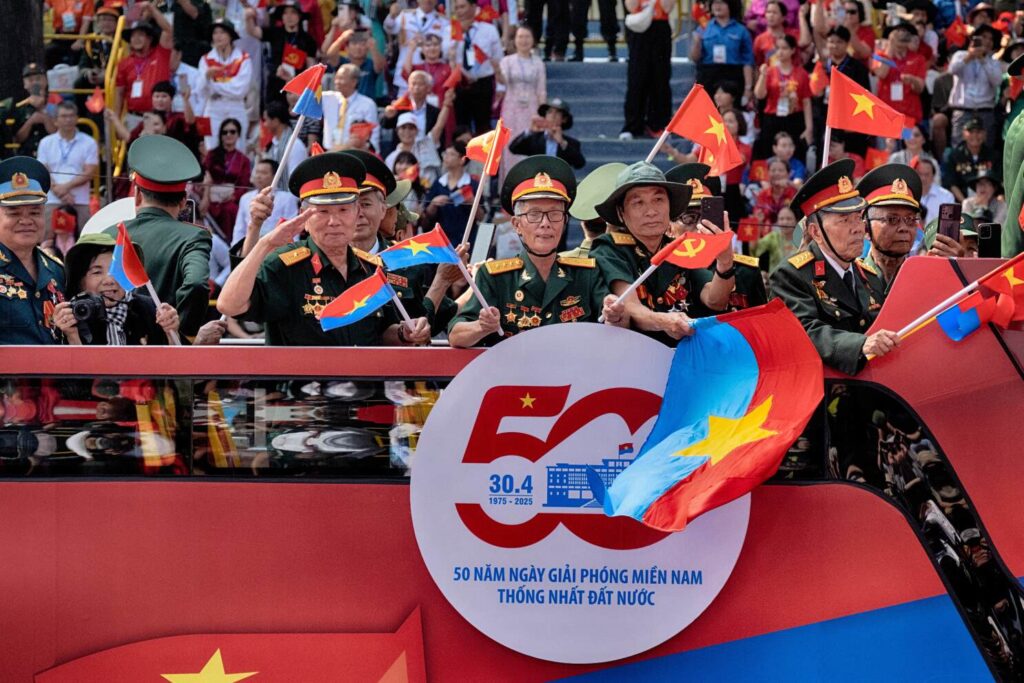
Memorializing events is a popular pastime with politicians, journalists, and old soldiers. Nothing wrong with that. Honoring sacrifice, preserving collective memory and encouraging reconciliation are all valid. Recalling the liberation of Saigon (Ho Chi Minh City) on April 30, 1975 is important. What is criminal, however, is that we failed to learn the vital lessons that the US defeat in Vietnam should have taught us all. Sadly, much was forgotten, and the succeeding half century has witnessed a carnival of slaughter perpetrated by the Western world on hapless South Americans, Africans, Palestinians, Iraqis, Afghans, and many more. It’s time to remember.
As scholars say: Memory shapes national identity. If your cultural products—books, movies, songs, curricula and the like—fail to embed an appreciation of the war crimes, racism, and imperial culpability for events like the Vietnam War, then, as we have proven, it can all be done again. How many recognize today that Vietnam was an American imperial war in Asia, that “fighting communism” was a pretext that lost all credibility partly thanks to television and especially thanks to heroic journalists like John Pilger and Seymour Hersh. Just as in Gaza today, the truth and the crimes could not be hidden anymore.
All, or virtually all, armies rape their victims. The US Army is no exception—despite rhetorically jockeying with the Israelis for the title of “the world’s most moral army.” The most famous such incident of the Vietnam War was the My Lai Massacre of March 16, 1968, in which about five hundred civilians were subjected to hours of rapes, mutilation, and eventual murder by soldiers of the US 20th Infantry Regiment. Rape victims ranged from girls of ten years to old women. The soldiers even took a lunch break before recommencing their crimes.
The official commission of inquiry, culminating in the Peers Report, found that an extensive network of officers had taken part in a cover-up of these large-scale war crimes. Only one soldier, Lieutenant Calley, was ever sentenced to jail, but within days he was, on the orders of the US President, he was transferred to a casually enforced three and a half years of house arrest. By this act, the United States continued a pattern of impunity for grave war crimes that continues to this day.
The failure of the US Army to fully pursue the criminals will be an eternal stain on the US Army, whose soldiers went on in the succeeding five decades to commit countless rapes, hundreds of thousands of murders, and other crimes across the globe. If you resile from these facts, you simply haven’t read enough official information. Thank goodness for journalists, particularly Seymour Hersh, who broke rank and exposed the truth of what happened at My Lai.
Senator John McCain’s ‘sacrifice’ and the crimes that went unpunished
Thousands of Viet Cong died in US custody, many from torture, many by summary execution; but the Western cultural image of Vietnam focusses on the cruelty of the North Vietnamese toward “victims” like the terror-bomber John McCain. The future US presidential candidate was on his twenty-third bombing mission, part of a campaign of “War by Tantrum” (in the words of a New York Times journalist) when he was shot down over Hanoi.
Also emblematic of this state-inflicted terrorism was the CIA’s Phoenix Program, eventually shut down after public outrage and hearings by the US Congress into its misdeeds. According to US journalist Douglas Valentine, author of several books on the CIA, including The Phoenix Program: “Central to Phoenix is the fact that it targeted civilians, not soldiers.” Common practices, Valentine says, quoting US witnesses and official papers, included:
Rape, gang rape, rape using eels, snakes, or hard objects, and rape followed by murder; electrical shock (“the Bell Telephone Hour”) rendered by attaching wires to the genitals or other sensitive parts of the body, like the tongue; “the water treatment”; “the airplane,” in which a prisoner’s arms were tied behind the back and the rope looped over a hook on the ceiling, suspending the prisoner in midair.
No US serviceman, CIA agent or other official was held to account for these crimes.
Tiger Force—part of the US 327th Infantry—gained a grisly reputation for indiscriminately mowing down civilians, mutilations (cutting off of ears, which were retained as souvenirs, was common practice, according to sworn statements by participants). All this was supposed to be kept secret but was leaked in 2003. “Their crimes were uncountable, their madness beyond imagination—so much so that for almost four decades, the story of Tiger Force was covered up under orders that stretched all the way to the White House,” journalists Michael Sallah and Mitch Weiss reported.
Their crimes, secretly documented by the US military, included beheading a baby to intimidate villagers into providing information—interesting, given how much mileage the United States and Israel made of fake stories about beheaded babies on October 7th. The US went to great lengths to hide these ugly truths—and no one ever faced real consequences.
Helicopter gunships and soldiers at checkpoints gunned down thousands of Vietnamese civilians, including women and children, much as US forces did at checkpoints in Iraq, according to leaked US documents following the illegal invasion of that country.
Yet the worst cowards and criminals were not the rapists and murderers themselves, but the high-ranking politicians and military leaders who tried desperately to cover up these and hundreds of other incidents. As Lieutenant Calley himself said of My Lai: “It’s not an isolated incident.”
Here we are fifty years later, in the midst of the US-Israeli genocide in Gaza, with the United States fueling war and bombing people across the globe. Isn’t it time we stopped supporting this madness?
Part 2. Quiet Mutiny: The US Army Falls Apart
Vietnam is a lesson we should have learned—but never did—about the immorality, folly, and counterproductivity of imperial war. Gaza, Yemen, and Ukraine are happening today, in part, because of this cultural amnesia that facilitates repetition. It’s time to remember the Quiet Mutiny within the US army—and why it helped end the war by undermining military effectiveness, morale, and political support at home.
There were many reasons that the United States and its allies were defeated in Vietnam. First and foremost, they were beaten by an army that was superior in tactics, morale, and political will. The Quiet Mutiny that came close to a full-scale insurrection within the US army in the early 1970s was an important part of the explanation as to why America’s vast advantage in resources, firepower, and aerial domination was insufficient to the task.
‘Our army is approaching collapse’
In the Armed Forces Journal of June 7, 1971, Marine Colonel Robert D. Heinl, Jr. wrote:
By every conceivable indicator, our army that now remains in Vietnam is in a state approaching collapse, with individual units avoiding or having refused combat, murdering their officers and non-commissioned officers, drug-ridden, and dispirited where not near mutinous.
A paper held in the Gerald R. Ford Presidential Library—“Veterans, Deserters and Draft Evaders” (1974)—stated that “hundreds of thousands of Vietnam-era veterans hold other-than-honorable discharges, many because of their anti-war activities.”
Between 1965 and 1973, according to the Ford papers, 495,689 servicemen (and women) on active duty deserted the armed forces! Ponder that. For good reason, the defiance, insubordination and, on many occasions, soldier-on-officer violence was something that the mainstream media and the Western establishment have tried hard to expunge from our collective memory.
‘The officer said “Keep going!” He kinda got shot’
At age twelve, in 1972, I took out a subscription to Newsweek. Amongst the horrors I learned at that tender age was about the practice of fragging—the deliberate killing of US officers by their own men, often by flicking a grenade (a fragmentation device, hence fragging)—into their tent at night, or simply by shooting an officer during a combat mission. There were hundreds of such incidents.
G.I.: “The officer said, ‘Keep on going’ but they were getting hit pretty bad so it didn’t happen. He kinda got shot.”
G.I.: “The grunts don’t always do what the Captain says. He always says “Go there”. He always stays back. We just go and sit down somewhere. We don’t want to hit “Contact”.
G.I.: “We’ve decided to tell the company commander we won’t go into the bush anymore; at least we’ll go to jail where it’s safe.”
Refusing to fight
In “Soldiers in Revolt: G.I. Resistance During the Vietnam War,” David Cortright, professor emeritus at the Keough School of Global Affairs at the University of Notre Dame and himself a Vietnam veteran, documents the hundreds of G.I. antiwar organizations and underground newspapers that challenged the official narratives about the war.
Cortright’s research indicates that the US Army was close to a full mutiny, not just the “quasi-mutiny” of the early 1970s. It meant that the United States, despite having hundreds of thousands of troops in the country, couldn’t confidently put an army into combat. By the war’s end, the US army was largely hunkered down in their bases. Cortright says U.S. military operations became “effectively crippled” as the crisis manifested itself “in drug abuse, political protest, combat refusals, black militancy, and fraggings.”
Cortright cites over 900 fragging incidents between 1969 and 1971, including over five hundred with explosive devices. “Word of the deaths of officers will bring cheers at troop movies or in bivouacs of certain units,” Colonel Heinl wrote in his 1971 article.
At times entire companies refused to move forward—an offence punishable by death, but never enforced, because of the calamitous knock-on effect this would have had both at home and within the army in the field.
‘The rebellion is everywhere’
It was heroic journalists like John Pilger who refused to file the reassuring stories editors back in New York, London, Sydney, and Auckland wanted. Pilger told uncomfortable truths: there was a rebellion underway. The clean-cut spit-and-polish boys of the 1960s Green Machine had morphed into a corps whose 80,000-strong frontline was full of defiant, insubordinate “grunts” (infantry) who wore love beads, grew their hair long, smoked pot, and occasionally tossed a hand grenade into an officer’s tent.
Pilger’s first film, Vietnam: The Quiet Mutiny, aired in 1970. “The war is ending,” Pilger said, “because the largest, wealthiest and most powerful organization on earth, the American Army, is being challenged from within—by the most brutalized and certainly the bravest of its members. The war is ending because the Grunt is taking no more bullshit.” That short address to camera is one of the most incredible moments in documentary history, yet it likely won’t be seen during the commemorations in the Western world this year.
At the time, Granada Television’s chairman was apoplectic that it went to air at all, and described Pilger as “a threat to Western civilization.” So tight is the media control we live under now it is unlikely such a documentary would air at all on a major channel.
“I don’t know why I’m shooting these people,” a young grunt tells Pilger about having to fight the Vietnamese in their homeland. Another says: “I have nothing against these people. Why are we killing them?”
Shooting the messenger
Huge effort goes into attacking truth-tellers like Pilger, Chelsea Manning, Edward Snowden, or Julian Assange, but as Phillip Knightley pointed out in his book The First Casualty, Pilger’s work was among the most important revelations to emerge from Vietnam, a war in which a depressingly large percentage of journalists contented themselves with life in Saigon and chanting the official Pentagon narrative. Thus it ever was.
Pilger was like a fragmentation device dropped into the official narrative, blasting away the euphemisms, the evasions, the endless stream of official lies. He called the end of the war long before the White House and the Pentagon finally gave up the charade; his actions helped save lives; their actions condemned hundreds of thousands to unnecessary death, millions more to misery.
Race politics, anti-racism, peace activism
Race politics was another important factor. African Americans were sent to the front in disproportionately large numbers—about a quarter of all frontline fighters. There was a strong feeling among black conscripts that “This is not our war.” Black militancy, epitomized in the slogan attributed to Muhammad Ali (“No Viet Cong ever called me nigger”) resonated with this group.
In David Loeb Weiss’s film No Vietnamese Ever Called Me Nigger, we see a woman at an antiwar protest in Harlem, New York. “My boy is over there fighting for his rights,” she says, “but he’s not getting them.” Then we hear the chant: “The enemy is whitey! Not the Viet Cong!” We should recall that at this time the Civil Rights Movement was battling powerful white groups for a place in civil society. The US army had only ended racial segregation during the Korean War, and back home, in 1968, sixteen states still had “miscegenation” laws banning sexual relations between whites and blacks. Martin Luther King was assassinated this same year. All this fed into the Quiet Mutiny.
Truth-telling and the lessons of history
Vietnam became a dark arena where the most sordid aspects of American imperialism played out: racism, genocidal violence, strategic incoherence, belief in brute force over sound policy. Sounds similar to Gaza and Yemen, doesn’t it? This year the United States may celebrate its first trillion-dollar military budget. When will they ever learn?
I’ll give the last word to John Pilger:
I’ve been in the mud of America’s war in Vietnam and I know that thousands of young American soldiers are fighting an enemy that isn’t called “Gook”—it’s called the US Army. And that takes guts.
RIP, John Pilger. You had the guts to tell the truth.
(Eugene Doyle is a writer based in Wellington. He has written extensively on the Middle East, as well as peace and security issues in the Asia Pacific region. He hosts the public policy platform solidarity.co.nz. Courtesy: MR Online, a forum for collaboration and communication between radical activists, writers, and scholars around the world, started by Monthly Review, the famed socialist magazine published from New York.)
❈ ❈ ❈
Vietnam: A Victory Never to be Forgotten
Allen Myers
It’s a historic anniversary that the U.S. ruling class and its allies around the world wish we would forget. Fifty years ago, on 30 April 1975, U.S. imperialism suffered the worst military defeat in its history as troops of the North Vietnamese Army and South Vietnam National Liberation Front took complete control of Ho Chi Minh City (then called Saigon) and the few scattered areas of the south that had not yet been liberated.
The Vietnamese victory was the culmination of more than three decades of struggle against Japanese, British, French and American imperialism. At the time, the United States was, as it still is today, the world’s leading military power. And yet that incredible power was defeated by a small, underdeveloped, mostly rural society.
The U.S. war against Vietnam at some stages involved well over half a million regular U.S. troops. During the war, the U.S. unleashed previously unimaginable firepower against the Vietnamese forces and the population in general. The tonnage of bombs dropped on Vietnam was approximately three times the total for all theatres in all of World War Two. The U.S. also employed chemical warfare, such as defoliants containing dioxin, which are still today causing deaths and genetic damage.
Vietnam received limited military supplies from China and the Soviet Union, but they were never enough to be decisive. Surface-to-air rockets, for example, increased the U.S. Air Force’s military losses but never came close to stopping the U.S. air war.
And yet all this firepower was unable to prevent Vietnamese victory. Something proved more powerful than massive weaponry. That reality is the lesson that the imperialists want us to forget.
The liberation of Ho Chi Minh City provided a striking emblem of the limitations of technological military power. As helicopters flew the remaining Americans and some of their Vietnamese agents to warships waiting offshore, the U.S. Navy pushed each emptied helicopter overboard into the sea to make room for those still in the air.
What eventually defeated U.S. military power? First and foremost was the heroism and endurance of the Vietnamese. The Vietnamese resistance gradually widened doubts and divisions in U.S. society, opening time and pathways for opposition to the imperialist war within the U.S. and eventually on a massive scale worldwide.
Combined with the US’s inability to inflict a decisive military defeat, this continually growing political opposition contributed substantially to the U.S. rulers’ calculation that continuing the war could cost them more than they were likely to gain. They could see that, around the world, oppressed and exploited peoples were concluding that the U.S. was not invincible and that it could be successfully resisted.
Earlier struggles similarly influenced the antiwar movement. After the 1940s and ’50s era of McCarthyism and “red scare” reaction and house-breaking of most labour unions, things began to shift with the rise of the Black civil rights movement and the ’60s cultural and political radicalisation. The opponents of the Vietnam War who organised the early teach-ins at universities were, in part, following the example of the combination of propaganda and action of early fighters for Black rights, particularly in the U.S. South.
The influence went in both directions. In April 1967, I was conscripted (“drafted”) into the U.S. Army in Chicago. By chance, this occurred on the same day that boxing champion Muhammad Ali had been ordered to report for induction—which he had publicly announced he would refuse because of his religion as a member of the Nation of Islam and his ethical objections to the war.
Ali, who had a talent for concise and colourful explanations, said, “Man, I ain’t got no quarrel with them Viet Cong. No Viet Cong ever called me nigger”. (“Viet Cong” was the name the U.S. military and media gave to the National Liberation Front.) A week before his scheduled conscription, Ali added:
I’m not going 10,000 miles from home to help murder and burn another poor nation simply to continue the domination of white slave masters of the darker people the world over. If I thought the war was going to bring freedom and equality to 22 million of my people, they wouldn’t have to draft me; I’d join tomorrow.
There was considerable public interest in what Ali would do, and one of the soldiers staffing the Chicago induction centre had turned on a radio tuned to a news broadcast. With the report that Ali had refused to be conscripted, I heard one of the Black soldiers mutter, barely audibly, “Damn, wish I had done that.”
As Vietnamese resistance forced the U.S. to increase its troop numbers in the country, conscription also necessarily increased, including of inductees who were either opposed to the war or at least suspicious of it. For thousands of young Americans and their friends, relatives and partners, the war stopped being a strange conflict in a distant country and became an immediate threat to their wellbeing. The impact was all the stronger for their ability to view scenes of the war on nightly TV news.
The U.S. ruling class was beginning to learn something that had only begun to be evident during the 1950-53 Korean War: there is a significant difference between a “citizen army” in which the citizenry feels its interests are seriously threatened by a menace such as fascism, and one facing an abstract enemy such as “communism” that poses no immediate threat—or an oppressed people fighting for their liberation. People who had witnessed or participated in mass antiwar protests tended to have their opposition increased, not weakened, by induction into the military.
During my two years in the army, 1967-69, all within the United States, the challenge was not to convince fellow soldiers that the war was wrong. We had to persuade other soldiers that they could do something about it. This was the period during which the publication of rank-and-file antiwar “newspapers” (really newsletters) proliferated at military bases in the U.S. and overseas.
At Fort Dix in New Jersey, we called ours the Ultimate Weapon, because the base’s main function was infantry training, and the Army liked to call its infantry “the ultimate weapon”. In the early ’70s, the Student Mobilization Committee, the most radical of the antiwar coalitions, launched a GI Press Service, which sought to provide information, exchange and cooperation among the varied military antiwar publications. We eventually knew of more than a hundred of them.
The spread of antiwar activity in the U.S. military was aided by higher-ups’ bureaucratic efforts to suppress it. A battalion commander who learned of “subversive” activity within his domain, fearing that it would hamper his chances for promotion, would arrange for one or several suspected “ringleaders” to be transferred to a different base, hopefully distant. It could not have been better designed if the object had been to encourage the spread of antiwar activity. The eventual situation was described by Colonel Robert D. Heinl, Jr., in Armed Forces Journal, 7 June 1971:
The morale, discipline and battleworthiness of the U.S. Armed Forces are, with a few salient exceptions, lower and worse than at any time in this century and possibly in the history of the United States. By every conceivable indicator, our army that now remains in Vietnam is in a state approaching collapse, with individual units avoiding or having refused combat, murdering their officers and non-commissioned officers, drug-ridden, and dispirited where not nearly mutinous. Elsewhere than Vietnam, the situation is nearly as serious.
In short, the U.S. rulers were worried about the effect of the war, not only on their troops in Vietnam, but on their armed forces more generally. President Nixon tried to ameliorate this situation through his program of “Vietnamization” of the war, which essentially meant withdrawing U.S. troops from Vietnam and supplying the puppet “Republic of Vietnam” with sufficient weapons and financing to fight on for U.S. interests.
From the U.S. standpoint, this was always a forlorn hope, which became increasingly evident after the departure of U.S. ground troops in 1973. When the liberation forces launched their final offensive in early 1975, the “RVN” forces largely melted away or collapsed.
The impact of the Vietnamese victory is still with us, something that capitalist rulers are still trying to overcome. In the U.S., that impact was often called the “Vietnam syndrome”, as though it described some sort of unfortunate disease. In fact, it referred to the reality that large sections of the U.S. public had seen that their rulers lied shamelessly about a major military conflict. Consequently, they tended to look sceptically at further military operations.
It has since become standard U.S. political doctrine that any new military adventure needs to be carried out quickly so that there is no time for large parts of the public to become really aware of it. To restore their ability to intervene militarily around the world, the U.S. rulers found it necessary to abolish conscription and to rebuild their army as “voluntary”—meaning using social and economic coercion to enlist mainly the poor and oppressed racial minorities.
The ending of conscription was a major setback for U.S. imperialism, and its rulers are today, half a century later, wondering whether they can get away with reintroducing it.
You can see another lesson ruling classes have drawn from Vietnam in government responses to the widespread upsurge of solidarity with Palestinians against the genocidal Israeli war on Gaza and the West Bank. The speed and extremism of government reactions against the first university protest encampments showed their fears of protests growing and spreading as they did with Vietnam. It’s the reason for the attempts to suppress free speech and the almost hysterical attacks on protesters. And just as imperialist propagandists of the Vietnam War sought to discredit opposition as “communism”, today supporters of Zionist genocide try to label any opposition as “antisemitism”.
Our side has also drawn some lessons, which is a part of the reason the Palestinian protests have taken the form they have: both the initial encampments and reaching out to broader layers through large and vocal rallies and marches. Around the world, there are uncountable numbers of oppressed and exploited people who may know little or nothing of the Vietnam War but who have absorbed the understanding that imperialism is not invincible, that it can be defeated by determined struggle, and that “If you don’t fight, you lose”.
(Courtesy: Red Flag, a publication of Socialist Alternative, an Australian socialist group.)