❈ ❈ ❈
‘Prove it’: Rahul Gandhi Doubles Down on Rigging Allegations After ECI’s Unsigned Rebuttal
The Wire Staff
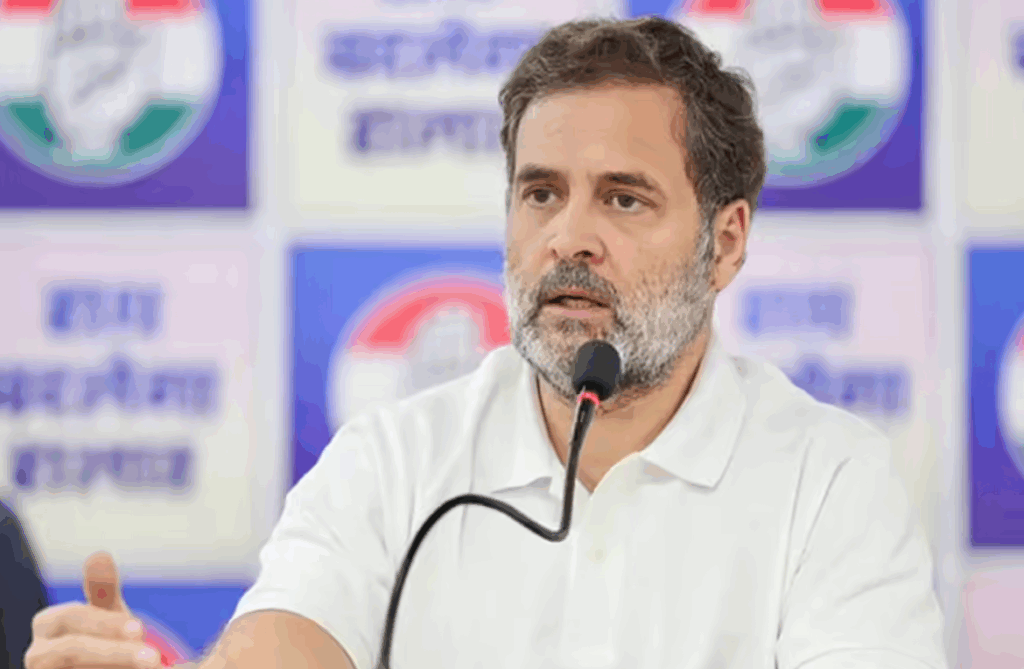
08 June 2025: Hours after the Election Commission of India termed Congress leader Rahul Gandhi’s allegations of “industrial scale rigging” in the 2024 Maharashtra assembly elections as “unsubstantiated”, the leader of opposition in the Lok Sabha hit back by challenging the ECI to publish “consolidated, digital, machine-readable voter rolls” of all the recent elections.
In a post on X, Gandhi wrote:
“If you have nothing to hide, answer the questions in my article and prove it by:
- Publishing consolidated, digital, machine-readable voter rolls for the most recent elections to the Lok Sabha and Vidhan Sabhas of all states including Maharashtra
- Releasing all post-5pm CCTV footage from Maharashtra polling booths
Evasion won’t protect your credibility. Telling the truth will.”
The row over alleged manipulation of electoral rolls has been a bone of contention between the Congress and the ECI ever since BJP sprung a surprise victory in the Maharashtra assembly elections, months after facing a humiliating defeat in the state’s Lok Sabha polls.
Gandhi reignited the debate by publishing an op-ed in many papers, raising pointed questions about what he called stark “anomalies”, which included an unexpected spike of nearly 41 lakh voters between the Lok Sabha and assembly polls of Maharashtra – a majority of which were polled in favour of the BJP. He also said that the voter turnout after the ECI released a provisional turnout at 5 pm on the polling day increased unprecedentedly by 7.83 percentage points, equivalent to almost 76 lakh voters.
The ECI responded soon, citing that most of these allegations were “unsubstantiated” and that it had already published clarifications on ECI’s website on December 24, 2024.
“It appears that all these facts are completely being ignored while raising such issues again and again,” it said.
“Any misinformation being spread, by anyone, is not only a sign of disrespect towards Law, but also brings disrepute to the thousands of representatives appointed by their own political party and demotivates lakhs of election staff who work untiringly and transparently during elections. After any unfavourable verdict by the voters, trying to defame the Election Commission by saying that it is compromised, is completely absurd,” the ECI said, while publishing an unsigned and undated note that appeared to be its clarification.
Regarding Gandhi’s allegation on the sharp increase in voter turnout after 5 pm on the polling day, the ECI contended that the spike amounted to “65 lakh voters” casting their votes in the last two hours, and that it was “much below the average hourly voting trends (58 lakh voters per hour)” through the day.
The ECI said that voting happened in the presence of authorised polling agents of all parties across all booths. The Congress alone has 27,099 polling agents spread across polling booths in the Maharashtra elections. It added that no “abnormal voting” was reported by returning officers and election observers.
It further said that out of the 89 appeals that were filed before the first appellate authority (district magistrate), only one appeal was followed up with the second appellate authority (chief electoral officer). “Therefore, it is amply clear that there was no grievance of INC (Indian National Congress) or any other political parties before the conduct of Maharashtra assembly elections of 2024,” the ECI said to counter Gandhi’s allegation on manipulation of electoral rolls.
Importantly, it said that the revised electoral rolls were prepared as per the Representation of People’s Act, 1950 and Registration of Electors Rules, 1960 and a copy of which was already handed over to all political parties, including the Congress.
However, Gandhi retorted to say that the ECI response was “evasive” and didn’t specifically answer the specific queries he made. He went on to ask that if the ECI had “nothing to hide”, it should release “all-post 5 pm CCTV footage” from all booths and show more transparency by publishing electoral rolls of all states, including Maharashtra.
“You are a Constitutional body. Releasing unsigned, evasive notes to intermediaries is not the way to respond to serious questions,” he told the ECI.
The Congress believes that merely comparing hourly averages may be misleading, as the allegation is regarding a sudden concentration of voters in the booths after 5 pm. Some of its leaders have also said that the party found anomalies after studying the voting patterns over a few months after the elections. By saying that the Congress did not raise a complaint during or immediately after the elections does not free the ECI from its accountability, the leaders believe.
Gandhi also found support from its party leader Ramesh Chennithala, who is the Maharashtra in-charge for the Congress.
“Rahul Gandhi’s powerful exposé is not merely an article – it is a wake-up call. It exposes how Maharashtra, once a proud torchbearer of democratic values, has become a cautionary tale of how institutions can be compromised, how power can be snatched instead of earned, and how silence can become complicity. This is no longer about one state or one election. It is about the soul of our democracy,” Chennithala said.
“When I assumed charge of Maharashtra in early 2024, the Congress-led Maha Vikas Aghadi defied the Modi wave in the Lok Sabha elections…And yet, merely six months later, in the Assembly elections, that same Maha Vikas Aghadi – which was poised to win over 170 seats – was reduced to just 50. Is it believable that this staggering turnaround was due to governance or public sentiment? Even the most loyal BJP supporter would hesitate to make such a claim,” he said, adding that what happened in Maharashtra was a “massive electoral fraud”.
“It was a calculated and premeditated operation to distort the electoral mandate. Democracy in Maharashtra was not defeated – it was subverted,” Chennithala said.
“We call upon every citizen to stay vigilant, stay informed, and stay united. For if we allow such subversion to go unchecked, we may soon lose not just elections – but the very freedoms that define us,” he said.
The Congress has also claimed that contrary to the EC’s claim, the party sent two formal letters to it, on December 10 and February 7, on the Maharashtra voter list issue. A demand was also made on the floor of Lok Sabha by Gandhi on February 3, Professional Congress chairman Praveen Chakravarty posted on X.
(Courtesy: The Wire, an Indian nonprofit news and opinion website. It was founded in 2015 by Siddharth Varadarajan, Sidharth Bhatia, and M. K. Venu.)
❈ ❈ ❈
Why the Response to Rahul Gandhi’s Accusation of a Stolen Election is Less Than Convincing
Prem Shankar Jha
Part 1
13 June 2025: It has taken the Election Commission four months to respond to opposition leader Rahul Gandhi’s first disturbing accusation at a press conference in February – that the Commission had somehow managed not to notice that there were 16 lakh more adults on the voters’ list for the Maharashtra assembly elections than the entire adult population of the state, and that while the electorate in the state had increased by 32 lakh persons between the 2014 and 2019 Lok Sabha elections, it had increased by 39 lakhs in five months between the Lok Sabha and assembly elections in 2024.
On June 7, Rahul Gandhi repeated the accusation with elaborations in an editorial page article in the Indian Express. Its responses came in the same newspaper in the form of an elaborate piece by reporters quoting an unnamed official of the Election Commission and a condescending article belittling Rahul Gandhi, by no less important a person than the chief minister of Maharashtra, Devendra Fadnavis.
That these were published within 24 hours of Gandhi’s article shows that the Indian Express had felt it necessary to submit Gandhi’s letter to the Modi government and had waited for its response before publishing. This extraordinary act of caution from a newspaper widely respected for its courage shows just how severe the pressure from the Modi government on the media has become during the past 11 years.
Since these are separate pieces, I shall deal with their merits separately.
Defending the present system for the constitution of the Election Commission, the piece by three Indian Express writers asks why no previous government did not institutionalise a “more transparent appointment mechanism”. The answer is that till the advent of the Modi government, no previous regime had felt the need to do so. This was because the Chief Election Commissioner was appointed by presidents and prime ministers of India who so deeply respected the letter and the spirit of the Constitution that the possibility that any one of them would conspire with the government in power to gerrymander the result of a Lok Sabha or assembly election had never arisen.
T. Swaminathan was the CEC in 1975 when Indira Gandhi declared the Emergency and in 1977 when, despite having been warned by the Intelligence Bureau that the Congress would lose heavily in the next election she went ahead with it. As P.N. Dhar, her principal secretary in those years, has written in his memoirs, the possibility of continuing the Emergency for another year never arose in her mind.
By the same token, S.L. Shakdher was the CEC when the Congress (I) came roaring back to power in 1980. No one questioned his complete integrity either then or later. Then, T.N. Seshan put an end to booth capturing by splitting the Lok Sabha elections into several phases and getting every polling station guarded by the police or the Central Reserve Police Forces.
The opposition went to the Supreme Court only after it became convinced that Modi was pressuring the Election Commission members to secure decisions from them. This became public knowledge when the next-in-line CEC, Ashok Lavasa, abruptly submitted his resignation to the President of India, to join the Asian Development Bank in August 2020. He did so because he did not agree with the CEC’s exoneration of Modi and home minister Shah from charges of violating the EC’s Model Code of Conduct during their campaigning for the 2019 elections.
It was this blatant discord within the Commission that made the Supreme Court issue its directive in 2023 that future election commissioners had to be selected jointly by the prime minister, the leader of the opposition, and the Chief Justice of India. The Modi government once again treated this directive with contempt, and made a mockery of the Supreme Court directive by passing an amended version that replaced the CJI in the three-member panel of selectors with a minister, pretty much, of the prime minister’s choice.
The Indian Express piece quotes an unnamed ‘senior Election Commission official’, who says: “Now for the first time a law made by Parliament under article 325 is in place for the appointment of the CEC and ECs … now there is consultancy, there is transparency”. This is an insult to anyone who reads the English language. The only “transparency” in the new law is that in the future it shall be the prime minister who will appoint all the members of the Election Commission.
Coming to Rahul Gandhi’s second charge, that 41 lakh new voters were added to the electoral rolls in five months between the Lok Sabha and assembly elections, the lengthy response on Indian Express can be summed up in one sentence: if there has been widespread electoral malpractice, then why did no one from a single opposition party lodge a complaint before the election?
It points out, “[P]olitical parties are involved at every stage of preparing the final electoral roll…Election authorities regularly hold meetings with political parties, provide them free copies of draft and final rolls, and publish these on official websites. During the summary revision period, weekly lists of additions and deletions are shared to allow objections.”
The Election Commission’s website has, in fact, a 24-page detailed report that elaborates upon this process at length.
Ahead of the Maharashtra election, it went on to add, it held discussions with 103,727 representatives of the various parties, of whom 27,099 were from the Congress. The piece does not say “various opposition parties”, so this offers no clarity on how many were from the Maha Vikas Agadi opposition coalition. What this ‘scrutiny’ piece did not say was that even if we assume that half of these representatives – so, 52,000 – were from the MVA, then for this number of representatives to examine the lists of 100,186 polling booths, each MVA representative had to examine current and earlier versions of voters’ lists that contained close to 2,000 names.
Closely comparing current and earlier voting lists for every polling booth, even if comparable lists existed or had been preserved, would have been a mammoth task that few would have been able to accomplish, even if they had considered it necessary. And before the 2024 elections it had never been considered necessary because the nation’s trust in the Election Commission had been complete. This is the trust that the Modi government has shattered.
This loss of faith is justified.
When the Aam Aadmi Party did begin to examine the updated voters’ lists closely after its shock defeat in Delhi, it found that the names added and deleted in 17 out of its 70 constituencies using Form 7 of the Election Commission’s registration forms had shifted an average of 3% of the vote to the BJP. The impact of these additions and deletions can be judged from the fact that the BJP’s winning margin of the vote in Delhi was just 1.99%.
It is not surprising therefore that the EC has so far adamantly ignored the demand for access to all the Form 7s that were used to add or delete voters to and from the electoral lists in Maharashtra.
Finally the paper is silent on Rahul Gandhi’s two most important allegations: How has the voters’ list exceeded the entire adult population of Maharashtra by 16 lakhs, and how did the size of the electorate increase by nearly 41 lakhs in five months from the Lok Sabha elections of 2024 to the assembly elections of 2025, when it had increased by only 31 lakhs in five years from 2019 till 2024 ?
To this, needless to say, the Election commission has given no answer. So I went to Grok, the ‘most advanced’ artificial intelligence system developed in the world so far, for an answer. After surveying each and every election and by-election held in India over the past 75 years, it concluded that the result of the assembly election in Maharashtra “is the biggest mystery in the history of Indian elections”.
Part 2
16 June 2025: To destroy Congress leader Rahul Gandhi’s allegation of vote rigging in Maharashtra, Bharatiya Janata Party got a shot-gun fired by none other than Devendra Fadnavis, the chief minister of the state. The degree of consternation that Rahul Gandhi’s data may have created in the BJP can be judged from the fact that Fadnavis starts his article in the Indian Express – the same outlet which published Gandhi’s piece – with an untruth. “On the morning of June 7, returning from Gadchiroli to Nagpur, journalists brought to my attention an article written by Shri Rahul Gandhi.”
Not only was Fadnavis able to read Gandhi’s article, but he was able to write a 2,200 word rebuttal dripping with condescension, alert the Indian Express that it was on the way, and get it to the paper the same evening before it was put to bed. Gadchiroli is 171 kilometres from Nagpur, and according to Google the minimum time it takes to drive from one town to the other is 3 hours and 16 minutes. If he had travelled by helicopter, it would have cut the time down by at most an hour. So Fadnavis could not possibly have arrived at the state guest house before mid-afternoon.
Writing such a long and detailed article in the little time that remained would have been a creditable achievement even for a professional journalist reporting from a war front. For the chief minister of a state, who is not used to writing at express train speed, and would, in any case, have had a host of people waiting to meet him at Nagpur, it would have been next to impossible. The conclusion is therefore inescapable. This article was not written by Fadnavis, but by the BJP’s propaganda machine, for him to feed to the press.
Coming to Fadnavis’ response, his rebuttal is fully convincing on only one of the five issues raised by Gandhi. It is perfectly possible for there to be a disproportionate rise in the number of votes cast during the last hour of voting, which is from 5 to 6 pm on election day. This happens in part because a large number of voters are only able to come after working hours (most shops, delivery agencies and small scale enterprises do not shut down on election day), and because those in the queue before 6 pm are able to vote regardless of the length of the queue. This takes the actual closing time to well after that hour.
But Fadnavis’ attempt to rebut two other strong indicators of vote rigging fall flat on their face.
The first is his flippant dismissal of the fact that more voters were added to the electoral rolls in five months last year than had been added in the previous five years. To explain this huge discrepancy Fadnavis has used the increase in the number of persons who turned up to vote not the increase in the number who, by virtue of attaining adulthood, were entitled to vote. Fadnavis’ condescending dismissal of this is as follows: “If you want the data on how the number of voters increased in between the Lok Sabha and Assembly elections, here it is: In 2004, 5 per cent more in the Assembly elections than in the Lok Sabha polls. In 2009, 4 per cent more; in 2014, 3 per cent more; in 2019, 1 per cent more; and in 2024, 4 per cent more. So again, nothing new happened in 2024.”
It takes only a moment to see that what Fadnavis is quoting is the voter turnout and not the voters on the electoral roll. For the latter to have fluctuated so erratically, the number of Maharashtrian women who became pregnant 18 years earlier would have had to fluctuate in a similar manner. This is a manifest, biological absurdity. For Fadnavis to have put it up as a counter argument to Gandhi reflects the contempt in which he holds his readers.
For those who still believe that it is impossible for the chief minister of the second largest and by far richest state in the country to mislead his people, here are the figures for the increase in the size of the electorate between the Lok Sabha and assembly elections in Maharashtra in 2019 and 2024:
| Lok Sabha | Vidhan Sabha | Increase | |
| 2019 | 8,86,76,946 | 8,98,38,267 | 11,61,321 |
| 2024 | 9,30,61,760 | 9,70,25,119 | 39,63,359 |
In 2019 the electorate grew by 11.61 lakhs between the Lok Sabha and Vidhan Sabha elections. According to the Election Commission, during the same period of 2024, it has grown to almost 40 lakhs – nearly four times more, and that too at a time when the average family size in India has been declining because couples have been having fewer children for some time.
Further comment on Fadnavis’ rebuttal of Gandhi is superfluous, but it is necessary to point out that the Maharashtra chief minister has steered clear of the most important issue Gandhi has raised. ‘How has the electorate in Maharashtra exceeded the entire adult population of the state?’ In November 2019 the Union government’s National Commission on Population had projected that in 2024 the adult population of Maharashtra would be about 9.5 crores. But the voters list in 2024 had 9.7 crore names.
How has the Election Commission made such a huge blunder? The answer to this question was given, albeit indirectly, by the outgoing Chief Election Commissioner Rajiv Kumar in his farewell speech. It is that the preparations for a general election require the EC to mobilise more than four million workers (karyakartas), and because of their familiarity with the languages and customs of their people these karyakartas are necessarily drawn from the same state. So if the ruling party requires them to follow its directives, and the Election Commissioners are also the nominees of the same parties, the karykartas have no option but to follow orders, no matter how outrageous these are.
Fadnavis has condescended outrageously to Rahul Gandhi in the letter that I have described above. But in one brief paragraph he has gone beyond condescension to insult – not only of his, but the entire country’s intelligence. Here is what you have written: “From 1950 until a new law was enacted, your Congress government directly appointed the Chief Election Commissioner! Out of 26 commissioners to date, 25 were directly appointed by the central government. For the first time, the Honourable Modi ji established a committee that includes the Leader of the Opposition or the leader of the largest political party. But it seems you do not approve of this step, which strengthens democracy and was a principle never followed during your time.”
Fadnavis knows perfectly well that the obeisance to democracy that he is making is totally fake. He knows perfectly well that Prime Minister Narendra Modi has never hesitated to bend, amend or flout any law that stands as an obstacle to his wishes and to the goal of absolute dominance of the political system that he has set himself. If he does not, then he should try making even one half-way critical remark about anything that he has done or not done and see how far down, and how rapidly he slips down the greasy pole of his estimation.
Fadnavis should know that democracy is not created by articles inscribed in a Constitution. If that were so then Britain is still not a democracy but a monarchy. Democracy is the product of a yearning in the people of a country – a yearning for freedom and for equality before the law. The spirit this generates had existed throughout our country when the 25 Chief Election Commissioners you refer to had been appointed. So none before Modi had thought it necessary to enshrine it in a law.
It was only in 2023, after eight years of Modi’s rule, when large sections of the people of India felt that their freedoms were under threat, that they went to the Supreme Court for a directive on how future Election Commissions should be constituted. That directive required the government to set up a three-member panel consisting of the prime minister, the leader of the opposition and the Chief Justice of India, to select the next Election Commissioners. It is your party and your prime minister who have violated this directive by replacing the Chief Justice with a minister of the prime minister’s choice, thus creating a permanent 2-to-1 majority for whatever party rules India when it comes to the choice of the chief election commissioner and his subordinates.
And after all this, the Maharashtra chief minister describes his party as a servant of democracy.
(Prem Shankar Jha is a veteran journalist and author of ‘Kashmir 1947: Rival Versions of History’ published by OUP in 1996. Courtesy: The Wire, an Indian nonprofit news and opinion website. It was founded in 2015 by Siddharth Varadarajan, Sidharth Bhatia, and M. K. Venu.)