There is a question that should unsettle every thinking Indian: How does a civilisation that moved the conscience of an emperor, built some of the most sublime architecture in human history, resisted every invader for three centuries, and still holds the largest gathering of faith on earth — remain, in the national imagination, an afterthought?
Odisha is that civilisation. And the question of its marginalisation is not merely a cultural grievance or a political complaint. It is a mirror held up to the face of the Indian republic. What we see in that mirror — or refuse to see — says everything about who we are as a nation.
This is not a travelogue of temples. It is not a census of cultural artefacts. It is an attempt — urgent, overdue, and inadequate — to reckon with a land that has been conquered by armies, reduced by emperors, carved up by colonisers, starved by indifferent governments, shot by the state for protecting its own soil, and battered by the sea with clockwork cruelty. And which, in each instance, got up.
The question is not whether Odisha has survived. It has. The question is: at what cost? And who owes what debt?
I. When Kalinga Made an Emperor Weep
Let us begin not with geography but with grief.
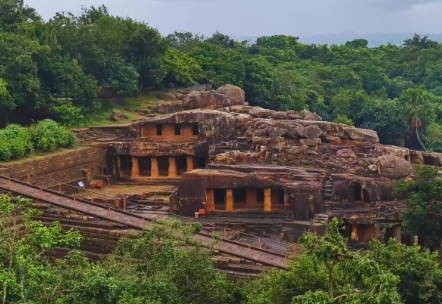
In 261 BCE, on the banks of the Daya River — daya, in Sanskrit, means compassion — the Mauryan emperor Ashoka broke the kingdom of Kalinga. What he did not expect was that the breaking would break him. An estimated 250,000 lives perished. The ancient inscriptions he left at Dhauli, carved into hillside rock that still stands outside Bhubaneswar, record something extraordinary for a monarch of antiquity: not triumph, but anguish. He wrote of beloved sons, of the grief of conquest, of his realisation that every death was a person and every person was someone’s universe.
Kalinga made Ashoka moral. That is not a small thing to have done to the world.
But here is the other side of that famous transformation — the side Indian historiography tends to soften: Kalinga did not consent to become a lesson in the emperor’s spiritual education. Its people did not die so that Ashoka could find dharma. They died resisting an invasion. They died defending something. And the state that was born of that resistance — not the remorseful conqueror, but the unconquered spirit of the land — is what we call Odisha today.
The rock edicts at Jaugada near Berhampur, and at Dhauli, are among the world’s oldest surviving exercises in public accountability by a head of state. They are Odishan soil. They exist because of what this land cost. The next time a politician in Delhi invokes Ashoka’s legacy of peace, someone should ask: which Odisha do you mean? The one that died so he could learn? Or the one that never stopped fighting?
Kalinga did not die so Ashoka could find peace. It bled so the world could understand what empire truly costs.
II. Stone Speaks What Words Cannot — The Civilisation Odisha Built
Drive into Konark at first light, when the mist still sits on the paddy fields and the fishermen’s fires are not yet cold. The Sun Temple appears before you not as a monument but as a phenomenon — a chariot of stone so colossal, so intricately alive, that the ordinary vocabulary of architecture fails it. Twenty-four carved wheels, each a calendar of seasons and hours. Seven stone horses in arrested gallop. Every surface an inhabited universe: gods, nymphs, lovers, demons, astronomers, soldiers, musicians — the entire range of human experience pressed into sandstone and told to stay.
Narasimhadeva I built this in the 13th century to celebrate a military victory over invaders from Bengal. Think about that. In the same era when much of the Indian subcontinent was being razed, plundered, and stripped of its cultural memory, an Odishan king built this. As a statement. As a declaration that his civilisation was not hiding — it was creating. The Eastern Ganga dynasty, which held the title Kalingadhipati, had resisted Muslim conquest for three centuries while kingdoms all around fell. And they spent that resistance not just in warfare but in this: Jagannath’s temple at Puri, the Lingaraj at Bhubaneswar, the Sun Temple at Konark. An architecture of defiance so beautiful it still stuns the eye nine hundred years later.
Pattachitra — cloth paintings born in the shadow of the Jagannath temple — are perhaps the most intimate expression of this civilisational confidence. During Anavasara, when the great wooden idols of Jagannath, Balabhadra, and Subhadra are taken away for a fortnight’s rest, the chitrakaras paint the gods on cloth so that devotion does not stop. Art steps in where the idol cannot be seen. The painting becomes the prayer. This is not a craft. This is a theology of the image — a declaration that the sacred is not confined to the sanctum, that it can be carried in a scroll, hung on a wall, passed from hand to hand through a village.
And then there is Odissi. Not just a dance form — a body philosophy. The tribhangi posture, that triple-bend of head, torso and hips, is copied directly from the carved figures on Konark’s walls: the body trying to become what the sculptor imagined. Kelucharan Mohapatra, who revived Odissi from near-extinction after independence, described it as ‘the temple come alive.’ Every performance is a conversation between the living and the carved, between the present dancer and the ancient stone. To watch Odissi danced well is to feel history moving through a human body.
The Gita Govinda — that blazing Sanskrit poem of divine love written by Jayadeva on the banks of the Prachi river near Puri in the 12th century — became the foundational text of Vaishnava devotion across the subcontinent. It was composed in Odisha. By an Odishan. On Odishan soil. It is sung in temples in Tamil Nadu and Kerala and Bengal. But it is rarely spoken of as Odisha’s gift to India.
This is the pattern. Odisha gives. India takes. And does not say thank you.
The body of the Odissi dancer bends in tribhangi — three bends, three defiances — as if the living flesh refuses to be straightened by what history has done to it.
III. The Long Dispossession — Conquest, Fragmentation, Famine
In 1568, Kalapahad — the iconoclast general of the Sultanate of Bengal, whose very name has become Odishan shorthand for cultural devastation — swept through the land. Temples were desecrated. The idols of Jagannath were hidden by priests in the forests of the interior, carried in secret from village to village, protected by ordinary people who understood that if the god was destroyed, something in themselves would also die. It took years before the deity could be returned to the sanctum. The hiding of the god is itself a story of resistance — devotion weaponised against violence.
What followed was three centuries of being carved up. Mughal governors. Maratha revenue officers. Local zamindars with no accountability. And then, in 1803, the British East India Company, arriving not as administrators but as extractors, folding Odisha into their revenue architecture without even preserving its territorial integrity. The Odia people — one of India’s oldest, most linguistically and culturally cohesive communities — found themselves split between Bengal Presidency, Bihar, and Madras. Separated from each other by administrative lines drawn for colonial convenience.
Gopabandhu Das — Utkalmani, Jewel of Utkal — fought his entire life to bring these severed pieces back together. A poet, journalist, educator, and freedom fighter, he founded the Satyabadi school with the revolutionary conviction that education belonged to the poor. He wrote from Hazaribagh jail. He launched the newspaper Samaj to give Odisha a voice in its own language. He attended the All India Congress Committee to personally persuade Gandhi that Indian states must be reorganised on linguistic lines — a cause he would not live to see fulfilled. He died in 1928, aged fifty-one. Odisha became a separate province only in 1936, eight years after his death.
Then came 1866. A year so catastrophic it became a temporal landmark — Odians still compute historical time from it. The Na Anka Durvikhya. The Famine of the Ninth Year.
An estimated one million people died. Not in a day. Slowly. In the way that the starving die — the body consuming itself, the children going first, the silence in the villages deepening until there was no one left to notice the silence. The rains had failed. The rice was gone. And the British administration, wedded to the ideology of non-interference in the market, held back relief until the dying was already an accomplished fact.
Let that number sit for a moment. One million. The entire population of a large modern city. Dead in Odisha. Recorded in colonial reports. And largely absent from India’s national memory of its own famine history, which tends to reserve its grief for Bengal 1943.
The famine did not just kill. It catalysed. Bichitrananda Das and Gouri Shankar Roy, horrified and furious, launched Utkal Deepika — the first independent Odia newspaper — in the very year of the famine, 1866. Its purpose was not journalism as we understand it today. It was testimony. It was the act of a people deciding that their suffering would be witnessed in their own language, that no administration could pretend it had not happened if Odisha was writing it down.
A million dead — and the colonial record calls it a ‘revenue shortfall.’ The Odia press called it what it was: murder by indifference.
IV. The Soil Speaks — Adivasi Resistance from Dhauli to Kalinganagar
The hills of Odisha have always been dangerous to empires.
Long before the educated nationalist class discovered Gandhi’s non-cooperation, the tribes of this land were fighting. The Paik Rebellion of 1817 — led by Buxi Jagabandhu Bidyadhar, the commander of the royal cavalry of Khurda — was an armed uprising against British rule that predated 1857 by forty years. He died under house arrest. The Ghumsar Rising of the 1830s under Dora Bisoi. The Khond Uprising under Chakra Bisoi. The Bhuyan Rebellions under Ratna Naik. Each was a people saying, in the clearest possible language: this land is not yours to administer.
Laxman Naik of Koraput — a Bhuyan tribal, barely educated, born in 1899 in what is now Malkangiri — became one of the most extraordinary freedom fighters in Indian history. He led the Quit India uprising in Koraput with a ferocity that terrified the colonial administration. He was hanged in 1943. He was forty-four years old. You will find his name on a government building somewhere in Odisha. You will not find it in most national history textbooks. The resistance of tribal India against the British has been gently excised from the story of Indian nationalism, which prefers its freedom fighters educated, upper-caste, and from cities.
But the exploitation did not stop with colonialism. It changed management.
After independence, the same Adivasi communities that had protected this land with their bodies — that had hidden Jagannath’s idol from Kalapahad, that had died in Buxi Jagabandhu’s rebellion, that had given Laxman Naik to a gallows — discovered that the new India had a different kind of hunger for their soil. Not for revenue. For minerals.
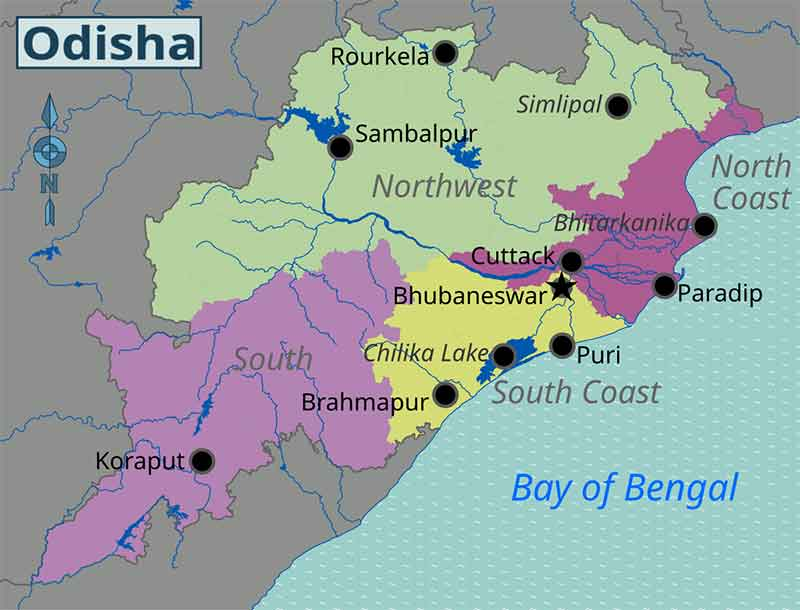
Odisha holds vast reserves of iron ore, bauxite, coal, chromite, and manganese. The mineral wealth concentrated precisely in the forest belts where tribal communities live. In the KBK belt — Kalahandi, Bolangir, Koraput — the same red earth that grows the sal trees and hides the roots that feed the villages also holds the ore that makes steel. This created, in independent India, an obscene arithmetic: the richest land, and among the poorest people. The wealth flowed outward. The poverty stayed.
And then came Kalinganagar. January 2, 2006. The date should be as seared into Indian consciousness as any other atrocity. It is not.
Nearly a thousand Adivasi farmers from the Munda community gathered at Kalinganagar in Jajpur district. They carried what they had: axes, bows and arrows, lathis. They had gathered to protest the construction of a boundary wall by Tata Steel on what they said was their ancestral land — land that IDCO, the state’s industrial development corporation, had acquired and sold to the company at prices that bore no relationship to what the land was worth to the people who had lived on it for generations. They had protested before. Their demands had been ignored before. They were not going to move.
The Odisha state government sent twelve platoons of police — over five hundred armed personnel — equipped with modern weapons, tear gas, stun grenades, rubber bullets, and live ammunition. Against farmers with bows and arrows.
By mid-morning, paddy fields were soaked in blood. Twelve Adivasis were killed on the spot — including three women and a thirteen-year-old boy. Four more died of their injuries later. A policeman also died. And then — in a detail so grotesque it seems impossible until you read the official inquiry reports — the bodies of the dead were mutilated. Hands and private organs severed in post-mortem, reportedly to prevent identification. Sini Soy, whose son Bhagaban died in the firing, asked the question that no commission has ever answered:
“Who killed them and by whose order? And even dead bodies were mutilated by chopping off private organs of both male and female bodies! Did they all happen while tribal people were dancing or making fun?”
The Justice Mohanty Commission — appointed to investigate and given nine years to complete its work — eventually gave the police and administration a clean chit. The commission’s logic was unambiguous: the thousand villagers with traditional weapons posed a threat; the five hundred armed police maintaining order for a private corporation’s construction project were doing their job. The lathis and bows were ‘deadly weapons.’ The rifles were ‘adequate.’
The Tata Steel plant at Kalinganagar was commissioned on November 18, 2015. Its first phase, built at a cost of Rs. 25,000 crore, has a capacity of 3 million tonnes per annum. At Ambagadia village, on the road alongside the plant’s bright lights, there is a 70-foot memorial pillar where the thirteen were cremated. Every year, Adivasis from across Odisha march to that pillar with their traditional weapons. The march is the only justice they have been given.
This is not ancient history. This is 2006. This is a democracy. This is India.
They came with bows and arrows to protect what the earth had given them. The state came with rifles to protect what a corporation had bought. And called it law and order.
V. When the Sea Came — and How a Nation Rebuilt its Soul
October 29, 1999. The people of Jhatipari village in Erasama block, Jagatsinghpur district, had no warning. The Super Cyclone — winds at 250 kilometres an hour, a storm surge that turned the Bay of Bengal into a wall — arrived in the dark. By morning, 315 of the village’s 850 residents were dead. In one night. In one village. One in three.
Haladhar Mandal was ten years old when the sea took his parents and his two younger brothers. He survived by accident — he was in a neighbour’s brick house. He has run a fish business in the village for twenty-five years. He says time is a great healer. His eyes say something else.
Amar Moharana of Sandakuda held onto a tree and watched the tidal waves take his wife and children. He never found their bodies. When he was asked about it, a quarter-century later, he said only: ‘The sea devoured everything.’ There is no verb in that sentence that the English language can adequately translate. The Odia word for what the sea did that night is not in any dictionary.
Nearly ten thousand people died across twelve coastal districts. 12.9 million were affected. The damage bill was 4.44 billion US dollars. India’s most powerful recorded cyclone. And Odisha, as usual, was largely on its own — the central government’s response covered barely 40% of the affected areas. The rest was managed by a state that was already poor, already struggling, already carrying the weight of its own neglect.
What happened next is one of the most remarkable stories in modern governance — and one of the least told.
Rather than simply rebuilding and waiting for the next disaster, Odisha made a decision that required a kind of courage its critics would not expect from a state perpetually described as ‘backward’: it institutionalised its own grief. It studied what went wrong. It built systems. In 1999, the state became the first in India to create a dedicated disaster management authority — the OSDMA — years before the national body existed. Over 800 multi-purpose cyclone shelters were constructed along the entire coastline, designed to withstand 300 km/h winds. Early warning systems were installed in nearly 1,200 coastal villages. Watchtowers at over 120 locations.
When Cyclone Phailin struck in 2013 — comparable in intensity to the Super Cyclone — nearly one million people were evacuated before landfall. When Cyclone Fani, a rare summer cyclone of extraordinary violence, made landfall in 2019, 1.2 million people were evacuated in 48 hours. Fatalities: under 100. Odisha was featured as a global success story in the United Nations’ 2015 Global Assessment Report on Disaster Risk Reduction. The World Economic Forum cited it. The World Bank cited it.
A state that the rest of India describes as underdeveloped is now the world’s reference point for how to protect human life from climate catastrophe. Hold that irony. Sit with it.
The nation that forgot Odisha found it again when it became a model for the world. Grief, disciplined into policy, became the most sophisticated disaster management system in Asia.
VI. The Central Contradiction—Mineral Richness, Human Poverty
There is a concept in political economy called the ‘resource curse’ — the paradox by which nations or regions rich in natural resources often develop less than those without them, because the wealth is captured by elites and corporations while the communities on the land bear only the costs. Odisha is the resource curse made flesh.
More than 22% of Odisha’s population are Scheduled Tribes — 62 recognised communities, thirteen of them so marginalised they are classified as Particularly Vulnerable Tribal Groups. They are concentrated in the forested highlands of the west and south: Koraput, Malkangiri, Kandhamal, Mayurbhanj, Rayagada. And it is precisely in these regions that the earth yields iron ore, bauxite, chromite, coal, manganese. The communities that have lived on this land for millennia — that have built their entire cosmology, their medicine systems, their agricultural knowledge, their art, their language around this specific soil — are sitting, in the government’s calculations, on an inconvenience.
The KBK region — Kalahandi, Bolangir, Koraput — became nationally infamous in the 1980s for the reports emerging from it: child sales. Families so pulverised by drought, displacement, and debt that they were selling their children to survive. The reports were disputed. The hunger was not.
Consider the Dongria Kondh of the Niyamgiri hills. They are the worshippers of Niyam Raja, the mountain god. Their entire existence — ritual, agricultural, medicinal, cosmological — is organised around this forested plateau. It is, in the only sense that matters to them, sacred. It also contains one of the largest deposits of high-grade bauxite in Asia. The resulting conflict produced one of the most unusual legal confrontations in Indian history: Vedanta Resources, backed by the state, vs the Dongria Kondh, backed by the Forest Rights Act and eventually the Supreme Court. In 2013, the court ordered that the gram sabhas — the village assemblies — of the Dongria Kondh must decide. Every gram sabha voted. Every single one said no.
It was, possibly, the first time in independent India that a tribal community’s voice carried enough constitutional weight to stop a multinational corporation. The forest is still standing. The bauxite is still underground. The Dongria Kondh are still on the mountain. This is not a small victory. It is a civilisational argument that the Adivasis won.
But the broader pattern persists. In Sundargarh district — a Scheduled Area where over 50% of the population are Scheduled Tribes and 40% of the land is forest — the mineral wealth is being extracted, the industrial plants are operating, and the residents of those mineral-rich regions, as the research records it plainly, ‘still breathe amidst the adversity of poverty and underdevelopment.’ The wealth flows out. The poverty stays. The children migrate to construction sites in Surat and Chennai, carrying their dispossession with them.
And when they go, they take something else: language, song, the specific way a Saora woman paints her wall, the Bonda headgear that encodes a social grammar in its beadwork, the Kondh knowledge of which root cures which fever, the Gadaba textile that records a community’s relationship with its ancestors in every woven thread. When a community is uprooted, these knowledge systems do not relocate. They die. Slowly. Without obituary.
The wealth of Odisha’s earth has built furnaces in Jamshedpur and skyscrapers in Mumbai. The people on that earth have been compensated with a memorial pillar and an inquiry commission that blamed them for dying.
VII. What Odisha Is—and What We Owe It
And yet. These two words are perhaps the most important in the Odishan lexicon. And yet.
The Rath Yatra in Puri — where the word ‘juggernaut’ was borrowed into English by European observers who could not believe the scale of what they were seeing — still draws millions every year in an act of collective faith so large it can be seen from space. The chariot of Jagannath is assembled new every year from specific trees, by specific families who have held the hereditary right to build it for generations. Nothing about it is accidental. Everything about it is intentional, continuous, alive.
The Sambalpuri weavers of the western hills — their Ikat sarees, those extraordinary fabrics where colour and pattern are woven into the thread before the thread becomes cloth, a technique requiring a precision of imagination that is almost incomprehensible — are now worn at fashion weeks in Mumbai and Delhi by women who do not know the name of the district from which the fabric came. The Pattachitra painters of Raghurajpur have collectors in New York and Berlin. Odissi is performed in opera houses in Tokyo and Paris. Odisha’s knowledge has entered the world. Odisha itself has been left at the door.
The state’s hockey players are national heroes. Its mathematicians and scientists are in the country’s premier institutions. Its IAS officers run departments in Delhi. Its literature — from the 12th-century devotion of Jayadeva’s Gita Govinda to the searing modernity of Sitakant Mahapatra, who received the Jnanpith — has enriched India’s cultural inheritance without receiving commensurate acknowledgement. Its disaster management model is taught in universities from Geneva to Manila.
What, then, is owed?
Not charity. Not development schemes with their embedded condescension. Not another commission of inquiry that will take eleven years and exonerate the powerful. What is owed is recognition — the simple, structural acknowledgement that Odisha is not a beneficiary of Indian development. It is a creditor. The iron in your infrastructure, the bauxite in your aluminium, the chromite in your steel — much of it was pulled from Odishan soil. The lives of the Adivasis who were moved from that soil, who built their world around it, who died protecting it: they are part of the cost-price of modernity that modern India has not yet paid.
What is owed is justice for Kalinganagar — not the commission’s conclusion that the police were defending themselves against bows and arrows, but an honest accounting of what it means when a democratic state deploys five hundred armed personnel to help a corporation build a wall through someone’s ancestral land.
What is owed is an education policy that teaches Indian children that Odisha’s tribal uprisings against the British preceded the 1857 Mutiny by decades, that Buxi Jagabandhu and Laxman Naik died for this country, and that the Kalinga War — which produced the only instance in recorded history of a conquering emperor publicly repudiating conquest — happened on this soil.
What is owed is a national conversation that does not begin with Odisha when floods happen and end with Odisha when the water recedes.
Odisha does not need India’s pity. It needs India’s memory. To remember what was taken. To reckon with what was owed.
Coda: The River Has Not Forgotten
I grew up in Cuttack, on the banks of the Mahanadi. The river does not ask to be understood. It moves, it floods, it recedes, it carries everything — the temple bells from upstream, the fishing boats from the delta, the silt of the centuries, the unnamed dead. It has been doing this since before Ashoka arrived on its banks and learned that war is grief.
At Kalinganagar, near the bright lights of the steel plant, there is a 70-foot memorial pillar at Ambagadia where thirteen people were cremated. Their names are on it. Every year the Adivasis come to that pillar with their bows and arrows. Not to threaten. To remember. To stand in the landscape from which they were dispossessed and say: we were here. We are still here.
At Konark, a stone chariot wheel — carved in 1250 CE, cracked now but not fallen — catches the morning light. Twenty-four spokes for twenty-four hours. The wheel does not stop. Time does not stop. The stone chariot of the sun god does not stop. It was built by a king who had just won a war, as a declaration that beauty was the highest form of power. He built it in Odisha. Because this is a land that has always known something the rest of the world is still learning: that what endures is not the sword. It is the song. It is the wheel. It is the river.
The Mahanadi does not forget. It never has. The question is whether we will.
Research & Sources
This analysis draws on: Amnesty International’s 2007 report on Kalinganagar; the Justice P.K. Mohanty Commission Report (submitted 2015, tabled 2017); Countercurrents and Sabrang India documentation of the 2006 firing; the World Bank Opinion on Odisha’s disaster management model (November 2023); the UN ESCAP report on Odisha’s Zero Casualty Model (2025); Encyclopaedia Britannica’s historical archives on Kalinga; Wikipedia documentation of the Kalinga War and the 1999 Odisha cyclone; testimonies collected by Down to Earth correspondents from Erasama, Jagatsinghpur, and Kendrapara (2024); SC/ST Research and Training Institute publications on Particularly Vulnerable Tribal Groups; academic research on the KBK region; Gopabandhu Das’s documented writings and Wikipedia biography; and the author’s own research as a socio-political analyst tracking Adivasi rights and mineral displacement in eastern India.
[Nihar Nalini Sarangi is a socio-political analyst with a focus on political economy, democratic governance, and structural inequality in South Asia. Courtesy: Countercurrents.org, an India-based news, views and analysis website, that describes itself as non-partisan and taking “the Side of the People!” It is edited by Binu Mathew.]