❈ ❈ ❈
Obliterating the Truth About Nazi Defeat
Prabhat Patnaik
Nazi Germany was basically defeated by the Soviet Union. The sacrifice made by the Soviet people in defence of their country in that war was utterly unimaginable. From the very beginning however there has been an effort by the western powers to obliterate this truth and to claim instead that the defeat of Nazi Germany was the result of their endeavour. In the beginning pushing this alternative narrative was only a muted effort; and it did not cut much ice with the people of the western countries themselves, let alone with western intellectuals, who had directly experienced the war and knew how it had progressed.
I personally recollect Professor Joan Robinson, the renowned Left Keynesian economist, saying on more than one occasion at Cambridge seminars, whenever anyone was excessively critical of the Soviet Union: “Don’t forget that but for the Soviet Union we would not be sitting here like this today”. She was the daughter of a well-known British general and by no means pro-Communist, but this was her perception, which indeed was shared generally by western academics for a long time after the war. The effort to obliterate this truth however gathered momentum as time passed; and, as newer generations appeared on the scene that had neither seen the war nor knew much about it, this effort also acquired greater success.
Hollywood too, perhaps unwittingly, played a role in this obliteration of the truth. It made a number of blockbuster movies ranging from The Longest Day and The Guns of Navarone to Saving Private Ryan, which basically showed the western powers pitted against the Nazis and valiantly and successfully vanquishing them. These movies of course were made for western audiences, which explains their basic story-line. But they doubtless contributed to the success of the narrative that the Second World War had been primarily between the western powers on the one hand and the Nazis and their allies on the other, and that the latter had been defeated by the former.
The fact that the UK had lost a little less than half a million persons during the war including both combat forces and civilians, and the U.S. a slightly smaller number, compared to the 27 million persons who had lost their lives in the Soviet Union, receded to the background in western public memory. To be sure, comparing the number of deaths is invidious and all sacrifices in that war, no matter how small, have to be respected; but what is being discussed here is the unfairness of western public memory which increasingly became oblivious of the magnitude of sacrifice made by the Soviet people.
This obliteration suited the Cold War objective of the western powers; in fact, alongside the obliteration of the role of the Soviet Union in the defeat of fascism, the western powers were spreading another monstrous falsehood, namely that the Soviet Union was an expansionist power with aggressive designs towards Western Europe. It was conveniently forgotten that a country that had lost 27 million people in a recently concluded war and had undergone immense destruction could not possibly be nurturing any aggressive designs at the end of that war. But western propaganda, spearheaded by arch-imperialists like Winston Churchill, deliberately concocted a narrative of Soviet danger to Europe, in order to strengthen the European ruling classes whose hegemony had come under serious threat in the aftermath of the war, a threat that had found expression in the concessions they had to make. One concession was yielding to the creation of a welfare state domestically, while the other was the grant of independence to their colonial possessions abroad (to which Churchill, an architect of the Cold War, was opposed).
As a matter of fact however the Soviet Union had scrupulously adhered to the understanding reached at the Yalta and Potsdam conferences of the anti-fascist combatant powers, and even refrained from coming to the aid of the Greek Revolution which had led to its defeat. Imperialism however had no compunctions about persisting with its narrative of a Soviet threat in order to drum up support for an imperial order that was facing an existential challenge.
It is often not recognised that the sacrifice forcibly extracted from the people of colonial India, especially of Bengal, was several times greater than the sacrifice that the western countries themselves had to make during the Second World War. Britain’s war on the eastern front against Japan for instance was financed to a significant extent by large scale ‘deficit financing’ by the colonial Indian government. A part of the deficit finance was to meet the war expenditure of the colonial government itself, since India was dragged as a combatant in the war without any consultation with its people; however most of the deficit finance that took the form of printing money, was against forced loans taken from India by the British government for the war expenditure of Allied forces on the eastern front. Although the loans were recorded as claims by India vis à vis Britain, called “sterling balances” and treated as reserves against which money was printed, no part of these ‘reserves’ could actually be drawn until long after the war ended. This form of deficit financing led to a steep rise in prices, especially of foodgrains, which, in the absence of any rationing of food distribution in rural areas, caused a famine in Bengal that killed at least three million people (compared to the half-million who had died during the entire course of the war in Britain itself). The irony is that even the accumulated “sterling balances” that were payable to India by Britain lost most of their value, partly because of the hyper-inflation of the war and immediate post-war years, and partly because of the devaluation of the pound sterling in 1949. The three million dead in Bengal were in every sense of the term war casualties, despite not being willing combatants in it.
The obliteration of the role of the Soviet Union has reached its apogee with Donald Trump, who is not just silent in recognising the primary role of the Soviet Union in fighting Nazi Germany; he is brazen enough to claim that it is the United States that played the primary role in defeating Nazi Germany. Some have attributed Trump’s fantastic claim to his sheer ignorance. But, born in 1946, he is old enough to have direct experience of the aftermath of the war, and to have imbibed enough knowledge of its course of development. His brazen claim is simply the ultimate limit, expressed most unashamedly in typically Trumpian fashion, of the western imperialist falsehood that was being slyly propagated ever since the end of the war itself.
The decision of the western powers to boycott the celebration in Moscow of the 80th anniversary of the defeat of Nazi Germany, though expressed in terms of opposition to Putin for the Ukraine war, certainly owes much to this falsehood which has now gained currency. True, Putin has nothing to do with the Soviet Union, and his celebration of the anniversary is designed to corner some of the glory of the Soviet Union; but the western powers’ boycott of it was never sought to be justified by them by drawing any distinction between the Soviet Union and Putin.
It is noteworthy in this context that a large number of countries of the global south, not just China, Vietnam and Cuba, but also Brazil, Venezuela and Burkina Faso (that is currently trying to shake off Franco-American neo-colonialism), made it a point to attend the celebration. India, predictably, was absent; after all, the precursors of the current Hindutva leaders had been great admirers of Mussolini and Hitler, and on the side opposed to the majority of the world’s people, during the Second World War.
There is an additional factor at work here. With fascism making a comeback across a swathe of countries of the world, even celebrating the victory over fascism eight decades ago, has stopped being a matter of priority for the western powers. Most western governments are either themselves fascistic, or are planning to have deals with emerging fascist parties. Donald Trump belongs to the first category; indeed his colleague and confidante Elon Musk is an avowed supporter of the German AfD which is a blatantly neo-Nazi party. The Ukraine regime, engaged in a war with Russia and enjoying the support of the imperialist powers, is full of people who are followers of Stepan Bandera the notorious collaborator of the invading Nazis during the Second World War.
Vladimir Putin, even granting that he is trying to corner some of the glory of the Soviet Union, can at least be credited with knowing where the glory lies; the same cannot be said of the western imperialist powers.
(Prabhat Patnaik is Professor Emeritus at the Centre for Economic Studies and Planning, Jawaharlal Nehru University, New Delhi. Courtesy: People’s Democracy.)
❈ ❈ ❈
The Soviet Feat and Trump’s Ignorance
Hedelberto López Blanch
President Donald Trump’s historical and cultural ignorance is so vast that he is unaware of former President Franklin D. Roosevelt’s views on the heroism of the army and people of the former Soviet Union in defeating the forces of Nazism during World War II (WWII).
With his usual grandiloquence, Trump wrote on his Truth Social account,
Many of our allies and friends celebrate May 8 as Victory Day, but we did more than any other country, by far, to produce a victorious outcome in World War II. Therefore, I am renaming May 8 as World War II Victory Day and November 11 as World War I Victory Day.
He added,
We won both wars; no one came close to us in strength, courage, or military brilliance, but we never celebrated anything. That’s because we no longer have leaders who know how to do it!
Maria Zakharova, spokesperson for the Russian Ministry of Foreign Affairs, quoted none other than the 32nd president of the United States (from 1933 to 1945), Franklin Roosevelt, to refute this. The first was a statement on April 28, 1942, when he said:
On the European front, the most important event was the crushing counterattack by the great Russian Army against the powerful German group. Russian troops have destroyed, and continue to destroy, more troops, planes, tanks, and guns of our common enemy than all the other Allied nations combined.
On February 4, 1943, in a letter to I.V. Stalin, he stated:
As Commander-in-Chief of the Armed Forces of the United States, I congratulate you on the brilliant victory of your troops at Stalingrad, achieved under your high command. The 162 days of epic fighting for the city, a struggle that has immortalized your name, as well as the decisive result that all Americans celebrate today, will constitute one of the most glorious chapters in this war of the united peoples against Nazism and its imitators.
In another letter to Stalin, dated February 22, 1943, Roosevelt emphasized: These achievements can only be accomplished by an army with competent leadership, solid organization, adequate training, and, above all, the determination to defeat the enemy no matter what the sacrifices… The Red Army and the Russian people have undoubtedly put Hitler’s forces on the road to final defeat and have won the lasting admiration of the people of the United States.
On a previous occasion, the current White House president stated that Russia “helped” Washington win the war.
Let us ask ourselves then: Has Trump read Roosevelt’s memoirs, or have his advisors told him about them? Has he studied any documents or books about those wars? The answer, of course, is no.
Official data indicate that the USSR’s losses in World War II were 27 million people and incalculable material damage, reflecting the enormous Soviet contribution to the victory over Nazi Germany. The United States lost 418,000 people during the conflict and suffered no material damage on its territory.
There were many decisive battles in the defeat of German forces within Soviet territory, such as the resistance to the siege of Leningrad (now St. Petersburg), which lasted from September 8, 1941, to January 27, 1944, that is, 872 days during which entire families died of hunger and cold, but the Nazis were unable to take the city.
The Battles of Moscow (1941-1942), Stalingrad, now Volgograd (1942-1943), and the Kursk Bulge (1943), to name but a few, stand out for their heroism and love for the homeland.
Let us remember that in June 1944, after the Soviets had dealt the Hitlerian hordes their heaviest blows and taken the strategic initiative away from the invaders, the Allies decided to open a second front with the Normandy landings.
This allowed the Soviet Army to begin Operation Bagration, march on Berlin, and cross the German border in January 1945. In three weeks, they covered the vast territory between the Vistula and Oder rivers and reached about 65 kilometers from the German capital. However, they halted their advance in the face of the Nazis’ Operation Solstice in February, also known as the Stargardt tank battle, which postponed the battle of Berlin.
Hitler turned Berlin into a huge fortress. Three defensive lines were erected around the capital, with all access routes mined. It was protected by three gigantic anti-aircraft towers, fortresses, barricades, tunnels, and bunkers. He had 460,000 men, 1,500 tanks, and 3,300 aircraft at his disposal for defense.
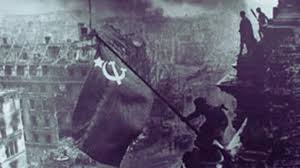
After an air and long-range artillery offensive, the Red Army attacked the Reichstag for the first time. On the afternoon of April 30, Hitler committed suicide, and at 9:30 p.m., Soviet troops took the Reichstag and raised the victory flag on its dome.
In that single battle, which culminated in the defeat of German fascism, the Soviets suffered 45,000 dead and 172,000 wounded.
The feat of the Soviet people cannot be equaled by any other country. After this brief summary, one can only hope that one day Trump will learn a little universal history. A task that will apparently be difficult.
(Hedelberto López Blanch is a Cuban journalist who writes for Juventud Rebelde and the weekly Opciones. Courtesy: Cuba en Resumen and Defend Democracy Press, the website of the Delphi Initiative. The ‘Delphi Initiative’ is a network of mainly (but not exclusively) European thinkers who oppose the attempt of international finance and international corporations to impose totalitarian control over Europe)