❈ ❈ ❈
How Indian States Are Using FIRs to Reframe Wage-Related Workers’ Disputes as Crimes
Rakhi Sehgal
In April, a series of protests by contract workers in the industrial belts of Manesar and Noida in the National Capital Region were met with a wave of First Information Reports that list several provisions of the Bharatiya Nagarik Suraksha Sanhita.
At first glance, these FIRs appear to document incidents of disorder – unlawful assembly, rioting, damage to property and attacks on police personnel. A closer reading reveals that they do far more than describe events. They actively reframe a wage-related labour dispute as a matter of public order and criminality.
Labour protests and strikes have been rolling across India since early this year – from Barauni in Bihar, to Panipat, Faridabad and Manesar in Haryana and Noida in Uttar Pradesh.
Different industries, different states, different employers but the same complaints: workers pushed to a breaking point by stagnant wages, rising prices, 12-hour shifts paid as eight, precarious employment conditions and a cost-of-living crisis sharpened by the cooking gas shortage.
What connects the protests is the condition of being a contract worker in India in 2026 – formally employed, substantively unprotected, and now, when they protest, criminally liable.
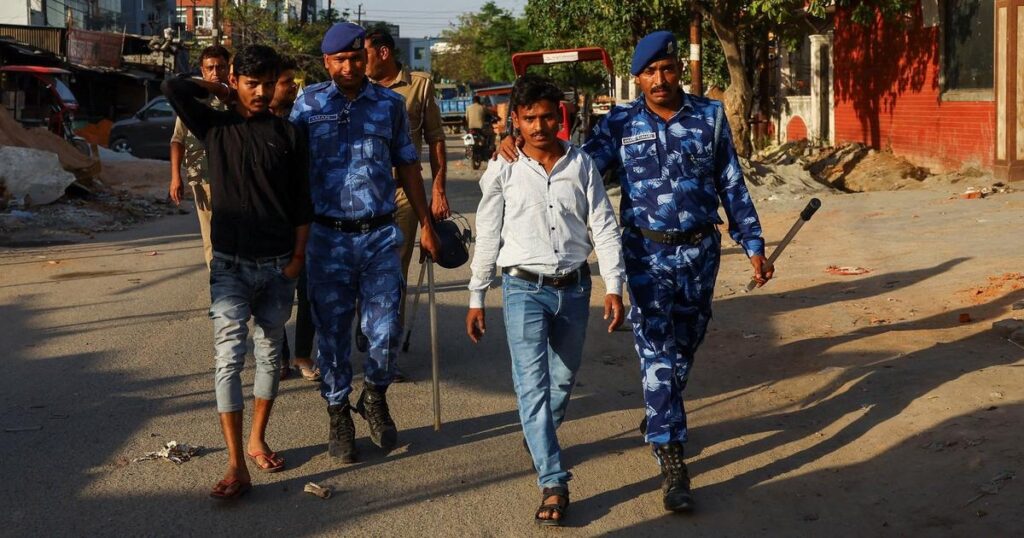
In Noida, protests by workers in April were first ignored and then met with prohibitory orders and mass detentions under Section 170 of the Bharatiya Nagarik Suraksha Sanhita. Nearly 1,100 workers were detained between April 11 and April 16. They were held in Luksar jail for several days, even though the provision is meant for preventive detention, not punishment.
Alongside this, at least ten FIRs were registered, invoking a wide range of serious criminal charges. The workers’ protests were not negotiated. They were policed out of existence.
Reasonable demands as a threat
In the FIRs, wage protest becomes unlawful assembly. Collective bargaining becomes rioting. Workers become a mob engaged in stone-pelting, whipped up by outside instigators. A demand for fair wages becomes a threat.
This is not sloppy drafting. It is intentional. The moment a labour action is classified as a public order problem, an entirely different state machinery becomes available. Labour law requires conciliation, adjudication, a process. Criminal law requires none of that. It only requires an FIR.
A careful reading of the ten FIRs in Noida makes clear what is missing.
There is no mention of the state’s failure to implement or revise minimum wages, despite a legal obligation to revise them every five years. There is nothing about women earning Rs 6,000-Rs 9,000 a month for ten- to 12-hour shifts in garment factories without basic facilities such as toilets. The LPG crisis does not find mention, nor does the fact that workers often arrive at their factories having eaten nothing.
These omissions are not an oversight. A worker who is responding rationally to hunger, fuel poverty and wage theft is not a rioter. To make her a rioter, you must first make her material conditions invisible. That’s the function of the FIRs.
What the FIRs cannot say – and what mainstream narratives of labour unrest have consistently refused to say is the obvious thing: that when the industrial relations system provides no space for workers to articulate and resolve their grievances, what you get is a pressure-cooker bursting. The FIR criminalises the explosion. It says nothing about the cause.
The instigation myth
The FIR attributes the strikes to unions and external organisations, implying that without this outside agitation, workers would have stayed quiet. This is false and deliberately so.
The protests in April were, by all accounts, spontaneous, spreading factory by factory. But the instigation framing strips workers of political agency – recasting them as manipulated rather than aggrieved. This provides the authorities with a legal handle. If unions organised this, you can go after organisers. They can be arrested at protest sites, picked up from their homes at night or placed under house arrest. That is precisely what happened.
Trade union activity in response to a workers’ crisis is a democratic right that remains protected in Indian law. The FIR does not acknowledge this. Long before any court reaches a conclusion, the strike has been broken, the workers have gone back, lives have been destroyed and the lesson delivered forcefully.
The FIR narrative sequence runs: workers assemble → police warn → workers disobey → force is used. It reads like a neutral account of events. It is not. It is a pre-emptive justification for everything that comes after – the lathi-charge, the detentions, the arrests from homes, the FIRs.
By the time anyone asks whether the force was proportionate, whether management or police had escalated first, whether the workers who were beaten and arrested had done anything beyond standing in the street, the answer has already been written. They disobeyed. Therefore, what happened to them was restoration of order.
The bigger picture
The FIRs in Manesar and Noida did not emerge from nowhere. They emerged from a decade-long restructuring of the relationship between Indian labour law and Indian capital, a restructuring that reached its logical conclusion in November 2025, when four Labour Codes replaced 29 older laws and were implemented nationwide. Those codes weakened collective bargaining, expanded contractualisation and made hire-and-fire easier. What they took away from workers in legal protection, criminal law is now being asked to enforce in its place.
This is the pattern. Weaken the labour court, strengthen the police station.
This analysis is not new. In 2015, I had noted the same pattern during the unionisation battle of Maruti Suzuki workers in Manesar – industrial disputes being converted into law-and-order problems through deliberate management provocation, police deployed before any violence had occurred, and a labour department that recused itself while the criminal machinery moved in.
The FIRs at Manesar and Noida in 2026 are the Maruti Manesar protest playbook, updated.
Collective labour action is first rendered unlawful through assembly provisions, then escalated into violence through rioting and injury charges, then consolidated as organised criminality through conspiracy – and, in the most serious FIRs, attempt to murder and mischief by fire, carrying life imprisonment.
The material conditions that precipitate protest appear nowhere in the legal record. The workers’ demands do not appear. Their names, often, do not appear. What appears is the crowd, the mob, the unnamed mass, the conspiracy.
The result, taken together, is a shift in how labour itself is governed, less as a subject of rights and negotiation, and more as an object of surveillance, control, and, when necessary, criminal sanction. The FIR is the instrument of that shift. That is what the FIRs do not say – and that is exactly why they matter.
[Rakhi Sehgal is an independent labour researcher with over two decades of association with the trade union movement. Courtesy: Scroll.in, an independent Indian digital news platform launched in 2014, known for explanatory journalism, investigations, culture writing, and in-depth coverage of politics, society, and human rights. Its English edition is edited by Naresh Fernandes.]
❈ ❈ ❈
Money, ID, Only Link to Family: Noida Police Hold on to Phones Despite Workers Being Released
Rakhi Sehgal
Most of the nearly 1,100 workers detained by Uttar Pradesh police under Section 170 of the Bharatiya Nagarik Suraksha Sanhita – a provision meant for preventive detention, not punishment – have been released. But when this article was written, more than 15 days after they were released, the workers’ phones or personal belongings had not yet been returned.
They had been detained after a series of protests led by contract workers across industrial units in Noida over the course of six days from April 9. The workers were drawing attention to their low wages, worsening working conditions and lack of statutory protections. Adding to their problems has been the rise in the price of cooking gas since the start of the war on Iran.
Rather than being addressed as labour disputes, these assertions of basic rights were met with a police crackdown, converting an industrial relations issue into a question of public order.
Not returning the phones of the workers after they were released from detention is a continuation of punishment after the detention has ended.
A phone, for most working-class Indians, is their only interface with their financial lives and identity proof: UPI, mobile banking, the digital wallet hold whatever little they may have saved while their Aadhaar, driving licence, medical history is also saved on their devices.
The police have offered no timeline for returning the workers’ belongings. There has been no communication, process nor acknowledgement that these items belong to someone. Lawyers also say that had there been a paper trail of the belongings seized, they could have submitted an application to the courts.
Among those stuck in the digital limbo is a pregnant woman who alleged that she was kicked in the stomach by the police during the scuffle on the streets outside her factory. She said was allowed to go only when she managed to communicate that she was pregnant. Even though she was not formally detained, her phone was not returned to her.
She needs her phone to communicate but also as a medical necessity since it holds her previous prenatal records and the Rs 3,000 to pay for an ultrasound.
Then there are migrant workers who came to the National Capital Region to work and send money home. Their families have been unable to travel from their home states to visit them in jail or arrange legal help because the money that would fund that travel was sent through phones that the police still hold.
It was their co-workers – fellow migrants, themselves living close to the edge – who stepped in and arranged legal representation. Many families have incurred debts that will keep them beholden for years on end.
Young workers who have been released from preventive detention want to return to their villages but are stranded. They cannot leave behind their phones which have money, identity documents and the Aadhaar that ties them to every entitlement they receive. Towards the end of April, those in Noida faced another crisis with rent due but their only funds being locked inside the phones the police will not return.
Meanwhile, many workers have not returned to their workplaces. Word has spread that HR departments are identifying and getting workers arrested at the factory gate itself. Until workers get their phones back, they have no money or documents. They are trapped between the police station that refuses to return their belongings and the factory that is now a site of ongoing reprisal.
Is access to one’s phone now a human right? Does that mean not returning the workers’ phones violates their human rights? That is how it is increasingly being seen.
The United Nations Special Rapporteur on Freedom of Expression has long held that access to digital communication tools is inseparable from the right to free expression and participation in public life. The Supreme Court of India, in the Anuradha Bhasin case in 2020, recognised that the right to access the internet is connected to the fundamental rights under Article 19, which guarantees the freedom of speech, and Article 21 protecting life and personal liberty.
A phone, in this country and at this moment in history, is much more than a gadget: it is a person’s access to their money, identity, healthcare and family.
The detained workers were not charged with any offence. The law used against them is explicitly preventive – it carries no criminal conviction, no trial, and must lead to release within 24 hours without a magistrate’s order. They workers walked out, legally free (albeit after five to seven days in custody instead of 24 hours). But the police hold onto their belongings.
A pregnant woman is waiting for an ultrasound she cannot afford without her phone. That should be all anyone needs to hear.
[Rakhi Sehgal is an independent labour researcher with over two decades of association with the trade union movement. Courtesy: Scroll.in, an independent Indian digital news platform launched in 2014, known for explanatory journalism, investigations, culture writing, and in-depth coverage of politics, society, and human rights. Its English edition is edited by Naresh Fernandes.]
❈ ❈ ❈
May Day Under Police Watch in Noida: Workers’ Resistance Persists
Mukund Jha
New Delhi/Noida: This year’s International Workers’ Day on May 1, in Noida and the industrial belt of Gautam Buddh Nagar was far from a routine commemoration. Instead, it unfolded as a politically charged moment shaped by workers’ assertions of rights, visible state surveillance, and an ongoing confrontation between labour and authority. Despite heavy police deployment and administrative restrictions, workers not only observed May Day but also sent a clear message of unity and resistance.
From early morning, an unusually high police presence was visible across Noida, Greater Noida, and adjoining industrial clusters. Security personnel were stationed outside several factories, reportedly to prevent workers from assembling or organizing collective events. According to labour leaders, in multiple instances activists were placed under informal house detention, prevented from putting up banners and posters, and even discouraged from raising slogans. The administration’s approach appeared aimed at ensuring that workers’ collective visibility on a politically significant day like May Day remained minimal.
Yet, these efforts did not entirely succeed.
At several locations—including the Anmol Industries unit in Greater Noida—workers and members of the Centre of Indian Trade Unions (CITU) gathered in small but determined groups. They hoisted red flags, held brief meetings, and reaffirmed their commitment to labour rights. For many participants, the act itself carried symbolic weight: a declaration that intimidation and restrictions could not silence workers’ voices.
This year’s May Day observance must be understood in the backdrop of the recent wave of labour unrest that began in Noida on April 9. Thousands of workers had taken to the streets, demanding an increase in minimum wages, implementation of an eight-hour workday, fair overtime compensation, and enforcement of basic labour protections. Workers argued that wages ranging between ₹11,000 and ₹13,000 per month were grossly inadequate in the face of rising living costs.
The movement quickly grew in scale, drawing attention from both the administration and industrial management. However, tensions escalated following incidents of violence reported on April 13. In the aftermath, the region witnessed intensified policing: detentions of workers and activists, frequent raids, and the creation of what many described as a “security grid” across industrial zones. Labour groups have consistently alleged that these actions went beyond maintaining law and order and were aimed at suppressing the workers’ movement itself.
The atmosphere of control extended into May Day.
While authorities appeared determined to prevent large gatherings, workers adapted by organizing decentralized events. These smaller assemblies became acts of symbolic defiance—assertions that workers would not abandon their historical legacy or collective identity under pressure.
A notable moment occurred when Gangeshwar Dutt Sharma, Vice President of CITU (Delhi-NCR), engaged in a heated exchange with police officials who attempted to stop him and his colleagues from hoisting the flag and addressing workers. Sharma reportedly asserted that in a democratic society, such restrictions were unacceptable, adding that even the threat of force would not deter them from observing May Day.
He further stated that an atmosphere of fear and intimidation was being deliberately created across industrial areas. According to him, the administration was attempting to divert attention from workers’ real issues—low wages, lack of basic rights, and exploitative conditions—by imposing restrictions on their democratic expressions. “an Indian news website founded by Prabir Purkayastha in 2009, who also serves as the Editor-in-Chief. Industrial peace cannot be established through repression,” he emphasised, arguing that genuine stability would only emerge when workers receive their due rights and exploitative practices are addressed.
Sharma also highlighted persistent violations of labour standards. Workers, he noted, are frequently denied overtime payments, weekly holidays, and bonuses—benefits that are legally mandated. He described attempts to prevent May Day celebrations as deeply troubling, given the historical and symbolic importance of the day.
Mukesh, district president of CITU in Gautam Buddh Nagar, drew attention to another structural issue: regional disparities in minimum wages. He pointed out that workers in Delhi, Gurugram, and Noida receive significantly different wages despite facing similar living costs. This disparity, he argued, has contributed to growing dissatisfaction among workers. Even the recent wage revisions, he said, fall short of meeting basic livelihood needs.
Mukesh further alleged that workers are routinely made to work 10–12 hours a day without appropriate overtime compensation. He also expressed concern over what he described as intimidation tactics by authorities, including police visits to factory gates and the filing of questionable legal cases against workers.
Bringing a broader perspective, A.R. Sindhu, National Secretary of CITU, connected the current struggle to the historical legacy of May Day. She recalled that the demand for an eight-hour workday was won through intense struggles over a century ago, yet workers continue to raise the same demands today. This, she argued, reflects the unfinished nature of the fight for labour rights. She cautioned that any further weakening of labour laws would only deepen workers’ vulnerabilities.
Rupesh Verma, district secretary of the All India Kisan Sabha (AIKS), emphasised the importance of worker–farmer solidarity. He described May Day not merely as a commemorative event but as a symbol of ongoing struggle. Attempts to restrict its observance, he said, were unfortunate but ultimately ineffective, as workers had demonstrated their resolve to continue fighting for their rights.
Labour organisations have also raised broader concerns about the role of the state. They argue that the government’s actions signal an attempt to reassure industrial interests that profitability will be protected, even at the cost of labour rights. According to them, the recent upsurge in worker mobilisation has exposed the exploitative conditions underlying Noida’s image as a modern industrial hub.
The developments in Noida thus raise critical questions about India’s development trajectory. Can industrial growth be sustained if it sidelines workers’ rights? What does it mean for democratic practice when expressions of labour solidarity face restrictions? These questions go beyond a single region and reflect larger tensions within the country’s economic model.
May Day 2026 in Noida stands as a powerful illustration of these contradictions. On one hand, there is visible state control—police presence, restrictions, and surveillance. On the other, there is persistent worker resistance—adaptable, determined, and rooted in a long history of struggle.
Despite the constraints, workers succeeded in marking the day, reaffirming their demands, and sustaining their collective voice. Their message was clear: repression may limit visibility, but it cannot extinguish the underlying grievances or the will to resist.
In that sense, the events in Noida are not just about one day or one region. They are indicative of a broader moment in India’s labour landscape—one where questions of dignity, fairness, and rights are being asserted with renewed urgency. And as history has shown, such assertions, once articulated collectively, rarely fade away quietly.
[Mukund Jha is an independent journalist and documentary filmmaker whose work focuses on labour rights, migration, social justice and grassroots movements in India. Courtesy: Newsclick, an Indian news website founded by Prabir Purkayastha in 2009, who also serves as the Editor-in-Chief.]