❈ ❈ ❈
Nepal’s Gen-Z Uprising is About Jobs, Dignity—and a Broken Development Model
Atul Chandra and Pramesh Pokharel
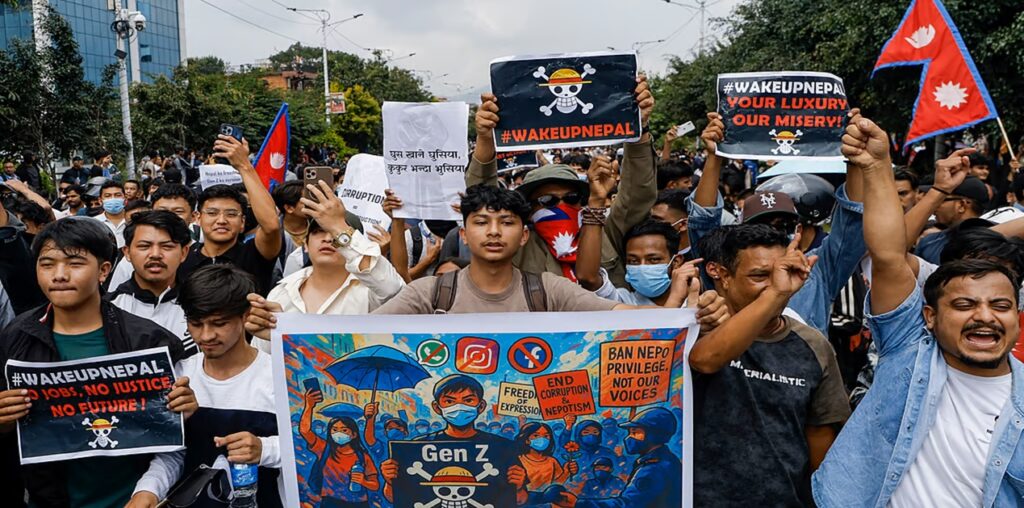
Kathmandu is on edge not because of “apps,” but because a generation raised on the promise of democracy and mobility has collided with an economy and political order that keep shutting every door. The proximate trigger was regulatory: the government ordered 26 major social-media platforms to register locally and began blocking those deemed non-compliant, including Facebook, YouTube, Instagram, WhatsApp, X and others. Crowds surged toward Parliament; police deployed tear gas, rubber bullets and, in several places, live fire. By late 9 September, at least 19 people were killed and well over 300 injured. Under pressure, the government lifted the social-media banand Prime Minister K. P. Sharma Oli resigned.
The Spark Was the Ban. The Fuel Was Political Economy
It is tempting—especially from afar—to narrate this as a clash over digital freedoms. That would be analytically thin. For Gen-Z Nepalis, platforms are not just entertainment; they are job boards, news wires, organizing tools, and social lifelines. Shutting them off—after years of economic drift—felt like collective punishment. But the deeper story is structural: Nepal’s growth has been stabilized by remittances rather than transformed by domestic investment capable of producing dignified work. In FY 2024/25, the Department of Foreign Employment issued 839,266 labor permits—staggering out-migration for a country of ~30 million. Remittances hovered around 33 percent of GDP in 2024, among the highest ratios worldwide. These numbers speak to survival, not social progress; they are a referendum on a model that exports its youth to low-wage contracts while importing basics, and that depends on patronage rather than productivity.
That is why the ban detonated so quickly. With youth under- and unemployment already high at 20.82 percent as seen in 2024, ministerial churn the norm, and corruption scandals ambient, attempts to police the digital commons looked less like “order” and more like humiliation. The movement’s form—fast, horizontal, cross-class—echoed Bangladesh’s student-led mobilizations and Sri Lanka’s Aragalaya: school and college students in uniform, unemployed graduates, gig and informal workers, and a broader, disillusioned public converged around a shared verdict on misrule.
Facts on the Ground: Casualties, Curfews, and Climb-Down
The event’s sequence is unambiguous. An expansive registration order and blocking decision ignited protests; security forces responded with escalating force; by Monday night 19 were dead and hundreds injured; curfews and assembly bans spread; the Home Minister quit; an emergency cabinet huddle withdrew the ban; by Tuesday, Oli resigned.
Importantly, the grievance was never only digital. Protest signs and chants centered on corruption, elite impunity, and the absence of a credible development horizon. Amnesty International demanded an independent probe into possible unlawful use of lethal force—another reason the uprising hardened from a platform quarrel into a legitimacy crisis.
Migration as the Silent Plebiscite
If one metric explains the generational mood, it is Exits. The 839,266 labor permits issued in FY 2024/25 (up sharply from the previous year) translate into thousands leaving every day at the peak. These are not tourists; they are the very cohort now on the streets. Their remittances—~33 percent of GDP—keep households afloat and the import bill paid, but they also mask a lack of structural transformation in the domestic economy. In a system that cannot absorb its educated youth into stable, value-adding work, the public square—online and offline—becomes the one place where dignity can be asserted. Trying to close that square amid scarcity was bound to provoke an explosion.
A Self-Inflicted Wound for Nepal’s Left
Following Nepal’s four-year IMF Extended Credit Facility (ECF) program, the government faced pressure to boost domestic revenue. This led to a new Digital Services Tax and stricter VAT rules for foreign e-service providers, but when major platforms refused to register, the state escalated by blocking them. This move, which began as a tax enforcement effort, quickly became a tool of digital control, and it occurred as the public was already dealing with rising fuel costs and economic hardships driven by the program’s push for fiscal consolidation. The government’s platform ban became the final trigger for widespread protests against corruption, joblessness, and a lack of opportunities, highlighting that the unrest was less about a “color revolution” and more about material grievances fueled by austerity measures.
That the crackdown and its political denouement unfolded under a CPN (UML) prime minister makes this a strategic calamity for Nepal’s left. Years of factional splits, opportunistic coalitions, and policy drift had already eroded credibility among the young. When a left-branded government narrows civic space instead of widening material opportunity, it cedes the moral terrain to actors who thrive on anti-party cynicism—individual-cult politics and a resurgent monarchist right. The latter has mobilized visibly this year; with Oli’s resignation, it will seek to portray itself as the guarantor of “order,” even as its economic vision remains thin and regressive. This is the danger: the very forces most hostile to egalitarian transformation can capitalize on left misgovernance to expand their footprint.
From an anti-imperialist vantage—one that opposes Northern privilege yet insists on unsentimental analysis—the crisis is textbook dependency without development. Remittances smooth consumption but entrench external dependence; donor-driven governance tweaks rarely become employment-first industrial policy; and procurement-heavy public spending feeds rent circuits more than productive capacity. In such an order, the state is tempted to police visibility rather than transform conditions. That is why an attempt to regulate platforms by switching them off—rather than by ensuring due process and narrow tailoring—was read as an effort to manage dissent, not to solve problems.
What Opposition Signals Tell Us (and What They Don’t)
Opposition statements recognized the larger canvas sooner than the government did. Pushpa Kamal Dahal (Prachanda) expressed condolences, urged action on anti-corruption demands, and called for removing “sanctions on social networks.” The CPN (Unified Socialist) and CPN (Maoist Centre) statements condemned the repression, demanded an impartial investigation, and linked digital curbs to failures on jobs and governance. These reactions matter analytically because they show that even within mainstream politics there is acknowledgment that the crisis is about livelihoods and legitimacy, not merely law-and-order.
But these signals also reveal the predicament of the left: if its leading figures can only react to a youth uprising rather than prefigure the development horizon that would have prevented it, then the arena will be dominated by anti-establishment and royalist currents claiming to deliver order faster—even at the cost of democratic space.
The bottom line
These protests in Nepal began because a government tried to regulate by switching off the public square. They exploded because that square is where a precarious generation looks for work, community and voice in the absence of opportunity at home. A complete accounting must therefore record both the human toll—19 dead and hundreds injured—and the structural toll: hundreds of thousands compelled to leave each year and remittances that prop up consumption while postponing transformation. With Oli’s resignation and the ban withdrawn, the immediate confrontation may ebb, but the verdict delivered by Gen-Z will not. Until Nepal replaces remittance complacency and coalition arithmetic with an employment-first development model, the streets will remain the most credible arena of accountability.
[Atul Chandra is a researcher at Tricontinental: Institute for Social Research. Pramesh Pokharel is a political analyst and part time lecturer of Anthropology at Tribhuvan University. He is a Central Committee Member of CPN (Unified Socialist) and General Secretary of All Nepal Peasants Federation. Courtesy: Globetrotter, a project of Independent Media Institute, a nonprofit organization that educates the public through a diverse array of independent media projects and programs.]
❈ ❈ ❈
Five Theses on the Situation in Nepal
Vijay Prashad and Atul Chandra
If your house is not clean, then the ants will come through the door and draw in the snakes.
The crisis in Nepal escalated in early September, bringing down the center-right government of Prime Minister KP Oli. The immediate spur was the regulation and banning of social media on September 4. Protests over this action were met by police firing, which resulted in the killing of 19 protestors. This escalated into major manifestations, leading to attacks on the homes of politicians and the national parliament building as well as the presidential building.
Several narratives are circulating about the current upheaval, but two dominate:
- Systemic governance failure: That years of unmet promises, corruption, and opportunistic alliances produced a legitimacy crisis not for this or that party, but for the establishment. The present upsurge is explained as a popular backlash due to the cumulative neglect.
- Color Revolution thesis: That the protests are engineered by an external force, most of the fingers pointing at the United States and at the US Congress’ National Endowment for Democracy’s funding towards Hami Nepal (established in 2015).
Both theories make it easy for the stakeholders within Nepal to deflect responsibility – either onto foreign meddlers or onto a vague idea of the “political class”. There is no discussion in these theories of the underlying bourgeois order and its problems in Nepal: a century-long patronage economy, the control of land, finance, and government contracts in the hand of an oligopoly with close ties to the monarchy, and a growth paradigm depending on the export of migrant workers and of debt-financed infrastructural development. The structural sources of peoples’ grievances are flattened into simplistic, but evocative concepts such as “corruption” and “color revolution”.
Neither of these theories are totally incorrect or correct but are only partial and their partiality can be very misleading. This article cannot by itself correct that partiality, but it hopes to offer some ideas for discussion. The five theses below are intended only to frame the debate that we hope will be held not only over Nepal’s predicament, but that of many countries in the Global South.
1. Mismanagement of the opportunity. After the new Constitution was enacted in Nepal in 2015, there was immense hope that the broad left would be able to advance the social situation of Nepalis. Therefore, in 2017, the various communist parties won 75% of the seats in the national parliament. The following year, the larger communist parties joined together to form the Nepal Communist Party – although the unity was not very deep because the parties had their own structures and their own programs and could not truly form a unified party, but mainly a unified electoral bloc. The lack of a common program for communist political activity, and a common agenda to solve the people’s problems through the instrument of the State led to the dissipation of the opportunity provided to the left.
The unified party split in 2021, and since then the various left parties rotated in power, which people saw as individualism and opportunism. When the Home Minister Narayan Kaji Shrestha (2023-2024) of the Maoist Center tried to use the instruments of the state to investigate corrupt practices – even in his own party – he was hounded out of office. Since 2024, the government in Nepal included a rightist fraction of the left (led by K. P. Oli) and the one fraction of the right (the Nepali Congress), which made it a center-right government. The long fight for democracy that began with the 1951 Revolution, deepened with the 1990 Jana Andolan, and then appeared to be cemented with the 2006 Loktantra Andolan only appears to be defeated, when in fact that long struggle will reappear in another form.
2. Failure to tackle the basic problems of the people. The problems in Nepal in 2015, when the new Constitution was adopted, were grave. A massive earthquake in Gorkha devastated the province, leaving over 10,000 people dead and rendering hundreds of thousands homeless. At least a quarter of Nepalis lived under the poverty line. Caste and ethnic discrimination created a great sense of despair. The Madhesh region along the Nepal-India border was particularly angered by the sense of disadvantages and then by an analysis of being further marginalized by the 2015 Constitution. Weak public healthcare and education – underfunded for a century – could not meet the aspirations of the emerging middle class.
The left governments did put forward various policies to address some of these issues, lifting large sections of the population from poverty (child poverty went from 36% in 2015 to 15% in 2025) and from infrastructural abandonment (electricity access now at 99% and a registered improvement in the Human Development Index).
There remains, however, a huge gap between the expectations and the reality, with inequality rates not dropping fast enough and migration at startlingly high levels. Corruption levels also remained too high in the country as corruption perceptions deteriorated (ranked 107/180 in 2024). Corruption, inequality, and inflation could not be contained by the government, which made very poor deals for trade and for finance (the return to the IMF’s Extended Credit Facility narrowed its fiscal possibilities).
3. The tendency to seek refuge in the idea of the Hindu Monarchy. The Nepali petty bourgeoisie, which sent their children to English medium schools, and often come from oppressed or “backward” Hindu castes are frustrated by the continual domination of upper castes and are inspired by the right-wing Hindutva petty bourgeoisie politics of India’s Uttar Pradesh, one of the states that borders Nepal. That is why there were many posters in the protests of Yogi Adityanath, a leader of India’s right-wing Bharatiya Janata Party (BJP) and the leader of the Uttar Pradesh government. This fraction of the population is also in the mood to “return” to monarchy, which is a Hindu monarchy. Several political forces back these tendencies, such as the pro-monarchy party (Rashtriya Prajatantra Party or RPP) and its broader allies (Joint Peoples’ Movement Committee – formed in March 2025 as part of the return to monarchy protests, Shiv Sena Nepal, Vishwa Hindu Mahasabha).
Since the 1990s, the Hindu Swayamsevak Sangh (HSS), the Indian RSS’s international affiliate, has quietly built shakhas (groups) and cadre since the 1990s. The HSS – along with a tentacular group of organizations such as the Shiv Sena and the RPP – has campaigned against secular policies and for a return to Hindu Raj. Rather than merely target secularism, the Hindutva bloc has focused attention on what it says is a revolving door of elites in Kathmandu that has held power ever since the monarchy was abolished in 2008. They frame their civilizational rhetoric around anti-corruption and charity, with mobilizations through Hindu festivals and through online influencers as well as selective outreach to marginalized and oppressed castes in the name of Hindu unity. This bloc, powerfully organized unlike the youth, has the capacity to seize power and to restore order in the name of the Hindu state and the monarchy, bringing back authoritarianism in the name of anti-corruption.
4. Tired of the Migration Escape Valve. If we ignore small countries such as Montserrat and Saint Kitts and Nevis, Nepal is the country with the highest per capita rate of migration for work. With a population of 31 million there are currently 534,500 Nepalis (recorded) who work overseas – 17.2 people per 1,000 Nepalis. The numbers have surged in recent years. In 2000, the recorded figure for Nepalis who obtained foreign employment permits was 55,000, now it is ten times higher. There was a new record in 2022-23 with 771,327 permits issued).
Large sections of youth are angry that they have not been able to meet their needs for employment within Nepal but are forced to migrate and often to horrible jobs. A terrible incident in February 2025 took place in Yeongam (South Korea), when a 28-year-old migrant, Tulsi Pun Magar, likely committed suicide because the employer at the pig farm where he worked kept revising the wage rate downwards. Tulsi came from the Gurkha community in Pokhara. In the wake of his suicide, reports came that 85 Nepalis have died in South Korea in the past five years, half of them by suicide. News of stories such as these increased the frustration and anger at the government. Online, many shared the sentiment that the government was more considerate of foreign direct investors than of its own migrants, whose investment in Nepal through remittances is far higher than any foreign capital.
5. The external influences of the United States and India. The center-right government of KP Oli had been close to the United States. Nepal had joined the US government’s Millennium Challenge Corporation (MCC) in February 2017, a decision by a left government that was hugely contested by large sections of the left. Due to the pressure from below, Nepal’s government stayed away from the MCC, but Oli’s center-right government welcomed John Wingle (Deputy Vice President of the MCC) to Kathmandu in August 2025 to hold talks about resumption of US aid and to discuss the continuation of infrastructural projects. Meanwhile, India’s far-right government of Narendra Modi sought to promote the role of the Hindu nationalist far right party in Nepal, which has thus far been at the margins. If there was any external activity in the 2025 protests, it is more likely that India, and not the US, had a hand in the events. However, even here, it is possible that the far-right wing in Nepal will merely take advantage of the collapse of the Oli government and the enormous sentiment against corruption.
It is important to recognize that no home or office of the RPP was attacked, whereas in March the RPP cadre attacked one communist office – a foreshadowing of what happened in September.
The army appears to have restored some calm in Nepal. But this is a calm that is one of disorder and danger. What comes next is to be seen. It will take time for the dust to settle. Will the army invite one of the online celebrities to take over such as Kathmandu mayor Balendra Shah? The protestors have suggested Sushila Karki, who is a highly respected former Chief Justice of Nepal (2016-2017), who has made a career of being independent of political parties. These are caretaker choices. They will not have the mandate to make any significant changes. They will pretend to be above politics, but that will only disillusion people with democracy and plunge the country into a long-term crisis. A new Prime Minister will not solve Nepal’s problems.
[Vijay Prashad is an Indian historian, editor, and journalist. He is a writing fellow and chief correspondent at Globetrotter, and the director of Tricontinental: Institute for Social Research. He is a senior non-resident fellow at Chongyang Institute for Financial Studies, Renmin University of China. He has written more than 20 books. Atul Chandra is the co-coordinator of the Asia program of Tricontinental: Institute for Social Research. Courtesy: Peoples Dispatch, an international media organization with the mission of highlighting voices from people’s movements and organizations across the globe.]