❈ ❈ ❈
How Nehru Used Science for Nation Building
S. Irfan Habib
Jawaharlal Nehru is justly seen as the main architect of modern India. Undoubtedly, he was one of the most enlightened leaders of India’s freedom struggle. He was not merely a leader but also an idea, which we as citizens lived for a few decades since 1947. For him, science was not limited to industry and development, it was for him a romance which he wanted everyone to experience and live. For him, science was actually a dream, an imagination, where he dreamt about an India which will be not only robust, but also self-reliant. While he wanted to salvage whatever was constructive in India’s tradition and culture, he battled against the hegemony of religious dogma and orthodoxy which were obstructing the country’s development and modernisation.
Given the stature of the man and his passionate involvement with the building of new India, it was inevitable that indictment would also knock on his door. Nehru and Gandhi are probably the two most venerated and critiqued leaders of modern India. However, the crass rubbishing of the Nehruvian legacy today is not only misplaced but also misinformed and motivated. We tend to telescope our present into the past and evaluate Nehru against the neoliberal standards of today, and, expectedly, he fails in this appraisal. If we care to ponder and look into the India Nehru inherited, we find an India exploited and colonised for 200 years. Scientific research and technological developments conformed to the needs of the empire and not the welfare of common Indians.
Most of the scientific teaching and even some research were around field-based sciences like geology, zoology, botany and some more, which could facilitate colonial exploitation. Nehru had an arduous task at hand. He had to reverse the role of science and technology and make it compatible with progress and development. It is easy to be condescending but difficult to be critically discerning.
Progressive and scientific vision
Jawaharlal Nehru’s initiation into science began early in life when his father, Motilal Nehru, engaged Ferdinand Brooks, a theosophist, as his tutor in 1901. Nehru wrote later that “Brooks also initiated me into the mysteries of science. We rigged up a little laboratory and there I used to spend long and interesting hours working out experiments in elementary physics and chemistry.” He took his interest in science further when he joined Harrow in 1905 and later a Science Tripos from Trinity College, Cambridge.
His years in Cambridge provided him with an opportunity for some contact with the Cavendish Laboratory where many of the leading British scientists in the late 19th and early 20th centuries worked—men, such as James Jeans, Arthur Eddington, J.J. Thompson, and Lord Rutherford. Though he abandoned science after his stint at Cambridge for a law degree, later to be followed by a long political career in India, his university studies in science, along with other fundamental dispositions, clearly left a strong commitment to science as an important means of solving human problems.
There is enough to show in his letters and other literature that Nehru did not see a career in science. However, instrumental use of science for nation building and, more than that, scientific and rational thinking remained with him forever. As his celebrated biographer S. Gopal noted: “The encouragement of science and scientists was expected to help not only in improving the material environment but in influencing even the mental conditioning.” Nehru aptly said once that “we live with every century surrounding us, not only in our external lives but in our minds”. Gopal felt that according to Nehru “the spread of scientific knowledge would reveal the absurdity of such mental co-existence by strengthening the scientific attitude, which to Nehru was basically open-mindedness, the effort to search out the truth by experiment, not to believe in anything that could not be proved to be true nor to disbelieve anything unless proved wrong.”
Even Bhagat Singh, our iconic revolutionary, had appreciation for Nehru’s progressive and scientific vision. He approvingly cited a passage from Nehru in 1928, saying, “Every youth must rebel. Not only in the political sphere, but in social, economic and religious spheres also…. Everything unreasonable must be discarded even if they find authority for it in the Vedas and Quran.” Bhagat Singh expressed similar views in his famous essay “Why I am an atheist”, saying that “any man who stands for progress has to criticise, disbelieve and challenge. …mere faith and blind faith is dangerous: it dulls the brain and makes a man reactionary”. For his scientific and rational vision, Bhagat Singh went on to call Nehru a revolutionary who stood for a radical change and not mere reform.
India gained freedom along with several other countries, including Pakistan, almost simultaneously. I do not want to draw detailed parallels between them and their profiles as newly emerged nations. However, the option Nehru chose in the available social and political context stood India well in contrast with everyone else. His engagement with India’s scientific development began in the 1930s, much before freedom was won. Subhas Chandra Bose as Congress president constituted the National Planning Committee (NPC) at the suggestion of the physicist Meghnad Saha, who also insisted that a prominent national leader should be its head. Saha and some scientists in Calcutta, inspired by the Soviet model, were contemplating plans for the application of science and technology for national development. They had also launched a monthly journal called Science and Culture in 1935, where they put forth a blueprint for future scientific and technological planning.
For Subhas Bose, Nehru was the obvious choice to head the NPC. In 1937, Jawaharlal Nehru articulated the worldview of the party when he asserted: “Congress represents science, and science is the spirit of the age and the dominating factor of the modern world. Even more than the present, the future belongs to science and to those who make friends with science and seek its help for the advance of humanity.” While circulating a note to NPC members, Nehru wrote: “Our plan for national development must, therefore, be drawn up for a free and independent India. This does not mean that we must wait for independence before doing anything towards the development of a planned economy…. All such efforts, however, must be directed towards the realisation of the plan we have drawn up for a free India.” This decade of the 1930s also saw Nehru reading and talking about Bertrand Russell, J.D. Bernal, J.B.S. Haldane and other radical scientists of the decade. Their influence is palpably visible in the work of the NPC as well as in the later scientific and technological expansion during the Nehruvian era.
The NPC produced a detailed report in 27 volumes, with a separate volume of views and recommendations for an integrated national plan. Seen in historical context, the NPC forged a common platform for the country’s leadership in politics, science, technology and industry. The action plan charted out in these documents had much to say about economic independence and political freedom. It is fashionable to be critical of Nehru today but seen retrospectively, his plans were in tune with the spirit of the anti-colonial struggle, which had to be gradual and consensual and dependent on state-led initiatives. Nehru moved away from Gandhi’s aversion to industrialisation and even said once to the Mahatma in 1940 that if a country sat on its large-scale industries, then other countries will sit on that country.
Following the declaration of Indian independence from colonial rule, the Congress Party gradually assumed the role of government. Jawaharlal Nehru, who was at the helm, inherited a nation which had seen two genocides, the Bengal famine and Partition. The country was littered with beleaguered refugees who had lost homes and families. They looked up to Nehru with hope and he did not disappoint them. Nehru used science and technology as a healing balm.
As Shiv Visvanathan recently said about Nehruvian times: “We used science as an enzyme of hope, an elixir of development.” These were times when the Euro-American world was sceptical about science after the atomic bomb disaster in Japan and also the concentration camps in Germany. For Nehru, science continued to be a dream, where millions of Indians had to be looked after and a new nation had to be rebuilt. Reacting to the atom bomb in Japan, he warned, “The use of the atom bomb, if properly made, will lead to world peace, otherwise the world will be ruined.” And he expressed hope as well when he said, “If the atomic energy behind the atomic bomb is utilised for constructive power, it will very much develop the entire structure of the world. The world is bound to change in the coming few years and I hope that atomic energy will be used in constructive power to uplift mankind.”
With this spirit, Nehru engaged the physicists Homi Bhabha and Meghnad Saha to carry forward the atomic physics programme and develop institutions for higher research. Bhabha had already founded the Tata Institute of Fundamental Research (TIFR) in 1945. The institute started functioning on the campus of the Indian Institute of Science in Bangalore and moved to Bombay later that year. The TIFR’s new campus in Colaba was inaugurated by Prime Minister Nehru on January 15, 1962. Soon after Independence, in 1948, Nehru established the Atomic Energy Commission to institutionalise and expand scientific research activities in atomic physics. Nehru also went ahead with the creation of the Atomic Energy Establishment, Trombay, in 1954, which was renamed Bhabha Atomic Research Centre in 1967 after the tragic death of Homi Bhabha.
Jawaharlal Nehru also had to contend with the competing aspirations of Bhabha, Saha and Shanti Swarup Bhatnagar and yet take forward his own vision of creating possibilities of “big science”. An industrial research system is considered one of the founding pillars of an industrial society and Bhatnagar took up this task with the founding of the Council of Scientific and Industrial Research (CSIR). The idea for the CSIR grew out of the deliberations in the NPC and the journal Science and Culture, and took a final shape following the visit of Prof A.V. Hill, Biological Secretary of the Royal Society, to India in 1943. Bhatnagar became the first head of the CSIR and through his proximity to Nehru he was able to establish a network of 22 “national laboratories” under the CSIR between 1948 and 1958.
Nehru was personally present, along with Maulana Azad, to inaugurate most of these laboratories. We can see his sense of personal involvement with the enterprise of science when he spoke at the launch of the National Physical Laboratory in Delhi on January 21, 1950. He said: “When I think of this tremendous adventure, i.e. science in the past and the tremendous adventure that I hope it is going to be in the future, I am fascinated by this prospect and I feel how much better it would have been for me to be a Director of this Institute if I had the competence than to be the Prime Minister.”
The image of Nehru as a philosopher-statesman and Nehru as entrapped within the world of realpolitik has proved to be the bugbear of most historians. What is certain is that he reposed in science a close-to-religious faith deriving from his perception of the transformation of the world around him. As a historian with remarkable skills, having authored Glimpses of World History and The Discovery of India, he visualised, true to his age, the emergence of modern science and technology as altering the lives and outlook of people in the non-Western world. He most sincerely believed that a critical commitment to science could drive the spirit of development of the new nation by igniting the spirit and minds of the people: science was to be the principal instrument for bringing about rapid change. As he once said: “Science is not a matter merely of looking at test tubes and mixing different gases and producing things big or small or gadgets. Science ultimately is a way of training the minds and the mind’s working and their whole life functioning according to the ways and methods of science.”
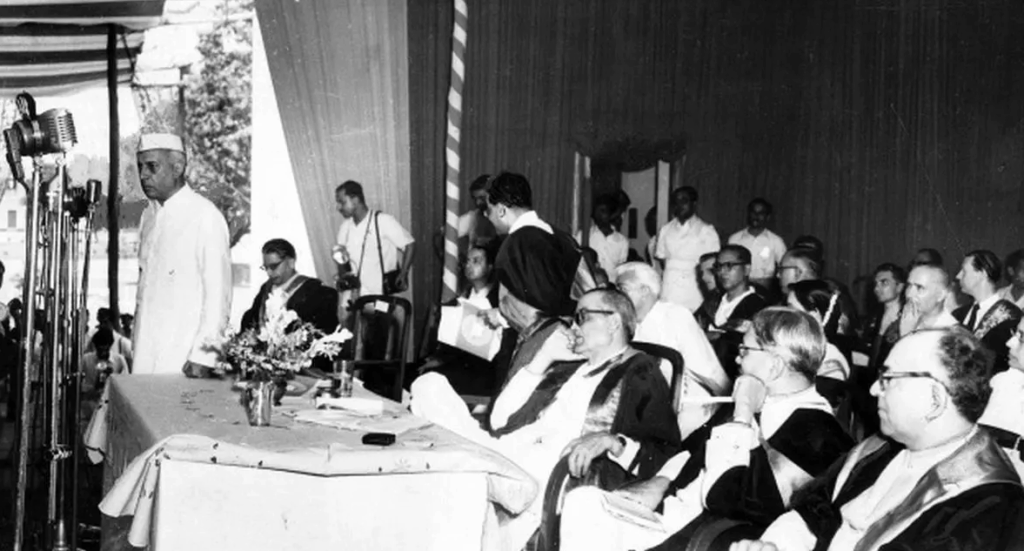
Nehru was conscious of the fact that large-scale scientific and industrial projects will need trained manpower, and a band of skilled young men and women to make them function effectively. A 22-member committee was set up under Sir Nalini Ranjan Sarkar and its report was used as a blueprint to launch the prestigious network of the Indian Institutes of Technology (IITs). The first IIT was set up just three years after Independence in 1950 at the site of the Hijli Detention Camp near Kharagpur in West Bengal.
Speaking at its first convocation in 1956, Nehru said: “Here in the place of that Hijli Detention Camp stands the fine monument of India, representing India’s urges, India’s future in the making. This picture seems to me symbolical of the changes that are coming to India.” To maintain regional balance, four more IITs were established by 1961, in Bombay, Madras, Kanpur and Delhi. Despite the Cold War tensions, Nehru could manage these institutions with the support of the Soviet Union, the United States, Germany and Great Britain. We could carry forward the nation-building processes on the firm foundations laid down during the definitive decade of the 1950s.
Committed to self-reliance
Jawaharlal Nehru was deeply committed to the idea of self-reliance and self-sufficiency in food production as he inherited an impoverished and economically exploited India. He was unswervingly dedicated to the promises and values of the freedom struggle and was in a hurry to deliver. To raise agricultural production, he conceived a plan of big dams for irrigation, which was really indispensable for the task at hand.
A series of Soviet-style Five Year Plans resulted in multipurpose river control works that included the Damodar Valley Project in West Bengal and Bihar (now Jharkhand), inspired by America’s Tennessee Valley Authority, and the Hirakud Project, in the eastern Indian State of Orissa, designed to irrigate over 1.5 million acres (one acre is 0.4 hectare) of crop land. The most promising of all was the Bhakra Dam, stretched across a 1,700-foot canyon on the Sutlej river in Bilaspur, Himachal Pradesh, to prevent floods and carry water and electricity to the fertile Punjab. At its dedication in 1963, Nehru famously called Bhakra, “the temple of a free India, at which I worship”.
It will be sheer pettiness and denial of facts if we do not concede that it was Nehru’s consistent and spontaneous political support that made scientific and industrial projects possible during the critical formative phase of the country. Over 45 laboratories in different fields were launched during his 17 years in office. It was also during the last two years of his tenure that the first steps were taken to launch India into the electronics and space era.
For Nehru, the solution to India’s problems lay in a combination of socialism and science, of technology and heavy industrialisation. He reiterated his commitment to the scientific temper all his life. Nehru once observed nostalgically: “And though circumstances made me part company with science, my thoughts turned to it with longing. In later years, through devious processes, I arrived again at science, when I realised that science was not only a pleasant diversion and abstraction, but was of the very texture of life, without which our modern world would vanish away. Politics led me to economics, and this led me inevitably to science and the scientific approach to all our problems and to life itself.”
(S. Irfan Habib is Maulana Azad Chair, National University of Educational Planning and Administration, New Delhi. Courtesy: Frontline, 26 November 2014. Frontline is a fortnightly English language magazine published by The Hindu Group of publications headquartered in Chennai, India.)
❈ ❈ ❈
Despite the Assaults on Nehru’s Legacy, India Still Lives in the House That He Built
Mohan Guruswamy
Jawaharlal Nehru died 61 years ago on May 27, 1964. He was 74. He had a stroke that morning at 6.25 and lost consciousness almost immediately. He died without regaining consciousness, and according to a member of his household, his death was due to “an internal hemorrhage, a paralytic stroke, and a heart attack”.
He had returned the previous day from Mussourie, “hale and hearty” but Nehru was clearly ailing. Parliament, then in session, and the nation were told about his death at 2.05 pm.
A major event such as this inevitably gives rise to “where were you?” questions. Where were you when Kennedy was assassinated? Where were you when Indira Gandhi was killed? Where were you when the World Trade Center was brought down?
The shock of the event magnifies the immediate around you and imprints itself in your mind. I still can vividly recall the day Nehru died and the moment I learnt about it.
I was in Poona studying German at the Goethe Institute, and after class that afternoon I was cycling into town to meet a friend. As I passed a government building, I saw a flag flying at half-mast. I asked and, when told, a great fear descended over me.
Like many young Indians I too was unwilling to contemplate India without Nehru, despite having read many speculations about Who Next?
The most widely read book on the subject was by the American journalist Welles Hangen, After Nehru Who?
Hangen speculated on a list of personalities and wrote: “Many people in India who concede that Nehru can now be replaced have told me that only he could have held the country together in the early days after the partition of British India.”
Clearly, to many, Nehru had outlived his purpose, particularly after the disastrous India-China War of 1962.
Not knowing what was in store next sent me scurrying down back to my hostel, where a radio set was reporting the mourning as only AIR and Melville de Mello’s dulcet voice could. We began discussing the succession. Even though Gulzarilal Nanda was appointed the interim prime minister, few took him seriously as a successor.
By late in the night our fears took over. One refrain was that the military would take over. Another was that either the Communists or the Central Intelligence Agency would set off a coup. None of this happened. Nehru had built a modern and democratic India to last.
India was fortunate to have his leadership in the formative years of the Republic. We took the road less traveled and it made all the difference. Recall Robert Frost, who wrote: “I shall be telling this with a sigh/Somewhere ages and ages hence:/Two roads diverged in a wood, and I – /I took the one less traveled by, /And that has made all the difference.”
We could have done better but we could have done worse – like many other countries in our situation did. The India conceptualised by Nehru and the founding fathers still endures, weathering blows from the philistines opposed to the foundational philosophy of modern India.
Nehru was a man with a towering intellect and a long vision. No one who has read Discovery of India will think otherwise. He tried to forge a new all-inclusive nationality for us. I have often tried to explain this notion in simple terms. This is to make the Meenakshi Temple in Madurai or the Taj Mahal in Agra or the Golden Temple in Amritsar equally our heritage.
Every invasion or migratory wave, every musical instrument and kind of music, and every literary form and style that flourished in India was equally ours. The raag and ghazal were ours, just as Bhimsen Joshi and Begum Akhtar were our very own.
Nehru made mistakes. When big people make mistakes, they are often monumental. He misunderstood the nature of the dispute with China. He tied the economy in the ropes of central planning, which, while giving us an industrial base, helped spawn very many undeserving millionaire tycoons.
But he had a bigger vision. He contemplated the new India to be guided by reason and infused with the scientific temper. Instead we are now increasingly a people driven by dogma and blind faith. Religion and blind faith are our biggest fault lines and the cause of much social friction and breakdown of orderly public behavior and order.
In recent years, the assault on Nehru’s memory has become vicious. It is led by small men, men who do not know history and who confuse Taxila with Patna, the Indus with the Ganges, and Alexander with Seleucus; who do not know science and think the Ganesh was real and not a symbol and who cannot tell between a transplant and plastic surgery; who cannot distinguish between history and mythology, science and superstition, and fact and fiction.
They are now trying to define our identity in narrow and divisive terms, and hence excluding the majority.
Our never-ending economic malaises and the seemingly intractable problem of Jammu and Kashmir serve as ready sticks to beat the memory of Nehru. And in the hands of the half-knowing and politically vicious politician these become deadly weapons, however false they may in fact be.
Then of course there is the myth perpetuated that it was Jawaharlal Nehru’s eagerness to become prime minister that forced the agreement for the partition of India. There is a good deal of irony in this for those who seem to castigate him loudest on this are those who hate Muslims the most.
The attempted deification of Sardar Vallabhbhai Patel, who supposedly disagreed with Nehru on all these and other issues, serves the political purpose of those who, having got their day in office, misused it and now are desperately hoping to get another term.
It is sad to see few willing to stand up and take a position in defence of Jawaharlal Nehru these days.
In my time I have been a frequent critic of Nehru, yet even I will have little hesitation in stating that he was the greatest statesman this country has known for several centuries. We were fortunate to have had him in the beginning.
Our unique diversity and common perception about ourselves bound by a modern and egalitarian Constitution is now being challenged. India has weathered worse. We are, after all, the people of India, that is Bharat. And we still live in the house that Nehru built.
(Mohan Guruswamy is the chairman of the Centre for Policy Alternatives, a New Delhi-based think-tank. Courtesy: Scroll.in, an Indian digital news publication, whose English edition is edited by Naresh Fernandes.)